
First Look at the 2021 Chevy Suburban and Tahoe from a Recent Owner
Steve plays auto journo and offers his thoughts on the latest sheetmetal out of Detroit with the newly announced 2021 Chevy Suburban and Tahoe, as a recent first-time 2018 Suburban owner.
Thoughts On The New Metal From A RECENT Suburban Owner
As a recent first-time domestic vehicle owner, first-time truck owner, and first-time Chevy owner with my 2018 Suburban, I was keenly interested in the new 2021 Chevy Suburban and Tahoe, and what changes and improvements they might make. It’s funny how I’m digesting all of the facts and figures about these trucks, but couldn’t tell you the first thing about the latest BMW 3-series or ///M cars. My, how times have changed, but that’s a story for another day.
I have to say that I’m pretty impressed with the new full-sized SUVs from GM, and that there’s a lot to like. You can read from my previous two blogs about my 2018 Suburban, which I’ve found to be an overall very well thought out and engineered vehicle. The 2021 Suburban and Tahoe will be even better.
CHEVY SUBURBAN LYFE - ONE YEAR REVIEW - November 15, 2019
FULL REVIEW: HOW THE HELL DO YOU GO FROM DRIVING A BMW 335I TO A 2018 CHEVY SUBURBAN - February 2, 2019
Big Gets Bigger
The Tahoe is now a Suburban Lite
Both the Suburban and the smaller Tahoe have grown in size, but the biggest difference is actually with the Tahoe, which has seen a substantial lengthening of 6.7 inches, and a wheelbase stretch of 4.9 inches. 2nd row legroom improves by 3 inches to 42.0 inches, and 3rd row legroom is improved by a whopping 10.1 inches to 34.9 in, finally giving the Tahoe a 3rd row of seating that’s fully usable by most adults. But wait, there’s more. The rear cargo area behind the 3rd row of seats is also hugely improved from a skimpy 15.3 to a generous 25.5 cubic-feet. Maximum cargo area (with all seats folded) is also improved from 94.7 cubic feet to 122.9, giving the new Tahoe as much total cargo area as the outgoing Suburban! This is thanks mostly to a cargo floor that appears to be around 6 inches lower than before, but is also due to the additional length. The new Hoe almost really is a Suburban-lite, and is now also a more proper big brother to the Traverse large crossover SUV, with more space, more capability, and more performance.
If Only THe Suburban Were a Bit bigger…
The Suburban really can’t get much bigger, or else it will start to reach a size where even the better than average drivers who buy them won’t want to deal with them anymore, so fortunately the biggest changes are inside of the Suburban and not with its exterior dimensions. The Suburban picks up a gargantuan 23 cubic-feet of additional total cargo space, up to 144.7 cubic-feet from 121.7, due to the same lowered cargo floor as the new Tahoe. This will make loading bulky cargo into the Burban a good bit easier than before, which has been one of my few complaints with my 2018 Suburban.
Other than that, dimensional changes to the Burban are minor. It stretches in overall length just 1.3 inches, and gets a wheelbase stretch of 4.1 inches. Inside, the 2nd and 3rd rows of seating each get about 2 inches of additional legroom, and the rear cargo area behind the 3rd row of seats gains about 2 cubic feet of space, thanks mostly to the lower cargo floor.
I’m not going to say that any of the Burb’s increase in size is going to fundamentally change its maneuverability, but that one Trader Joe’s parking lot that has already tended to be a skin of your teeth affair with my 2018 Burb, might finally be out with the new one. It’s amazing how maneuverable the big Burban is in tight parking lots, but I really hope that GM engineers have somehow been able to keep the turning circle in check!
Updated and Entirely New Powertrains
You can still get V-8 Engines!
Praise the Lord that GM stuck to their senses and kept their excellent small-block V8 engines in the lineup that just keep getting better and better. The 355hp 5.3L and 420hp 6.2L V8 engines are back with the same outputs as before, and with the same updates as on the Silverado pickup line. The biggest difference is that the new engines have a dozen or so different cylinder deactivation modes versus just V-8 or V-4 on the outgoing engines. Hallelujah for no peaky DOHC V6 engines (GM’s 3.6L is actually pretty good), and heaven forbid not their turbocharged 2.7L 4-cylinder.
The GM-Ford jointly developed 10-speed automatic is now standard across the board, so the solid but basic GM Hydramatic 6-speed 6L80E is gone, as is the clunky 8-speed 8L90E that never seemed to work as it should. It’s also been reported that a 3.23 axle ratio will be the sole available rear-end ratio. This might be somewhat disappointing for those that hoped to get the 3.42 axle ratio with the 5.3L V8, which had been a really nice combination when opting for the Max Towing package. Hopefully the additional cogs in the 10-speed automatic will even things out.
A Duramax 3.0L Inline-6 Turbodiesel
The biggest news of all with the new trucks is the addition of a segment first diesel option, in the form of GM’s new 3.0L Inline-6 Duramax engine, with 277 hp and 460 ft-lbs of torque. I’ve been saying that these full-sized SUVs have been screaming for a diesel engine for ages, and now they finally have one.
My wife and I both loved our 2012 BMW E70 X5d, which also had a 3.0L Inline-6 turbodiesel engine with a bit lower output. All of the torque provided very zippy performance around town, and it easily achieved 26-28 mpg highway on long trips. With my current Suburban managing around 23-24 mpg on the highway with its 5.3L V8 and 6-speed automatic, I have no doubt that the new Suburban and Tahoe ought to be able to achieve 25-26 mpg highway if not a tad more depending on configuration, and probably 16-17 mpg city with the new Duramax. These would be pretty significant improvements for such large vehicles.
Thoughts from a former 3.0L Turbodiesel Inline-6 SUV Onwer
Since I’ve actually owned an SUV with a turbodiesel Inline-6 engine, here are some thoughts on what to expect from the Duramax Hoe and Burban.
Our diesel X5 had a curb weight of 5200 lbs and had 265 hp and 425 ft-lbs of torque. Considering the regular gasser X5 had 300 hp and 300 torques at the time, losing 35 hp but gaining over a hundred torques was a bit of a no-brainer. For the most part, you could just fling yourself around with that massive wall of torque. It felt pretty zippy and even light on its feet for most local driving, but definitely lacked top-end passing power when you really needed it — think country two-lane passing maneuvers.
I expect that the newly stretched Tahoe is going to come in at around 5800 lbs equipped considering its increase in size, and that the Suburban will probably be just as heavy as before also. Not one word of GM’s press release said anything about weight, weight reduction, or weight savings, so I think whatever platform weight savings there might have been in going from the K2xx to the T1xx platform has likely been gobbled up in the vehicles themselves being larger, especially with the Tahoe, and from all of the content that’s been added. While I considered the wheezy 265hp top-end of our diesel X5 to be just barely enough when you really needed maximum horsepower, these GM SUVs are going to be quite a bit heavier for only 12 additional ponies to be handling.
I think the Duramax will make for an excellent pairing with the lighter Tahoe, especially if 2WD, but if you’re talking about a fully loaded 6000 or more pound 4WD Suburban loaded to the max with people and gear, I expect that the Duramax is going to come up a bit short. Going from 355hp with the base 5.3L gasser V-8 to only 277 hp with the Duramax diesel is a lot of power to lose in such a large vehicle — we’re talking barely any more highway passing power than a Toyota Yaris, and probably getting smoked by a base Corolla. You can do the math yourself (peak horsepower per ton of vehicle is a useful metric), and the results aren’t pretty.
Yes, all of “dat torq” is great most of the time, but peak horsepower still matters when you need it, and these Duramax SUVs are definitely going to leave a lot to be desired here. So unless you absolutely don’t care at all about tricky highway merges, passing performance, or “get yourself out of trouble power”, most will probably be better served by the standard and updated 5.3L V8. Regular fuel does tend to be a bit cheaper than diesel as well. I’m sure some performance chips will be available for the Duramax practically as soon as the vehicles themselves are on the lots to rectify the issue, but that also involves tossing warranties out the windows of brand new $50-80k SUVs.
What these full-sized SUVs really needed was that baby 4.5L Duramax V8 that GM never made. Its 310hp and 510 ft-lbs of torque would have made it just about perfect for these 5600-6000 lb SUVs, but I’m happy to have the any Duramax as an option. The diesel they have to offer at a reasonable cost (around $2500 in the Silverado pickup line) is better than no diesel at all. While the engine’s power might be better suited to the lighter Silverado pickup trucks, I’m glad that GM product managers didn’t try to put the 310 hp turbocharged 4-cylinder engine in these beasts, which would have been sacrilege, and have gotten very mixed to negative reviews. Just no to that.
It’ll be interesting to see what the take rate is with the Duramax in these full-sizers, and I look forward to reading about them and possibly sampling one in a Tahoe myself.
ALl The Other new Stuff
Independent Rear Suspension
The “antiquated low-tech donkey cart live-axle rear suspension” is finally gone. GM and auto journos will hype the improved ride quality and how much better it is, but the truth is that there hasn’t been even a single ride quality complaint from any family member in my 2018 Suburban. The ride is definitely a bit jittery when empty when they’re not in the truck, but that tends to be the case with heavier truck suspensions that are designed to haul things. The 22” wheels don’t help anything either, but neither of those two have anything to do with the live-axle rear end. GM has stuck with the live-axle for so long because it’s simple, effective, and also very rugged, and because they’ve actually managed to make them ride pretty well. GM didn’t come to dominate the full-size SUV market because nobody could stand the ride.
I can think of exactly one time in a year and 15,000 miles of driving my 2018 Suburban where I managed to run over a bump that upset the rear-end in a way that an independent suspension would have handled better. I do live in an area where the roads are relatively well maintained, so take that for what it’s worth. I’m more about the big picture and what will get the job done, and less about which specific ingredients are involved to make it happen. Claims about improved ride and handling when I don’t have any real complaints about ride and handling relating to the live-axle doesn’t sell me.
What does sell me is below.
Massively Lower Load Floor
The biggest thing the independent rear suspension will do for buyers of these trucks is lower the load floor to make loading bulky cargo a bit easier, because of the space that’s cleared out in the floor plan of the vehicle. Depending on how exactly you calculate it, the outgoing Suburban has about 40-45 square-feet of cargo floor. Without any significant change in length or width, GM is claiming that the new Suburban has gained 23 cubic-feet of cargo space. To gain that much additional cargo space in a vehicle that’s not really any taller, wider, or longer, means the new load floor is about 6 or so inches lower than the old. Indeed, this is about what it looks like from these comparison photos with my own Suburban on the left, and the new Suburban on the right. You can see that the load floor of the outgoing Burban falls at about the middle of the seat back, whereas it’s down at seat cushion level with the new one. That’s a huge difference, and will make loading bulky items a whole lot easier than before.
I couldn’t line up the angle exactly, but pay close attention to where the seat backs of the 2nd row lands against the front seats, and especially the arm rests of the second row. The new load floor is much lower! That’s my 2018 Suburban on the left, and the new 2021 on the right.
Here’s another view of the Tahoe at a slight angle.
I’m guessing that the vertical opening of the rear hatch is now tall enough, and the load floor short enough, that maybe you don’t have to take the legs of couches off before stuffing them inside. Then again, furniture legs will snag on and scrape up various interior pieces anyway, so you’d still probably want to take them off. We’ve now had more than a few couches in the back of our Suburban, and they’ve all fit one way or another, even without a lower load floor. I think furniture designers take these dimensions in mind when designing their furniture. “Has to fit inside a Chevy Suburban.” Check. Lol
Lights, Cameras, Action, and Screens Galore
There’s now a zillion different camera angles and “Surround HD vision” or whatever they’re calling it for parking [HD Suround Vision, I was close]. There’s more displays in the interior, and they’re bigger, the HUD is fancier and has more colors, and blah, blah, blah. I’m personally not a fan of the “iPad stuck into the dashboard look”, but it’s just how they’re doing things these days. This stuff doesn’t really sell me. I just drive.
On the outgoing SUVs, the rear backup camera and auto tilt-down on both side view mirrors while using your “Mark I Eyeballs” gives you 270 degree coverage to the sides and rear while parking, which I’ve found more than good enough for me, and then there’s front parking sensors which help also. I specifically didn’t opt for any of the interior entertainment options in my own Suburban not just because it kills head space, but because both of my kids are more than happy to keep their eyes glued to their iPads all day long if we let them.
Call me weird, but as an Electrical Engineer I already spend my days fiddling with electronics that don’t work, and strongly prefer to just drive when I’m in vehicle and not be fiddling with screens and electronic doo-dads. And as a former BMW driver, I’ll say that BMW killed my enthusiasm for many of their cars by making them overly electronic and fake feeling, isolating drivers that know the difference from the glorious mechanical engineering that resides underneath! Why pay premium money for a BMW when they don’t feel any better to drive than a Toyota? I realize I’m getting off on a tangent, but you feel more “connected” to the vehicle and road driving my 2018 Suburban than you do with most BMW’s these days, which is really sad! I hope that these new SUVs maintain that level of feel and the confidence that it gives you, and that they don’t become ‘electronically white-washed’ like so many other vehicles have been!
Moving on… /tangent /rant
Air Suspension
The new trucks will now have an optional and adjustable air suspension on higher level models that can raise and lower the ride height through a total range of 4 inches. This will let the trucks squat while on the highway for better aerodynamics, and allow them to rise up if additional clearance is needed for off-roading or snow. On the existing trucks, you get a rear self-leveling air suspension with the Max Towing package, but not a 4-corner air suspension that adjusts ride height. Existing Suburbans and Tahoes just have a fixed ride height and a big chin spoiler to direct the airflow away from the wheels and undercarriage.
The trick air suspension will probably be more useful in the Tahoe, where you can still do a bit of off-roading especially with the Z71 package. Air suspension or not, the Suburban is still going to get owned by its terrible break-over angle limitations because of the huge wheelbase, so the air suspension is more for convenience and tweaking a few tenths of a mile per gallon out of it. I’m not sure that it’s worth the added expense and complexity, but then again you already get a rear self-leveling air suspension in Max Towing equipped vehicles on the outgoing SUVs, so perhaps it’s not that big of a deal to have it at all four corners.
Electronic Shift Buttons
The totally old school steering column mounted shifter is finally gone, having been replaced with a push button arrangement on the dashboard. The steering column shifter never bothered me, but I know it irked plenty and gave them flashbacks to the bad old days of GM, so I say good riddance.
Unlike a lot of these push-button or rotary shifter arrangements, it seems as though GM has put some solid human factors engineering efforts into this with what appears to be an anchor point for your middle finger such that your hand doesn’t slip, and so that you don’t confuse buttons while maneuvering. It looks like you can anchor your hand with your middle finger, and then use your pointer finger to hit Reverse or Park, and then probably your Thumb to punch it into Drive. It seems like it should work pretty well, and it looks a whole lot better than some competitors new shifter arrangements that look like they’d either be an awkward reach, or would easily be confused.
Sliding Second Row Seats
The second row seats will now slide fore and aft through a range of 10 inches, which is definitely handy and allows for a bit more flexible passenger space. The fixed second and third row seating positions on the outgoing Suburban have seemed just about right for my family, although the third row seats definitely aren’t for larger adults. 6-footers will fit back there so long as they’re thinner framed people, and not giant 6’3” 260-pounders like myself. With the sliding second row seats, now larger people will be able to sit in the third row if needed.
Verdict: NEW OR OLD?
So what’s the verdict? Should you or I buy one or upgrade?
New
Old
The New Burban
If you’re in the market for a Suburban, the new one will be the best one yet for sure, but you could also get a screaming good deal on the outgoing 2020 that’s long had all of the bugs worked out through the middle of the year, and before the 2021’s are hitting the lots. Tough call. I guess if you’re planning on moving a lot of bulky furniture around and really need the lower load floor, or if you’re hung up on fuel economy and are open to a diesel (and don’t care about performance so much), those would be the two biggest reasons to wait around for the 2021’s. It’s not like the outgoing Suburban lack space in any way (lol!) I imagine that for-hire service folks would probably do pretty well with Duramax Suburbans also. Imagine getting in excess of 700 miles per tank of fuel. Otherwise, the outgoing 2020’s are still awesome trucks that you’ll be able to get great deals on.
My family and I love our 2018 Suburban, and we’ll probably stick with that. This was always planned to be a buy it and then drive it into the ground for 10+ years type of vehicle for us, and we’re not fundamentally displeased with it in any way to warrant a trade, nor are we hung up on not having the latest metal. In fact, our expectations have been more than exceeded in almost every area with our existing Suburban, so we’re happy to keep plowing ahead.
The New Hoe
If you need three rows of seating from time to time or even all the time, clearly wait for the 2021 Tahoe, as it has so much more space in the 3rd row, and a much improved cargo area. And unlike the Suburban, I think the new Tahoe will be just light enough to make for a pretty nice pairing with the Duramax diesel. You’ll have a far more versatile truck than before that can also get much better fuel economy, while still having a reasonable level of performance. If 3rd row seating isn’t a factor for you, it might be worth it to get a great deal on the outgoing 2020 models.
If I were to make any move at all, I might try to see if I could downsize a tad to the new Tahoe, and just hook up a hitch mounted locking cargo box to the rear for those summer road trips. That would leave me with a smaller, more manageable, and more efficient vehicle the rest of the time, although I have to say, once you have a nearly 9-foot long cargo area to haul stuff and shove couches into, it’s tough to want to give that up! Suburbans are definitely handy in ways that Tahoe’s aren’t!
For the needs of my own family, the large crossover Chevy Traverse was a bit too small. The Suburban has been amazing, but definitely leans more towards the overkill side of things. The new 2021 Tahoe could finally be the “just right” for our needs, even if it won’t swallow couches whole.
Steve’s Final “First Look” Word For now
I think Chevy knocked it out of the park with the new SUVs. Given these are GM’s prime money makers, they have to get these trucks right especially in the face of emerging competition, and I definitely feel that they’ve done that. The Suburban has seen very nice and meaningful improvements to it, and the not-that-much-shorter-anymore Tahoe now makes a much stronger case for itself than it did before. The underpinnings for success are all there, and I have no doubt that both of these new Chevy’s and their more upmarket GMC and Cadillac versions will be very impressive also, once they’re announced. (Spy Photos: The new Escalade looks fantastic!) Whether you want to wait for the latest, or if you want to get a screaming good deal on the outgoing models, I think you’ll be getting top notch products either way.
All photos credit GM in this blog.
GM’s Press Release
CHEVROLET INTRODUCES ALL-NEW 2021 TAHOE AND SUBURBAN: https://media.chevrolet.com/media/us/en/chevrolet/suburban-tahoe.detail.html/content/Pages/news/us/en/2019/dec/1210-tahoe-suburban.html
See the 2021 Chevy Suburban & Tahoe Announcement Site here: https://media.chevrolet.com/media/us/en/chevrolet/suburban-tahoe.html


Chevy Suburban Lyfe - One Year Review
Here’s an in-depth review of our Chevy Suburban at one year and just short of 15,000 miles. We love this thing!
It’s hard to believe it, but we’ve already had our 2018 Chevy Suburban for a year, so I figured I’d give it a one year review blog. TL;DR — we love it!
RELATED: FULL REVIEW: HOW THE HELL DO YOU GO FROM DRIVING A BMW 335I TO A 2018 CHEVY SUBURBAN
The Good Stuff
It Drives Awesome
Everything is subjective, but I really like how the Suburban drives, which is strangely very BMW like! If BMW ever wanted to make a super-sized North American only market SUV called the “X9” while partnering with either GM or Ford, the Suburban would be a great starting place. The Suburban already has a 50/50 weight distribution which is where its balanced feel comes from, it already feels smaller to drive than it is, the Magnetic Ride Control suspension is amazing and is already used in very high-end and even exotic cars, and the steering is already on-point with a great feel and weighting that gives you a lot of confidence while driving, unlike a lot of the newer BMWs! Just add in the BMW twin-turbo V8 mill, the world standard ZF8HP automatic transmission, and the independent rear suspension coming on the next-gen SUVs, and you’re pretty much there as far as the overall drive goes.
It was sad to leave the BMW brand and that the X7 just wasn’t what we needed, but it hasn’t felt like I’ve needed to go all that far. That’s how good the Suburban is.
5.3L + 3.42 + Mag Ride = Sweetness
The standard 5.3L 355hp V8 with the optional 3.42 axle ratio in the Max Towing package is the sweet spot in the lineup that helps the truck feel lighter on its feet and more than able to keep up in traffic and then some, while saving you the expense of the bigger 6.2L V8 and technically being required to put premium fuel in. If you don’t care about 0-60 in 7ish seconds versus around 8 then feel free to skip, but my brain is hard-wired to be happy with any vehicle that can hit 60 mph around this range or better, and not once have I ever felt like it hasn’t been enough and that I should have sprung for the 6.2, even fully loaded.
It turns out that the shorter 3.42 axle ratio is greater than the 10% paper difference suggested versus the standard 3.08 gearing. They’re just short enough to have the engine ‘on-cam’ on the highway at 70 mph and in a significantly meatier part of the engine’s torque curve, whereas the 3.08 gears land just below that. Based on GM’s published power curve for the L83 engine, you have about 200hp available in top gear at 70 mph and 1750 rpm with the 3.42 gearing, versus only about 160hp available at the same speed with the 3.08 gearing and 1550rpm, a 25% difference! It’s hard to believe that only 200rpm more in cruise can make that much of a difference, but it does. That’s huge for going up highway grades while remaining in top gear, lets the engine better utilize the V-4 cylinder shutoff mode for better efficiency, and the shorter gearing is also more responsive around town and while pulling out of slower 2nd and 3rd gear corners. There’s literally no way to lose with the 3.42 gearing. They’re a win-win and a must-have option.
Combine the better responsiveness of the shorter optional gearing with the Magnetic Ride Control suspension on the LTZ/Premier trim trucks, and you really have a crisp handling and driving truck. I’ll stop short of saying that it feels “agile or “light on its feet”, but with the Mag Ride, there’s no nose diving during hard braking, and hardly any body roll in turns, all of which helps to keep my motion sickness prone family members from puking. If you’re not a former a—hole BMW driver that demands a vehicle actually turn well, and don’t have family members prone to motion sickness, you can probably save a big bundle of cash with an LT spec truck with the standard suspension.
The Ultimate Road Trip Machine
The Suburban is without a doubt the ultimate road trip machine. It’s supremely comfortable on the highway and rides great, you always have a commanding view of what’s going on, it has plenty of passing power when needed, and it’s super quiet with a physics defying lack of wind noise. It will get a no joke 23-24 mpg on straight highway runs, everybody has plenty of space in the cabin, our kids have never fought (hallelujah!) and we have all the room we need for whatever cargo we’ve needed to haul along with us. All of the windows from the 2nd row on back have very deep tints with excellent solar rejection, so there’s never any issues with the cabin becoming an oven, and the air-conditioning system is powerful and quiet. And last but not least, GM’s infotainment and navigation system works pretty darned good, and is easy to use. It’s just amazing.
We arrived in Virginia Beach early before we could check into our AirBnB, but no problem. We all just hung out in the lounge!
One of my favorite trips of the year, taking William all the way down to VIR (Virginia International Raceway) for Hyper Fest 2019!
Up in Shenandoah National Park over Memorial Day. We cruised the entire length of Skyline Drive from top to bottom.
On a Cub Scouts Camping trip with William.
On a week long trip to Virginia Beach this past summer with 5 humans plus a dog, we packed all of the luggage you’d need for said 5 humans for a week at the beach, plus two extra bags of bedding for the AirBnB rental, folding dog crate, folding dog fence, dog food, supplies, and toys, two boogie boards, folding 10x10 beach canopy, beach chairs, beach toys, camera bags, backpacks, folding “large wheel” beach wagon, and several bags of food. It all fit while only needing to fold down a single rear seat, leaving room for 6 passengers. We could have brought one more!
The photos below show the two-thirds side of the third row folded down just because it shows all of the stuff we brought better, but I actually figured out how to get all of this to fit with just the single right side seat folded.
I actually figured out how to get all of this to fit with just a single seat folded down in the 3rd row.
I’ve Never Been More Relaxed Driving
Nobody f—-ing “misses” a Suburban, and nobody in their right mind wants to f—- with one either, and I like that quite a bit at this point in my life.
As much as I loved blasting around in my beloved BMW 335i for years, I’m sad to say it got tiring driving the car. I could never relax driving it, not just because it’s a smaller car that nobody wanted to see especially with the top down, but because it was a target for all of people’s aggression. I literally could not go more than a day or two without some moron nearly running me off the road, either because they were Toyota driver style oblivious and just didn’t see the car, or deliberately because everybody wants to run a BMW 335i off the road if given the opportunity, “because BMW drivers are a—holes and deserve it”, right?
It’s been a bit more forgiving for my wife as a female 335i driver, but as a male 335i driver, you have to drive the car in a kill or be killed manner, or else. If we don’t drive “assertively”, people will go well out of their way to run us off the road, but we BMW drivers are the a—holes? I’m sorry but if you’re going well out of your way to run me off the road while I’m cruising along in my BMW, I’m not the a—hole, okay? Not once have I ever tried to intentionally run someone off the road, and I also use my turn signals properly every time, but yup, BMW drivers are the jerks. :)
I think that the human behavioral sciences folks could have a field day analyzing all of this, but at 42 I’ve long since grown out of the phase of life of wanting to compete or “race” or otherwise “play with” or do stupid things on the roadway around other cars. I’ve had 99 problems in my life already and just want to chill when I drive, and I can finally do that in the Suburban.
It Haulz Allz
This really needed to be its own section. The Suburban has enormous hauling capacity. There’s 39.3 cubic feet of cargo space with all three rows deployed, 76.7 cubic feet with the third row folded, and a whopping 121.7 cubic feet with second and third rows both folded. What’s more, there’s also an incredible 102 inches (8.5 feet) of bed length with second and third rows folded, which is longer than a long bed Chevy Silverado pickup truck at 98 inches, and way freaking longer than the “CCSB” (Crew Cab Short Bed) configurations that many truck owners are purchasing these days, at a mere 70 inches in length. You are limited somewhat by the high load floor of the Suburban, but other than that this thing is just a beast at hauling stuff.
The following is a sampling of what the Suburban has hauled for us just in the past year.
The Burb backed in unloading its latest ‘kill’ is a very common sighting at our house.
In addition to road tripping, the Suburban has hauled a few couches, leather chairs, ottomans, deck furniture pieces, and even bed frames. It’s also hauled several tons of replacement soil for landscaping repairs (not all at once), several tons of mulch (not all at once), a thousand pounds of landscaping stones for a new fire pit, and a 24’ extension ladder, in addition to hauling volumes of trash away from several home renovation projects, and so many other things that I’ve honestly lost track. If you routinely need to haul lots of cargo, but also need to routinely haul 5 or more people and a dog, sometimes at the same time, the Suburban is the perfect vehicle for you.
The Burb hauled this entire living room set, but not all at once, and from different locations. We’ve easily saved over a thousand dollars in delivery fees for furniture from various places just in the past year alone.
The Burb swallowed our new 70” TV and brought it home from Costco, no sweat.
It’s also really saved my —s for work by hauling this “erector set” around.
Bringing home a bunch of new deck furniture!
Hauling away a set of cabinets from our old kitchen. Our entire old kitchen cabinetry set was donated to the local Re-Store, which definitely took a few trips!
It also brought this 24-foot extension ladder home.
And a thousand pounds of landscaping stone for our new fire pit.
Our new fire pit is awesome, and actually put out enough heat to keep us warm!
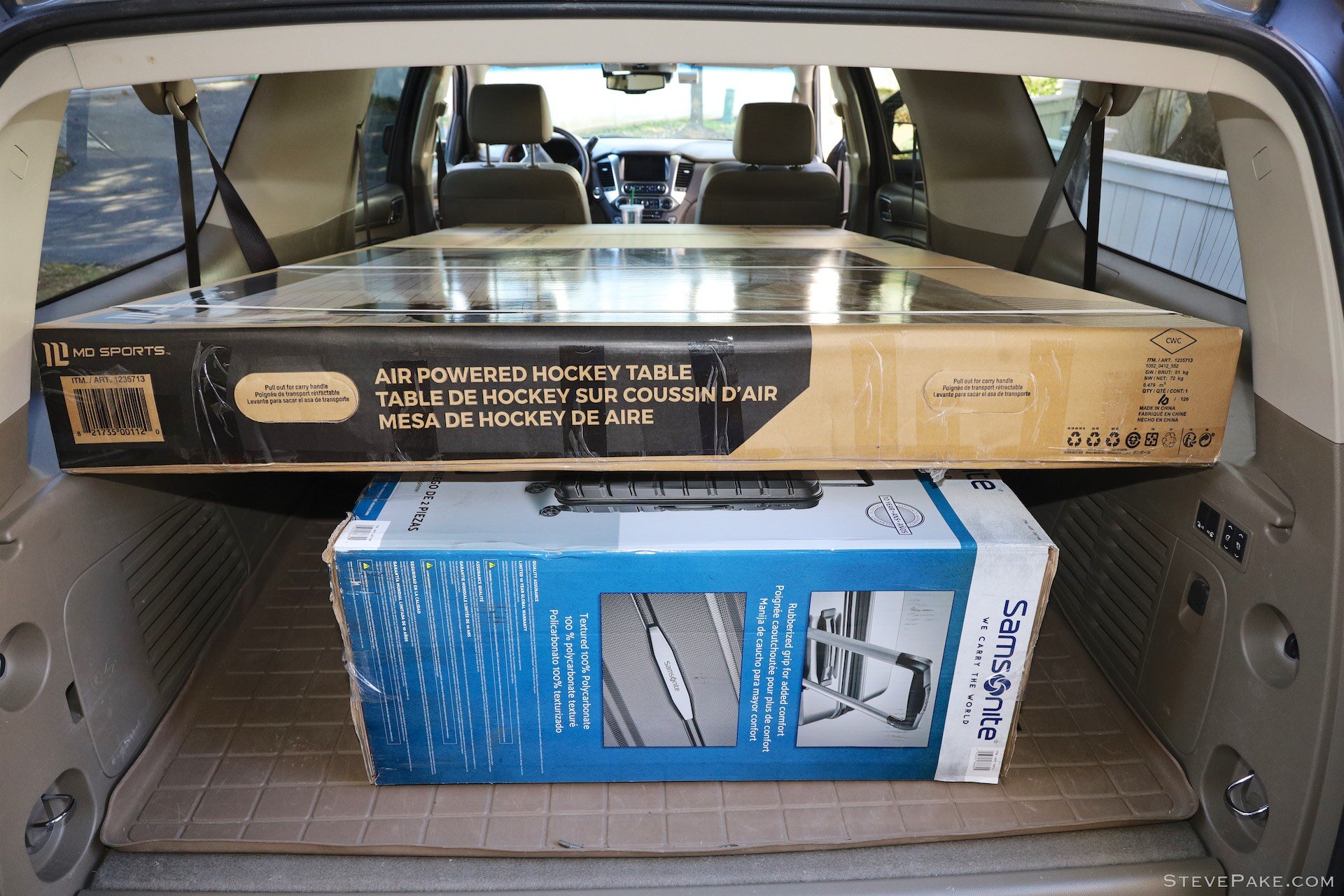
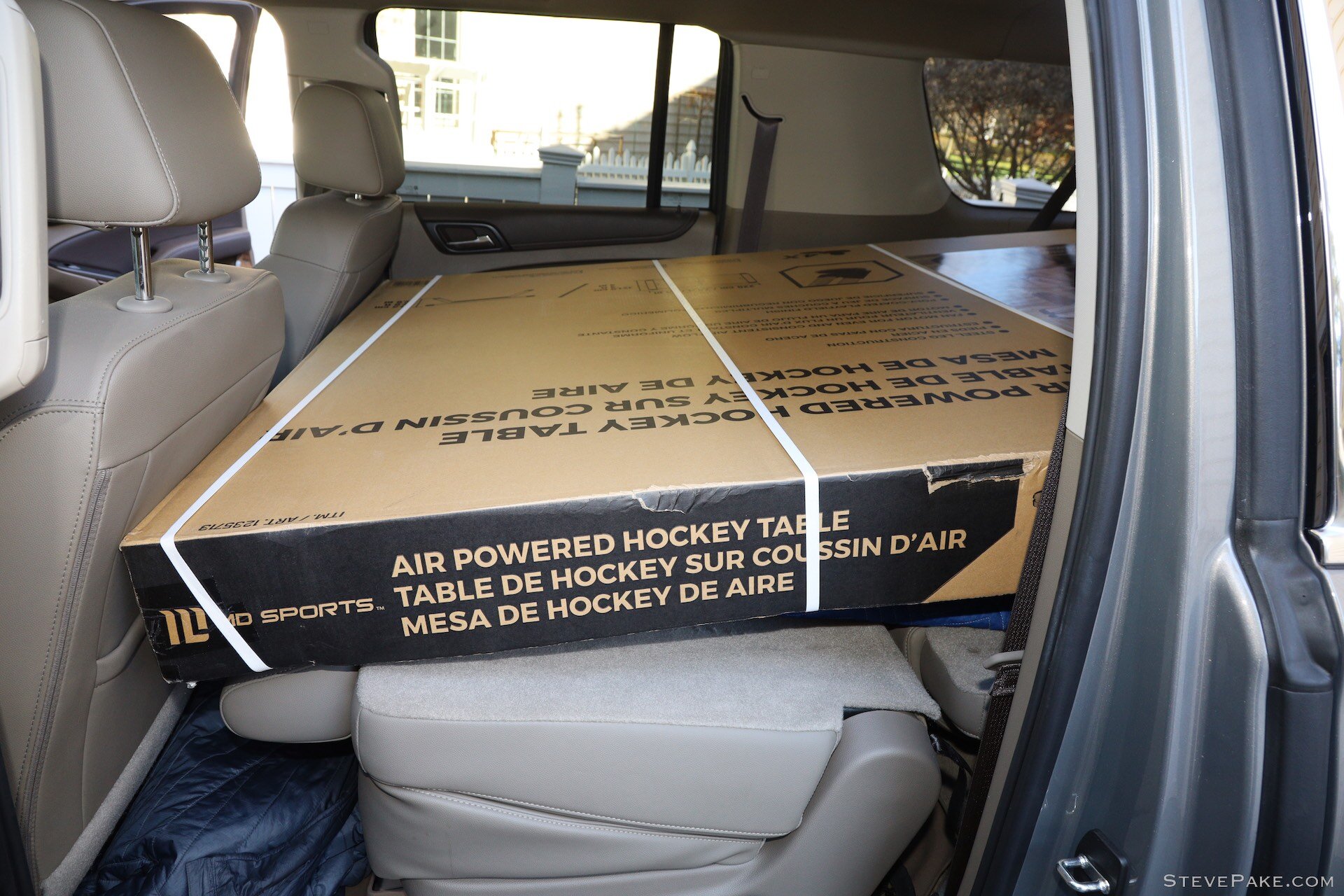
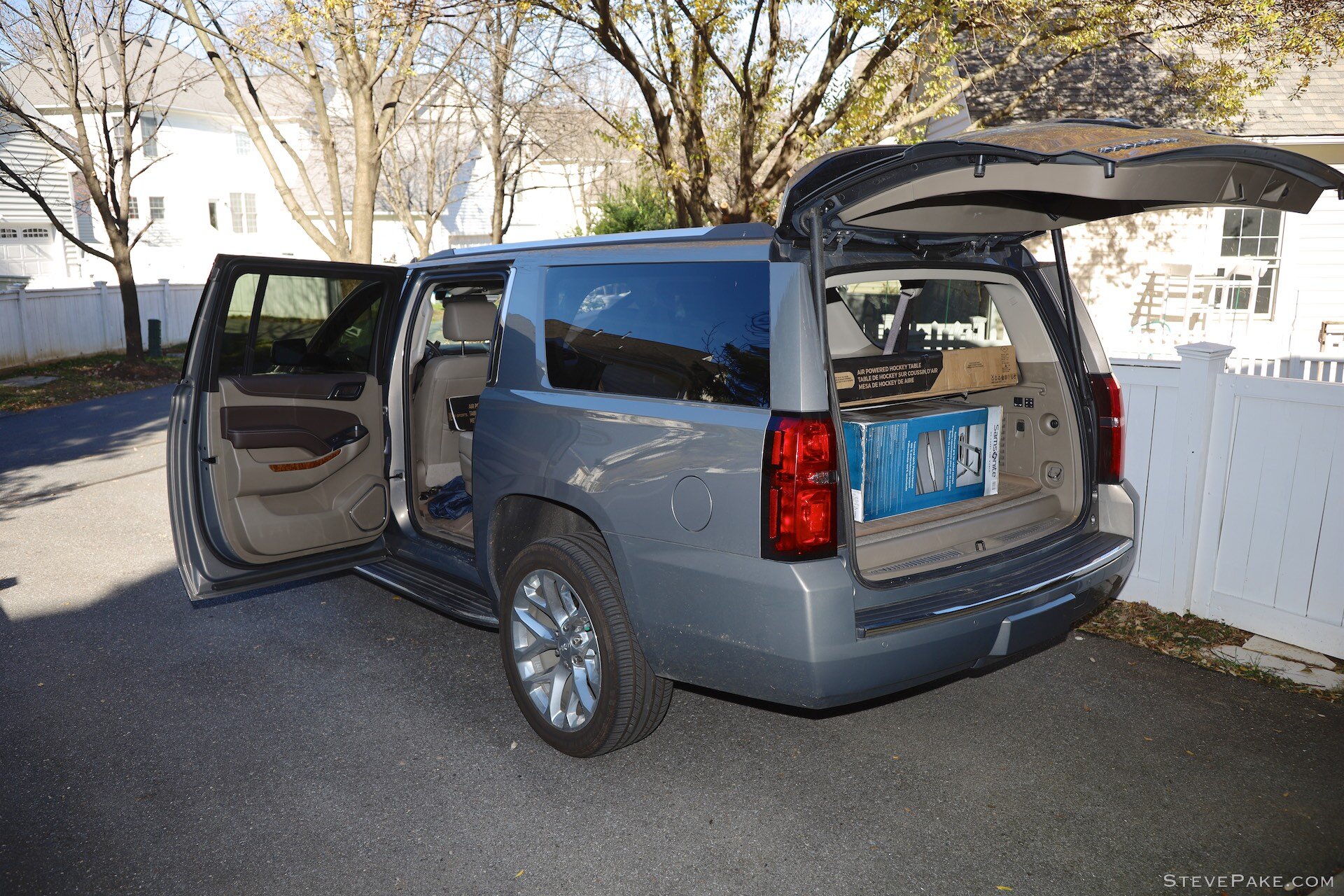
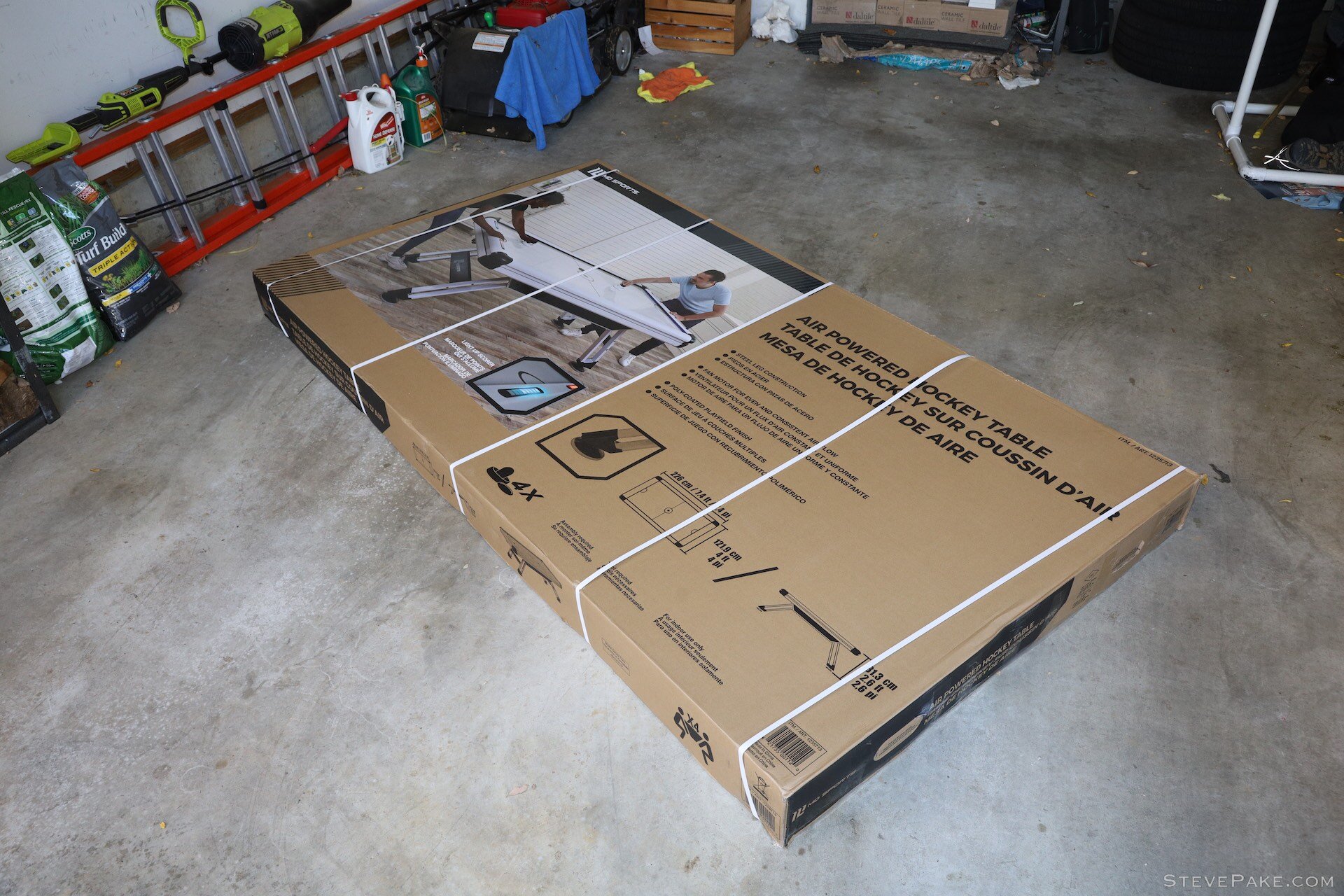
Our Suburban’s biggest haul yet has been this Air Hockey table from Costco measuring 92” x 50” and weighing a freaking ton. It would not have laid flat without it sticking out of the bed in anything other than a long bed pickup truck, but the Suburban swallowed it whole, and its cargo area was exactly wide enough to accommodate the box.
Friends of ours lost a few trees on their property and now have a lifetime supply of firewood, and said to help ourselves! I had hoped to back the Burb down their property to the bottom of their hill where the big stacks of firewood are, but they weren’t actually there when we swung by and didn’t want to drive on their grass without asking first. Also, I’m not even sure if I could have made it.
And of course, a big load of firewood from some friends who lost a few trees and have basically an unlimited supply of firewood. There are three rows of firewood stacked in the back, and still room for two rows of passengers.
One thing the Suburban really can’t do is go off-road. The chin spoiler helps improve fuel mileage by about 1 mpg on the highway, but it totally kills the approach angle. The maximum break-over angle of a Suburban is also a big LOL. Just no. It’s funny, but as capable as the Suburban is, most crossover SUVs are more adept off-road simply because of better approach and break-over angles. I probably could have backed down their hill, but would have had to back up it also, to avoid the highly likely possibility of getting hung up on or ripping off the chin spoiler. Didn’t want to chance it, so we just three-person relayed all of this up the hill and into the back of the Suburban, and that counted as our workout for the day! :)
May 2020 Update
My son and I got new mountain bikes, so the Suburban’s latest trick is hauling all of our bikes around. I was dreading having to pickup a bike rack of some sort because of the expense, only to realize I didn’t even need to. Although there’s only three bikes in the back here (my wife doesn’t ride), it can no joke haul 4 bikes in the back with the 3rd row of seats folded down separated by furniture pads, and still has plenty of room for 4 people and a dog.
The Less Than Good
True grips are few and far between, but in the interest of full objectivity, here are a few.
Nitpicks
The enhanced 8” driver information display is gorgeous and even has accurate shadowing rendered for the digitally rendered quad analog gauges, but ends up wasting a lot of space and potential because GM largely just re-used the information screens from the lower-tier clusters without giving everything the proper reworking that it needed. A lot of screens could easily be combined, and there’s no single screen that shows everything you might want. This leads to a lot of pointless flipping and becomes somewhat of a distraction, and so is a bit of a let down.
The adaptive cruise works well, but is far too aggressive at trying to recover speed than it ever needs to be. Dude, it’s a Suburban — it’s okay if it takes a few seconds longer to get back to the set speed. GM probably has a one-size fits most type of calibration, but misses the mark here with totally unnecessary multi-gear kickdowns and a roaring engine just to get back to 75 mph from 65.
I’ve never really figured out the exterior lighting modes, and the manual is vague all around. By default they just stay on Auto and do their thing, but that’s not the problem. The issue is that the Auto lights tend to switch on pretty aggressively and especially in high contrast situations with a lot of glare. When it does this, it also dims the interior instrument and navigation lighting down to about nothing, which is precisely when you still need them to be at full brightness. They almost become unreadable, which is a major pain if you’re in the middle of using the navigation screen. Turning the exterior light control to off then kills all the exterior lights including the daytime running lights, which are precisely the lights you want left ON in high-contrast roadway lighting conditions. This also doesn’t reset the interior lighting back to normal daytime levels, and the interior lighting adjustment dial doesn’t have a notch to manually reset interior instrument lighting back to full brightness, as many cars do. This just doesn’t make any sense. Luckily this condition doesn’t last for more than about a minute when it happens, and often it’s less than that.
None of these are huge deals — just various annoyances and things that clearly weren’t thought through quite as well as they should have been. No car is perfect.
Nature Of the Beast Issues
The following could be genuine complaints, but because I did my homework before buying (for 2 years!) expectations were properly set and there were no surprises.
Expect about 12-14 mpg during local driving, but at least it only needs regular grade fuel. You don’t want to buy one of these trucks unless you know you’re going to need and use it.
Yes, the high load floor from the truck frame and live rear axle does inhibit the loading of some bulkier items compared to a minivan. It’s only been an issue for me once, but what I was loading was so oddly shaped that I’m not even sure it would have fit in a minivan, either. Keep a tool kit handy so that you can do partial tear downs of bulkier items before loading.
Body on frame trucks do have more or “different” vibrations over the road than the unibody cars and SUVs that many are used to. While this generation of “K2xx” GM trucks have been problematic here, it was really only an issue on 2015-2016 model year Suburbans, especially with 22” wheels. My 2018 definitely makes more noises than your typical unibody vehicle, but again no complaints from anyone, it’s just something that will take a little getting used to. It was nice and quiet on the highway except at 63 mph, and swapping out the factory Bridgestone tires for Michelins resolved what few issues there were. Definitely take any of these trucks for a thorough test drive before buying, especially up to full highway speed.

Lastly, since this is a truck based SUV, it also has a truck based 4WD system, which is much more rugged and capable than the AWD systems in many crossover SUVs. Leaving the 4WD system engaged on dry pavement can damage the drivetrain. It does have an Auto mode that you can use and leave on when there’s a mix of slippery and dry conditions, but it’s noisier and less efficient. The 4WD system is really intended to be left in 2WD mode in normal conditions. I know this is a big step for a lot of people, but you’ll actually need to be conscious and think about something while driving, and if perhaps you should be in one 4WD mode or the other. God help us all if you’re piloting a 6000 pound SUV, but aren’t really “there”.
See here: https://www.gmc.com/gmc-life/how-to/when-to-use-four-wheel-drive
Part of my job as an engineer is to find faults and deficiencies in new products before they find their ways to customers. Although I don’t work in the automotive industry, it’s actually a huge compliment if the biggest fault I can find in a truck with a $74,000 MSRP is wasted space and potential in an optional display, and some relatively minor human factors engineering grievances.
Believe me, I’ve had far bigger complaints in some other vehicles I’ve owned, including a Honda and a Toyota, neither of which I could stand to drive after a year because they were so freaking awful and poorly thought out in various ways. The Suburban is nothing of the sort, and is an overall very well engineered and thought out product.
Snow
On the topic of snow, we didn’t get a whole lot of snow in the D.C. area last year, but the one time we got a good couple of inches of snow, I took the Burb out at night when no one was really on the roads just to see how it handled. I put it in 4HI mode, which is only for “off pavement” or slippery conditions and NOT dry pavement ever, and it was a beast. The chin spoiler still gives you 8” of clearance, but pull that off and put a set of winter tires on, and these things are basically unstoppable.
A big part of the Suburban’s prowess in slippery conditions is from its G80 auto-locking rear differential, which gives it an incredible amount of traction even in 2WD mode. When roads are merely wet or slushy, you can leave it in 2WD mode and you’ll still have plenty of traction. (Click here for a cool video).
Everybody asks about two things — fuel mileage and parking — so I’ll address these in the next two sections below.
About Parking
Here’s the litmus test. If you already have a mid to large-sized SUV or a minivan, and you don’t have long scrapes down the side of it, you’re going to be just fine. If you do have long scrapes down the side of your vehicle, then maybe buying a nearly 20 foot long vehicle isn’t such a good idea, not just for your own sake, but for whomever or whatever you might end up hitting to cause more of those long scrapes!
If you don’t have long scrapes down the side of your vehicle, but maybe you’ve hopped a few curbs and scraped up wheels, pay close attention. You’ll need to make some adjustments, or else these minor things can and will escalate to the big long scrapes!
Believe me when I say that it’s just better, overall easier, and safer for all involved if you back this thing into a parking space most of the time.
Unless you’re going to need to load a significant amount of cargo into the rear, or the parking lot is big enough to make head in parking doable, like at Costco or many grocery stores, just back in. It’s better, easier, and safer for everyone.
You wouldn’t believe how sharply these things can turn. They’re far more maneuverable in crammed parking lots than you’d think possible. That said, they are still nearly 20 feet long, so here’s what to expect.
Head-In Parking is usually a 3-point maneuver
Pulling head into a parking space is easy when the outside parking space isn’t occupied. You can just let the nose of the truck swing wide through the outside space, and then you can pull straight in. As tight as the Suburban turns, it’s still really long, and it’s generally not possible to pull head into a parking space with another vehicle parked in the space to the outside in a single maneuver, as the nose will smash into the outside car.
For head in parking when the outside adjacent space is occupied, you’re generally looking at a 3-point turn. Go about a full parking space past your intended space while going full lock on the steering, turning in to complete the first third of the turn. Then go opposite lock and reverse while getting the next third of the turn, and then you should be able to pull into the space while completing the last bit of the turn without the Suburban’s large ass hanging out to the side at a weird angle. Even people with regular length SUVs and minivans ought to be doing this from time to time, but get lazy and don’t, and this is how they end up with long scrapes down the sides of their vehicles!!! This is NOT a vehicle you want to half-ass your parking maneuvers with.
Reverse-In Parking is Usually just a 2-point Maneuver
To reverse in, start from the same side as the intended parking space if possible (so if the parking space is on your left, you’ll want to dive to the opposite side of the parking lane first), and then go full lock on the steering turning away from the parking space while pulling about two parking spaces beyond. Remember, this is a much longer vehicle than most, and you need the tail of your Burb lined up to enter the spot. Now you should be able to reverse straight in while going opposite lock on steering. The combination of the backup camera, which is excellent, and the auto tilt-down on the side view mirrors giving you a clear look at the parking space lines and how well aligned you are, makes this a piece of cake and usually only a 2-point turn.
Why Reversing In Is Better
The reason why reversing into a parking space is generally easier is because the front wheels that steer remain in the clear the whole time. Once the front wheels are buried between two cars while head in parking, you’re extremely limited on steering angles and overall maneuverability. This is why you can usually back into a space in a quick 2-point maneuver, whereas head-in parking usually requires a 3-point. You can keep the steering at the bump stops half way into a space while reversing in, whereas with head-in parking you need to be pretty much lined up already as soon as the nose is between two cars. That forces you to complete the required turn in less space, hence needing an extra point for your turn.
If you think head-in parking is going to be “easier”, you’ll probably change your mind the first few times you try reversing out a nearly 20-foot long truck with limited maneuverability due to the front wheels being buried deep in your parking space, and limited visibility behind you for both other cars and pedestrians. The camera is great, but not as good as your own two eyes. It’s far easier and safer to be able to pull out of a parking space going forwards rather than reversing.
Plus, when you back in with a grassy area behind you, you can let the Suburban’s long ass hang out over the curb, and you’ll effectively consume less of the parking space than the bozo next to you who half-assed their parking job with a car half the size. Backing in also means that the person exiting a parking space next to you only has to peer over your hood, as opposed to the much taller and tough to see through rear glass, so it’s safer and easier for others to egress from a parking space next to you if you back in as well.
Plan Your Ingress For Your Egress
This is one of those vehicles where you really ought to think about how you’re going to get out of a spot before you enter it. The best example is if you need to make a sharp turn when exiting a parking space in a garage. Whichever direction you need to turn in, make sure there’s not a large structural support column for the garage in the front of your space and in the direction you need to turn in, as it will cut into your turning radius and make exiting your space a total pain. Been there, done that, and had to have my family members get out and spot me because it was that close, and the garage was really tight. Choose another spot if possible. In that case it wasn’t because it was literally the last space in the garage, but we made it.
Watch Out For Parking Garage Clearance
YES! You need to start paying attention to the maximum vehicle heights for parking garages. The Suburban is 74.4” tall, or just round up to 6’-3”. I don’t like going into garages that are any less than 6’-6” tall. MOST of the time you’ll have enough clearance, but once in awhile you won’t, which is why you need to pay attention at all times! There’s definitely some shorter garages that you can NOT park in with one of these, and you definitely don’t want to find out the hard way!
It’s not just the vertical clearance either, but also the sharp turns and narrow ramps that can really be problematic, and are tougher to gauge.

It’s a freaking miracle that I made it out of this garage without anything more than a little curb rash on the right front wheel. There’s a reason why there was no surcharge for oversized vehicles in this parking garage, because they don’t actually fit! LOL! So it’s not just vertical clearance that matters, but also the tight and narrow turns. Umm, we won’t be parking in this garage again, and my wife is fired from SpotHero. :)
SQUARE OFF YOUR TURNS
Remember, this is a nearly 20 foot long vehicle. What you can get away with in a Toyota Corolla or even many SUV’s, you can’t in one of these. When you pull out onto the street with a 90 degree turn, you need to pull out a little bit further, and then turn a little bit more sharply to avoid hopping curbs. In general, you need to turn a little bit later and then a little more sharply during slow speed maneuvers (or as late as possible and then as sharply as possible in tight garages), as you need to let the extra six feet of vehicle behind you that you’re not used to, clear an obstacle such as a curb or another car before you start cutting your turn.
When you’re in a tight spot, you also need to be looking behind you on the inside of your turn in addition to looking in front of you, to make sure the back half of your vehicle is clearing any obstacles!
There are many, many, many vehicles in the D.C. area that have long scrapes down their sides because their drivers failed to do this, even with far smaller vehicles. You definitely need to pay the <bleep> attention when maneuvering a large vehicle in a tight space like this.
For Kids used To Minivan Doors
If you’re worried about your kids that are used to sliding minivan doors flinging their doors and smashing the cars next to you, well, that’s going to be a problem with any vehicle, and not just a Suburban. As long as you park centered in a reasonably sized parking space and the idiots adjacent to you are also reasonably well parked, you’ll always have enough space to open the doors “one notch” and get out. The doors opened one notch is going to be plenty for most people, and especially for kids. Just be sure to remind them before getting out. And come on, paying attention to surroundings and not slamming into other people’s thing is kinda a life skill anyway!! They’ll be fine with proper guidance!
Don’t Worry, YOU’ll BE FINE TOO
As long as you meet the litmus test above and have only merely been guilty of hopping some curbs or perhaps scuffed a few wheels, you can do this. If you’re the long scrapes down the side of the vehicle type, just don’t. Do us all a favor and just stick with your beat to sh*t Toyotas.
Debbie can park it!
My “car brain” has no problems driving whatever I need to. I hadn’t driven a stick-shift car in 12 years, but rented a little turbodiesel Renault Clio while we were in Italy with a 5-speed manual, and it was like I’d never stopped driving a stick. There was never any question of if I could drive a Suburban, but rather of just how big of a pain it might be to drive and park one of these in the crammed D.C. suburbs. It wasn’t until I really started looking for them that I realized just how many of these full-sized GM SUVs are on the road of all generations, driven by both men and women, plenty of which don’t have backup or 360 degree cameras, or even “self-parking” systems, but are pristine with no scrapes on them at all! Reality check. If these things were really that bad to drive and park, would sooo many people be driving them? No.
Yes, it’s an adjustment, and yes it can be a little intimidating at first, but trust me you’ll be fine. If you’re worried, just find an open parking lot to practice in as soon as you bring one home, and your brain will very quickly re-calibrate itself. I don’t even really have to think about parking anymore, and just do it.
About Fuel Economy
Awwww, a puuuuuppppy!!!! Lol
The bottom line is that if you find yourself in a place in life where you’re routinely hauling around 5 or more people, and if you have a dog, and if you’re an active family that goes places and does things, and if you sometimes have one or two more along with you as well, and if you have a home and property that you’re doing a lot of renovations on and are constantly needing to haul things for, and if you’re often needing to haul both people and piles of cargo or gear at the same time, it’s pretty much one of these or a minivan. And a minivan won’t typically haul bulky or larger cargo while also hauling three rows of people, so that can definitely help narrow it down!
A legit 24 mpg straight highway absolutely fully loaded.
20.5 mpg combined on an 880 total mile road trip.
23-24 mpg on straight highway runs absolutely loaded to the max with two vehicles worth of people and stuff is actually pretty freaking good, and you’re still usually looking at just over 20 mpg for full road-trip combined fuel mileage including all local driving. If you’re to the point where you’d have to take two cars everywhere, two separate vehicles would both have to be getting 48 mpg highway and 40 mpg combined each to match this, so that’s pretty efficient.
One fully loaded Chevy Suburban is as efficient as two Toyota RAV4 Hybrids. These are efficient vehicles within the proper context.
While the highway efficiency can be considered impressive, 16 mpg combined and 14 mpg city can be a little tough to swallow. The Suburban will definitely be doing a lot of that, as the (revised) EPA mileage estimates more or less match up with reality. You have to make these trucks work for you to really make sense. According to the EPA, my Suburban cost me about $500 more to drive over the past year than the Chevy Traverse that I almost bought. It’s easily paid its own fuel bill many times over in terms of the delivery services we haven’t had to pay for, trucks or vans that we haven’t had to rent, and from the convenience of being able to haul everything or everyone in one trip or with a single vehicle rather than multiple, saving both time and fuel.
You don’t buy a Suburban because fuel consumption is your top priority. You buy one because you’re an active family like us that goes places and does things, because you need to haul things, and because you need the capability that lesser vehicles don’t offer. Yes, minivans and large crossover SUVs are more fuel efficient, but have less capability. As soon as you start talking about bulky cargo like dog crates and fences, folding cots for glamping, and large coolers and other bulky items, you have to start folding seats down and compromising on passenger space in a minivan, whereas you can keep using all rows of seating completely with a Suburban.
And do you know how many minivans and even mid-sized SUVs I’ve seen with completely bottomed out suspensions that look like their wheels are going to fall off? The Suburban is a truck based vehicle with an actual frame. It’s designed to haul stuff, and tow too. In the photos below, there’s 1400 pounds of replacement soil loaded into it. There’s hardly any suspension squat due to the air-leveling suspension, and when driving it home it barely felt like anything was there at all. Nice.
If you can’t make one of these things work for you like that, there might be better options. My truck most definitely works for me.
We Love Our Burb
Swish! The Suburban has been a slam dunk for us.
Buying a car is always tough and pretty nerve wracking. The automotive press is completely bought out which can lead to ridiculously biased and misleading reviews, plenty of things can mask themselves on short test drives that are usually only a few miles long, and I’ve ended up buying some cars in the past that I’ve ended up hating as a result. Vehicles tend to be long-term investments for us, so we try to get things exactly right. You can tell after a year if something is going to be a “keeper” or not, and the Suburban is definitely one of the big winners.
“The poor man always pays twice!” I was worried that if I didn’t buy a Suburban, I’d just end up kicking myself, and sure enough there have been more than a few occasions over the past year where we’ve managed to fill this baby up completely with gear and people and stuff that a lesser vehicle wouldn’t have been able to swallow. Even Debbie — who swore up and down that I was crazy and that we’d “never need anything this big”, and who came home from the Chevy dealership all pouty faced because it wasn’t an X7 — has really come to appreciate everything our Suburban has been able to do for her that an X7 could only dream of.
Near Misses
As for the BMW X7, we didn’t get to see one until after we had already bought our Suburban. Cargo space numbers and online photos don’t process for Debbie, but as soon as she saw it in person she knew it hadn’t a prayer. The gap between the second row captain’s chairs is so tiny that even our 20 pound mini Goldendoodle wouldn’t have been able to hang out there. And while the third row of seats are more adult-sized, there’s virtually no cargo space left at all at less than 10 cubic feet. By the time you fill an X7 up with six passengers and a dog, there’s no room left for anything else, whereas you can still bring half of your house with you with a Suburban.
Vehicles like the X7 and the Mercedes GLS aren’t at all designed to do what the Suburban can do. They’re designed to haul a regular-sized family around, for taking friends out to a swanky dinner in the city when you don’t need any cargo space except for your leftovers, and for impressing professional and business clients, and that’s it. Nobody in their right mind is going to be loading over a thousand pounds of mulch or landscaping stones into one of these. These things are clearly built to impress and coddle, and not to do actual work.
The most shocking thing about seeing the X7 wasn’t the X7 itself, but rather seeing Annamarie Pistone, who had sold us both of our BMWs down at Passport BMW years ago, sitting in the office right behind the X7 at Rockville BMW! It was short-lived and she was only there for a few months, but we just happened to catch her and it was nice to see her again. Annamarie is the only “good” car salesperson I’ve ever had!
The Kia Telluride has also come out and looks really nice, but it’s a competitor for the Chevy Traverse and Volkswagen Atlas, and definitely not a Suburban replacement or alternative, either. The only thing like the Suburban on the road is the Ford Expedition Max, but the shockingly inadequate cargo space for even 5 people without starting to fold down the third row of seating in the Expedition Max was an instant disqualifier for us. Reviews that state that the Expedition Max has “similar” or “matching” cargo space to the Suburban, of which there are many, are just flat out lying.
I’m not surprised that the Chevy Suburban and all of its Tahoe and Yukon / Yukon XL platform mates continue to outsell the much newer Ford Expedition by a 3-to-1 margin even in the GM platform’s last year, and excluding all of the Escalades. Pardon the pun, but Ford really missed the boat, and since it has to do with hard points in their design, they’ll never be able to fix it in a refresh. I’m not sure what Ford was thinking designing a vehicle with enough space for 7-8 people, but not even enough cargo space for 5.
If I Had To Do It All Over Again
If I had to do it all over again, there’s a couple of things I would change.
First, I’m still not overly crazy about the Pepperdust Metallic exterior color, but when you’re trying to find a really good deal on a closeout “on the lot” 2018 model as the 2019’s are rolling in and you want very specific features, you have to be flexible somewhere, and exterior color ended up being it. It hides dirt and grime well, and it’s a lighter color so stays much cooler in the sun and will never be mistaken for an UberXL. I much prefer the looks of the pearl and cream colors, and the dark blue looks stunning. I do get a bit jealous when I see them, but the Pepperdust is okay — it’s just not a very exciting color.
A near twin spotted at Costco — 22” vs 20” wheels.
I’d also skip the 22” dubs. They look cool, but are more trouble than they’re worth, and contribute to a lot of the body noises and vibrations, since having been minimized by swapping to Michelin tires. I had actually intended to buy an identical model with the 20” wheels like the above instead, but it had just been sold the day before. The problem is that most Suburban LTZ/Premiers already come with 22” wheels from the factory, so it can actually be tough to find one with only the 20” wheels. If you’re getting a GMC Yukon Denali or a Cadillac Escalade, then yeah you “need” the 22’s as it completes the look. Denalis and Sclades look a bit barren with the 20” wheels, but the lowly Chevy looks just fine.
No Sun & Entertainment package in ours (moonroof and flip-down TV screens). Nobody has ever missed not having a moonroof, it cuts down on the potential for body vibration issues and leaks being parked outside 24/7, and our kids are more than happy to stare at their iPads all day. We’d just assume have a bit more vertical headroom for some taller family members, so no regrets not getting this stuff.
Last Call for the “K2xx” GM SUVs
The next generation Chevy Tahoe
The new “T1xx” generation of GM’s large SUVs based on the latest Silverado pickup trucks are due as early as the Spring of 2020 as 2021 models, so now is the last call for these outgoing “K2xx” models. I’m sure the new trucks will all be great (eventually), and they’re supposed to have independent rear suspensions with a bit better ride as well. Good luck.
I’d never buy a first year model of a brand new vehicle from any manufacturer, including from Toyota, and especially not from GM. Yeah. No! The best vehicles to buy have always been at least third year models after all of the kinks are ironed out and major issues addresses, and especially the mid-cycle refresh models with all of the planned feature and styling upgrades having been made. Some people just love having the latest sheet metal, but I need my vehicles to work for me and not become yet another “problem child”, so no thanks.
The worst car I’ve ever owned as far as overall quality and reliability was a second year model that I thought would be safe enough. It had a never ending stream of recalls, had to have the transmission replaced, was terrible to drive and had the most atrocious road manners and behavior, and it even left me stranded in my driveway once and had to get towed — and it was a Toyota! Go figure. I’m certainly not knocking GM or Chevy as it’s just the nature of buying a brand spanking new vehicle in its first year of production, but I’m sure Chevy will get their new generation of SUVs right by about the 2023 model year!
The End
That’s it! I hope you enjoyed this blog, the photos and the story, and find them useful. We love our Suburban and it’s definitely been the 100% correct choice for my family. They drive, handle, and perform well, are far easier to drive and park than you’d ever expect, are more fuel efficient than ever before, pretty darned reliable, and will haul 7 full-sized adults and your dog in comfort while also hauling all of your luggage and bulky cargo for a road trip. It’s also my first American built vehicle, and I’ve found it to be a very well engineered and well-rounded product of good overall quality. We couldn’t be happier with it, look forward to driving it for many more years to come, and know that it will be able to handle whatever life throws at us next.
STAY TUNED…
When you have a family that’s reached “critical mass” as ours has, one thing that happens is that it just becomes a major pain and prohibitively expensive to fly places for shorter duration trips. And do dogs really like getting shoved in crates and put into the bellies of aircraft, or having to get boarded? Nah bruh. We’ve all enjoyed traveling in our Suburban so much and have found it so pleasant to drive, that we have some true long-haul road trips planned that we’re very much looking forward to. So there will definitely be some Suburban road trip blogs in the future!


FULL REVIEW: How The Hell Do You Go From Driving a BMW 335i to a 2018 Chevy Suburban
My review of our new 2018 Chevy Suburban Premier 4x4, how the hell I transitioned to driving one of these from my low-riding 2011 BMW 335i convertible, and comparisons to minivans, larger crossover SUVs, and of course the Ford Expedition Max for our family of five plus dog and occasional add-ons!
I knew we needed something not just a little bit bigger than my wife’s beloved 2012 BMW X5 35d with the special order only three row seating, but rather a lot bigger, but what? Every man is allowed to own a big truck at least once in his life, and you don’t need permission by mere virtue of the fact that you’re a member of the male species. I’ve always wanted a truck, preferably something American, and preferably with a V8 before they go extinct, so here’s my new 2018 Chevy Suburban Premier 4x4!
This is a pretty far departure from my previous 2011 BMW 335i convertible, which we still own and my wife drives now, but we’re no longer the family of four that we once were. Now we’re a family of four, plus my wife’s adult brother who is disabled that we care for. That necessitated a bigger house that I commonly need to haul things for, and then came the dog, and my folks aren’t getting any younger and really need to be driven around when we go places together, rather than taking two cars and trying to follow. We’re always going somewhere and doing something and travel a lot, and we’re always piling into the airport at least a a few times a year also, possibly with an “extra”, so I think you get the idea…
Life has taught us to expect the unexpected and to be prepared for almost anything, and I don’t think there’s a more appropriate vehicle for that than a Chevy Suburban.
How Does It Drive?
Well, the Suburban doesn’t drive like my classic E9x BMW 335i, or even our traded E70 BMW X5, but damn if it isn’t too far from the latter. You don’t have to make excuses for this thing - it doesn’t just drive well “for such a large vehicle”, it drives well period, handles well, turns well, and is pretty quiet and has a comfortable ride despite the 22-inch “dubs”. Many of the reviews you’ll read about these GM behemoths (Yukon XL and Escalade ESV also) will commonly mention that they feel much smaller to drive than they really are. It’s true, and a lot of different things go into that.
The steering is just about perfect. It’s very accurate, there’s no slop or on center dead spot, and the variable weighting is on point. It’s easy to turn in parking lots, and stiffens up nicely when you’re taking turns at speed, all of which allows you to pilot this 6000lb hunk of steel down the road with confidence while keeping it pointed and tracking exactly where you want it to. If only the electric power steering in modern BMWs were this good, none of the BMW fanboys would have been complaining, myself included.
The Magnetic Ride Control adaptive suspension in the LTZ/Premier trim keeps body roll to an absolute minimum, automatically softens on rough roads and stiffens in corners, and overall really transforms the truck. This is the same suspension system used in the Corvette and a number of Ferrari’s and other high-end vehicles, and I can see why - it’s amazing and works extremely well! I have numerous family members that are prone to motion sickness which can be from body motion among other things, and there have been no issues even with the 22” wheels. Although the ride is a bit on the stiff side, we’re quite used to it coming from taut but compliant European suspensions. A test drive of a few rental Suburbans with the standard “Premium Ride” passive suspension was a no-go, however. They were much too floaty and had insufficient damping, and even I got a bit motion sick in them. The Magnetic Ride suspension comes as standard on the LTZ/Premier trim trucks, and unfortunately isn’t an option on any of the lower trims.
The Suburban is no screamer performance wise, but 0-60 mph in around 7.2s and a 15.5s quarter mile time with the optional 3.42 gears is no slouch and more than adequate, which was all I was looking for. I don’t need a three-ton SUV to be as fast as my 335i. Its overall powertrain calibration is clearly geared more towards comfort and smoothness which is fine, and the 6L80E 6-speed automatic transmission “granny shifts and doesn’t double-clutch like it should”, especially on 2-3 upshifts, but don’t let that fool you. The 355hp 5.3L V8 roars to life when you put your foot down, and this “Trump truck” will haul ass and move with authority when you need it to. When you need to stop, the brakes definitely aren’t as good as the effortless autobahn grade brakes on our Bimmers, but overall braking performance and feel all seem just fine to me, even if instrumented tests have shown braking distances to be a bit long.
Finally checked the box. My first V8! Yeehaw! It’s a GM L83 5.3L V8 with 11.0:1 compression, direct injection, cylinder shutoff capability, and dual-equal style variable valve timing on the single block mounted cam. 355hp and 383 lb-ft of torque on regular grade fuel, and 22 mpg highway in this 6000lb 4WD beast. Not bad for an “antiquated low-tech pushrod” engine.
Numerous reviews have really knocked the GM Hydramatic 6L80E transmission. I agree that it’s nothing special these days, but a 6-speed automatic is hardly “antiquated”. The laws of diminishing returns start to kick in once you get past 6 forward gears, so are they suddenly outdated just because there are other transmissions out there with more forward gears? Both of our Bimmers have had German ZF 6-speed automatics, which work brilliantly. I’ve sampled the gold standard ZF8HP 8-speed successor many times in BMW loaner vehicles, and for the most part it just seems like they have a bunch of unnecessarily extra overdrive gears. An extra gear or two might be helpful if you’re routinely towing or hauling heavy loads, but otherwise the 6-speed is fine, especially when paired with an engine with a very broad powerband. Be careful what you wish for, however. There have been widespread issues with lots of these 8-10 speed “super” transmissions as far as erratic shift mapping, “excessive shifting”, and rough shift quality or feel. The more complicated something becomes, the more difficult it is to make it work well. The 6L80E is probably about as close as you can get these days to a simple, drama free, and bulletproof transmission, which I think is a good and often overlooked “feature” to have.
Truth be told, most engines have more than enough power these days, and it ends up being the transmissions and their gearing that really make or break the driving experience. Auto manufacturers have pretty much tapped out horsepower marketing, so now they’re using number of gears in their transmissions as the next best marketing tools. An extra cog or two might feel a bit more luxurious to drive, but considering the issues GM has had with their half-baked clunking and jarring 8-speed automatic (and their new GM/Ford 10-speed hasn’t been problem free either), I’m more than happy with the lowly 6L80E and don’t feel like it detracts from the driving experience. Remember that it was 6-speed automatic transmissions that arguably finally leveled the playing field in terms of performance and efficiency versus manual transmission equipped vehicles. There’s nothing wrong with a 6-speed automatic, and sometimes less is more.
On the topic of transmissions and gearing, one thing you really need to get especially if you’re a former ‘ahole’ BMW driver with expectations like myself is the aforementioned optional 3.42 final drive ratio, which can be had in the Max Trailering Package for $500. The 3.08 gearing is fine in a thousand pound lighter Silverado pickup that isn’t going to do much towing or in a RWD Tahoe, but are just too long when it comes to the Suburban. I mean, 2nd gear will wind all the way out to nearly 80 mph with the 3.08 gearing, which is ridiculous. Low speed corner exit performance is also unacceptable with the 3.08 gears, leading to a lot of awkward 3-2 and totally annoying 2-1 kickdowns. What the hell? GM should have just made the 3.42 gearing standard, but I guess then they wouldn’t have been able to up-charge you for them. There’s no reason to not get the 3.42 gears and there’s not even a fuel economy penalty either. The 3.42 gears still only have the engine at 1800 rpm at a 75 mph cruise, so this is still pretty long gearing which is also right on the bottom edge of the engine’s torque band. The 3.08 gears are even longer and have the engine revving even slower on the highway, and there just isn’t enough rock bottom end torque to pull these way long gears well in such a beast. It leads to a lot more downshifts while going up highway grades and less cylinder cutoff V-4 operation as well. The 3.08 axle ratio just isn’t a good match for the 6000lb Burb, so unless you absolutely don’t care or live out in the plain states where there’s no hills to contend with, be sure to get one with the 3.42 gears.
The easiest way to tell if a 2015-2019 Suburban or Tahoe has the 3.42 gearing is to look for the optional Max Trailering Package equipment, which includes the trailer brake controller and an option for 4 LO on the transfer case control, to the left of the steering wheel and next to the light switch.
Suburbans (and Tahoes and Yukon/XL’s) with the Max Trailering Package and the 3.42 gears are easy to identify, because they’ll have extra dash-mounted controls to the left of the steering wheel for the trailer brake controller, and will have both 4HI and 4LO options on the transfer case control since you get a 2-speed transfer case as part of the deal also. 6.2L V8 equipped trucks all have a 3.23 axle ratio, and enough extra oomph that you won’t care.
What’s It Like Inside?
It’s more like an apartment than a car. The amount of space inside is incredible of course, which is why you buy a Suburban. Some casual car shoppers seem to think that the Suburban actually has the same cramped 3rd row seats as the shorter wheelbase Tahoe and just more cargo space, but that’s not true at all. The Tahoe is on a 116” wheelbase and is 204” long overall, vs. the Suburban on a 130” wheelbase and being 224” long. That’s a lot of extra floorplan in the Suburban. First and second row legroom is identical between the two, but the Suburban has 34.5” of third row legroom vs 24.8” in the Tahoe, and 39.3 cubic feet of cargo space behind the third row of the Suburban vs. 15.3 cubic feet in the Tahoe, both of which are huge differences if you’re routinely using three rows of passengers.
Cutaway image via Chevrolet.com, Cocoa/Dune Interior
There’s tons of space up front obviously, and it’s plenty comfortable for long drives. The 2nd row captain’s chairs don’t adjust other than the pitch of the seatback, but there’s plenty of space and legroom there as well, and more than enough room for me to sit behind myself at 6’3” tall. You can also get a 2nd row bench seat if you want which gains you an extra seat, but this tends to make the cabin feel a bit claustrophobic for that many passengers. The 3rd row seats three full-sized adults, and while the outboard seats won’t be the first choice for super tall people, you can definitely fit three 6-foot tall adults back there, with unlimited legroom for the center-rear seat passenger with the space opened up from the 2nd row captain’s chairs. If you have a dog, the space opened up from the 2nd row captain’s chairs are the ideal place for them to hang out while on the road.
The seats are supportive and comfortable, and the interior materials are decent enough, but they’re not going to compare to the luxury brand SUV’s also in this price range. You’re paying for more metal and a much larger vehicle with your money, not for top-notch materials quality. And it’s a Chevy. That said, there’s nothing that I find offensive. There’s no options for 37-way adjustable massaging seats, although you do get heated and cooled seats. There’s also no option for fancy exotic leather that’s straight off a coddled European calf fed all organic meals. You have to step up to the Cadillac Escalade for that, but we’ve all been on hours long road trips in our “Canyonero” and nobody has had any complaints.
Image via Chevrolet.com, Cocoa/Dune Interior
Driving position and overall visibility are also pretty darned good, and there’s just not a sense that you’re sitting up high or are in some massive vehicle. On some vehicles you can get completely lost in the hood lines, or lack of lines, and have no idea where you even are on the road. That isn’t the case with the Suburban, and it’s easy to keep visually aligned, including while parking. The side view mirrors seem a bit small, unbelievably to help with aerodynamics, but I’m used to smaller mirrors from my 335i and so it hasn’t been an issue for me. You’ll definitely want to get the optional blind spot warning system in the Burb, though.
I actually like the steering column shifter. It clears up so much space in the center console area, and unlike these small rotary knob shifters, and potentially dangerous “return to center” and ridiculous push button shifters they’re coming out with these days literally trying to reinvent the wheel (the shifter), the old school GM column shifter is easy to find and use by feel alone, and otherwise just says the hell out of your way. I think only GM could do this, and that for every other automaker it’s considered a faux pas or something. I like it and think it works well, but because it’s how GM does it, everybody else has to do it differently. I don’t care. :)
Cruise control set at 75 mph, near following distance (far is like a 1/4 mile away it seems like), and the HUD is sweet.
If there’s one thing I’m OCD about, it’s the instrument cluster. It needs to look “right” to me, and if it doesn’t I can’t buy the vehicle. The standard “midlevel” instrument cluster even on the Premier model just seemed about 10 years out of date to me, so the upgraded “Enhanced Driver Information Center” (Enhanced DIC, lol) cluster with the digital gauges that also comes with the heads-up display are nice, and the adaptive cruise control takes away a whole lot of the fatigue of long distance driving. Checking this option, which is the only one I wanted on the Premier trim, also gets you Forward Collision Alert with automatic braking, whose functionality works off of the adaptive cruise setup. This stuff really ought to be standard at this level, but I’m not going to complain. Chevy is nothing like how the Germans bend you over on the up-charges.
The infotainment setup is well-sorted and very easy to use, it’s not overly complicated or a long reach, the touch screen works well, and there are enough dedicated controls for commonly used functions that no one will have any complaints. Bonus, I’ve fallen in love with SiriusXM and have never had it in a vehicle before. You can enjoy the same stations no matter where you are, which is great on long trips.
The ride is generally quiet, but unfortunately you don’t get a German vault-like experience. This generation of Suburban is known for some odd cabin vibration and resonance (humming) issues that you can read all about on various Internet forums. It’s definitely worse with the 22” wheels, but is mostly due to the factory BridgeSTONE tires. This truck has a mild case of that, but fortunately it’s not bothersome enough to cause any complaints. The best fix is to replace the factory tires with Michelins, or go down to 20” wheels.
Beware of potential noise and cabin vibration issues especially with the 22” wheels, but mostly has to do with the tires. Be sure to thoroughly test drive including up to highway speeds to check.
On my truck, you’ll notice some low speed shuddering over bumps, but it’s quickly damped and not a bother. There’s one “bad speed” where the resonance hits a peak at around 63 mph (and 66 when the tires are still cold). It almost sounds like the steady humming on an aircraft, but it’s easy enough to just avoid cruising steadily at that speed with the heads-up display, and otherwise nobody notices or cares. So I’ll save my money for now and just burn up the factory Bridgestone tires, but will eventually replace them with the Michelins.
If you’re shopping for one of these vehicles, be sure to take it for a very thorough test drive to check for this, including up to highway speeds, and especially if equipped with the 22” wheels! My truck is okay, but there have been a lot of complaints about this on the Internet and far worse examples and horror stories, especially in the 2015-2016 models. Most all of the production tweaks that were made to mitigate the vibration issues were done by the 2017 model year, which is also a reason why I always try to avoid the first few model years of a brand new vehicle. I’ve always preferred to buy mid-cycle refresh models that have all of the kinks worked out, optimizations made, and the extra features added in that should have been there in the first place, but before all of the cost-cutting that tends to occur in the last model years of a vehicle’s production cycle! Hey I’m just an engineer, what do I know? :)
Furniture Hunting
I think it’s like a right of passage or something that as soon as you buy a Suburban, you have to go find a couch to shove in the thing, and that’s exactly what we ended up doing! :)
After Christmas, we sent our kids and dog packing up to Pennsylvania with their grandparents, and did a little furniture shopping while they were gone. No issues squeezing couches, bed frames, chairs, and other things inside. It paid for itself that month just in all of the delivery fees we saved. On the way up to PA to pickup our kids and dog, we swung by another furniture outlet and found a matching leather chair and ottoman we wanted. The Suburban swallowed them both, and still had plenty of space leftover for the kids luggage, the dogs crate, and a bunch of other stuff, and we all drove comfortably back home to Maryland with zero complaints from anybody. “We’ll never need anything this big”, she said! Bwahahahah! Glorious! I love my truck. :)
Our new couch and leather chair, “free” delivery courtesy of the Suburban. We managed to find another matching leather chair and an ottoman a few days after this, and also picked up a new bed frame. What delivery fee? :)
But What About Parking?
You would be shocked at how tightly this thing can turn, and how maneuverable it is in parking lots. That said, you’re still definitely going to want to back in most of the time, as you’ll have a lot more maneuverability that way. The standard backup camera and auto-tilt down feature on both side view mirrors makes it easy to get lined up and dead nuts on in your space, which is important because the Suburban will take up ALL of most parking spaces, but not a square foot more. There’s no 360-degree parking camera available on the Suburban (or Yukon XL), but the combination of the backup camera and auto-tilt down mirrors work well enough together that it’s a non-issue. If you really want a 360-degree camera, you can get one on the Escalade.
Parking a Suburban is more a matter of trust. There’s no reason you can’t get it into most any spot you want, but if you see cars in adjacent spaces that are all crooked, or especially Toyota’s with bashed in bumpers and long scrapes down their sides, which is every other Toyota where I live, maybe you should move on. Just because you have the skill to park a behemoth like this doesn’t mean that others have the skill to maneuver around you while reversing out. How do you think they got those long scrapes down the sides of their cars and bashed in bumpers in the first place?
Do yourself and everybody else a favor and just park out of most people’s way if you can, and back in if possible not just for your own maneuverability, but so that they only have to peer over your hood while backing out and won’t have all of their side vision blocked with the massive trunk area, too. You can also let the Suburban’s long tail hang out over the grass, which will make it even easier for people around you to get out.
The one situation where you’ll have trouble parking is when the parking lanes are narrow enough that two cars can barely get by. Pulling in front first here will be impossible, and even backing in can be challenging if other long cars are parked nearby and hampering your maneuverability even further. This is rarely the case, and most parking lots have more than enough space, but it does have its limits.
JUST REMEMBER It’s Nearly 20 Feet Long
Most cars at most wheelbases and lengths are proportioned such that as soon as you clear an obstacle from the driver’s seat, like a concrete pillar in a parking deck or another parked car, you can start turning and you’ll be okay. The Suburban is NOT like that! You need to be aware that this is a long vehicle at nearly 20 feet long, and to pull out a little more, turn a little bit later and more sharply, and to “square off” your turns while in tight quarters. Just because you’ve cleared the concrete pillar of the parking deck or the car parked next to you from your driver’s seat, doesn’t mean that the rest of a Suburban will if you immediately start turning!
If you have a brain that can naturally process three-dimensional space awareness then you’ll get this, but if you have no idea what the hell I just said, maybe you shouldn’t drive one of these things. Isn’t it funny how every other Toyota I see has bashed in bumpers and long scrapes down the sides of their cars, but almost every Suburban I see is pristine? Funny how that works. Some people shouldn’t be driving period.
But Why not the…
We ended up buying a bigger house before we bought a bigger vehicle, which then punted the new car down the road another year. Then we finally got a dog to go with the bigger house, which increased the amount of space we’d need and had to rethink a bit. All of that left lots of time to consider options in a nearly 2 year long car shopping process. We take our time and try to get exactly what we want the first time, because buying the wrong car and having to trade in the near term can be a pretty costly affair. Literally every larger vehicle on the market was considered.
So first up, the obvious question…
Why Not A Minivan?
I’m sorry, a what?
Listen, we’re just not minivan people, okay? I just can’t. I’d rather slit my wrists than drive one, and Debbie has similar thoughts on that front. Yeah, they’re a ton cheaper, more fuel efficient, can haul lots of people and bulky cargo, and the sliding doors make a ton of sense and are super convenient, so it’s a shame that we’ll never own one of these. I even rented one on a road trip once upon a time and thought it was great! I almost could have bought a Chrysler Pacifica, but only if we traded both cars and got a Dodge Challenger R/T at the same time going full MOPAR. Debbie was horrified of being seen in either vehicle however, so that was that.
And let’s be honest, going from a BMW 335i “sex machine” convertible to a freaking minivan is just plain cruel and inhumane, but a full-sized SUV with a V8 is doable. :) Minivans make a ton of sense for most people, but not everything in life needs to make sense, and we’re not “most people”. So there. Enjoy your minivans. I’d rather get run over by one than drive one myself.
Next?
Why Not A Larger Crossover SUV?
No matter what large crossover SUV you’re looking at, they all have one thing in common. While many can haul 6-7 adults in relative comfort, they tend to have almost no cargo space when the 3rd row of seats are in use. That’s nice if you’re taking you and your friends into the city for a nice swanky dinner, but we’re an active family that goes places and does things. We need to have room for people and cargo at the same time.
The Mercedes-Benz GLS (top) and the BMW X7 (bottom)
The Mercedes-Benz GLS class is considered by many to be the top large SUV, but it has a totally inadequate 16.0 cubic feet of cargo space with the 3rd row in use, versus the Suburban’s cavernous 39.3 cubic feet. The brand spanking new BMW X7 is even more pathetic with only 11.5 cubic feet with the 3rd row up, which is barely enough to go to the grocery store. The Honda Pilot matches the GLS with 16.5 cubic feet, but has a terrible 3rd row seat that’s literally on the floor and results in your knees being in your face. It’s just awful. The new Volkswagen Atlas is packaged much better than the Pilot and has a far superior 3rd row seat, but still only has around 20 cubic feet of cargo space. It’s more reasonable and I can see why a lot of people are buying them, but just isn’t going to cut it for us. The Toyota Highlander? 13.8. Meh.
The Chevy Traverse Near Miss
Unlike a lot of mid to large sized crossover SUVs, there’s actually a fair amount of vertical space behind the 3rd row seats to stack bags in.
The recently redesigned Chevy Traverse and its long wheelbase platform twin, the Buick Enclave, came pretty darned close and are almost in a class of their own. The Traverse is what I had actually intended to buy for awhile, and it has a much more useful and respectable 23.0 cubic feet of space behind its third row, not including a useful sub-trunk area where you could shove another duffel bag or two. I’d still have needed an external cargo carrier of some sort for many of our road and beach trips, or have needed to fold down one side of the third row seats, but a couple of things turned me off.
First, and not that I’m even really a stickler for color combinations, but the interior and exterior color options on the Traverse were a complete mess. I couldn’t find even a single interior and exterior color combination that I liked or that my wife would accept, and the two-tone gray and tan interior is an abomination. Next, how does the standard AWD system not have an “auto” mode? It’s either FWD or AWD, but you have to switch it yourself with a hidden knob, which just seems backwards. There were also some extremely cheap bits in the vehicle that just seemed out of place, but the final nail in the coffin for the Traverse was the realization that the 3rd row seating is really only two and a half seats wide and not three. While we could have gotten away with it for now, our kids aren’t getting any smaller, and we’d once again be crammed for space sooner rather than later which took it out of the running. I wanted whatever I bought to be a 10+ year drive it into the ground type of vehicle, and not something we’d ever grow out of. Suburbans are pricey, but if you can get 10+ years of use out of them as many people do, they become a good investment.
I like the Traverse and think it’s a really nice option for many, but just felt like we’d either outgrow it, or our lives would change once again and I’d have been kicking myself for not just buying the Suburban. After hauling furniture AND people at the same time in our Suburban over the holidays, the Traverse would have already proven to be too small for us, so the point has already been made and I’m glad I didn’t get the Traverse. The Traverse is big enough for what you can plan for, but we’ve learned to expect the unexpected in our lives, and I like having a more vehicle.
Why Not The Ford Expedition Max?
The Suburban’s most natural and only true competitor is the Ford Expedition Max, (previously the Expedition EL), but it had an immediate deal-breaking issue that prevented it from from even being considered. Somebody is lying out their you know what’s about cargo space, and I personally think it’s Ford.
A rental “Chevy Suburban or equivalent” 2018 Ford Expedition Max.
Ford claims a practically identical 36.0 cubic feet of cargo space behind its third row of seats to the Suburban’s 39.3 cubic feet, but I can’t get over just how little cargo space the brand spanking new Ford Expedition “Max” has, and it ended up being a non-starter because of that. Go look at them yourself back to back at an auto show, or bring all of your luggage to dealerships and there’s just no comparison. I think maybe Ford meant 26.0 cubic feet and made a very convenient typo, but either way the Suburban has way freaking more cargo space!
Just a couple of things from Costco and the Expedition Max’s trunk space is already almost completely consumed! Umm, there’s just not a lot of space here??
I rented a “Chevy Suburban or equivalent” one weekend which ended up being a new Ford Expedition Max, so I’ll just let the pictures do the talking. Here’s the Expedition Max with our 5 large medium to large sized rigid bags for our international travels. Normally there’d be another small duffel bag or two, a few backpacks, and my camera bag also, but I stuck to just the large items to avoid the clutter and having to find them all.
Expedition Max trunk space completely consumed with just 5 large rigid bags.
That’s it! There was no more space to squeeze the extras in after our main travel bags! I could have squeezed the small duffel in, but what about the backpacks and my camera bag? It just wasn’t going to fit, and then I’d have had to fold down one of the third row seats which I might have needed for passengers on some of our trips.
Below are the exact same bags in our 2012 BMW X5, and unlike the Expedition Max, I have plenty of room to squeeze in our small duffel, the couple of backpacks, and then my camera bag. Unbelievable. There’s no optical illusions or tricks of different angles going on here, the Expedition Max just has totally inferior cargo space.
Our 2012 BMW X5 with the same five international trip rigid bags, with room to spare for all the extras!
The lack of cargo space in the Expedition Max ruled it out completely, so when I finally had my new Suburban in my driveway I did the same test. The Suburban has so much more space than the Expedition Max that I could fit my son in there along with the little extras! Just 3 cubic feet difference, my ass! Either Chevy is understating their cargo space or being extremely conservative with it, or Ford is overstating. You know what I think.
My 2018 Suburban with all three rows of seating deployed.
With the same 5 bags, there’s tons of space leftover for even one or two more rigid bags, and more than enough space for our usual complement of duffels, backpacks, and my camera bag.
There’s so much more cargo space in the Suburban that I could squeeze my son back there and STILL fit all of the extras. There’s just no comparison. The Suburban has far superior cargo space despite the similar specs.
I really don’t know what to say, but I think there’s reasons why Ford went out of their way to conveniently crop out or try to obscure the cargo space of the Expedition Max in press and brochure photos, and why they’re visually marketing external cargo carriers for the Expedition as well, because they know the cargo space is lacking. How it is that a vehicle that has practically the same overall length and wheelbase as a Suburban is lacking in cargo space is beyond me, so Ford really screwed this up in my view. The Expedition Max might have a bit more passenger space with its sliding 2nd row seats, but none of us felt like the Burb is lacking for passenger space and accommodations while also having far superior cargo space, so that sealed the deal for us.
The rest of the Expedition was nice enough. It definitely needs their optional suspension system, because the body roll with the standard suspension was excessive, and my wife said it felt like it was going to tip over. I wasn’t nearly as much of a fan of the 3.5L EcoBoost V6 as I thought I’d be, which sounded and felt like a combination of a vacuum sweeper and a blender, and actually felt quite rough at times. It had nowhere near the sound, character, or overall refinement and smoothness of our beloved turbocharged and turbodiesel Bavarian Inline-6 engines, which Mercedes-Benz has started making again now too. Power wise the Expedition is definitely faster, but really didn’t feel all that much better than the 5.3L V8 in the Chevy. Apparently if you brake-torque the Expedition to get the twin-turbochargers on boost before launch, you can get a high-5 second 0-60 time, but who the hell is going to do that in a freaking Expedition? With a normal street start from idle it felt about the same, and matting it on the highway felt about the same, too. And let’s face it, who the hell cares? Nobody buys these things to race.
The 10-speed automatic mostly skipped gears, but at times it went through them sequentially one-by-one, almost like shifting a multi-speed bicycle while jerking you in your seat a little bit on each shift, much of which just felt totally pointless and annoying. When you’re to the point that you end up skipping gears most of the time, you have to realize that a 10-speed automatic is really just for bragging rights and marketing, and that there’s not really much of a point to one while also making things far more complicated than they need to be. GM uses this same transmission design, as it’s a jointly developed transmission between the two. I haven’t driven it in a GM vehicle yet, but from what I’ve read it’s supposed to be a little more transparent, but not without “issues”, either. See what I mean about transmissions?
If you buy based on paper specs, the Ford Expedition Max should be the obvious choice because it has more horsepower, more torque, more gears in its transmission, it’s faster, can tow more, and and has more “sophistication” in its design, but it just didn’t add up for me. It felt much more clumsy than even a standard suspension Suburban, felt much bigger to drive either way, and the more flexible interior somehow led to totally insufficient cargo space despite similar specs and dimensions.
Numbers do lie because humans manipulate them and have different ways of measuring them, and you really just have to go test drive these things and try them out for yourself. You can hardly shop based on specs that manufacturers bend or stretch the truth about, and while I’m not going to say that a 6-speed transmission is “better” than the new 10-speed, the 6-speed sure is less annoying to drive and doesn’t have any of the annoying issues that tend to find their way into many of these 8, 9, and 10 speed transmissions. Don’t even get me started on CVTs. The best place to drive a vehicle with a CVT transmission is off a cliff!
Why Not A Yukon Denali XL, Suburban RST, or Cadillac Escalade ESV?
You’d think a former ‘ahole’ BMW 335i driver would want max power. You can get the Corvette derived 6.2L V8 with 420hp in the 2019 Suburban RST, or the GMC Yukon XL Denali, which is a pretty big upgrade over the standard 355hp 5.3L V8 in the Suburban. Why not?
Two words: Running Costs.
The Suburban gets a “respectable” 15 mpg city, 22 mpg highway, and 18 mpg overall on regular grade fuel, all of which I can vouch for in my own driving. The 31.5 gallon tank is massive, and the 27 gallon fill-ups from when the low fuel warning light comes on ends up being around $60 based on current fuel prices. That’s not too bad. As appealing as that 6.2L V8 might sound, fuel mileage drops to 14 mpg city, 20 mpg highway, and 16 mpg overall, but on premium grade fuel, and now your cost to fill the tank goes all the way to around $90, and you’ll be filling it more often. Ouch. So how badly do you need your 6000lb SUV to be as fast as your BMW 335i? For me, not nearly enough.
19.1 mpg overall on our first Thanksgiving road trip of 538 miles, including all local driving, a few country two-lane full throttle passes, and an hour or so of idling at various places with 5 people and a dog and luggage on board was seriously not bad at all!
Technically you don’t have to put premium grade fuel in the bigger engine, which also runs a slightly higher compression ratio of 11.5:1 than the 11.0:1 in the 5.3L V8. It says right in the book that you can put regular 87 octane fuel in the 6.2, but that it will detune itself. If you’re going to do that, then why get the 6.2? Listen, I’m an engineer. If something is designed for higher octane fuel, there’s reasons for it and that’s what I’m going to put in it. I’d never feel right putting regular grade fuel in the bigger 6.2L V8 with 11.5:1 compression, and had absolutely no interest in paying thousands more for a truck and then thousands more in fuel costs, all for performance that I didn’t really need or have much of an interest in. If I really want to go fast I can still take the 335i for a spin, which unlike these land yachts, actually has true sports car like cornering ability, and the overall handling and braking ability to back up the straight line performance. If I had something heavy to tow regularly that would be one thing, but otherwise it’s just looks and one-upsmanship in my opinion. :)
Focus On Running Costs, Not Just Fuel Mileage
In the grand scheme of things, the overall running costs of something like a Suburban are actually not that bad. No, it won’t beat a Chevy Traverse or a minivan, but it actually compares favorably to most any mid-sized or larger “luxury” SUV. What do the BMW X5 40i, BMW X7 40i, Mercedes GLS450, and the Volvo XC90 T6 (non-hybrid) all have in common? They actually have higher running costs than a Chevy Suburban! They might all have slightly better EPA fuel mileage ratings than the Suburban, but when you factor in that they all require premium grade fuel, any advantage in running costs just went away. The Volvo XC90 PHEV Hybrid will beat out the Suburban in running costs, but it’s as expensive as one too, and still not nearly big enough for us. Boo!
The Suburban actually has LOWER running costs than other large SUVs.
It’s a shame that diesel never really caught on in the U.S., and that the VW/Audi diesel emissions scandal broke all of the momentum right when diesel finally seemed to be getting there. Our traded 2012 BMW X5 was the turbodiesel model, and it was fantastic. Gobs of torque helped it feel very zippy around town, and the superior efficiency of diesel engines kept both fuel consumption and running costs lower, despite the wide price range through which diesel fuel can vary. A lot of these large SUVs are absolutely screaming for diesel engines, but between strict emissions requirements, the overall tax structure here in the U.S. including fuel taxes, and the VW/Audi diesel emissions scandal, there have just been too many headwinds in the U.S. for true mass market diesel acceptance here.
GM had actually developed a “baby” 4.5L Duramax V8 turbodiesel engine with 310hp and 510 ft-lbs of torque, which would have been ideal for their full-sized trucks including the Suburban, but scrapped production when the financial crisis hit in the late 2000’s. In a parallel universe I’d be driving a Suburban with one of those, but oh well.
Overall
Overall I love my new truck and have no regrets after 3 months and nearly 4000 miles, which is good because we’re broke after buying this thing! :) It’s definitely a luxury to be able to haul whomever and whatever I want, whenever I want, and not having to constantly ask Debbie to borrow her SUV, and then getting the riot act about not scratching it up or getting it dirty. It’s not a “chore” for me to drive or park, and it’s very easy for me to see why tons of people drive these, both male and female. I’ve never felt like I should have gotten the 6.2L V8 either, as the 5.3L and 6-speed automatic have both proven themselves without a doubt after some country two-lane passing maneuvers with a loaded truck. The Trump truck moves!
The Suburban is, of course, a beast in the snow even with all-season tires. The truck-based no nonsense 4WD system has locking differentials and just goes. With winter tires and a leveling kit and/or pulling off the front lip spoiler, it would basically be unstoppable in the snow, but we don’t have winter weather severe or long enough to warrant that here in the D.C. area.
You can tell that GM has really done their homework with these trucks, and engineered out as many reasons as possible that somebody might have for not buying one. You’d think it might have rough “trucky” ride or be uncomfortable, but it actually rides very smoothly and quietly. You’d think you’d never be able to drive something this big, but it actually feels much smaller to drive than it is. You’d think you’ll never be able to maneuver it or park in tight parking lots, but it actually turns quite sharply and is easy to maneuver and reverse into a space with very little practice. You’d think it’s going to be a dog to drive, but it’s actually reasonably zippy (with those 3.42 gears), and you can upgrade to the 6.2L V8 if you really want more power. You’d think it’s going to cost you a fortune in fuel to keep running. Well, that it might, but it actually has lower running costs than many luxury SUVs thanks to it’s lower stressed naturally aspirated V8 engine and only needing regular grade fuel. A lot of vehicles these days are ridiculously overcomplicated as well, with dozens of different driving modes, transmission modes, and AWD system modes to adjust just about everything. The Suburban has none of that and just goes, and yet everything feels just about right to me. The Suburban also has engineered simplicity, and I like that as well. Things don’t need to be so complicated.
Although I didn’t factor in or even foresee work hauling needs in buying a Suburban, I’ve recently needed to haul a bunch of test rigging and gear for work. The Suburban has come in extremely handy for that and really saved our butts as well, and whatever I can’t fit inside I can tow.
This might sound crazy, but I don’t actually miss driving my convertible at all. I loved it and enjoyed it and drove the hell out of it for 7 years after my cancer fight as a young adult. It was the right car for me to have at the time, but the painful truth is that the D.C. area is home to some of the worst drivers in the entire country, and the car might as well be invisible. Everybody is looking for a big SUV or a minivan and just don’t see small cars like these, especially with the top down. I could hardly go a day or two without having somebody nearly run me off the road, and it just got old after awhile, and made it difficult to enjoy such an amazing car when you had to be constantly on the lookout for the next moron that was going to try to run you off the road. The people here are absolutely terrifying to drive around, and it’s even more terrifying when you’re in a smaller vehicle.
My beloved 2011 BMW “E93” 335i convertible. It’s truly a glorious machine and literally the last of its breed with BMW’s classic hydraulic power steering, before they muddied their driving experience with over-electrified cars. I’m glad we kept this one.
There’s also a lot of passive aggressive types who are either jealous of a nice vehicle or otherwise mental in some way, assume the person driving it probably has money that they can sue for and have nothing to lose themselves, and then intentionally try to cause an accident with totally reckless maneuvers. Don’t think it doesn’t happen because it does, and that’s exactly why I put dash cameras in both of our vehicles! Debbie and I have both been “targeted” on the road numerous times in our Bimmers, and in ways that never happened when we were driving our Toyota’s.
On that note, I love that the rate of accident avoidance type BS has gone way down in the Suburban. Most people are smart enough to just stay the f*ck out of your way in this thing and not do anything stupid around you, which is exactly what I wanted and another reason why I just got the ‘Burb. I can always count on totally idiotic and oblivious Toyota drivers to pull completely boneheaded maneuvers around me, but other than them I can finally drive in peace for the most part. I like that.
We miss our “his and her” Deep Sea Blue BMW pair! My wife’s 2012 X5 was a great vehicle that served us well, but our lives have changed and moved on, and even the new X7 wasn’t going to serve our needs.
I left it up to my wife on which one we traded, and she elected to keep the convertible and trade her X5, so for now she’s enjoying it and not having nearly as many issues. For whatever reason, I’m just a magnet for total sh*thead drivers, which also went into the decision matrix in buying my “Trump truck” Suburban. It was a sad day to turn over our keys and paperwork and leave the X5 at the dealership. It was a great vehicle that served us very well, but life has moved on for us and it was long past the time for a change.
I hope you enjoyed this review and that buyers of the 11th generation 2015-2019 Suburban find this helpful!
There’s always someone bigger than you, lol!
StevePake.com