
Does The Burden of Cancer Ever Go Away?
The burden of cancer might not ever go away, but you can turn it into a force for good in your life and your world. I live the rich, full, and complete life that I do because of the burden of cancer that drives me. I would not have my life any other way today.
I still remember how optimistic I was when I had reached two years cancer free, thinking that this terrible burden of cancer would be gone, and this huge weight would be lifted off my shoulders. It was a great moment when my oncologist declared me still cancer free, and I sent out a big note of thanks to friends, family, and colleagues that had been there to support me. I thought this was all done, but the truth was, I was still just as afraid of cancer in the weeks and months after my big two years cancer free milestone as I was before, and I was disheartened and continued to struggle in life. I still had anxiety issues, I still suffered from periods of depression due to cancer, and yes, I still suffered from posttraumatic stress as well.
When I reached five years cancer free, I thought that would be the big moment. I didn’t even technically need to be followed by an oncologist anymore, and opted to be “fired” and have what minimal annual checks I ought to have done taken care of by my primary care at annual physicals. I had evolved so much by this time, had found ways to find peace and fulfillment in spite of having had cancer in my life, and release so many of the fears that I had been holding onto. As fate would have it, someone I had cared for so deeply passed away from a late recurrence of his cancer right as I was going through my five year checks and formal discharge from oncology. My friend's late recurrence came seven years after his original fight had ended, and he died nine years after his original diagnosis. How then could I possibly feel truly at peace and at ease with cancer at the five year mark for my own cancer, right as I was preparing to fly out to be by the side of my friend’s family and speak at his celebration of life? If it happened to him, it could happen to me too. Even at five years, the fear never left me.
Turning 40 last year was definitely a huge deal for me, because for years I’d just felt cursed and accepted in my mind that I would never make it to 40, and have lived my life accordingly. I spent most of 2017 as a 39 year old being a little freaked out, as this small part of my mind just wouldn’t let go of this idea that I wasn’t actually going to make it to 40, whether due to cancer, a freak accident or tragedy, or anything else. Turning 40 definitely reset things for me, and redefined my own impossible. For the first time I’ve been able to think about my future as if I might actually have one, this thing called a career, and long-term goals. The burden of cancer, however, remains.
As I celebrated Christmas with my family as a newly minted 40 year old “middle-aged adult”, I couldn’t help but wonder once again, would this be the last one? Strange pains are never a good thing for any cancer survivor, but guess what's common for cancer survivors that have been through harsh treatments and invasive surgeries, guess what's more common in the cold winter months, and as anyone gets older? Yes, strange pains throughout my body, some localized and some spread out, and along with that the fears of my cancer having returned and facing the same fate as my friend, or a second cancer having developed, and all of the worries, fears, and anxiety that comes with that. Once you've had cancer, it never truly leaves you.
Once you've had cancer, it never truly leaves you. Sadly, in the months after I turned 40, I just felt that much closer to the inevitable.
Sadly, in the months after I turned 40, I just felt that much closer to the inevitable, and whatever cancer or disease or terrible tragedy was going to happen next. Not that I was really expecting it, but there was no warm and reassuring blanket of security wrapping itself around me, and telling me that I was going to be okay now. You lose that security blanket forever as soon as you hear the words “you have cancer” and have to learn to live without it. I enjoyed every moment of our 40th birthday celebrations with our family and friends. The smiles and the laughs were all real, and I have the poundage on me to prove we've been eating well. But in the midst of all of this, another round of anxiety and depression from which I’ve struggled off and on with for years because of cancer. It’s a blessing to live in a time where cancers such as mine can be cured, but life is never easy as a cancer survivor, and the burden of cancer never truly goes away.
The way I see it is this. I’ve been blessed with seven amazing years since cancer, and I’ve lived my life so fully each year since, that my cancer diagnosis feels like it was an entire lifetime ago. I know there’s never any guarantees for the future, but if I keep living my life the same way I have been, I’ll have felt like I've lived an entirely new lifetime in the next seven years and will still be considered young by many at only 47. And that's exactly what I plan to do. As we've gotten 2018 vacation plans finalized, it put my mind at ease, because if this is going to be my last year, dammit it’s going to be so amazing, again! This is how I've lived each year since cancer, and it's the only way I know how to live. As I reflect back on my seven years of cancer survivorship and having graduated to middle adulthood, I see a lifetime of so many amazing memories and adventures with family and great friends to look back on, and I’m “only 40”. I’ve lived more each year since cancer than I had in all of my previous 33 years combined before. Whenever the time comes for me to go, there's no question that I'll have lived a rich and full life.
"A man who lives his life fully is prepared to die at any moment." - Mark Twain
It took me a long time to understand this quote by Mark Twain, but I get it now. The burden of cancer never truly goes away, but turn it into a force for good in your life. Live your life positively, love yourself, love others, make a difference in the world, live your dreams, and enjoy every moment of time that you have with your family and friends, and people that truly mean something to you. Appreciate every day, every moment, every smile, every laugh, and every opportunity. When you so immerse yourself in the moment like this, you have a very rich life experience where you don't miss a thing, and you feel so complete. We all have a time and a moment coming where our lives are going to change. I pray I have many more years coming, but knowing that I’m living my life completely and not wasting any time helps to put me at ease when I once again face uncertainty, and I always have a wealth of positive memories to draw comfort from. I live the rich, full, and complete life that I do because of the burden of cancer that drives me.
The richness in my life, the depth of my experiences, and the force for good that I've turned this burden into far outweighs the occasional pain that I continue to endure from it. I would not have my life any other way.
StevePake.com


Cancer Survivors Are Grieving Too
One day I was reading my friend's website, and my jaw hit the floor when I read a post about grief. It was the first time I'd ever seen a "grief chart." I had no idea there even was such a thing, and I could easily identify myself at every single step of this big curve as a cancer survivor. I had been writing and sharing in my cancer journey for a few years at this point, and it had never occurred to me even once that this entire process and all that I was going through, was all really one massive grief curve.

My good friend, Hanssie, writes about the very painful divorce that she went through on her website. I've always enjoyed reading her thoughts, as she writes about her divorce in almost the same exact ways that I've written about my cancer experience. It's comforting in a way to know just how similarly we can experience and process traumatic events in our lives. I've really found myself in some of my friend's writing despite such different situations, and being at opposite ends of the country from one another, and never having actually met in person yet at that point, and being different genders. What does that tell you? It doesn't really matter what traumatic life experiences we've had, as we're all human inside, process things in all of the same very human ways, and that we're never alone. To struggle is human.
One day I was reading my friend's website, and my jaw hit the floor when I read a post about grief. It was the first time I'd ever seen a "grief chart." I had no idea there even was such a thing, but I could easily identify myself at every single step of this big curve as a cancer survivor. I had been writing and sharing in my cancer journey for a few years at this point, and it had never occurred to me even once that this entire process and all that I was going through, was all really one massive grief curve.
Mind blown.
It's pretty obvious and intuitive that when you experience something such as a divorce, that you're grieving the loss of your marriage, and someone you had loved. Similarly, if you've lost someone that you love to cancer, or a disease or some tragedy, no one needs question if a grieving process is taking place or not. Duh. When it comes to cancer survivors though, it's completely counterintuitive, and nobody really seems to understand, that cancer survivors are grieving too.
Everybody seems to think that cancer survivors are just supposed to be happy. Our doctors are ecstatic when they can actually cure someone, because plenty of cancers aren't curable. They think we're just supposed to go on with our lives and be over the moon, because we beat cancer. Our families and friends tend to think the same. Yes, they'd been through a little something, but emerged victorious and ought to be feeling like a million bucks. I'm telling you, it ain't like that. So what are we grieving?
Cancer Survivors Are Grieving The Loss of Their Lives As They Once Knew It
Nobody gets married thinking they're going to get divorced, and so a divorcee is grieving the loss of their marriage, the loss of someone they had loved, and are now facing the entirely new challenges of single life, and single parenting or co-parenting, all of which had been previously unimaginable. I know a few mothers, fathers, and wives who have lost someone that they've loved to cancer, and are now facing the challenges of a life that they couldn't possibly have imagined either, while missing their loved one every single day. All of these are naturally understood, but cancer survivors are grieving in much the same way. We too are grieving a "loss" - a loss of our lives as we once knew them - and are facing new lives as cancer survivors that we couldn't possibly have imagined, either.
Related: Cancer Survivorship - The Fight After the Fight and All of its Firsts
We were invincible and nothing could possibly happen to us, until something did, and now we know just how vulnerable we all are. We were in the best shape of our lives, and then cancer beat us down to nothing, and we have to start all over again. We thought we had control over everything, only to realize we don't, and now we feel so powerless. We were worry free, but now every cough brings the worry that our cancer has returned, and that there won't be a cure the next time. We're overwhelmed and afraid. It's all too much to handle, and we fall into depressions for weeks or even months at a time, when previously we had always been upbeat about everything. We find ourselves sitting in a corner one day, in tears and scared out of our minds, because our eleventieth follow-up scan is the next day, and we're petrified that "this is the one" where they're going to find something. We worry that our cancers have returned, that we've just lived our last good day (again), and that we're not going to be so "lucky" this time. We feel so alone as all of our friends are continuing on with their lives like business as usual, while we're perpetually fearing death and stuck dealing with all of this crap.
This is not the life we had expected for ourselves, facing cancer and all of this misery - and much like the divorcee, we couldn't possibly have imagined the lives we're having to live now if we had tried. The divorcee, the widower or someone that's lost someone, and the cancer survivor, all have something in common - the loss of their lives as they once knew it, and the completely unforeseen challenges of an entirely new life that they couldn't possibly have foreseen nor imagined. We all grieve. It's all the same process of loss and loss adjustment, just about different things.
How Do Cancer Survivors Grieve?
Going Down
I know some people in their 60's who have recently been diagnosed with various cancers, and many of them are in shock and disbelief, thinking they're too young for this. How do you think I felt at 33? That's right, nobody ever thinks they're going to get cancer, even those right at the median age for the diagnosis of many cancers. When I was diagnosed with cancer, I felt everything on the left half of that grief curve all at once. I was in shock, I was in denial, I was angry, and I cried for days. I was terrified out of my mind and thought for sure that I was going to die, and was in complete disbelief about everything. How could this be happening to me? I'm only 33! What about my children? We had just brought them into the world, and here I was on my way out already? Searchings, Disorganization, and Panic. I had just been laid off from my previous job in the months before I was diagnosed with cancer, so I can tell you a few things about loneliness and isolation, too. That was like being kicked when you were down.
Everybody is a little different, but during my cancer fight I went entirely numb. I shut down emotionally and just put a brave face on for my family and my children. If daddy looked like he was going to kick this cancer's ass, my family wouldn't worry as much. I didn't want them to. My children were so young and didn't know anything about cancer, but they understood that daddy's back went out once in awhile. We just told them that daddy had spiders and ladybugs in his back, and had to get some really nasty medicine for a few months to kill them all, and then I'd feel better. We eventually told them that I had cancer, and that I write this website to help other people find their way through this really rotten grief curve that nobody seems to think cancer survivors should be experiencing. Maybe they will after this.
The actual grieving process can easily look much more like the one on the right than the left. This is not necessarily a linear process at all, but you get the idea.
Rock Bottom
After cancer, I was back to life, got a new job and was back to work, back to kicking ass again, and I was energized and motivated. I loved my new job, loved my new colleagues, and loved having money in the bank again. Know what was awesome? Just having money to go out to lunch with friends, which was a helluva lot better than sweating every penny because I was out of work for six months due to a layoff and fighting cancer at the same time. We're one of the few people that actually kept a six month buffer of living expenses in the bank, because I had been worried about losing my previous job. That did happen, but who would have ever thought we'd need every bit of that to fight cancer, too.
For my first year and a half after cancer, I thought I was doing great, but still didn't have even the slightest clue what had hit me, nor what I had been through, but it all started catching up to me. Monthly scans were starting to get the better of me, and when my body acted up I worried, but nothing makes cancer more real than when friends you had made started dying of theirs. It's almost like my subconscious mind really did want to believe that my cancer was just a really rotten case of the flu, but watching friends die suddenly made it all real. This is cancer, not the flu. People die of this, and families are torn apart by this, and watching this happen to people I cared about is when the emotional floodgates finally opened on me.
I nearly lost my mind. In fact, I did lose my mind for awhile. I always had this rock solid confidence about me, but now I didn't know up from down, and spent every waking moment of 2013, two years after my cancer diagnosis, trying to stay one step ahead of PTSD. I fell into a terrible depression, I withdrew from friends, and I withdrew from my colleagues, and to this day have never really re-engaged fully. I know why, but that's a story for another day, having to do with complex trauma issues. About the only people I could be around at all were my wife and my two children, and my world became very small for a while. I thought I had everything figured out, but here I was adrift like a kite in a thunderstorm, two years after my cancer fight.
"Re-Entry Troubles" to the max.
Finding My Way Up
Related: Steve Pake's Top 10 Guide To Surviving a Young Adult Cancer
It took me a year, but eventually I figured life out and wrote the above essay, not for others but for myself. When one finally emerges from a long struggle, there's this moment of clarity where you have an intimate understanding of all that went right and why, and all that went wrong and why, and how you got through it all. This is the very first essay about cancer that I ever wrote, and I wrote it for myself because I wanted to remember, and because I never wanted to hurt like this again in my life. God forbid if that day ever came, I wanted to be able to read my own writing, so that I'd know what to do if I had forgotten. I just couldn't hurt like that again. Ever.
This essay to this day has been shared and read thousands of times on social media, and within hours of its publishing I had a few offers to join various cancer non-profit organizations. From that point forward, it just became a mission for me in my life to do everything in my power to help others through not just their cancer fights, but these challenging survivorship years after. I joined the Testicular Cancer Awareness Foundation and started blogging for them, because it just felt like the right place for me to be, and I got all of the right vibes and energy from the family that founded it. I made a lot of new friends in the non-profit arena, and there's so many similar people on similar missions that just like me, have grieved loss in their lives, and wanted to do good for others.
New relationships and new strengths, and all of the right people that I needed in my life.
I wasn't out of the woods yet, but I finally knew how to take care of myself, and how I needed to live my life after cancer. I enjoyed the hell out of every day the best way I knew how, I ran like the wind because it gave all of the anxiety I had freewheeling inside of me a healthy way to exit, and I bled into my keyboard to give all of that dark energy inside of me a healthy way out, too.
New patterns and hope.
My wife would often see me at my computer in tears, and asked me why I wrote if it hurt so much. The answer was not that I was hurting because I writing, but rather that I was writing because I was hurting inside, and my writing gave that pain a healthy way out of me, just as my running gave my anxiety issues a healthy way out of me as well. The PTSD that I experienced two years after my cancer diagnosis came far closer to killing me than the actual cancer ever did. That was so painful to experience that it took me another three years to even start opening up about it, but I felt so much better after I did. My writing has helped me release so much pain, and it's helped so many others find their way through their own.
The Top of The Curve
You know that you've done something really amazing and worthwhile when you have someone tell you that your writing has saved their lives, because they were so lost and afraid after cancer that they were ready to end it all, just like I was. They had found my writing and another person suffering like they were, and just knowing that they weren't alone, weren't truly crazy, and that other people deal with this shit too, was enough to keep them going. That's just amazing.
What if I told you that I've been told such things more than a few times now?
Mind blown.
I'll tell you that recently becoming a Director at the Testicular Cancer Awareness Foundation, and having launched an entirely new from the ground up TCAF Ambassadors program that I've created and am really proud of is all fine and good. Having won an award for my writing, and being able to say that I'm an award-winning cancer blogger is a pretty cool thing to be able to say too, but all of this pales in comparison to those moments like the above. When someone reaches out to me to let me know just what a difference I've made, and that they might not be here today if it wasn't for what I've been working so hard at over the years, that's what matters, that's what counts, and that's why I do what I do, bleeding all over my keyboard for the past few years.
I still have some days here and there when I feel like something's once again gone or going terribly wrong in my body, and knowing that I've done some good in the world with my time here helps me to still feel at peace.
Affirmation, Helping Others, and Full Loss Adjustment.
I'm finally there. It only took me the better part of five years, and I've never had to work harder nor for longer at anything than I have at this, but I'm there.
I look back on this long grieving process of cancer survivorship, and tear up at some of these dark times I've experienced. It's not right, and it's not fair, but that's just how life is sometimes. No matter where you are on this grief curve after cancer, I'm here to tell you that you're going to make it, even if your body isn't. Our bodies are fallible, but souls are immortal. I'm all-in on believing that even if you don't, because it's the only way I could stop being afraid of cancer, and I refused to live my life in fear anymore. Otherwise, I wouldn't have gotten to where I am today. I'd be perpetually stuck somewhere back on that grief curve around re-entry troubles and depression, and I just refused to accept that that's how things were going to be. No f****** way!
You just head straight past Go, and onto New Relationships, New Strengths, and New Patterns (including thinking patterns and beliefs!), because that's the only way you're going to get past where you are. You have to evolve. My motto is this. So long as you're not hurting yourself or anybody else, it's all fair game.
Now tell me again that we're just supposed to be happy after cancer. The next time you run into someone who thinks this, send them my way. I don't think my friend is fully over her divorce yet, just as I don't believe that deep inside I'm fully over having had cancer yet, either. I don't think my friends that have lost husbands or sons to cancer will ever fully be "over it" either, but we grieve and we evolve slowly but surely, and maybe one day, we can eventually reach that plateau of full acceptance and loss adjustment.
Related post: Longing To Feel What I Know I'll Never Feel Again After Cancer
There's still some days like the above when I once again find myself grieving about all of this, but I accept it now. Cancer survivors are hurting inside, just like a divorcee hurts, or someone that has lost someone hurts. We hurt about very different things, but it's all the same human process inside. There's nothing wrong with you. Cancer survivors are grieving too.
StevePake.com

Why You Shouldn't Be Afraid of the RPLND Surgery for Testicular Cancer
The retroperitoneal lymph node dissection surgery (RPLND) is a really gruesome and highly invasive surgery for some testicular cancer patients. It can be used as a primary form of treatment for some Stage I and Stage II patients that have been diagnosed with nonseminomatous germ cell tumors (NSGCT), and can also be used as a secondary form of treatment for the post-chemotherapy management of residual masses. The surgery is horrifying to many newly diagnosed testicular cancer patients and caregivers when they first read about it. Many will gravitate towards chemotherapy thinking that it’s “easier”, but I’m here to tell you not to be afraid of the RPLND surgery. It might actually be the better option for some.
The retroperitoneal lymph node dissection surgery (RPLND) is a really gruesome and highly invasive surgery for some testicular cancer patients. It can be used as a primary form of treatment for some Stage I and Stage II patients that have been diagnosed with nonseminomatous germ cell tumors (NSGCT), and can also be used as a secondary form of treatment for the post-chemotherapy management of residual masses.
The surgery involves a long incision from the sternum to a few inches below the navel, and then one side at a time, the patient’s innards are scooped out and folded onto the other side, while the retroperitoneal lymph nodes that testicular cancer tends to spread through are removed. The average surgery time runs about 6-8 hours for a full open bilateral RPLND surgery, and the inpatient hospital stay ranges anywhere from a few days to a week or more depending on the center this is performed at. The full recovery time where you'll need to limit physical activity to heal is 4-6 weeks, but you’ll feel it for longer than that! The surgery is horrifying to many newly diagnosed testicular cancer patients and caregivers when they first read about it.
Many will gravitate towards chemotherapy thinking that it’s “easier”, but I’m here to tell you not to be afraid of the RPLND surgery. It might actually be the better option for some.
Chemotherapy Isn't Easier
First off, there’s nothing “easy” about chemotherapy and being sick as a dog for months on end. Is that really easy? The RPLND isn’t any fun either, but as miserable as the surgery and my weeklong hospital stay was, everybody muscles their way through it, and looking back at this six years ago, it was a blink of an eye compared to months of misery on chemotherapy. It’s true that I was in quite a bit of pain from the surgery for a while, but guess what? I was also in quite a bit of pain for even longer because of the chemotherapy! Some of the effects from chemotherapy are delayed and not felt immediately, and I ended up developing terrible chemotherapy induced peripheral neuropathy symptoms such as shooting nerve pain, chronic muscle fatigue and weakness issues, along with persistent numbness in my feet, and loss of sensitivity in my hands and even my skin as a whole. It took many of these symptoms years to go away, but some have remained even to this day and are fully permanent (and annoying) side-effects.
One should never underestimate the potential for long-term effects of chemotherapy. In comparison, I have zero long-term side effects from the RPLND surgery, besides the loss of fertility. This surgery is far more difficult if done in a post chemotherapy setting due to how sticky our innards can become after, and fertility can almost always be preserved if done prior to chemotherapy and at a high volume center. My ejaculatory nerve was said to be spared by one of the world's very best RPLND surgeons, but I still suffered a complete loss of fertility despite that.
Chemotherapy Has The Better Chance At A Single Therapy Cure, But Is That What's Best For the Patient?
Major institutions have favored chemotherapy for patients over the RPLND surgery because chemotherapy typically has the best chance of a single therapy cure, but this isn’t necessarily what’s best for the patient. In my case, arguably no. With my diagnosis of a Stage IIB NSGCT testicular cancer, I could have done the RPLND surgery first, but never even asked because I was too afraid of it. I jumped right into EPx4 chemotherapy, thinking it was easier. It wasn’t. Had I done the RPLND surgery first, my fertility most certainly would have been preserved, and with surgical removal doing most of the heavy lifting of ridding my body of cancerous cells, I likely would have only needed 2 clean-up round of that EP chemotherapy rather than the full-bore 4 rounds, which would have affected my body significantly less.
For young adult cancer patients, the longer view needs to be seen. We have the potential to live for many decades after our cancer fights, and thus we’ll also have to live with whatever long-term and permanent side effects develop from treatments for quite a long time. In short, my body would probably be in much better shape today and have far less dysfunction had I done the RPLND surgery first, as it probably would have allowed me to do less of that chemotherapy later. At the time, I just had no appreciation for how much chemotherapy could affect our bodies long term, but I do now.
Lower Recurrence Rates with the RPLND SUrgery
The RPLND, when done as part of primary treatments, also reduces the overall risk of recurrence, and of late-recurrences of the disease. For patients that have already been through primary chemotherapy but have residual lymph node masses > 1cm, I say don’t leave it to chance. Even if tumor markers are negative, and there was no teratoma in the initial pathology, about 1 in 10 times they’ll still find something, either active cancer or teratoma. Any active cancer that still remains after the hard-hitting chemotherapy treatments is extremely dangerous cancer to deal with, and much better surgically removed at the time of primary treatments, rather than allowing it the chance to spread and the potential for having to face the even more toxic salvage and/or high-dose chemotherapy regimens later.
Peace of Mind Matters
Not written in any literature, but there's also a huge potential peace of mind benefit to doing the RPLND surgery, knowing that you left nothing to chance, and did everything that you could possibly do. I had to think of not just what was best for me, but for my family and my two young children. I didn't want to put them through this hell again, and so if there was even one stupid little cancer cell left in my body after chemotherapy, I wanted it gone via the RPLND. I developed PTSD in my years after cancer, and at times when I was so afraid, knowing I had done the RPLND surgery and left nothing to chance, was about the only frayed thread of sanity that I had left.
I’m glad that I did the surgery, and with the wisdom of many years of cancer survivorship behind me now, I’m here to say not only to not be afraid of this surgery, but that it might actually be the better option up front than chemotherapy in some cases. Talk with your doctors, talk with other testicular cancer survivors, explore all options, and get second opinions with experts at high-volume centers for testicular cancer. It's not just your life that's on the line, but your potential quality of life that needs to be protected, too. I feel blessed every day to be here, but my quality of life is less than what it could have been. Don't be afraid to ask the questions and challenged the preconceived notions that I didn't.
StevePake.com
UPDATE SEPTEMBER 2017: I see that this blog is getting a lot of hits, so figured I would link to some old information. Before I had a website, I "blogged" much of the active fight portion of my testicular cancer journey, including my RPLND surgery adventure, at the TC-Cancer.com web forum. Click the button above to go to a big thread there where most of my pre-website cancer journey is linked, or you can just go directly to my RPLND thread. I also had a fun little time with a lymphocele complication after the RPLND surgery that you can read about also!
If you have a question or comment, please do use the contact link at my website to get in touch. This is the very best and most reliable way to reach me, I typically respond to cancer related inquiries within 24 hours if not sooner, and I'm more than happy to talk people through the RPLND surgery or anything else!

Overcoming Post-Cancer Depression
I happen to be a good baseline for what post-cancer depression can feel like, because there had never been even a single depressive ‘bone’ in my body prior to cancer. I was always upbeat and optimistic about everything, believed that there were solutions to every problem, and did not have pre-existing issues with depression or anxiety. My cancer diagnosis at the age of 33 is the first time I faced any mental health issues in my life at all, and they hit me like a load of bricks.
I happen to be a good baseline for what post-cancer depression can feel like, because there had never been even a single depressive ‘bone’ in my body prior to cancer. I was always upbeat and optimistic about everything, believed that there were solutions to every problem, and did not have pre-existing issues with depression or anxiety. My cancer diagnosis at the age of 33 is the first time I faced any mental health issues in my life at all, and they hit me like a load of bricks.
Forget About All the Statistics
First off, forget about any statistics you might have read about post-cancer depression, anxiety, or posttraumatic stress. I don't know of a single cancer survivor that hasn't experienced mental health related issues after cancer, it's just a matter of what it is, and how bad. You should never feel bad about yourself if you find yourself suffering from depression after cancer, because how could you not be depressed after something like this?
Post Cancer Depression Can Happen At Any Time
I thought I had been doing pretty well my first year or so after cancer, all things considered. I struggled in various ways, yes, but the heavy-hitting emotional fallout didn’t hit me until nearly two years later, when friends I had made started dying. Watching friends die of cancer is what finally made all of this real deep inside my mind, and not just a bad dream. Reaching two years out from my cancer diagnosis was a huge milestone. I should have felt like I was on top of the world, right? No. With one friend in the ground and another in hospice care, I was terrified out of my fucking mind, and felt like if something was going to happen to me, it was going to happen sooner rather than later, and I had the fear of God in me.
I didn't want this anymore. I was tired of feeling so afraid, tired of feeling so vulnerable, and tired of having my own body scaring the hell out of me with all of its strange post-cancer pains and behaviors, making me think my cancer had returned. I lost interest in various hobbies and things that had interested me, didn’t want to be around anyone besides my family and a few extremely close friends, and didn’t even really want to be around myself. I largely withdrew from the world, and stopped being social for a long time. I finally hit an emotional rock bottom and a very deep depression, two years after my cancer diagnosis and fight.
Nobody Could See My Depression
I didn’t stop living my life, but my inner struggles were invisible to the world. I would go out on weekends with my family, or with friends, and have the time of my life. We enjoyed great trips and vacations, and had so much fun together. But whenever we returned, this misery was always there waiting for me, the waiting, the wondering, the fear and the doubts. How could this not drag you down? I felt so vulnerable, defective, and worthless inside. I was literally damaged goods. Who would want to be around someone like me? Even I didn't want to be around me, or my body, but what choice did I have? I was so haunted inside, and just felt trapped. I wanted out of this experience and would have given everything I had just to escape this miserable life experience of continually waiting and wondering. Cancer is merciless. It will push you well past your limits until you break, listen to you screaming for mercy, and then just keep on pushing you relentlessly. The only person that could hear my internal screaming was me.
I enjoyed literally every second of this blissful week at Disney World with my family in the spring of 2013. Can you tell that I was in the midst of a terrible post-cancer depression here?
So What Can You Do?
Live Your Life Balls To The Wall. That's actually an aviation term, and nothing to do with male anatomy! Whatever you want to call it, just live your fucking life. It's okay to be a wreck, it's okay to be scared out of your mind, but never stop living your life. Don’t let cancer rule you like that. Keep living your life at full speed ahead, and don’t slow down for anybody!
Stop Worrying. I had to learn to let go. Worrying never got me anywhere, but it did distract from my ability to enjoy my time right now. I was depressed because I was so worried, and the more I worried, the deeper my depression became. It was a viscous cycle. Just let go, realize you have no control, and live your life in the moment.
Find Faith. I replaced my worry with faith. I was so afraid that my cancer was going to come back, and that I was just going to die of cancer anyways. Developing faith and an independent system of beliefs helped to relieve me of those fears.
Stop Identifying With Your Body. Repeat after me. “You are not your body.” We're so much more than that. I had to learn to stop seeing the shortcomings of my body as some sort of personal failure, and to recognize the true me for me, the beautiful soul within. Your body’s failure is not yours personally, so stop beating yourself up for that as though you’re any less of a person than anybody else. You’re not. You are beautiful, scars and all.
Find Forgiveness. Part of why I was depressed was because I feared dragging my whole family through this hell again, if my cancer were to return. I had to learn to forgive my body for failing me. This is the true nature of life. These things can happen. There are no guarantees for anybody. I stopped identifying with my body, and learned to forgive it for doing what bodies sometimes do.
Find the Right People. There are a few amazing people out there that just had a magical way of connecting with me that would immediately put me at ease, relax my fears and my mind, and help me to just live in the moment. Soulmates, soul brothers, and soul sisters, they’ve all meant the world to me. There are people out there just like this for you, too. If you haven’t found them yet, keep looking.
Find a Purpose. With apologies to my many engineering world colleagues, I knew that I was never going to make the difference in the world that I needed to make doing engineering things. My non-profit work and writing about life after cancer has been a purpose fulfilled, a great method of coping and healing for me and for others, and has reached hundreds of thousands around the world to help them heal and find their ways through this, too. If I were to get bad news right now, I know that I’ve done something meaningful with my time here, thus taking away another fear and source of depression. I've lived my life well, and have done meaningful things with it. That matters.
Periods of depression are inevitable after cancer, even many years later. You can’t necessarily stop cancer-related depression from happening, but you have the power and control over your inner and outer environments to make sure that such periods will be shallow and brief. With the right people, the right coping mechanisms, and the right inner and outer attitudes, you can power through these periods of darkness, and get back to thriving after cancer again!
StevePake.com

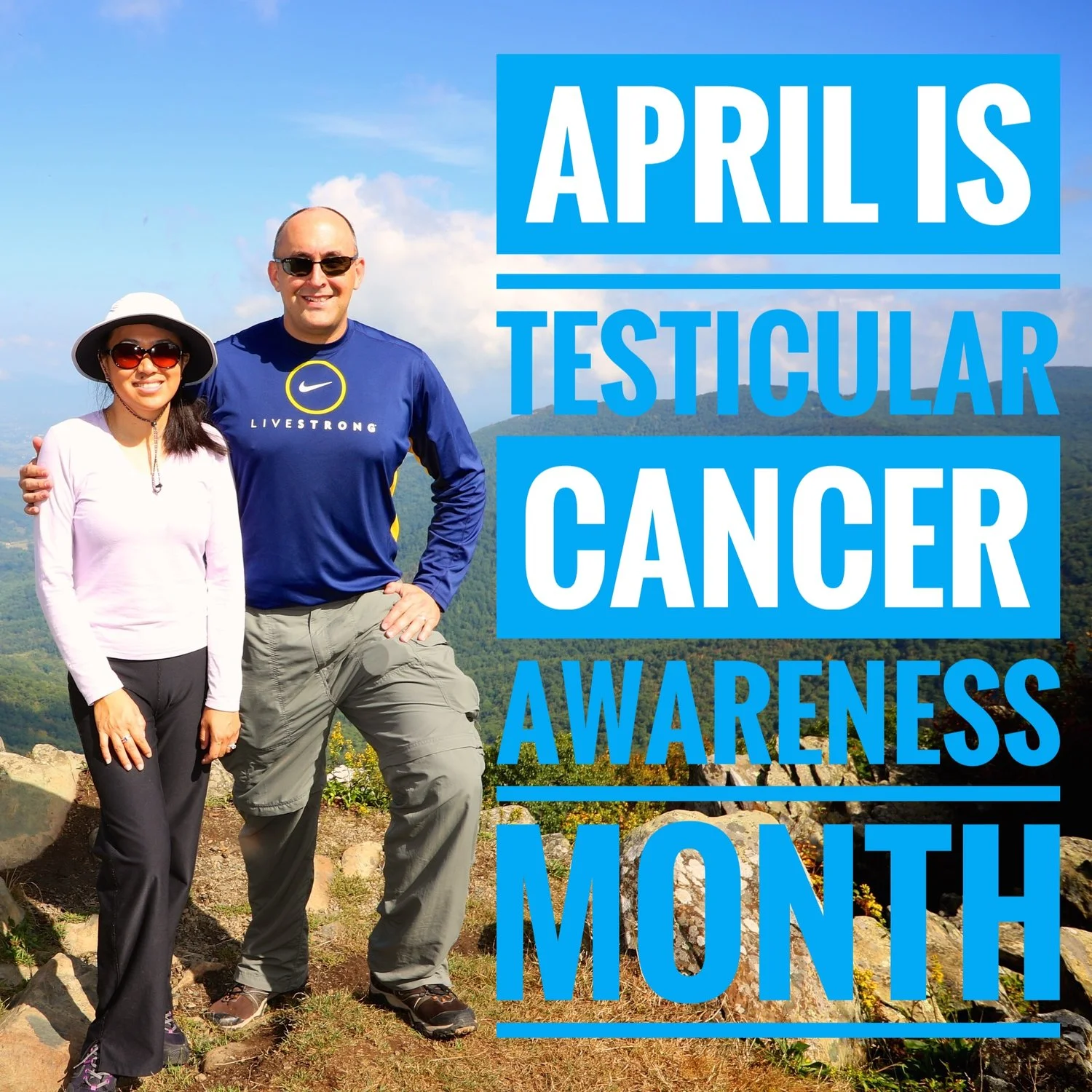
April is Testicular Cancer Awareness Month
April is testicular cancer awareness month, and as a 9 year survivor of this disease, I can tell you a few things about testicular cancer.The first is that contrary to what people might expect, testicular cancer is actually the #1 form of cancer in men ages 15-44 internationally, yet almost no one talks about the disease. It’s sad and frustrating that 20 years after the founding of a very famous organization in yellow by a now very infamous testicular cancer survivor, that we still have to struggle so hard for any sort of public awareness about this disease. Testicular cancer in young men is about as common as breast cancer is in young women, yet no one ever talks about testicular cancer! In the U.S. alone, someone is diagnosed with testicular cancer every hour, and someone dies of this disease every day.

April is Testicular Cancer Awareness Month, and as a 9 year survivor of this disease, I can tell you a few things about testicular cancer.
The first is that contrary to what people might expect, testicular cancer is actually the #1 form of cancer in men ages 15-44 internationally, yet almost no one talks about the disease. It’s sad and frustrating that 20 years after the founding of a very famous organization in yellow by a now very infamous testicular cancer survivor, that we still have to struggle so hard for any sort of public awareness about this disease. Testicular cancer in young men is about as common as breast cancer is in young women, yet no one ever talks about testicular cancer! In the U.S. alone, someone is diagnosed with testicular cancer every hour, and someone dies of this disease every day.
With an overall cure rate of over 90%, testicular cancer is a highly curable cancer, but it should never be considered an easy or a “good” cancer. Testicular cancer tends to be a pretty fast growing and aggressive form of cancer, and must be hit equally aggressively in order to get that cure. Orchiectomy alone, removal of the stricken testicle, can be enough to cure many Stage I patients, but the primary chemotherapy protocols and surgeries that are commonly used to treat people with metastatic disease are pretty rough, and can leave many additional physical and mental marks on people.
Regardless of the stage of the disease at diagnosis, testicular cancer is not an easy cancer to get through simply because of the younger men that it tends to strike. My 33 year-old self was unaccustomed to ever having anything more than the flu, and still believed that I was invincible and going to live forever. This loss of innocence and suddenly feeling so vulnerable at the prime of my life shattered my confidence. Mental health issues such as anxiety and depression are common, and posttraumatic stress to varying degrees is certainly not unheard of, either. Another thing that young men aren’t typically accustomed to doing, is asking for help when they need it. The rarity of young adult cancers can tend to leave survivors feeling very isolated and lost, which is why finding support from the young adult cancer community is essential. Regardless of gender or cancer type, young adults tend to face so many of the same inner struggles after a cancer fight. No one needs to fight alone.
There are a few risk factors for testicular cancer that include an undescended testicle, a family history of the disease, and being Caucasian, but most testicular cancer diagnoses simply come down to bad luck. Signs and symptoms include a painless lump or any change in size or any irregularity in the testicles. Pain or discomfort in the testicles, or any pressure sensitivity is certainly a potential sign, along with a dull ache or a sense of pressure in the lower back, abdomen, or groin. More advanced signs include significant weight loss, back or chest pain and coughing or difficulty breathing, and enlarged lymph nodes in the abdomen or neck.

Because testicular cancer isn’t preventable, monthly testicular self-exams are recommended for all men, and boys starting at 13. There are some groups out there that say not to bother, given that testicular cancer is so curable at any stage. This is terrible advice. Don’t listen to it. Just because a cancer has a high overall cure rate, doesn’t mean you should ignore any signs or symptoms until you have very advanced stage disease. I was lucky in that I actually had pain in my testicle that clued me in that something wasn’t right, and a thorough self-exam found the solid mass. Not everybody does, and that painless lump can quickly turn into a very dangerous advanced stage cancer in just a matter of months. Poor risk testicular cancer has a 50/50 cure rate, no better than a coin toss! Why leave your life up to a coin toss?
Believe me when I say that if you’re going to develop testicular cancer, you’re much better off catching it an early stage rather than late, as you’ll avoid significant trauma to both mind and body if you’re able to avoid some of the harsh treatments and surgeries that are used to cure metastatic testicular cancer.
There’s nothing to lose with a regular feel down below, and it could save your life.
StevePake.com

The Young Adult Cancer Time Warp
Most people experience the various stages of life in a relatively linear and predictable fashion, but what happens with all of this when you're diagnosed with cancer as a young adult? Forget about an early midlife crisis. This entire linear progression of time and life stages are blown sky high, and you experience an "entire life crisis" all at once.
How Most People Experience Life Stages

Most people experience their lives and its various stages in a relatively linear fashion. We're children and adolescents, and then become young adults. We finish schools, are building our lives and launching careers, and are getting married and starting families, too. In middle adulthood, we're maximizing our potential and trying to make a difference in the world, and trying to raise children that will become successful and productive members of society also. In late adulthood, we can finally slow down a bit, reflect back on all of our accomplishments, and enjoy life a bit more. Failure to achieve what we feel we were meant to achieve at one stage, can lead to problems and the inability to progress through the next. All of these life stages are described in Erik Erikson's Stages of Psychosocial Development, which is good background reading. Most people are already at least somewhat familiar with these stages, as the popularized "midlife crisis" represents what many experience at some point as they transition towards middle adulthood, perhaps feeling as though they hadn't lived as fully as they had hoped in their younger years. Sound familiar?
How Young Adult Cancer Survivors Experience Life Stages
All of this is very normal, but what happens with all of this when you're diagnosed with cancer as a young adult? This entire linear progression of time and life stages are blown sky high, and you experience an "entire life crisis" all at once. When I was diagnosed with cancer at the age of 33, I genuinely feared that I was going to die. After I didn't get a complete response to my cancer from chemotherapy alone, I nearly did die from a serious complication during a highly invasive surgery trying to evict the stupid cancer cells that way. And I once again feared death after a terrible recurrence scare in the years after. My end of life "death instincts" kicked in numerous times through these years, and what did I have to reflect back on? I feared that I had suddenly and abruptly reached the end of my life, but didn't really have anything to show for myself. How had I really lived? What had I really done? What kind of difference had I made in the world? How had my life been meaningful? These are questions that those in late adulthood might face, but instead I was facing them now, as a young adult. I didn't have any answers, and I was panicked.
At the same time I'd been facing those end of life questions, I felt like I hadn't been living and enjoying my young adult life to anywhere near its potential. I had terrible regrets for having lived my life so conservatively at the time of my cancer diagnosis, thinking I had all the time in the world to enjoy life later. Cancer made me realize that I didn't, and I had to start enjoying life at full speed right now, because there might not be a later. I needed to be young, wild, and free for once in my life, but I had yet more questions that needed to be answered also. What was I really meant to do and accomplish in this life, and how could I make a difference in the world at the same time? How could I bring meaning into my life? These were the "Generativity vs Stagnation" questions of middle adulthood per Erikson that I was also simultaneously facing, and for which I had no answers, either!
I've joked to friends for years that I'd already had my midlife crisis very early, thanks to cancer. As I look back on all of this, I realize what a short shrift that was of what I really experienced. Young adult cancer is really an "all adult stages of life crisis" all at the same time, and this explains the panicked rush that so many of us feel to really live our lives and accomplish our dreams so quickly after cancer. Life becomes a time warp where we feel the need to engage with and accomplish things at all of the adult stages of life, all at the same time. All of the plans we'd had for our lives, and all of the things we'd planned to do when we were younger or older, all becomes right now, and it's completely overwhelming.
Feeling Conflicts From All Adult Stages of Life at Once is Normal
I want you to know that all of this is normal to experience. You're not going to have all of the answers, but be true to yourselves. Listen to what your hearts are telling you, and not what others are telling you, nor what societies and cultures expect of you. Just be you, and nothing but you. Keep your hearts and your minds open, and you'll find the answers that you need with time. Be courageous. It can be difficult or even terrifying to make the changes and major course corrections that might be needed, but sometimes what you're most afraid of doing is the very thing that will set you free.
Cancer survivorship can bring with it moments of clarity, where you might realize you've been headed in the wrong direction, or living your life the wrong way. This is what it can feel like to change course, but it's also what will really set your soul free.
You're not going to figure all of this out at once. You can't; it's impossible, so don't demand that of yourself, and don't beat yourself up when you don't know. You have to let things come naturally. I didn't realize it at the time, but I just needed to be incredibly productive in some way, and tapping into my inner talent for writing and expression for young adult cancer advocacy non-profit work just came naturally. I've felt very fulfilled doing this, but ask me when I realized that this was something I really needed to do? It took me a few years after cancer to figure it out, and it might take you a few as well. You don't suddenly wake up one day as a young adult cancer survivor with an epiphany and vision about all that you need to do in this world. I've had some moments of clarity like that, but they've represented smaller pieces of a larger puzzle.
All of this takes time when we feel like we have none, and hence the panicked rush of young adult cancer survivorship. If you can't figure things out, DON'T WORRY. Just live and enjoy your life! I figured that out first; what to do with myself came after.
Where Am I Now As a Six Year Survivor?
I know some normal people that have done really stupid things, and have made extremely poor decisions for themselves as they've reached midlife. I've reassured family and friends that as I approach 40, I'm not going to be having a second midlife crisis this year. But if that's not where I'm at, then where exactly am I?? That's when I realized that a part of me is actually reaching not middle adulthood this year, but rather late adulthood instead!
As I exit my young adulthood and six years of cancer survivorship this year, I see what I've really been through at a very high level for the first time. On one hand, I'm very proud of all that I've done and achieved as a young adult cancer survivor through what was actually a first highly productive generativity phase in my mid to late-30s. Cancer put me far ahead of the curve, and because of that, I'm now feeling the wisdom and satisfaction that comes with the "ego integrity" of late adulthood when you feel as though you've been successful in these earlier stages of life. And how bizarre is it that I feel this at the tender age of 39 rather than 65, on this warped young adult cancer time scale?! There's so much more that I'd like to do, but if cancer were to take me now, I'm at peace with all that I've done and accomplished. On the other hand, I'm only turning 40 this year. I very much have a second life and a second generativity phase at my disposal. I have no idea what I'll do, but I'm not slowing down too much and plan to make the most of that, too.
Young Adult Cancer Survivorship Is A Very Different Life
Young adult cancer survivors are on very different paths through life than most. It's normal to feel the conflicts of and the need to engage with all of the adult stages of life at once. It's a mess to sort out, and some have to make the ultimate leap far before their time. I know just how blessed I've been with the gift of time to figure my life out, such that I've been able to live a fulfilled life here in this realm. Not everybody is granted this, and I know this, so perhaps this gift of time has been my greatest gift and blessing of all. I pray that you'll have this time as well, and that hopefully my words of wisdom can help to ease a bit of this inner conflict, and that it can help to expedite your path to living a more fulfilled life in our time warped young adult cancer world.
God Bless.
StevePake.com

How I Finally Found Peace After Cancer
An essay looking back on six years of young adult cancer survivorship. If cancer were to take me now, if today were my last day, and if this were my last sunrise, how would I feel right now?
My six year cancerversary is February 14th, 2017. This is an essay looking back on these six years of young adult cancer survivorship. If cancer were to take me now, if today were my last day, and if this were my last sunrise, how would I feel right now?
If Cancer Were To Take Me Now... I've Enjoyed the Love of a Beautiful Woman for Over 20 Years Now.
My wife is everything to me. She's my best friend, my lover, my soulmate, mother to my two beautiful children, and so much more. She's the one that's always made all that's been so wrong so right. We've supported each other through our very worst times together, but also shared in so many of our very best. After all that we've been through together, there's still only one person I'd want to be stranded on a deserted island with. Her. I'm so lucky. Not everyone is blessed with a love like this. I'm turning 40 this year. To have had such an amazing and beautiful woman along on this ride for over half of that journey has been the greatest gift a man could know. If cancer were to take me now, to my wife, thank you. Thank you for being so perfect, for providing me with such unconditional love, and for finding your way into my life so early. I pray we'll have so much more time to enjoy this love that we share in this lifetime, but if cancer were to take me now, I'm so grateful to have enjoyed our love for as long as we have. I love you. Thank you.
If Cancer Were To Take Me Now... My Children Know Their Father.
When I was diagnosed with cancer at the age of 33, my children were just turning 2 and 4 years old. Ask me what my biggest fear was. It wasn't dying of cancer or of a life not lived, but of leaving this world early with these two amazing young souls never having a chance to truly know their father. We've filled these years after cancer with so much quality time, and fun trips and adventures everywhere. A lifetime of happy memories has been created in just a few short years. They're still so young and have so much growing up to do, but at nearly 8 and 10 now, I've had the chance to see them grow so much. I've had a chance to know them and to have had an impact in their lives, to let them know how much I love them and believe in them, and to help them find their way in our crazy world. I pray we'll have many years of love and adventures in the future together, but if cancer were to take me now, I've been so grateful for these years, and the opportunity for my children and I to have known and loved each other. It's meant so much to me.
Just a small and by no means complete collection of truly beautiful souls in this world that we have come to know and really appreciate in large ways and small.
If Cancer Were To Take Me Now... I've Enjoyed Some Truly Wonderful Friendships.
Through my cancer fight and so many challenging years as a cancer survivor, my friends have meant the world to me. Whatever I've needed in a friend, the world has seemingly provided at the moment I was in greatest need. The love that I feel for my friends, and those that have truly been there for me through such dark times, knows no boundaries. It's such a deep love and appreciation that transcends the limits of our language to describe, and my ability to express. Let's just say that if I were to depart this world a bit early, if cancer were to take me now, that these friends of mine will have an angel watching over them up in the heavens. And when it's their time to make this transition, they'll soon see a familiar face welcoming them, and guiding them on their way up.
My friends have restored my faith and renewed my hope when I had completely lost it, and have represented the very best that humanity has to offer. I couldn't have made it through all that I have without these beautiful souls. If cancer were to take me now, I'm so thankful for our friendships, and for the differences we've been able to make in each others lives. Passage of time and the varying trajectories of our lives might take us to different places in our physical world, but the bonds of these friendships are for a lifetime, and will never be forgotten. I will love you all until the very end, and until we meet again. Namaste!
If Cancer Were To Take Me Now... I Know That I've Evolved.
I'm not the same person that I was before cancer or after. I'm a far more spiritual, connected, and compassionate individual than I used to be, or ever could have been. I've evolved more in these past six years of cancer survivorship than many might evolve in an entire lifetime. Such a huge transformation at a relatively young age has been incredibly painful at times, but now I have the privilege of living the considerable numbers of years I could have left in my life as a far better and far more evolved version of myself, and for that I'm very thankful. I'm neither afraid nor haunted anymore thanks to this evolution, and I'm free to live my life fearlessly. I'm finally at peace with all that I've been through, and have learned to be grateful for this journey. I pray that I'll have many more years, but if cancer were to take me now, I know that I'll be leaving this world as a far better soul than when I arrived, and for that I'm very thankful.
If Cancer Were To Take Me Now... I Know That I've Made a Difference in the World.
It's funny how having cancer as a young adult can warp and accelerate such linear concepts as time, and stages of life. We can feel this rush to truly live our lives, to accomplish things, and to make a difference for others and leave a legacy, all at the same time! I was lost for awhile, and didn't know what I was supposed to do, or how I was supposed to live my life after cancer. How do you accomplish things in every stage of life all at the same time? I was so frustrated, and took to writing just trying to sort everything out. At first, my writing was just a private coping mechanism for me, but it transformed into a powerful tool to help uplift and empower hundreds of thousands of others across the world, helping them find their way through their own life journeys and struggles as well.
It's through my writing that I found a purpose and the direction that I needed. I was meant to write, and so I've written, over a hundred thousands words so far. Being named a top cancer blog out of hundreds of entries by a huge cancer website helped me feel as though a life purpose had been fulfilled, and I've been so grateful for that. I have so much more I've yet to write, but if cancer were to take me now, I'll feel complete knowing that I put my inner talents and life experiences to good use in this world, that I've made a difference for so many people, and that I'll have left this world a better place than when I found it. Nothing is more honorable.
The purpose of life is not to be happy. It is to be useful, to be honorable, to be compassionate, to have it make some difference that you have lived and lived well.
Ralph Waldo Emerson
A special thanks to those that have believed in me, and that have given me the opportunity to share my writing on platforms with such a broad reach. Namaste!
If Cancer Were To Take Me Now... I Know That I've LIVED.
It took me a few years to really understand what Mark Twain meant in this quote, but I get it now.
The fear of death follows from the fear of life.
A man who lives fully is prepared to die at any time."
-Mark Twain
I was too afraid to ever really start living my life before cancer, and was afraid of not having one to live at all after. My second biggest fear after not being around for my children, was of a life not lived. My cancer diagnosis rocked our world. We started living our lives fully and completely after cancer, and have never looked back. You don't need permission from anyone to get out there and live your lives. The only person holding you back is you. We've gone to some amazing places, and have done some amazing things. We've had the time of our lives so many times over, and have created so many wonderful memories as a family, and with friends.
As I look back on six years of cancer survivorship, I'm so glad that no matter how lost, depressed, or afraid I'd felt at times, that I never stopped pushing forward, and never stopped living my life. I've lived more each year since cancer than I had in all 33 years of my life before cancer combined. That's a whole lot of LIVING in a few short years. I've not wasted a day, and I know that I've lived each and every one of them since cancer. I pray I'll have many more years on this grand adventure, but if this is it for me, if I get bad news tomorrow and learn that cancer is going to take me now, I won't be afraid, and will have no regrets. I know in my heart and soul that I've lived my life fully and completely and the best I know how, that I haven't missed a thing, and that I'll be thankful for every joyous day that I've been blessed with. I'm not afraid anymore, because I've known that the best way to survive cancer is to LIVE, and lived I have.
This is not a collection of our adventures over these past six years. All of these photos are from just ONE year, 2016, and we've made every single year since cancer just like this one. This is how life is meant to be LIVED! What are you waiting for? You don't need anyone's permission!
How Did I Finally Get Here After Six Years?
How did I finally get to where I am? How do I sleep so peacefully at night, and how do I live my life without fear or worry after cancer? Make no mistake, there were plenty of days where I was so distraught that I could never even get out of bed that day, nor leave that proverbial corner. But dammit I pressed on!
I never gave up, and I never stopped believing in myself, even when nobody else did. When I had fears, I confronted them. When my own attitudes and beliefs were just getting in the way and no longer serving me, I was smart enough to realize that and let them go. I always kept an open heart and mind, and adopted new ones so that I could move forward again. Our attitudes and beliefs are self-fulfilling prophecies, including towards ourselves. You'll find exactly what you look for, so look for something wonderful. Some people had really hurt and disappointed me in this journey. I let them go too, so that I could find better souls in this world to have along on my journey with me. I found so much fulfillment with these new friends, and learned that you never need to fear closing doors, because better ones will always open for you. I learned to forgive those that had hurt me, not because I felt all were deserving, but for me, so that I could again feel love and peace in my soul, rather than continuing to have it dragged down with so much hatred. I loved my wife, and I enjoyed my family and my friends endlessly. I stayed true to myself and went with what my heart told me. When people had made such a difference for me, I told them so, and let them know how much I loved and appreciated them. I lived my life fully and completely, and found a purpose through which I've been able to make a difference for so many others. I always strived to become a better person, and refused to ever allow myself to turn ugly. Sometimes it took everything I had to not become destructive to myself or others. You don't have to be the same person that you were yesterday. You can evolve. You can become a better version of yourself, but you have to want it to happen, and you have to work hard for it. It was so hard to have felt so wounded in life, and it was twice as hard to evolve, but twice as rewarding when I finally succeeded.
TL;DR - Just Grab Life By The Balls! ;-)
As I approach 40, I realize now more than ever that we're only here for a very short time. It's okay to be afraid, and it's okay to have a meltdown. Just don't stay there for very long. There's no time for that. Our lives are made up of two dates and a dash, and no amount of stressing or worrying can ever tell you when that second date will be. Just make the most of the dash. No matter how afraid I was, I never stopped living my life. The best way to survive cancer is to LIVE! Get out there and live your lives fully no matter what's hanging in the background. I've been blessed with all of these years since cancer, but I wouldn't be where I am today had I not been truly living my life. Read Twain's famous quote again. Read it over and over, and repeat it to yourself every day to let it sink in.
The fear of death follows from the fear of life.
A man who lives fully is prepared to die at any time."
I pray I'll have many more days, but if today is my last day, and if cancer were to take me now, I know that I've lived my life fully and without regret, and that I'll be at peace and ready. This is the ultimate peace that one can feel after cancer, and it again transcends the limits of our language and my ability to express to even begin to describe how wonderful this feels, after so many years of inner struggle.
Mission Completion. Hallelujah, I'm finally there! The next chapter begins now.
God bless,
StevePake.com
If you're lost and looking for some inspiration, you can never go wrong with TobyMac's #SpeakLife. I'm spiritual but not very religious, but you don't have to be Christian to appreciate and enjoy either his message or his music. I write about many of these and more in the Daily Inspiration section of my website!
Nickelback's "If Today Was Your Last Day" is a song that's really spoken to me as a young adult cancer survivor, and has been a favorite of mine for many years now. This is exactly how my life has felt like to live, and I can relate to almost every line of the song. Lyrics here.

Cancer Is Not Just Rogue Cells - And Not Just Inside the Patient
As I approach six years of cancer survivorship, never has it been more clear to me that cancer is not just a disease of our physical bodies, but a disease of our minds and souls as well. Thus, the argument that many make, is that cancer is not just a matter of eradicating the rogue cells from one's body, but of curing the entire patient.

A few words for World Cancer Day 2017.
As I approach six years of cancer survivorship, never has it been more clear to me that cancer is not just a disease of our physical bodies, but a disease of our minds and souls as well. Thus, the argument that many make, is that cancer is not just a matter of eradicating the rogue cells from one's body, but of curing the entire patient. To rid a patient of the physical disease, but to ignore the residual emotional and spiritual disease, does not a cure make.
In these six years after cancer, there's much more that I've had to overcome than a bit of testicular carcinoma. The chemotherapy did a number on my body, and I've had to overcome chronic fatigue because of chemotherapy induced peripheral neuropathy, but those were the easy parts. My anxiety was overwhelming at times, and I constantly feared that my cancer would come back. Some friends of mine didn't make it, and on several occasions, I thought for sure that my cancer had returned, and that I was next. I fell into depressions several times, and suffered from posttraumatic stress. I struggled emotionally for years, and even four years out from cancer, I couldn't stop being afraid.
Irregular hormonal levels for several years didn't help, either. Doctors of testicular cancer patients all seem to believe that because men have two testicles, that the other will "pick up the slack" and that we'll be able to keep flying along as normal, like a twin-engine aircraft. We survivors know otherwise, that it's not necessarily true, not nearly that simple, and that there's actually no evidence out there to support such assumptions, as no studies have ever been done! Because our testosterone levels might still test in an impossibly wide "normal" range, we're sent packing. Meanwhile, our moods, energy levels, and mojo can be flailing around all over the skies from 30,000 feet down to treetop level and back again, barely able to stay in the air at times. While having to contend with so many post-cancer fears, we're also having to contend with non-compliant bodies, and doctors that don't understand our problems. Life after cancer can be so cruel and unfair.
Loved ones and caregivers suffer right along with us, and should not be overlooked anymore, either. Where there is love, there's transference of emotion, transference of anxiety, and transference of cancer as a disease of our minds. Yes, caregivers suffer from the disease called cancer as well, and for them, it tends to be a more silent battle. They need to be strong and the pillar of support for the ones doing the physical fighting, but feel the same fears and anxieties as the actual patient does. Caregivers are fighting cancer as a disease of their minds, too, and deserve equal consideration for care. Don't just ask how the cancer patient is doing - ask how their caregivers are doing as well. It's entirely possible that no one has ever asked, while they're crumbling inside in the same way as the patient.
Survivorship care has come a long way in six years, but there's still much to this fight that's not well understood in medical professional circles, and so the drive to share in our journeys and our many struggles after cancer continues.
StevePake.com
Originally written for World Cancer Day at the Cancer Knowledge Network

Negotiating Surveillance and Long-Term Follow-up for Testicular Cancer
The National Comprehensive Cancer Network (NCCN) Guidelines for are the bible by which Testicular Cancer patients are treated and managed. The follow-up care recommendations within these guidelines only goes out to 5 years, and even within those 5 years, there's been some significant adjustments to the recommendations over time. It's entirely possible that if you were diagnosed with testicular cancer within the past few years, that you might be able to make some adjustments to your follow-up schedules in favor of fewer scans or appointments, but what do you do after that? It's up to you and can go on a case-by-case basis. Here are some answers.
The National Comprehensive Cancer Network (NCCN) Guidelines are the bible by which Testicular Cancer patients are treated and managed. The follow-up care recommendations within these guidelines only goes out to 5 years, and even within those 5 years, there's been some significant adjustments to the recommendations over time. It's entirely possible that if you were diagnosed with testicular cancer within the past few years, that you might be able to make some adjustments to your follow-up schedules in favor of fewer scans or appointments, but what do you do after that? It's up to you and can go on a case-by-case basis. Here are some answers.
Changes to NCCN Follow-Up Recommendations Within Years 1-5

The NCCN Guidelines are literally the most important guide for any cancer fighter or survivor to have, and the bible by which doctors should be treating their patients.
First off, there have been many, many changes to the NCCN follow-up recommendations since I was diagnosed with testicular cancer in 2011, and the latest testicular cancer guidelines (2-2017 as of this writing) states that "further study is required to define optimal follow-up durations." In other words, they just don't have the evidence to know what the best answer is here. What is too much and what's too little? Scan frequency has gone down quite a bit to minimize the risk of secondary malignancies from radiation exposure, especially from CT scans, but they don't have the evidence to know where the sweet spot is, thus making these follow-up schedules very much open to debate and negotiation. Yes, your follow-up schedules for testicular cancer are negotiable.
In my case, for Stage II non-seminoma good risk disease treated with both primary chemotherapy and the RPLND surgery, the changes to the follow-up recommendations have been significant. At the time of my diagnosis in 2011, the NCCN guidelines called for as many as 20 scans (chest x-rays) and follow-up appointments over 5 years. I was seen at Memorial Sloan Kettering Cancer Center (MSKCC) in New York who went above and beyond the guidelines, and I had a total of 27 chest x-rays over the years, with 18 of those coming in the first two years alone. Given I had the RPLND surgery, only one CT scan was needed 4 months post-op, and otherwise just chest x-rays for me.
As of 2017, how many scans are recommended by the NCCN guidelines for someone like me now?
SEVEN.
Just 7, with 8th and 9th scans in Years 3 and 4 being optional, and no scans at all in Year 5. Granted, I'd still need a total of about 16 office visits, but that's still a whole lot less stressful than twenty-freaking-seven. When I first saw how significantly the NCCN follow-up recommendations had changed and how many fewer scans they were recommending these days, I about fell out of my chair, and then needed to go sulk in a corner for awhile. This is really great news, as it shows that, yes, treatments for testicular cancer really are highly effective and completely curative most of the time, and that there really isn't a whole lot to be afraid of, despite the unavoidable and unimaginable amounts of worrying that it brings patients. Most people are just fine after treatments. Thanks to our collective piles of chest x-rays and CT scans that have never shown anything for most over the years, testicular cancer survivors will have far fewer scans to worry about after treatments today, and that's a very good thing.
Making Mid-Course Surveillance Schedule adjustments
A part of me regrets not questioning so many scans, especially now that not even a third of those scans are required today, but that's water under the bridge at this point. It wasn't easy, to put it mildly, but I got through them all. If you were diagnosed with testicular cancer a few years ago, there's a chance that you might still be on a more scan-heavy schedule. If so, you might be able to modernize your follow-up schedule after review with your doctors. Here's what you can do:
- Download the latest NCCN guidelines by registering for free at the NCCN website. Navigate to the Guidelines section, then to Cancer by Site, and then Testicular Cancer to get to them. Find the follow-up table that's relevant for your cancer about midway through the document based on type (seminoma or non-seminoma), and then stage, treatment path, and level of treatment received, and pay close attention to the super-scripted notes. Review what the current follow-up recommendations are now, against what you're actually doing. It might be quite different.
- Review With Your Doctor. With how many scans they've pulled from the follow-up schedules in recent years, chances are you might not need nearly as many now, or perhaps you could just do chest x-rays for scans and skip any further CT scans at this point, followed by the usual history and physical, and blood tumor marker checks? No more CT scans, wouldn't that be nice? If you look very closely in the guidelines you'll also see that scrotal ultrasounds are now mentioned as well. Sound like something worth doing? It was for me, and I'll get to that below.
- Do What's Best For You, with Your Doctor's Blessing. Whether you're at the point of cutting yourself free from oncology care if you so choose, or are making mid-course corrections between 1-5 years out, do what's right for you, so long as your doctors are on-board with your plan. There's both "scanxiety" from the follow-up appointments, but also anxiety from not having them. I don't know of a single person that actually enjoys getting CT scans done, but some might have more anxiety without them. Be true to yourself and your needs. If you're struggling, it can be worth it to make adjustments, and still meet the standards for care.
Of course, now that I've made it through 5 years and twenty-seven freaking scans, I have the moment of revelation that maybe I should have asked more questions than I did, but most of these scans were in the first two years, and before the NCCN started pulling back on the number of scans required. What's done is done, and I'm happy to have exited my 5 years of active surveillance.
How To Make Your Post 5 Year Follow-Up Plan
So, what to do after 5 years? Here's what I did.
You're the patient, you're the boss. You can do whatever you want to do after 5 years. If you feel like you're ready, you can opt to be formally discharged from oncology care, or if not, you can continue to be seen at whatever interval you're comfortable with. Your doctor will be more than happy to keep seeing you. It's up to you, and there's no right or wrong answer. The correct answer is whatever you're comfortable doing, with considerations for any specifics of your case, and that your doctors are on-board with.
For me, with good risk disease, primary chemotherapy and the RPLND which most people in my risk classification tend to skip, I just needed to be cut free. If I'd only had 7 to 9 scans and a dozen and change office visits over the years as opposed to 27 of them, maybe I'd still want annual follow-ups with my oncologist. Maybe I'd still want annual follow-ups had I skipped the RPLND, and I'm quite certain I'd still want them were I in a higher risk group. Instead, I've found myself totally and completely burned out emotionally from so many oncology office visits, and I just didn't want to have to keep going if there was no compelling reason to do so. I love my oncologist and he's a great guy, and my favorite oncology nurse (hello Trish!) has become a friend for life type with me, but I just needed to walk out of that office for once without another appointment scheduled. I really needed that like nothing else, otherwise everything would just keep perpetuating in my mind. I needed the closure of not having to go back, and so we developed a plan that supported that.
The first condition for my formal discharge from oncology care, both from my wife and from my oncologist, was the insistence that I have an annual physical exam done by my primary care every year. No problem there, and cancer survivors especially should have these done annually as it is. Next up, scans or no scans? For my stage of disease and level of treatments, one is more likely to see a false positive from a chest x-ray at this point than disease recurrence, and so I opted out of any more chest x-rays. I think 27 has been more than enough. Although my tumor markers (bHCG and AFP) had always been negative and resulting blood work not that useful, I elected to continue doing these. You're having blood work done at an annual physical anyways, so why not throw it in? Continuing with these tests are useful for catching a potential second primary testicular carcinoma that might have a slightly different signature, and that could be positive for these markers.
Testicular Ultrasounds. This is something that I'd highly recommend doing for every testicular cancer survivor out there at least annually. Testicular ultrasounds weren't in the NCCN guidelines when I was diagnosed with testicular cancer back in 2011 other than for initial workup, but they're included now for follow-up care as well, for obvious reasons. As with the above, testicular cancer survivors are at elevated risk for developing testicular cancer again on the other side versus the general population. If anything was ever going to catch this early, and give a heads-up that something is going on before there were symptoms or other signs, a testicular ultrasound is what could do it, and so this was a no-brainer thing to do.
Do a full hormone panel. It's not mentioned anywhere in NCCN, and not something that oncologists ever really pay much attention to, but get a full hormone panel done. Despite what doctors say about the other testicle "picking up the slack", there is literally no information out there to support that, and we survivors know very well that this isn't necessarily true. It's a given that we're far more likely to face hormonal issues as we age due to only having a single testicle. Almost nothing is known about male hormones, and we're pretty much on our own here. The more data points we have on ourselves, the easier it will be in the future to know what's going on, if and when hormonal issues do develop.
Why a full hormone panel and not just a testosterone level check? Some long-term testicular cancer survivors who are symptomatic of hypogonadism are finding not that their testosterone levels are too low, but rather that their estrogen levels are too high, and have had some success in being treated with estrogen inhibitors, rather than testosterone replacement therapies. Please note that this is all highly experimental reports from individuals within the testicular cancer community, and not from official studies, of which there are none to go on. The point is, just start collecting as much hormonal data about yourselves as you can now, as it will potentially be very useful later.
STICK WITH YOUR PLAN
Honor yourself, the doctors and nurses that helped you through your cancer treatments, and your family and friends that have been there for you as well, by sticking with whatever your agreed upon plan is. After the hell that so many of our bodies have been through fighting cancer, and the significant emotional investments made by so many supporting us, we owe it to ourselves to do everything we possibly can to maintain the best possible health for ourselves going forward. A big part of that is having an annual physical done, and should be a part of every cancer surveillance exit plan.
I'm happy to say that I just had my annual physical, and that it went very well. My cholesterol, HDL/LDL levels and ratio were all good, as was my blood pressure and fasting glucose levels. A few things that have been messed up since fighting cancer are still messed up, but stable. My creatinine levels have been 1.4-1.6 since cancer (normal was around 1.0 before), due to some damage to my left kidney sustained from chemotherapy, and then a complication from the RPLND surgery didn't help it out at all. My platelet levels also run low at around 100, which is due to some permanent bone marrow damage also due to chemotherapy. None of that has changed in years, and it's good to know that.
One thing in my CBC report has tracked a bit high, but that's always correlated with my weight, and I've vowed this year to finally lose every last "cancer pound" I'd ever gained. Before cancer, I was around 240-250 pounds, which was considered to be a good weight for me considering my significant height of 6'3", and my large frame. Because of how chemotherapy, steroids, and surgeries had all affected me while fighting cancer, I ballooned all the way up to 300 pounds as I exited MSKCC in New York after my RPLND surgery. Due to chronic post-cancer fatigue from chemotherapy induced peripheral neuropathy, I could never exercise hard enough in my first few years after cancer to burn that off. My weight has floated around 270 pounds for the past few years, but running helped me to get beyond my fatigue issues, and there's no excuse anymore.
I refuse to turn 40 later this year in anything other than the best shape of my life. When we Scorpios commit to something, we're either all-in 110% or don't bother, and so I'm all in with a gym membership and regular exercise, a strict diet and paleo foods, and all that. This will happen. Turning 40 will be the start of a new era and decade for me, and this baggage from cancer, including the residual flab on my sides, is not going to be a part of that.
At the time I walked out of my oncologist's office for hopefully the last time ever back in June of 2016 (knocking on wood), I wasn't able to really feel or appreciate that moment at the time due to so many other things going on in our lives. As I'm typing this now, over a half year later, I'm finally feeling that emotional release and tears of joy from this for the first time, and the relief of such an enormous burden in my life having been lifted.
I just couldn't accept having to keep seeing an oncologist every year for the rest of my life. I've finally made it. I know how quickly things can change, and am going to keep living my life exactly how I've learned to LIVE it after cancer, but this is done now.
I'm finally free, and I can't wait to see so many friends and connections I've made in the testicular cancer community finally reach this huge milestone, too.
StevePake.com

How To Overcome Your Fears After Cancer (Or COVID)
Experiencing fear on a regular basis comes with the territory of being a cancer survivor. It's a very normal and even healthy part of cancer survivorship, but something that needs to be managed, so here are six tips on how to help cope with and overcome it.

[April 3, 2020 Update: It’s been surreal to once again be experiencing so many of the same fears and feelings that I did as a cancer survivor in the midst of the COVID19 pandemic, and then having to engage the same exact coping mechanisms that I had developed so long ago. You can replace the word cancer in this blog with “COVID-19”, and it’s really about the same thing. Just stay 6 feet away from your friends. :) ]
Experiencing fear on a regular basis comes with the territory of being a cancer survivor. It's a very normal and even healthy part of cancer survivorship, but something that needs to be managed, so here are six tips on how to help cope with and overcome it.
1. It's Okay To Be Afraid
It doesn't matter what type of cancer you're diagnosed with, what your age or prognosis is, nor even if you have a "good cancer". The fact is, when it's your ass and life that's on the line, and you're the one left wondering if you're going to live or die, a cancer diagnosis is just plain terrifying. It's okay to be afraid, it's okay to not have the answers that we need, and don't let anyone tell you otherwise.
2. Fear Might Come When You Least Expect It
Fear isn't just something that we face at the time of cancer diagnosis and treatment. It's normal to experience fear in the years after while "S.O.S" (Stranded On Surveillance), and can hit you at the most unexpected times, and in the most bizarre ways. Like when standing in line at Starbucks one day, almost a year after my cancer fight had ended. I had been feeling good for a change, and had finally managed to forget about cancer for awhile, only for two people behind me to start talking about how a friend had been diagnosed with cancer, and how awful that was. My heart sank into my stomach, and it all came back.
I'll never forget the day that I was out for a run, when a paralyzing wave of fear swept over me that was so intense that I collapsed onto the curb in tears. I couldn't even believe what I was afraid of. I was terrified at the prospect of having to get the retroperitoneal lymph node dissection (RPLND) surgery done for testicular cancer, except that I'd already had this surgery done 18 months ago! I had always wondered why I hadn't so much as batted an eye going into that brutal and highly invasive surgery. Sometimes our fears are repressed in order to get through challenging situations.
I sat on that curb in tears for about 15-20 minutes, letting it all out about a surgery I'd already had long ago. I was so embarrassed and ashamed. I didn't understand why I was feeling this now, but it felt so good to release whatever this was. I was never afraid of that surgery again, and the recurring nightmares I'd been having about it stopped for good. I quickly realized that I had so many more repressed fears bottled up inside of me like this, and that they just needed to come out. My emotions had simply switched off while fighting cancer, and now they were finally coming out, years later.
3. Find Healthy and Productive Outlets
Running over lunch became my daily ritual. It was an hour just for me, away from the office and away from my family, where I could privately work my way through all of my inner pain, without distraction. There's nothing worse than having fight-or-flight type anxiety freewheeling inside of you with nowhere to go. Running, specifically outdoors, with the wind on your face and scenery passing you by, was just so satisfying in a very primal way, and gave this dark energy the perfect place to go. No matter how badly I'd been feeling before, I always felt so much better physically and mentally after a run. Running didn't just work wonders for my body, it worked wonders for my mind as well.
I also took up writing, per the encouragement of a friend. I didn't always understand what I was feeling or why, and plenty of times my thoughts or fears made absolutely no sense. Writing about them, in the form of a private journal at first, helped me to make sense of my inner hurricane of thoughts. Slowly but surely I managed to unravel what was truly behind a lot of these inner fears and insecurities, who and what I really was inside and what I needed, and began to find ways to heal. Plenty of quality time with family and friends along with an active lifestyle became a necessity for life in general, but running and writing became my two primary outlets for processing all of my inner fears and pain.
4. Be Your Own Best Friend and Advocate
It's important to be your own best friend and advocate. Don't make the mistake that I did, where for years I was closer to my own worst enemy, beating myself up for being afraid of a "good cancer," with a good prognosis. Stop this. It's okay to be afraid. Our fears come from the deepest and most true part of ourselves. Never deny what you feel, and don't deny your true self. Clean up your inner dialog and be your own best friend and advocate.
When you're overcome with fear and find yourself sitting in a corner in tears, would your best friend beat you up for this? No. My own best friends have told me that they couldn't possibly imagine what I've been through, and have been mortified knowing even half of what my cancer experience has entailed. They're not the ones mourning the loss of friends that didn't make it, sweating out scans and dealing with scanxiety, nor are they dealing with so many physical and mental challenges such as bodies that don't work like they once did, and depression or even posttraumatic stress. Cancer survivors need strong support to make it through all that we do, and that has to start from within. Cut yourself some slack, and kill off that negative internal dialog. Love and accept yourself and all that you feel unconditionally, and be your own best friend and advocate for yourself in handling your fears.
5. Find People That Can Support You*
When fears about cancer are already pushing you beyond the limit, you're going to notice more than ever how other people in your lives affect you. Make sure that you have the best people for you in your life, that can help bring a sense of calm, and positive energy into your world. Part of being your own best friend and advocate, is allowing yourself to find those people, and removing others that just aren't working for you. Especially as young adults, cancer can be such a lonely and isolating experience, because so few peers at our age will have experienced anything like what we have. Community support can be vital, and today I enjoy a wonderful mix of both regular and cancer community friends that I couldn't be without. They all add so much to my life, and help me to feel complete.
*But with respect to the COVID19 pandemic, just make sure you keep your friends at least 6 feet away, unless you’ve been co-isolating together. :)
6. A Little Faith Can Go A Long Ways
Slowly but surely, I found my way through my years after cancer. I found the outlets that I needed, I continued to run and write as my outlets, and led a busy and active lifestyle surrounded by family and friends that always managed to put a smile on my face. But I couldn't stop being afraid. My fears about cancer always managed to find ways to come back and haunt me, and with it, periods of depression that could last weeks or even months, and periodic episodes of posttraumatic stress that would put me back in that corner again, huddled up in tears.
Ultimately, it was neither an attitude, a routine, nor lifestyle, that helped me to finally overcome my fears. It was faith. When I talk about faith, I mean that in the broadest possible sense to encompass anything and everything that faith can be. I don't go to church, and I'm still not a part of an organized religion, all things that I had shunned in the past and continue to shun today. What I finally developed was an independent set of spiritual beliefs that worked just for me. I gave myself something to believe in about what we are, and where we go after our physical lives end, all based on things that I've experienced and believe in myself. There's no right or wrong answer when it comes to something like faith. Developing faith is just as individual of a journey as surviving cancer is. For me, after years of struggle, finally allowing myself a system of beliefs took the wind out of the sails of my fears of death and dying of cancer, and today I'm living my life without fear for the first time. I'm free.
A little faith can indeed go a long ways.
StevePake.com

Testosterone Challenges after Testicular Cancer
Every single testicular cancer survivor and their caregivers should be aware of the possibility of low or irregular testosterone levels after cancer, and that no, the other testicle might not necessarily ‘pick up the slack,’ as is commonly believed. It isn’t that simple. Every medical professional should also be aware of this possibility with testicular cancer survivors, especially if they’re symptomatic of hypogonadism.
Before I was diagnosed with testicular cancer at the age of 33, I had always been a very regular person. I had regular amounts of energy and enthusiasm for life, regular amounts of optimism about most everything, and there had never been a single depressive “bone” in my body. I felt confident and secure, had very regular moods which were all good, and very regular amounts of libido, too! My cancer diagnosis blindsided me, and shook my foundations to their core. How could you not feel depressed and anxious while you’re afraid for your life, and fighting like hell just to live at all?
I wasn’t the same person after cancer
I wasn’t the same person after cancer. My confidence had been shattered, my optimism faded, and my moods were all over the place. I wasn’t the predictable “rock” that my wife had known, and suddenly I became a very irregular person, the exact opposite of what I had been before. I had “times of the month” where I just felt completely out of it. I struggled with mood swings that went from euphoric highs and feeling on top of the world, to incredibly depressive lows. Some of this comes with the territory of being a cancer survivor, but I knew there was more to it than that. Most of the depressive phases would last merely a few days to maybe a week at the most, but then there was the time that I just felt completely out of it for over a month! I had absolutely no energy at all, and was completely lethargic and depressed. I felt directionless mentally, my libido was non-existent, and I just felt like a lump of asexual nothingness.
I’m a very lucky man to be married to such an incredibly beautiful woman. My wife and I have always been a very physically affectionate couple, and that has never changed even twenty years and two kids later, but this did it. Suddenly, I felt absolutely nothing for her. I had no interest, felt no love or attraction, and didn’t even understand why we were together! I didn’t recognize myself anymore, and my wife didn’t recognize me either. She had been used to getting regular physical attention from me in the form of simple caressing and playful squeezes whenever we’d pass each other, and more, but became very self-conscious and wondered if I didn’t love her or find her attractive anymore when all of that attention dropped off of a cliff! Forget about ‘scanxiety’ and cancer recurrence scares, which make you fear for your life. Not feeling anything for the love of my life was even more terrifying, because it made life not worth living for me anymore. This was a completely foreign life experience to me, and the most terrifying thing I’d felt throughout my entire cancer journey. I felt like Superman when he lost his powers – helpless, directionless, powerless – unable to do anything, and not even love my wife!
It’s Hormones, Stupid! What’s Normal??
I had no idea what the hell was going on with me, but one morning while in the midst of this, I woke up realizing that I didn’t need to shave. Even some body hair had seemingly thinned a bit, and it became obvious that my body was gasping for testosterone! It was my hormones talking, or rather, not talking! I went to see an endocrinologist in short order and did some blood work, which confirmed my self-diagnosed hypogonadism, aka “low-testosterone”. Normal free testosterone levels in men range from about 270 to 1070 ng/dl, and I tested out at 178. My testosterone levels had fallen through the floor, so the obvious question was, do I go on testosterone replacement therapy (TRT) or not?
The million dollar question that every testicular cancer survivor experiencing low testosterone-related issues is, of course, what were our normal levels to begin with? Unfortunately, almost nothing is known about the true nature of testosterone levels in men, which includes testicular cancer survivors. Even at the time of a testicular cancer diagnosis, the opportunity to get a clear snapshot of an individual’s natural testosterone levels are already lost, as the testosterone production of the cancer-stricken testicle could already have been compromised. Furthermore, testosterone levels in men can vary by month, by day, by time of day, mood, stress levels, and many other factors. Thus, getting a good idea of what “normal” testosterone levels are in even healthy men is by no means a trivial task. Was my normal testosterone level in the 200’s, and thus my recorded level of 178 ng/dl just a minor slump, or was my normal more like 1000, and my body was in a low-testosterone death spiral? There’s simply no way to know. After a testicular cancer diagnosis, most medical professionals will tell testicular cancer survivors that the other testicle will “pick up the slack”, but we’re not exactly like twin-engined aircraft that can keep flying almost as normal if a single engine fails. There might be a lot of peaks and valleys, but for how long? Will our natural testosterone levels recover to the point that we can maintain the same altitude as before, or will we be stuck near the ground? Nobody really knows, and there are long-term risks either way as far as whether to go on some form of TRT or not.
Key Things to Know About TRT
The major risk bullet points for hypogonadism and not going on TRT are decreased bone strength and osteoporosis, along with a potential increased risk of developing Alzheimer’s disease.
On the other hand, going on TRT ends up actually doing harm to our body’s natural ability to produce testosterone on its own, and can also decrease fertility. Once one is on TRT, you’ll likely be on it for life!
TRT can also promote cancerous and non-cancerous growth in the prostate gland, and testicular cancer survivors already have an increased risk of developing prostate cancer as compared to the general population.
Some Advice From Guys That Have Been There And Done That
So, what guidance do testicular cancer survivors have in navigating these hormonal pitfalls? Right now, none. A big part of the problem is that testicular cancer is so curable, that very little research is done to look into the challenges that survivors face in the aftermath. Perhaps this is a good problem to have with such a highly curable cancer, but problems are problems, and ignoring them never makes them go away.

Meeting Scott Petinga at the Minnesota State Fair, 2016
Minnesota businessman and testicular cancer survivor, Scott Petinga, is trying to change that. Petinga has suffered terribly from post-cancer hormonal challenges for over a decade now, but has never been able to find the answers he’s needed. Petinga took matters into his own hands, and founded not one but two non-profit organizations, The Center for Advocacy for Cancer of the Testes International (CACTI), and the TH!NK DIFFERENT Foundation, which he’s bankrolled with his own money, to finally support formal research into the very questions and dilemmas that testicular cancer survivors face. In the meantime, all we can do is make the best educated guesses for ourselves that we can, and hope for the best.
Every single testicular cancer survivor and their caregivers should be aware of the possibility of low or irregular testosterone levels after cancer, and that no, the other testicle might not necessarily ‘pick up the slack,’ as is commonly believed. It isn’t that simple. Every medical professional should also be aware of this possibility with testicular cancer survivors, especially if they’re symptomatic of hypogonadism.
Scott’s advice is to “most importantly, prior to your orchiectomy request that the Urologist perform a full hormone panel as a baseline. Once fully recovered a second panel will be used to conduct a variance analysis and based on the results you’ll be able to supplement effectively.”
Image via Ron’s Facebook
Ron Bye, a testicular cancer survivor of over 40 years, additionally suggests that “it is very important, when considering TRT, to truly understand the full complement of hormones and their relationships between them. High E2 (estrogen) can have the same symptoms as low T and often have that inverse relationship. If the issue is high E2, simply adding testosterone will often only increase E2 by converting the excess T to E2 with aromatase enzymes. Before starting TRT always get a full hormone panel!”
It’s A Personal Choice
As for myself, despite my miserable predicament at the time, I simply had no desire to go on potentially lifelong and expensive testosterone replacement therapy while only in my mid-30’s. My wife agreed, and with her support and understanding, I decided to forego TRT in the hopes that my body would right itself on its own. Around this same time, I just happened to start a daily program of vigorous exercise. Regular exercise is well known to keep people’s hormonal levels up, and this just happened to do the trick for me. Whenever I felt one of these hormonal slumps coming on, I made sure to get out for a run as soon as possible, and go as hard as I could. Without fail, I’d always feel much better the next day. Regular exercise has become a way of life for me after cancer; it has helped me to once again be that “regular” guy that I used to be, and so much more, going on 4 years now.
There might very well come a time when I’ll need TRT in some form, but I’m hoping to make it at least a decade or two out from my diagnosis before I get there. It’s hoped by myself and many other testicular cancer survivors, that the research being funded by Petinga’s non-profits will eventually bear fruit, and that we’ll have better information from which to make decisions regarding our hormones in the future.
Additional Perspective Via Nick O’Hara Smith
Image via Nick’s Facebook
This is a copy and paste of Nick O’Hara Smith’s very insightful and helpful comment below, but I wanted to make sure to incorporate it into the body of the blog itself so that it wouldn’t be missed. Nick broke so much new ground in this area over all of his years for all of us to benefit from today. Nick very sadly passed away from other causes in late-2018.
“I'm really glad exercise has been able to help you stay off Testosterone therapy. Nobody I know other than body builders wants to be on it.
I've been on "no choice" Testosterone therapy for close to 29 years because I lost both testicles. In truth, relying on a lifelong medication to enable mental, physical and irregular sexual stability sucks. It is not a given that ED and sexual stamina are cured by Testosterone therapy.
However, it is such an important hormone for us men, because it is fundamental to our overall health. Prolonged low levels affects practically every system in the body, from cerebral to heart, skin, blood, vessels and bone.
However, just because a testicle is lost and your Testosterone is low, it doesn't necessarily mean you have to take Testosterone for the rest of your life as you've found. Sometimes though exercise doesn't do it.
The need to take Testosterone or not really depends on the origin of the problem, whether it is testicular failure, or a failure of the system that demands testosterone from the testicles.
That system is controlled by the Pituitary gland which sends signaling hormones LH and FSH high, thereby requesting the testicles produce Testosterone. Sometimes the system is muted by confounding sources which, when corrected can allow normal production to resume.
In such cases where a testicle is lost, it is possible to induce signaling requesting the remaining testicle to make up for the loss of the other one using Clomiphene Citrate.
Sometimes that is all it takes. In some cases however, I have seen a combination of Testosterone therapy and Clomiphene Citrate together prescribed to ensure fertility is preserved. That particular treatment is exclusive to the USA experts in such matters so far as I can tell. The drug Androxal (Enclomiphene Citrate) is currently under trial and going through the FDA mill in the hopes of getting it to market to help those with Pituitary originating Testosterone problems.
Elsewhere in the world, Testosterone therapy is the only medication approved for treatment with the consequential loss of fertility when the remaining testicle shuts down its production. An unedifying prospect to say the least for any man.
The dangers of ignoring this problem are many, but it is largely ignored in the male population worldwide.
Doctors generally tend to be as ill-informed and dismissive as the average person in the street. However there are broadly similar guidelines covering most countries now, which I constantly advise patients to print, read and give to their doctor.
I find it ironic that something so fundamental to male health and fertility remains in the hinterland while male fertility world wide drops like a stone. One day man will wake up!”
Thanks so much Nick and God bless!
One final word
If you’re struggling with both testosterone levels AND you also want to maintain your fertility or explore fertility options, please do take a trip out to see Dr Ajay K Nangia at the University of Kansas. He truly gets the testicular cancer patient population and their challenges, and there’s no finer expert in fertility for testicular cancer survivors than Dr. Nangia. Many of us had the pleasure of meeting and interacting with Dr Nangia at the Testicular Cancer Summit in 2017, and he’s also appeared at a few of the follow-on events as well.
I hope that within my lifetime the testicular cancer patient population will have far more definitive guidance and options for the management of our hormones after cancer!
StevePake.com

Post-Cancer Fatigue and the Importance of Exercise
By far, the biggest physical challenge I've faced after cancer, is that of chronic fatigue. After months of being poisoned almost to death by harsh chemotherapy drugs, irradiated trying to nuke cancer cells out of existence, or having our bodies ripped apart and then sewn back together, our bodies are just plain tired.
By far, the biggest physical challenge I've faced after cancer, is that of chronic fatigue. After months of being poisoned almost to death by harsh chemotherapy drugs, irradiated trying to nuke cancer cells out of existence, or having our bodies ripped apart and then sewn back together, our bodies are just plain tired. They take a beating fighting cancer, there’s tremendous amounts of healing and rebuilding that needs to be done, and all of that requires a lot more rest. I went from being just fine on 6-7 hours of sleep per night before cancer, to needing at least 9-10 hours after. Anything less, and I would struggle badly throughout the day. My stamina also plummeted, and I had to very carefully balance the amount of physical activity in a given day, or else I'd simply run out of gas. This wasn’t an easy thing to manage while trying to live the best life that I could after cancer, while keeping up with my busy family of four!
A year or two after my cancer fight, and long after the pain from surgeries and various complications had finally subsided, I took notice of another type of fatigue. I realized that I had continuous low-grade aching and burning throughout my body that I never felt before cancer, and that it never really went away. Everybody thought I looked great, my hair and color had returned, and I had managed to lose a bit of the weight that I had picked up, but only I could feel this low-grade aching and burning in every single muscle in my body, and my continual struggle for energy despite the years that had passed. I never felt like I had anything more than a half tank of gas for the whole day, no matter how well rested I was. My body felt like it had aged at least 30 years, and I was formally diagnosed with chemotherapy-induced peripheral neuropathy by my GP. My oncologists told me that my neuropathy symptoms had improved to as good as they would get by this time, and that there was little hope for further improvement. I refused to accept that, and went to see my "other doctor."
My wife just happens to be a neurologist. She commonly sees older patients who might have had cancer a few times, some of whom have neuropathy problems so bad that they can't even stand or walk anymore. I was horrified. My wife encourages her patients to exercise, as that encourages nervous system regrowth and repair, but it’s a slow process that can take a long time. Few of her patients comply. I did.
For the next few years, I dedicated myself to a near daily program of exercise. I walked, or ran, or did whatever I could do on a given day. I gave up going out to lunch with my co-workers, as lunch was the only time I could truly exercise and push myself. It took everything that I had to get going in the mornings, and I was too exhausted from my day to exercise during the evenings. Progress, if you could call it that, was slow. It seemed like I was going nowhere, but I was happy for whatever incremental gains in strength and stamina that I could pickup. I'd wanted to give up so many times, but exercise always made me feel better, and there was no way in hell that I was going to spend the rest of my life feeling like an old man. I was a determined Scorpio on a mission.
Some tips. Our bodies have been through complete hell fighting cancer. Listen to what they’re telling you, and give them the rest that they need. Respect their limits, but keep pushing for more. Be patient, but persistent. Never give up, never lose hope, and find the support that you need, especially from other cancer survivors who know exactly what you're facing. Never underestimate the resiliency of our bodies to heal and recover. Our bodies are amazing, but need prodding and encouragement! Give that to them. Most of all, never stop believing in yourself.
I could never run more than a few blocks without having to go down to a walk, until one day I could. Then I could never run a full 5K in better than 30 minutes, until one day I was able to do it! Then, I couldn't do that consistently, until I could. I never could have imagined a time when I'd be able to exercise hard 5 days per week and feel fully charged each day, until today that I do! This progression has taken years, and not months as it might have for normal people, and might not have ever happened had I stopped believing in myself and quit!
April 1st, 2015 was the first time I was finally able to run a 5K in under 30 minutes, after over two years of pounding the pavement. I was so happy that I cried, as it represented the heavy chains of post-cancer fatigue coming undone, and physical freedom and energy that I hadn't had in years.
Five years after my cancer diagnosis and after so much hard work pounding the pavement and hitting the gym, I finally feel 30 years younger, and have all of the energy that I need again. I've been so happy at some of these milestones that I've cried, just being able to do something simple like jog behind my kids learning to ride their bikes, after a busy full day. I can see clearly now how my body has slowly but surely been coming back to me after all of these years. I couldn't be happier, finally having my rightful youthful energy back again, and having my confidence back knowing that I can do whatever I set my mind to. Never give up, and never stop believing in yourself. Cancer knocks all of us down, but keep getting back up.
All charged up from a workout at our local gym on a beautiful Sunday morning in the Spring of 2016, and ready for the day!
StevePake.com

PTSD After Cancer Part III - Managing Life After
In Part 1 of these essays, I described what posttraumatic stress felt like to experience, and in Part II, I described the various things that I did to cope with and recover from it. In this final essay, I'm sharing the things that I've done to manage my life after suffering from posttrauamtic stress after cancer.
PTSD will hollow you out inside. After these fires had raged inside of me for six solid weeks, there was nothing left of me but smoldering piles of rubble. My mind was scattered into a million pieces on the ground, and I hadn't a clue on what was supposed to go where, nor what the final picture was even supposed to look like. I was just gutted. As much as my life changed after being diagnosed with cancer, it changed just as much if not more after I started suffering from posttraumatic stress in the years after cancer.
PTSD After Cancer Part I - What It Feels Like
PTSD After Cancer Part II - Coping and Overcoming
PTSD After Cancer Part III - Managing Life After
In Part 1 of these essays, I described what posttraumatic stress felt like to experience, and in Part II, I described the various things that I did to cope with and recover from it. In this final essay, I'm sharing the things that I've done to manage my life after suffering from posttraumatic stress after cancer.
1. POSTTRAUMATIC STRESS IS NOT WHAT'S WRONG WITH YOU, IT'S WHAT'S RIGHT
If your home burned to the ground and you lost everything, and only narrowly escaped with your life, you can't tell me that the smell of smoke or the sound of a fire engine coming down the road wouldn't make you cringe, and possibly want to run out the door. This is a normal, healthy reaction to traumatic events in our lives. Human beings haven't evolved over billions of yeas to our position of dominance on our planet because we have poor instincts. We actually have extremely powerful instincts, and posttraumatic stress represents our protective instincts kicking in, trying to remove us from harm and situations that are perceived as threatening. You should never feel ashamed if something or someone that reminds you of a traumatic event, makes you feel afraid months or even years after the traumatic experience. It matters not weather it was a house fire, a plane crash, a war, or fighting cancer; when we experience things that remind us of our past traumatic experiences, it's the same protective instincts that kick in, trying to remove us from perceived harm.

PTS is not what's wrong with you, it's what's right. Act like it.
If something or someone reminds you of a traumatic experience, you're supposed to be afraid, you're supposed to want to run away, or hide, or fight back. Posttraumatic stress isn't what's wrong with you, it's what's right! It's a sign that all is well, and that your mind is working exactly as it should be!
2. POSTTRAUMATIC STRESS IS NOT "PTSD"
There's a huge problem with perception out in the world with how posttraumatic stress is perceived. Posttraumatic stress after a traumatic event, such as fighting cancer, is very normal. Such episodes might last anywhere from an hour to a few days, or maybe a week. Full blown posttraumatic stress disorder is when you have all of the symptoms of posttraumatic stress for extended periods of time, several weeks or more, and that never seem to let up even after being removed from the stimulus that had triggered the posttraumatic stress episode. This is a very serious situation that requires professional help or treatment, but because any sort of posttraumatic stress is generically only referred to at "PTSD", too many people feel like there's something wrong with them when there isn't, and might be more reluctant to seek the help and support that they need. Rest assured that feelings of posttraumatic stress after cancer are very normal to experience, and that there’s absolutely nothing wrong with you. These are our self-protective instincts coming to the surface, trying to remove ourselves from situations that have been perceived as being threatening.
3. ACCEPT WHAT YOU'RE FEELING
The extreme feelings of fear and anxiety that posttraumatic stress can cause us to experience come from our sub-conscious, and thus we have no conscious control over such feelings. We can't just tell ourselves to not be afraid. All we can control is how we consciously react to these sub-conscious feelings and instincts that come to the surface. We can beat ourselves up, and berate ourselves for being afraid when we feel like we shouldn't be, but this is denying ourselves. We're hurting inside, and beating ourselves up just makes things even worse. A far better approach is to simply accept what we're feeling, without criticism or judgment. Instead of criticizing yourself for being afraid, simply accept that you're afraid, and try to find healthy and productive outlets to channel those feelings into. Write about how you feel, or dump this energy into an exercise routine, for example.
4. STAY CLOSE TO YOUR COPING ROUTINES
As suddenly as the posttraumatic stress mechanism in our minds can be switched off, it can also switch back on again. Thus, it’s very important to stay close to whatever routines you’ve developed to help manage your posttraumatic stress. I took to running as a form of therapy to help manage mine, and I always made sure that my running shoes and clothes were prepped and ready to go so that there wouldn’t be any delays, should I suddenly need to go for a run. If I’d come home from lunch dealing with PTS issues in my mind and didn’t have my running gear ready to go, that’s 30 minutes wasted trying to track everything down with that terrible, panicking, freewheeling energy burning me up inside. It’s best to have ready-to-go “turn key” coping methods at your disposal that you don’t even have to think about, whenever the need arises. Stay close to your coping routines.
5. STAY CLOSE TO PEOPLE THAT BRING YOU COMFORT
As important as it is to stay close to whatever routines you’ve developed to help you cope with your posttraumatic stress, it’s important to stay close to the friends and people that help you to cope as well. Most people in my life genuinely cared about me, but just didn’t know quite what to do for me, or how to support me. Posttraumatic stress was just as foreign for them as it was for me, and some tended to shy away simply because they didn't want to cause any harm. There was a highly select group of people that just “got me” in some way, as though there were a very deep soulful connection in play that just engaged naturally when I needed it to. With or without having ever experienced anything that I had or not, these friends of mine have always known what to say and do, and not once have they ever run afoul of me or done anything that’s come even close to upsetting me in the years that I've now known them. These are the people that I needed to spend my time with, because they helped me feel normal and at ease, and gave me a break from this terrible hurricane in my mind. To have friends and people in my life that could help me forget all that I was in the midst of during such a terrible storm, was an unbelievably great gift and blessing to have. These select friends of mine know who they are today, and it’s a very deep and soulful love that I have for them.
6. NEVER STOP LIVING AND ENJOYING LIFE
Don’t ever let posttraumatic stress keep you down, and stop you from enjoying life. As I wrote in PTSD Part II, I pushed hard against the boundaries that posttraumatic stress was trying to keep me within, and made sure to get out with friends that I felt fully comfortable around. This is why it’s so important to have or find friends that really get you, even if you don’t understand how or why. Go with what feels right, even if you don't understand. These friends of mine helped to rescue me from the inner turmoil in my mind, and allowed me to keep busy, keep active, and keep enjoying life even during these times of great distress. The best way to survive cancer, is to LIVE!
A photo collage of our adventures in 2015, while I was still struggling to sort out inner post-cancer demons, and sources of posttraumatic stress. It didn't stop us from having the time of our lives. Get out and LIVE!!!!
7. Find little things to enjoy everyday.
When I was suffering from posttraumatic stress, I felt like an endangered species and like my life was being threatened everyday. As those of us that have experienced this have felt, posttraumatic stress can feel like you're walking around with a loaded gun pointed at your head constantly. You feel like a marked man, and the level of stress I felt from this were unlike anything I had ever experienced in life, even while fighting cancer! Weekend activities with family and friends, and vacation planning wasn't enough. I needed to find little things that I could enjoy everyday, and that gave me some sense of comfort and happiness. You have to eat everyday, so why not eat well? Treat yourself daily. I’ve become a well-known foodie to friends, and post all sorts of food pictures over social media and especially Instagram, when I had almost never done so before. I tried to pinpoint the time that I really got into food and became a foodie, only to realize that this was borne out of my posttraumaitc stress, and my desire to find things that I could enjoy in life everyday, no matter how small. A nice "last meal" everyday, because at the time, I felt like it could be.
"It's amazing how healing the power of good food and company is", says my friend Alexia Karanikas (lower right), co-survivor to her husband Nate, who also had testicular cancer. I couldn't agree more!
8. THE IMPORTANCE OF SELF-LOVE
For years, I lectured myself and beat myself up for being afraid, when logically I knew that there was no reason to be. I had a highly curable Stage II cancer. I went through a chemotherapy protocol that was a virtual guarantee of being cured, and then did the retroperitoneal lymph node dissection surgery on top of that for good measure. If there was even one stupid little sub-detectable cancer cell floating around my body after four rounds of chemotherapy, I just wanted it gone. I know what the stats are; I’ve read the medical literature. Almost no one whose had a Stage II testicular cancer that does both primary chemotherapy and the RPLND surgery ever experiences a recurrence, yet I was still so afraid and terrified. Allow yourself to be. Don't fight yourself! Love yourself by accepting what you feel, without judgement or criticism. Beating yourself up for what you feel just compounds the pain and makes things worse, and your sub-conscious will never let go of what it feels. Stop denying it. Love yourself, forgive yourself, accept your feelings, and work with them rather than against them. Be your own best friend.

No one expresses the need for self-love better than cancer survivor and author Anita Moorjani, who wrote about her incredible experience in her book, "Dying To Be Me".
9. FIND SOMETHING TO BELIEVE IN
My lack of firm spiritual beliefs ended up being another source of pain and difficulty for me in the aftermath of my cancer, and especially while dealing with posttraumatic stress. What makes the aftermath of cancer so terrifying? It’s because we fear our cancers will return, and that we’ll die. Firming up my spiritual beliefs helped to take the wind out of the sails of my fears of death, which in turn helped me to stop being afraid. We live in a society today that seemingly shuns religion and spiritual beliefs, and looks upon them with contempt. Yet, it’s my own independent spiritual beliefs that I fully developed and embraced that helped me to overcome my posttraumatic stress issues, and fears of dying of cancer. In the crazy world we live in today where mental health is at the forefront, why are we shunning and vilifying things such as religions and spiritual beliefs that can help us feel more at peace, and understanding of our place in the world? I feel that this is a huge mistake. If you’re suffering from anxiety, depression, or posttraumatic stress, but don’t have firm spiritual beliefs, reconsider why you don't, and that the lack of such beliefs might actually be contributing to the very anxiety that you're suffering from. This was the case with me.
10. TIME DOES HEAL
I've been asked, and I don’t think you can ever completely heal or cure yourself from posttraumatic stress, but it does get easier with time. Once you’ve been through a traumatic event or two in your life, and associations are made that trigger these fiercely protective self-preserving instincts, it can be difficult if not impossible to break them. That said, I have broken some associations, with extreme difficulty, but to this day I don’t think I could casually walk back to the infusion lab of my oncologist’s office to say hi to some of the wonderful nurses that I know back there, without breaking out into a nervous sweat, or my heart rate jumping through the roof. The mere thought of it sends shivers down my body, and that’s still posttraumatic stress in the background. I'd have to do something to break that association, but I can’t un-experience all of the hell that I’ve been through fighting cancer, such that the associations were never made in the first place.
As time has gone on, the posttraumatic stress reactions have become much less intense, my sub-conscious has seemingly become a bit more trusting of my conscious ability to keep myself out of danger, and plenty of positive memories made in the passing years has helped to write over the painful memories of the past. Another thing I had feared? Never really getting to live and enjoy my life. I've done that and then some in the past few years, and this has brought me a great sense of peace and comfort as well.
The best you can do is love yourself, care for yourself, forgive yourself, be your own best friend, and cope as best you possibly can. Finding the help that you need, the friends that know how to support you and make you feel right, hobbies and activities that serve as effective outlets, and that keep you present and engaged as much as possible, are all a part of the "cure" for posttraumatic stress. There's a reason why the center photo below appears on my homepage, as it represents all of the above in one photo. An enjoyable activity with my family, and with friends that just get me and that have always made me feel right.
The annual Blackberry Festival at Shenandoah National Park in 2014, with some very near and dear friends.
Final Thoughts
When I first started suffering from posttraumatic stress in my years after cancer, I scoured the Internet, but couldn’t find even a single real-life accounting and example of an actual cancer survivor experiencing posttraumatic stress. I had no idea if this was something that others had experienced or not, what it even felt like, nor how anyone might have managed to find their way through it. All I ever found were dry, clinical sounding pages that merely listed the symptoms. I never felt more alone in my life, not knowing what to do, nor if there were even anyone else out there who had experienced what I had. I think after experiencing posttrauamtic stress, that most people just don’t want to think about it again after they get through it in whatever way they manage, or don’t even know how to begin describing what they had felt inside. This leaves a great knowledge gap and void, and it's one that I wanted to fill with this writing. The world now has a first-hand accounting of a cancer survivor that suffered from post-traumatic stress, what it felt like, what it took to pull themselves through, and all that's been done to manage life in the aftermath.
Many tears and bottles of wine went into the making of these essays. It took me two years after I had started experiencing posttraumatic stress to even begin writing them at all, and over a year of writing in bits and pieces to get these series of essays together, because small bits at a time was the most I could handle. I’m currently five years out from cancer as I write this, and three years out from the point that I started suffering from posttrauamtic stress, and I finally feel completely at peace and at ease with everything. It’s my hope that these essays find their way to those that are suffering and in need of perspective, and that the sharing of my experiences helps others to find their way through this and heal, as I have.
God bless.
StevePake.com

There Is No Easy Cancer
On at least two occasions when I've mentioned my cancer story to new friends or acquaintances that hadn't known, I've received comments that were just short of dismissive that testicular cancer is an "easy cancer", alluding to the high cure rate. I'll be honest in saying that I haven't been offended by such comments, because I know that short of having been there in some way themselves, it's simply impossible for people to truly know what a cancer diagnosis feels like, nor all that one entails.
This is what I looked like after 5 months of hell fighting cancer and getting the massive RPLND surgery. I was all bald and bloated and disgusting feeling, having gained 30 pounds from the crazy ways in which the chemotherapy had affected my body. I had never been in more physical pain, nor more uncomfortable in my entire life, but believe it or not, this was the easy part of fighting cancer.
On at least two occasions when I've mentioned my cancer story to new friends or acquaintances that hadn't known, I've received comments that were just short of dismissive that testicular cancer is an "easy cancer", alluding to the high cure rate. I'll be honest in saying that I haven't been offended by such comments, because I know that short of having been there in some way themselves, it's simply impossible for people to truly know what a cancer diagnosis feels like, nor all that one entails.
Regardless of the type of cancer and early or late stage, the fact is, cancer turns your life upside down. Especially as young adults, we have so much of our lives left to live, and we wonder if we'll ever be able to live our hopes and dreams at all. Cancer forever casts a dark cloud over us, and it's a difficult adjustment to make when we're supposed to be brimming with optimism about our futures. There was nothing easy about the five months of toxic treatments and brutal surgeries that I had to endure, to get through my Stage II cancer. There was also nothing easy about the excruciating nerve pain and chronic muscle fatigue and weakness issues that developed, all due to the toxicity of treatments. I also suffered a loss of my fertility from a surgery that helped to cure me, which wasn't easy either. Fighting cancer left my body permanently scarred in dozens of ways.
The real scars however, were those within. It's tough to go from thinking that you have your entire life in front of you, to wondering if you're still going to be a free person, or have a life to live at all if your next round of monthly scans don't come back clear. We want to be free, and we want to know that our bodies are rid of our cancers forever, but you never really know. The uncertainty can eat you alive inside, and mental health issues such as depression are common. The anxiety about cancer tends to worsen in the years after fighting, because we live our lives constantly watching over our shoulders. We worry about every little pain in our bodies, because once you've had cancer, every such pain could mean the possibility that our cancers are back.
I became so spooked that my cancer had returned at one point, that it opened the floodgates to all of the terrible emotions that I had kept locked away when I was fighting cancer. I began suffering from post-traumatic stress, which puts the feeling of panic inside of you as though your house were on fire, except you have nowhere to go, and no avenue of escape. My body had betrayed me in the most terrible of ways, cheating on me with death at such a young age. I was terrified of living in my own skin and body. I wanted to run away from it all, but how do you run away from your own body? You can't escape it, or could you?
I was hurting so badly inside, that I contemplated suicide as a means of escape. My wife needed me. My children needed me. My family and friends needed me. I didn't do it, but I had to find a way to end this pain, and doing that wasn't easy either.
It took the support of the cancer community, some wonderful friends and mentors whom I will love for the rest of my life, the unconditional love of my wife who has never left my side, my family, and my two totally awesome children to help pull me through such a terrible ordeal. Not one single aspect of what I've been through could ever be considered easy. Everything has been hard, and I've had to reinvent myself and my life three times over since my cancer fight ended, all from an "easy" earlier stage "good risk" cancer with a 95% cure rate. A high cure rate is wonderful, but finding my way through these past five years after cancer have been the hardest five years of my life.
There is no easy cancer.
StevePake.com

What Cancer Surveillance and Scanxiety Feels Like
25 Appointments and Counting... On the eve of my 4 year check-up for cancer, I rather foolishly clicked on a news video link of Virgin Atlantic Flight VS43's emergency landing in Gatwick last December. I've watched emergency landing videos before, but this is just asking for trouble around surveillance appointments, and I should have known better. As the Boeing 747-400 came down without its starboard main landing gear deployed, and with emergency vehicles lining the runway that were prepared for the worst, it was as though all of the collective fear, anxiety, and tension of the passengers on-board that aircraft found a way to channel straight through me. I could relate to this so well, because I know exactly what this feels like, and it's how I had already been feeling at the sub-conscious level. This is what I've been going through for 4 years now, over and over again, as an 'S.O.S.' cancer patient, "stranded on surveillance."
25 Appointments and Counting...
On the eve of my 4 year check-up for cancer, I rather foolishly clicked on a news video link of Virgin Atlantic Flight VS43's emergency landing in Gatwick last December. I've watched emergency landing videos before, but this is just asking for trouble around surveillance appointments, and I should have known better. As the Boeing 747-400 came down without its starboard main landing gear deployed, and with emergency vehicles lining the runway that were prepared for the worst, it was as though all of the collective fear, anxiety, and tension of the passengers on-board that aircraft found a way to channel straight through me. I could relate to this so well, because I know exactly what this feels like, and it's how I had already been feeling at the sub-conscious level. This is what I've been going through for 4 years now, over and over again, as an 'S.O.S.' cancer patient, "stranded on surveillance."

Virgin Atlantic Flight VS43, a Boeing 747-400, makes an emergency landing at Gatwick in December of 2014, without it's starboard main landing gear (outboard) after circling for hours burning off fuel.
Nobody chooses to get on an aircraft that's going to have an in-air emergency. Who would possibly make such a decision, and how could you possibly know? Nothing like this was ever supposed to happen to you, yet there you are, settling in for your flight as the Captain comes on the PA system, announcing that there's been a landing gear malfunction, and that you might not be able to land safely. As in, we all might die. Your heart skips a beat. The words "you have cancer" are similar. All of a sudden, all that you've been working towards, and all of your hopes and dreams are, literally, up in the air. Your future, including weather you'll even have one or not, is now entirely dependent on weather you're able to get off of this plane alive or not. You're absolutely trapped and helpless, and there's not a damned thing that you can do about it.
The worst part is the waiting, circling the airport for hours while tens or even hundreds of thousands of pounds of fuel are either burned off or dumped, and the pilots exhaust every option they have trying to free the stuck landing gear. Flying around for hours reduces the weight of the aircraft as much as possible as fuel is burned off, which minimizes potential structural stress on landing, not to mention flammability. The wait is excruciating, but increases the odds of survival. Yes, survival. You could spin out of control on landing, or go up in flames. It really puts things in perspective for you when your life is on the line like this. That time spent in limbo gives you a lot of time to think about life, and what's truly important to you. It's the same for cancer survivors getting scans and blood tests done, and then having to wait forever to know the results. Back on the aircraft, the tears really start to fall when you start flipping through photos on your phone of your kids, your spouse, and your family and friends, wondering if you're going to live or die, and if you've already seen them for the last time or not. It's slow and agonizing mental torture.
Hours later, the moment of truth finally comes. You're on final approach, and emergency vehicles are ready. Either the pilots will be able to safely land the plane, or they won't. Either your scans and tests are going to come back clear, or they won't, and all you can do is pray. Feeling so helpless and out of control like this is what finally brought God into my life again, and man have I prayed. I haven't just prayed to God in these past few years as a cancer survivor, I've begged and wept so many times. "Please God, let me live for my children," I used to pray over and over again through tears. But most suddenly and unexpectedly, you hear the engines surge and you start gaining altitude? What's going on?? That familiar "dong" chimes, and the Captain comes on the PA system, terribly apologetic. "Sorry folks, but there's going to be another delay. There's a scheduling conflict - your oncologist isn't going to be in the office that day, and we need to move your appointment to next week." Ugh! But I had been spooked and finally managed to mentally prepare myself for this moment. You mean, now I'm stuck twiddling my thumbs in limbo for another week, and am going to have to go through this wretched mental process of preparing for what could potentially be my last moment all over again? F*ck me!
This is my twenty-fifth time going through this now.* That's twenty-five emergency landings. Each time it's a a little different, but still very much the same. It gets easier with time, but is it ever really easy? We get nervous and irritable, our moods sour, our anxiety levels go through the roof, and our imaginations run wild sweating every little ache or pain. We might become withdrawn and not really want to talk to anybody, as I have now as I write this. My wife and I both recognize this all too familiar pattern by now. My emotions are being held hostage again, and I'm going to be circling the airport for quite a long time before yet another emergency landing.
"There's a zillion reasons to be having strange pains in your body, but when you've had cancer, all you can think about is that your cancer is back."
I somehow kept making it through these moments for awhile, but after my fifteenth emergency landing at the end of 2012, I completely lost it. I was so spooked and afraid, and thought for sure that this was going to be the time that I would finally go up in flames, or maybe crash into the water and drown? There were so many strange things going on with my body, along with some other bad omens in the world that had spooked me. I was fine. Extra tests that were done came back negative. There's a zillion reasons to be having strange pains in your body, but when you've had cancer, all you can think about is that your cancer is back.

US Airways Flight 1549, successfully ditched in the Hudson River in January of 2009. Imagine having to go through something like this every other month.
Maybe this one was a bit like US Airways Flight 1549, when Captain "Sully" Sullenburger famously had to ditch his Airbus A320 in the freezing Hudson river in January 2009, after losing both engines to a dual bird strike. Miraculously, everyone survived, but man did I sink. That one broke me. I just couldn't go on. I was so done. I couldn't do this anymore. I just wanted to run away from life and let whatever was going to happen to me happen, but my network of supporters lifted me with their love, and carried me when I could go no further myself. I was alive and breathing, but drowning in cold and traumatic memories of all that I had been through, that I had somehow managed to keep locked away and repressed up until that point. After that time, and that landing, it all started pouring out. On my sixteenth emergency landing, two months later in February of 2013, I was so emotionally blown out from feeling so much, that I couldn't feel anything at all for awhile. I was still numb and broken. After my seventeenth emergency landing in April of 2013, I sat in my car and just cried for a half hour afterwards. I was so happy and relieved to be alive, despite the fact that this was killing me, too. I just needed this all to be over with, but knew I still had such a long ways to go, and that I would have to find better ways of dealing with this pain.
It's not my five-month long fight against cancer that's marked me and changed me as a person, but rather the repeated emotional trauma of one emergency landing after another in the years after on surveillance. Every single time, it's the same feelings of endangerment, yet having nowhere to run and nowhere to hide, and just having to wait it out. It's ironic how these rigid surveillance protocols are designed to catch recurrences of our cancers as early as possible, and give us the best chance of survival after decades of accumulated medical knowledge, yet the extreme stress that the protocols themselves bring on can kill us at the same time. Mental health issues such as post-traumatic stress and depression are common in cancer survivors, and it came as no surprise to me whatsoever that post-traumatic stress is common in airline passengers that had been involved in emergency landings as well. Sadly, even suicides were common for the first generation of young adult cancer survivors, in the absence of all of the knowledge and support that we have today in the connected world. It's always been a blessing to be alive, but it's been a hard life to live.
The thorn in all of our sides is that we never really know if our cancers are gone or not. Passage of time without any new evidence of disease is the only thing that proves that we're cured. It's not the surveillance that kills us, but rather living with so much uncertainty all of the time, and the constant reminder of just how fragile our lives have become. We want to know that we're going to be healthy and that we'll never get sick again, but there's never been a guarantee for anybody. It's a false sense of security about life that we lose after cancer, and we never get that back again. It's been so hard learning to live without that.
"No cancer survivor should ever be left alone and without support."
A successful cancer survivorship is marked by our abilities to adapt to our new lives, to find outlets that help us cope and relieve this extreme stress, and by finding the support that we need. This can't be done alone, and no cancer survivor should ever be left alone and without support. Consciously, I know that there's little reason for me to be so afraid at 4 years out, as my surveillance appointments are mostly a formality by now. It's post-traumatic stress and my defensive instincts kicking in that's causing me to be this way, so withdrawn, irritable, and tense. It's that same feeling of dread coming back to the surface, as you approach yet another emergency landing. We can't just turn off our instincts. Oh, how much easier life could have been these past few years if there was just an 'off' switch for this, but these are hard-wired into us and they're always on, always alert, and some of us have stronger defensive instincts than others. We have to find ways to work with these defensive instincts of ours, and so I run. I run as hard as I can go at times, consequences be damned. I write, I spend plenty of time with family and friends, and never stop LIVING in between these emergency landings. Doctors and well-meaning friends will say that you'll adjust to a "new normal" after cancer. They haven't the slightest clue what they're even talking about, but this is it. Welcome home.
As VS43 touched down, almost teetering on the edge of balance as the pilots delicately applied flight and then ground controls without its starboard main landing gear deployed, a passenger can be heard weeping on an in-flight video that someone took as the aircraft finally rolled to a stop. It's such a different situation, yet emotionally, exactly the same as what we go through as cancer survivors on surveillance. Who would volunteer to do this over and over again, if somehow they knew a flight was bound for trouble? They'd rightly be called a fool, a daredevil, or an adrenaline junkie not long for this world. I'm not one of these people and never have been, yet this is my life on surveillance after cancer. We endanger ourselves for real if we don't subject ourselves to this, but it can easily overwhelm and push our mental sanity far beyond our limits when we do. Going through this broke me as a person, forcing me to rebuild my life from the ground up in order to accommodate such extreme stress and pressure. Sometimes it takes everything I have to just survive, and I have to utilize every source of support and coping mechanism that I've developed just to get through some days. A well-stocked liquor cabinet, or in the galley on the plane, is your friend, too.
Here we are at last, on final approach for real this time, emergency landing cancer surveillance check #25. Some deep breathes and a final prayer said, and one last "F*ck You, Cancer!" just for good measure. What will happen this time? You just never know, and have to learn to live with the uncertainty and your life being constantly thrown up in the air like this as best you can. 100 feet, 50 feet...here we go again.
Brace! Brace! Brace!
StevePake.com
* My cancer surveillance protocol by Memorial Sloan-Kettering Cancer Center for Stage IIB non-seminoma testicular cancer, treated successfully with combination EPx4 chemotherapy and the RPLND surgery, is the most aggressive (conservative) I've ever heard of. I've had H&P, blood tumor marker checks, and a chest x-ray every month for the first year, every two months for year 2, every three months for year 3, and every four months for year 4. These short intervals are what help to detect a potential recurrence as quickly as possible, which gives the patient the maximum odds of survival. It's part of why testis cancer centers of excellence like MSKCC have the highest survival rate for testicular cancer in the world. I would never even think of becoming non-compliant, but the rigors of being on such an aggressive surveillance protocol have certainly left a mark, and taken a huge emotional toll on me.

The Truth About Testicular Cancer Markers, and Detection with Pregnancy Tests
It seems like every few months, a story pops up somewhere where somebody managed to detect their testicular cancer with a pregnancy test. Yes, it's true! Thiscan be done. In a strange coincidence of nature, the hormone called beta human chorionic gonadotropin, or HCG for short, which is emitted from the cells that form the placenta when a woman is pregnant and is what the pregnancy test looks for, can also be emitted by some types of testicular cancer. Since HCG should never be elevated in men except for in a few rare and very specific situations, a positive pregnancy test result in a man is almost a sure sign of testicular cancer!

It seems like every few months, a story pops up somewhere where somebody managed to detect their testicular cancer with a pregnancy test. Yes, it's true! This can be done. In a strange coincidence of nature, the hormone called beta human chorionic gonadotropin, or HCG for short, which is emitted from the cells that form the placenta when a woman is pregnant and is what the pregnancy test looks for, can also be emitted by some types of testicular cancer. Since HCG should never be elevated in men except for in a few rare and very specific situations, a positive pregnancy test result in a man is almost a sure sign of testicular cancer!
The latest story on this is that of Byron Geldard, from Huntingdon, Cambridgeshire in the UK, first reported in the Daily Mail, and then The Telegraph, Liftbump, and other UK based media outlets. The problem with many of these stories is that an incomplete truth, or even dangerous misinformation can often emerge. In Geldard's story, the Daily Mail had it correct and quoted Dr Danish Mazhar, Consultant Medical Oncologist at Cambridge University Hospitals, who said: "The pregnancy hormone (HCG) is often (but not always) produced by testicular tumours," meaning that a simple pregnancy test is not a foolproof test for testicular cancer. Other types of testicular cancer tumors produce another type of marker called alpha-fetaprotein, or AFP, which the pregnancy test won't detect. A third type is an enzyme called lactate dehydrogenase, or LDH, which is not reliable enough to be used as a primary indicator for testicular cancer, but is commonly used as a secondary one to gauge the extent of disease. Guess what? The pregnancy test doesn't look at this either, and it's also possible to have testicular cancer that doesn't give off any markers at all.
Which types of markers the various types of testicular cancer may or may not give off are known and very well understood. There are two main types of testicular cancers, which are called seminomas and non-seminomas. Seminomas are very simple, and 95% of the time are the classical seminomas. Non-seminomas are a bit more complicated, and are divided into embryonal carcinoma, choriocarcinoma, yolk sac, and teratomas.
Seminoma can occasionally give off HCG, but never AFP.
For non-seminomas:
Embryonal Carcinoma can give off HCG and/or AFP, but might not give off either.
Choriocarcinoma always gives off HCG.
Yolk Sac almost always elevates AFP, but in rare cases might not.
Teratomas do not give off either type of marker.
With the exception of seminomas, testicular cancer tumors are rarely a pure type. Non-seminomas are commonly mixed with another non-seminoma type of the cancer, or a seminoma, to form a mixed germ cell tumor. Information like this is good to keep handy because of the fact that testicular cancer is still considered a relatively rare cancer, which means there are a lot of oncologists out there that just aren't that familiar with the disease. If your pathology report says 100% pure seminoma, but your lab results are showing elevated AFP, it's a sign that something might have been missed in your pathology and that you need to get a second opinion!
As you can see, properly detecting and diagnosing testicular cancer is a bit more complicated than just taking a pregnancy test. There's only one sub-type of testicular cancer that a pregnancy test will detect every single time, and that's choricarcinoma, but which tends to be more rare. It's a crap shoot with all of the other sub-types, as only some "can" emit the HCG marker, and others won't do so at all. Reader beware! Any article or story you see discussing how testicular cancer was detected with a pregnancy test that only talks about HCG, but makes no mention of AFP, or the possibility of no markers at all, are not giving you a complete set of information. And any story that suggests or implies the reliability of a pregnancy test for diagnosing testicular cancer without mentioning other required tests, is dead flat wrong, and very dangerous misinformation. If you suspect testicular cancer, don't 'Net MD' yourself into thinking you're okay if you take a pregnancy test and it turns out negative, because a pregnancy test hardly represents a proper work up for a patient that could have testicular cancer.
If you suspect testicular cancer and take a pregnancy test,
a negative result can NOT, by itself, rule out testicular cancer.
My personal pathology was 90% embryonal carcinoma and 10% yolk sac mixed germ cell tumor, but my cancer emit neither HCG nor AFP! My LDH was slightly elevated, but considering I was injured at the time (from doing something incredibly stupid, I might add), it could have just as easily been elevated from that as it could have from cancer. We'll never know. With my primary HCG and AFP markers always having been negative, the only way to track my cancer during treatments and on surveillance has been radiologically. I still get blood draws and tumor marker checks at every surveillance appointment for HCG, AFP, and LDH, but they're more useful for potentially catching a second testicular cancer (knocks on wood) that might just happen to elevate one of the markers, than it is for tracking my previous cancer that never emit any. Had I depended on a pregnancy test to tell me if the ache in my right testicle was cancer or not, and then brushed off a negative result for a few months until more severe symptoms appeared, I might not be here today! Luckily, I was smarter than that, and you should be too.
I spoke to Michael Muriett, Testicular Cancer Awareness Foundation Vice President and Director of Education, who had the following to say. "We walk a very dangerous line when information like this is published in mainstream, and even more so in Social Media. The impression is given to these men that there is a quick and easy solution. Publishing stories like this without the additional, medical based, factual information in regards to tumor types, cancer marker levels, and how they can be effected can give a false sense of security to people. The best, and wisest route to take will always be consultation with a doctor, cancer screening from that doctor or a hospital, and promoting things like the monthly TSE for early detection."
Although neither the Daily Mail or The Telegraph mentioned the AFP marker, they both did a reasonably good job, assuming one read the entire article, of making it pretty clear that a pregnancy test isn't a foolproof test for testicular cancer, but can be used as a diagnostic tool. Things went terribly wrong at LiftBump however, where the author, 'Katie', with no contact information posted, completely misquoted the Trust spokeswoman mentioned in The Telegraph piece. The LiftBump piece said, "A spokeswoman for the Trust told the Telegraph that a pregnancy test can be used to diagnose, or rule out, testicular cancer, because the disease produces the same hCG hormone that is produced by a developing placenta." Wrong. They never said that. It can produce the HCG hormone, but might not, and the spokeswoman clearly stated in The Telegraph, and even quoted in LiftBump that, "if [a pregnancy test] is negative, it just means that further tests are needed." Yet somehow, LiftBump managed to add into the spokeswoman's statement that a pregnancy test could be used to "rule out" testicular cancer. That is absolutely dead flat wrong. It can not, and this is incredibly confusing, misleading, and dangerous misinformation that has now been shared 24,000 times over on Facebook, with 415,000 views as of 10PM Eastern on March 12th, 2015. Unbelievable. And yes, the LiftBump piece being shared on social media is how I personally first saw this story.
As always, know the signs and symptoms of testicular cancer, and keep doing monthly self-exams. If you detect a mass or have other signs and symptoms, feel free to take a pregnancy test, but please do the proper thing and get to a doctor immediately regardless of what any pregnancy test might say. They simply are not a reliable diagnostic tool for detecting testicular cancer by themselves. Properly working up a patient suspicious for testicular cancer requires the care of a doctor, and for other tests to be run. Even Snopes says so.
StevePake.com

Doctors Say, Keep Checking Your Nuts
In February 2015, Steven Petrow published an article in the Washington Post titled "Guys, here’s why it’s not worth testing yourself for a ‘lump’ down there", coming out against testicular self-exams (TSE) after having previously been supportive of them. What's surprising about the article is not just that such a view against testicular self-exams exists, but because Mr. Petrow himself is a twenty years and change survivor of advanced stage testicular cancer. I applaud and congratulate Mr. Petrow on reaching such a milestone. It's something that we cancer survivors take great pride in and stories like his are inspiring to so many of us, but I could not disagree more with his recommendation against TSE. Petrow thinks that it's "smarter" now to keep his hands to himself, but is it really?
In February 2015, Steven Petrow published an article in the Washington Post titled "Guys, here’s why it’s not worth testing yourself for a ‘lump’ down there", coming out against testicular self-exams (TSE) after having previously been supportive of them. His article responded to a "Today" show segment which aired late in 2014 featuring David Samadi, who is Chairman of Urology and Chief of Robotic Surgery at Lenox Hill Hospital, and is also a Fox News Medical Correspondent. On the "Today" show episode, Samadi gave testicular exams to anchors Willie Geist and Carson Daly on live television. What's surprising about the article is not just that such a view against testicular self-exams exists, but because Mr. Petrow himself is a twenty years and change survivor of advanced stage testicular cancer. I applaud and congratulate Mr. Petrow on reaching such a milestone. It's something that we cancer survivors take great pride in and stories like his are inspiring to so many of us, but I could not disagree more with his recommendation against TSE. Petrow thinks that it's "smarter" now to keep his hands to himself, but is it really?
Why Is there Even a Debate?
The original source of the recommendations against doing testicular self-exams comes not from Petrow, but rather from the US Preventive Services Task Force (USPSTF). The USPSTF recommended against testicular self-exams back in 2012, citing "moderate or high certainty that the service has no net benefit or that the harms outweigh the benefits". In his article, Petrow spoke with Kenny Lin, assistant professor of family medicine at Georgetown University Medical Center, who agreed. Lin said that even if self-exams were effective, that they'd have "little if any bearing on outcomes for those who are diagnosed." Lin went on to say that he thought the "Today" show episode was "a stunt cloaked as a health message." Petrow went through a brief discussion of benefits vs harm, but couldn't seem to find any benefits at all for the TSE. Much of the rest of the piece then focused on psychological biases as to why doctors (and patients) would still want such screenings despite there being "no benefits". Well, maybe they're looking at things the wrong way.
Problems with the Recommendation Against TSEs
One of the biggest problems with Petrow's article is the fact that no matter which type of cancer he was discussing, there was no mention whatsoever of cancer survivorship quality of life, or the overall wellness of a patient after cancer. He only looked at "surviving" cancer from the singular perspective of the net final outcome - whether the patient lived or died in the end. Because the "final outcome" isn't likely to change, don't bother with screenings or self-exams, goes this line of logic. If you get cancer, just go get chemotherapy or radiation, or whatever it is that you need, and get cured. As I wrote in my own lengthy blog post on this exact topic in June of 2014 titled, "The Value of Testicular Self-Exams and Early Detection from the Survivorship Perspective" this is a woefully incomplete, and dare I say even irresponsible perspective. We're so much more than just a binary "1" or "0" on someone's spreadsheet on whether we're alive or dead. We're very much analog creatures, and cancer survivorship itself is a million shades of gray.
Petrow stated in the article that he went through 4 rounds of chemotherapy and two surgeries to get cured, but didn't mention what, if any, long-term or possibly permanent side-effects he might have suffered as a result of this. As I wrote in my own blog last year, the potential for long-term health risks and permanent side effects when going through treatments for cancer are not to be underestimated. I've suffered a complete loss of fertility, for starters. Not having much if any feeling in my left foot is more minor and something that I've gotten used to over time, but more severe is the fact that I also suffer from chemo-induced peripheral neuropathy. I deal with chronic muscle fatigue issues to varying degrees every single day, and continue to have nerve pain issues that have never really gone away completely. Even after my cancer fight was over, I still had to keep fighting because one of my kidneys nearly failed due to a complication from the RPLND surgery that I went through. It took another year after my cancer fight, and tons of painful diagnostic procedures and stents to finally nurse my body and my kidney back to health. Even more troubling are the increased risks of developing a secondary cancer just from having been exposed to chemotherapy agents and/or radiation treatments. Patients who are exposed to either chemotherapy or radiation therapy have a two-fold increased risk of developing a secondary cancer compared to the general population, and a three-fold increased risk if a patient has been exposed to both types of treatments, according to studies. Mental health is also at stake. After fighting so hard, my mind eventually caught up with all that I and my body had been through, and I fell into a depression and suffered from post-traumatic stress for a year.
Testicular cancer tends to hit younger men, like myself, who have so much of their lives in front of them. They're going to have to live with these potential long-term side-effects of treatments for quite a long time, which is why it's so important to detect testicular cancer as early as possible. The earliest possible detection of cancer helps to minimize the amount of treatment needed, the potential trauma to both mind and body, and helps to maximize quality of life after cancer. It's important to be a "1" on that spreadsheet and to survive, but we can't take our eye completely off of the ball when it comes to the impact on quality of life that cancer treatments can have. Why would you not want to detect a cancer as early as you can via something as simple as awareness of the disease itself, and a virtually zero cost TSE? Is it really in the best interests of the general population to have people darn near on their death beds before being properly diagnosed? It doesn't make sense. Especially with testicular cancer, a rapidly advancing cancer, a pain or mass detected in the testicle via a TSE might be the only sign of testicular cancer one has before its had the opportunity to completely overrun one's body. This is why testicular cancer is sometimes referred to as the silent killer!
What Some Experts Really Think
One really needs to understand what's behind these USPSTF recommendations against many types of screenings. A trip across the Beltway and up the Baltimore-Washington Parkway from Georgetown, is The Johns Hopkins University in Baltimore. Philip M. Pierorazio is an Assistant Professor of Urology and Oncology at the Brady Urological Institute there, and Director of the Division of Testis Cancer (Pierorazio is also a member of the TCAF board of directors). Pierorazio weighed in on the USPSTF recommendations on his own blog in a piece titled "Testicular Self-Exam: Why There Is Nothing Wrong with a Regular Feel". He writes,
"It has to be conceded that there is no evidence that TSE is effective for the diagnosis of testicular cancer or helps find men at an earlier stage of disease. However, lack of evidence does not mean that TSE is not effective – it means that no study has effectively investigated the role of TSE in an at-risk population." Dr. Phil Pierorazio
In his summary, Pierorazio respectfully disagreed with the USPSTF recommendations, stating that the recommendations are themselves based on very little existing evidence. "While the cure rate of testicular cancer is wonderful, the burden of the disease is greatly under-appreciated. Even if a free, painless self-examination leads to an unnecessary doctor's visit, saving one man from advanced disease is well worth the "risks and costs" of TSE.", concluded Pierorazio. In case you didn't follow, the issue is simply that there just hasn't been a formal study done to prove the effectiveness of TSE. It doesn't mean that they don't work or aren't effective. It just hasn't been proven that they're effective via a study. Thus, in the absence of a formal study either proving or disproving effectiveness, the USPSTF recommendation to "discourage the use" of the TSE is based on very little evidence as well!
I had a chance to speak with David Samadi personally on Petrow's article, and that "Today" show segment. Samadi shared the sentiments of Pierorazio and myself but in a slightly more vocal manner, stating that he felt the USPSTF recommendations against the TSE and screenings for other types of cancers were "a terrible mistake". While some of these screenings might not be perfect, he and others believe they're still effective tools that can change the final outcomes for patients, and that it's always better to catch a cancer at an earlier stage to minimize the treatments needed to cure a patient. I shared my personal story with Samadi, and that I had missed being able to pickup on my symptoms of testicular cancer for a few months. If only I had been more aware of the disease and how to do a proper TSE, I potentially could have caught my cancer at an earlier stage, and spared my body and my mind from the harsh treatments that were needed for me to get that cure. Samadi's response? "Exactly." Samadi went on to say in a statement.
"Given how common testicular cancer is in young men, we should be urging them to perform monthly self-exams. Young women are encouraged to perform monthly self-breast exams. Why shouldn’t men? Early detection begins with the patient. If he is aware of the risk factors, he will care about prevention. Self-exams are a no cost prevention method and if something is discovered, a simple ultrasound can tell us what’s happening." - Dr. David Samadi
I agree with that this is a double-standard, and had mentioned it myself. Women are encouraged to get to know the shape and feel of their breasts, but men are supposed to keep their hands off of their balls?
There's no finer authority on testicular cancer anywhere in the world than Lawrence Einhorn, a Distinguished Professor of Medicine and Lance Armstrong Professor of Medicine at the Indiana University. "Einhorn" is a household name in the oncology world, and a man who needs no introduction. Einhorn's work at Indiana University 40 years ago experimenting with the Cisplatin drug is what turned testicular cancer from a death sentence into the greatest success story in modern oncology, having been compared with walking on the moon! Einhorn's work has literally saved the lives of hundreds of thousands of men with testicular cancer, my own included. I reached out to Dr. Einhorn and asked if he could weigh in on the USPSTF recommendations against the TSE, asking if "men should really be discouraged from doing testicular self-exams?" Einhorn's response? "Not really." He went on to express skepticism on the effectiveness of a national policy for TSEs, citing the low overall incidence rate of testicular cancer, but he couldn't have been more clear on the importance of knowledge and awareness of the disease.
"Men should be aware there is cancer that can start in the testis and the presence of pain or a feeling of firmness in the testis should not be ignored", stated Dr. Einhorn.
I don't think there's a finer endorsement to be had on the topic of testicular cancer awareness and the TSE than from Dr. Einhorn. Men need to be educated and aware of the possibility of testicular cancer, and how to properly feel for any abnormalities via a TSE!

Move Forward With Education & Awareness, Not Backwards with FUD
The solution to the potential downsides of TSEs, such as the cost of false positives and fear and anxiety, is not to forego TSEs altogether, but rather to help minimize them with education and awareness. This is precisely what organizations like The Testicular Cancer Awareness Foundation are all about. We teach people about the signs and symptoms of testicular cancer, which will help men of all ages to understand what to look out for. Knowledge of how to do a proper testicular self-exam will help to familiarize them with their own anatomy, and establish the difference between normal and abnormal. Knowing all of this can help to minimize unnecessary office visits and expense, and cut down on stress and anxiety.
As for the true costs when an office visit is needed, Pierorazio weighed in on this in his blog also, citing a University of Kansas Medical Center study. The cost to treat an advanced stage testicular cancer with both chemotherapy and the RPLND surgery is equivalent to hundreds of office visits to look at a worrisome TSE. When cancer is detected (and actual masses that are detected in the testicle are almost always cancerous), the costs to treat earlier stage cancer enabled by awareness of the disease and TSEs, is a mere fraction of the costs to treat advanced stage testicular cancer. A mass can't always be detected in the testicle by self-exam in testicular cancer patients (a proper study on the TSE would help to better understand this), but in my case I did, and I wished I had given it a proper feel a few months earlier when it would have been at an earlier stage. Instead, my cancer advanced for several months to the point that I had to be treated with both chemotherapy and the RPLND surgery, and at great cost both in terms of the dollars required, and the impact to my body. A few ultrasounds that turn out negative are a drop in the bucket.
The "Cost" of Getting to a Doctor Too Late When It's Cancer
If there's one thing that I think most all of us could agree with Petrow on wholeheartedly, it's the fact that many men, and especially young men and boys, can be just plain shy or too embarrassed to talk about potential issues with their bodies when they notice them. In Petrow's article, he shared the story of one of his own doctors, who developed a case of hemorrhoids. Even his doctor was embarrassed, and delayed getting it checked out. Samadi would agree with the reluctance of men to go see doctors as well, and says it's not men but rather women who end up being the ones who finally get men into his office. "If you want a job done right, you give it to a woman,” said Samadi in a Forbes article. "Women are the most proactive healthcare champions in the family and are the driving force in men’s health. Time and again, it’s women who make the final push for their husbands, fathers, and brothers to come see me.” But we're talking about cancer screenings here, not hemorrhoids. The consequences of not getting to the doctor on time for what could potentially be cancer can be deadly.
In a call for comments on this topic on a testicular cancer support group, there were no shortage of comments from those who had lost loved ones, or those whose quality of life had been impacted. If only they could have picked up on the cancer sooner with either more awareness about the disease or with self-exams, maybe their loved ones might still be here, or their quality of life might not have suffered as much. In one post, Melia Elliot shared the tragic story of her son, Ben. As Ben grew into puberty he had noticed that one testicle grew larger than the other. Ben 'Googled' that this could be normal, and then never said a word to anybody. When other symptoms started to appear, a sign of very advanced stage testicular cancer, he was unfortunately misdiagnosed for nearly two months by doctors in their hometown of Joplin, MO, even after an ER visit and two follow-ups. It wasn't until Ben became paralyzed from the chest down that doctors finally realized that he had testicular cancer! Not trusting the doctors in Joplin to care for her son, she got Ben up to Kansas City where Peter Van Veldhuizen, who is a Professor of Internal Medicine and Director of the Hematology/Oncology Division at The University of Kansas Medical Center, started Ben on BEPx4 chemotherapy for advanced stage disease.
It turns out that I had conversed with Melia personally during this time via one of the Testicular Cancer support forums on the web. It sounded like the BEPx4 might not have been working, and I recommended that she get her son under Einhorn's care at Indiana University STAT. Ben's case sounded so dire that I insisted that she call Einhorn's office that day, and that it couldn't even wait until tomorrow. Too many mistakes had already been made prior to Ben's diagnosis, and too much time had already been lost. She made the call to Einhorn's office immediately, and Ben was rushed to get started on high-dose chemotherapy with stem-cell transplant under Van Veldhuizen's care and with Einhorn's guidance. Melia stated to me in a comment that the quality of care between Van Veldhuizen and Einhorn was exemplary, but it was just too late. Ben fought a hard and courageous battle, but died tragically 10 months from his diagnosis.
Testicular cancer is curable, but it's also a killer! Someone dies of the disease every day, and on that day it was Ben. Early detection remains the key, and knowledge and awareness about testicular cancer is so important, especially with teenage boys!
Guys, Keep Checking Your Nuts
Pierorazio's statement bears repeating. "lack of evidence does not mean that TSE is not effective – it means that no study has effectively investigated the role of TSE in an at-risk population." The recommendations by the USPSTF are themselves based on very little existing evidence. When prominent doctors with expertise specifically in testicular cancer continue to believe in the TSE despite what the USPSTF has said, I think the message is pretty clear.
All of us in the Testicular Cancer advocacy world know what the true "cost" is when you're too late. For Melia Elliot and her son Ben, the price was far too great. Samadi sums things up well in his bottom line. "Encouraging men to be more aware and preventive when it comes to common cancers could be the only chance we have to save their lives.” Women especially know just how stubborn men can be. Along with Dr. Samadi, we encourage women to be proactive and get involved in men's health issues. Take the #SamadiChallenge for Testicular Cancer and make sure that the men in your lives including your children are aware of men's health issues that could affect them, encourage them to perform self-exams, and seek the care of a doctor immediately if they notice something abnormal. And most of all...
Keep checking your nuts!
The doctors who really know Testicular Cancer say to.
StevePake.com
Special thanks to Melia Elliot for her willingness to share the story of her son, Ben. Ben passed away on August 22, 2014.

Cancer Survivorship - The Fight after the Fight and All of its Firsts
After our fights with cancer are over, we all want so badly to believe that everything is behind us and that life is going to get back to normal. Those first weeks and months after our cancer fights are such a precious time. It’s our first taste of freedom after having been wrongfully held hostage by cancer for so long. I had my life back, but as time and the months went on I realized that it wasn’t my old life that I had back, but rather an entirely new one. Cancer survivorship brings with it an entirely new set of life circumstances and a whole lot of firsts, many of which I was completely unprepared to handle or to deal with at all.

I thought I was all done with cancer here. I was really just getting started.
After our fights with cancer are over, we all want so badly to believe that everything is behind us and that life is going to get back to normal. Those first weeks and months after our cancer fights are such a precious time. It’s our first taste of freedom after having been wrongfully held hostage by cancer for so long. I had my life back, but as time and the months went on I realized that it wasn’t my old life that I had back, but rather an entirely new one. Cancer survivorship brings with it an entirely new set of life circumstances and a whole lot of firsts, many of which I was completely unprepared to handle or to deal with at all.
For the first time in my life after my cancer fight, I was genuinely afraid. Gone was that false sense of security that we all tend to have about our lives and our health, especially as young and invincible adults, replaced with incredible feelings of insecurity. My cancer fight had stripped me bare of all of this false security, and I felt naked, afraid, and vulnerable. It’s not something you dwell on during the actual cancer fight because you’re so focused just trying to survive and get through each day. It tends to hit you later after your cancer fight, it never really goes away, and it's terrifying that you never really feel safe like you always had before.
For the first time in my life, I also had to deal with some pretty serious secondary health issues. As a result of chemotherapy and a complication from a surgery, one of my kidneys nearly failed. On one hand I was happy just to be alive and took it in stride as the price of the cure, but on the other hand I was frustrated and disheartened, and in a lot of pain for quite a long time. The one and only body I’ll ever have had just taken the beating of its life at only 33, and I began to worry about what life might be like as I aged, and what my quality of life would be like if I faced another health crisis. I worried that my body wouldn’t be able to handle it, and this just added to the existing feelings of vulnerability and insecurity.
For the first time in my life, I learned what an emotional roller coaster was in the form of cancer surveillance checkups. Suddenly we go from living a normal life and dreaming and working towards wherever we want to be in 5, 10, or 20 years, to just trying to get through our next set of scans a month or two down the road. The thorn in the side of every cancer survivor is that we never really know if we're "cured" or not. The passage of time without any new evidence of disease is the only way we know, and it's a terrible thing to have hanging over your head for so long, and it’s a huge shift in our mentalities especially as young adults.
For the first time in my life, I developed hormonal issues in the form of low testosterone. This resulted in spells of fatigue, depression, mood swings, and low or even zero libido among other things, which could last for as little as a few days or as much as a few weeks. We’re already dealing with insecurities and anxieties about this whole new world that we’ve been thrust into, only to have hormonal issues playing head games with us too! It just piles on, and it’s so cruel and unfair. It was totally not me and a truly awful feeling to be a moody, depressive, lethargic, and asexual lump. It was disconcerting to my wife as well, who had been used to always getting a certain amount of attention from her husband. When that attention suddenly trailed off, she felt self-conscious and wondered if I still loved her, or if I didn’t find her attractive anymore? It was nothing but the hormones talking, or rather not talking!
For the first time in my life, I had a body that would no longer do whatever I asked it to do, whenever I asked. I didn’t get my old body back, but rather a new post-cancer body that needed a whole lot more rest than it ever did, and that no longer had anywhere close to the stamina that it did before. My body had developed permanent symptoms of peripheral neuropathy as a result of my chemotherapy. To this day I cannot really feel my left foot, have limited feeling in my other foot and both hands, and have had to learn to deal with almost constant feelings of muscle fatigue and weakness to varying degrees. Imagine waking up each day and never feeling like you've got anything more than a half tank for the whole day, no matter how well rested you are. It was an entirely new body that I had, with an entirely new set of limitations that I head to learn to respect and stay within, or else suffer the consequences in the form of terrible and nearly disabling fatigue spells.
For the first time in my life, I truly felt loss. I had gained numerous cancer warrior brothers during my fight against testicular cancer, but not all of us were fortunate enough to win our battles. I mourned the loss of each of these friends as if they really were family and brothers. And when one friend passed who left behind his wife and four children, I learned what survivor’s guilt was all about. Why him and not me when I only have two children and he has four? I was so sad, devastated, and felt so guilty that I cried everyday for two weeks.
For the first time in my life, I began to very deeply resent the fact that my wife and I are basically only children, and became extremely jealous of the many people I knew who enjoyed close relationships with their siblings. It was the herding instinct coming to the surface, and the feeling of safety in numbers. I wanted to believe that if for whatever reason I wasn’t going to make it, that our brothers and sisters would be there for my wife and my children, and provide that peer level support and continuance to my family. Instead I felt nothing but a vacuum, which added yet more layers of insecurity on top of numerous other layers of insecurity.
For the first time in my life, I learned that a cancer recurrence scare can be even more terrifying than your initial cancer diagnosis, because all of your naivety and innocence about the brutality of fighting cancer is gone. When you experience a recurrence scare, you're fully aware of the pure hell and world of terror that you could be in for all over again. You know that you've already exhausted the best treatment options and will be on to second and third best options, each with decreasing effectiveness and chances of a cure. When I’ve had recurrence scares, I’ve been so afraid that I’ve cried myself to sleep, only to have terrible nightmares and anxiety that just woke me up again. I was so convinced that my cancer had come back at one point that my death instincts kicked in again. It’s the feeling that this is it, and of needing to tie up loose ends and to say goodbye to people that you love and care about. It was enough to feel these terrible instincts once after my initial diagnosis, but deeply traumatizing to feel them for a second time after a recurrence scare over a year after my cancer fight had ended.
For the first time in my life, I experienced acute extreme anxiety so bad that I’d commonly find myself huddled up in a corner and in tears. I fell into a very deep depression and experienced post-traumatic stress. My terror from the past and worries about the future all combined into one terrifying present, to the point that my mind lost the ability to distinguish real from imagined. Everything and everyone around me felt like a threat that I needed to protect myself from, and my world became very small for a while. I was so spooked and afraid, so tired of my reality of living in constant fear of cancer, and was terrified of living in my own body from which I knew there was no escape. I had had it. I was so done with all of this and just wanted out, but knew that I had to press on. I had beaten the cancer that had taken me hostage, only to have my own mind and its out of control fears and emotions take me hostage during survivorship. I had to learn how to regain control of my mind, and how to master and control all of my fears and emotions, rather than allowing them to control me as they had been. I was ill and hurting so badly inside, but my family needed me. My wife needed her husband, and my children needed their daddy back.
And for the first time in my life, I finally realized just how different life really was after cancer, and how different my needs were as a person. It wasn't just a new life or a new normal after all, but rather a whole new world that I was living in. The terrible anxiety, depression, and post-traumatic stress that I experienced for months over a year into my cancer survivorship was both the very worst thing that happened to me, but also one of the best. It was only then that I realized the need for a complete reset and reboot of my life, and only then that I allowed myself full license to do whatever I needed to do to help myself feel whole, writing people and things out of my life that had been hurting me or just weren't what I needed, and bringing those that were closer.
We do go back to our established adult and young adult worlds after cancer, but we’re also born into this entirely new and terrifying world of cancer survivorship where we’re only just children, and that we’ve only just begun to live in. The way we suddenly lose so much support from all of our doctors and nurses and other medical professionals after we’re declared cancer free, simply because we don’t have anymore appointments to go to, is not unlike abandoning a child in a way! We return to all of the pressures and challenges of our existing lives, but now with all of these new challenges of cancer survivorship, and without the experience and wisdom that age provides to always know how to overcome. We end up having so much growing up to do all over again, but without the benefit of a real childhood in which to learn and explore more freely.
I was declared all clear in July of 2011, but it took me until December of 2013, two and a half years later, to finally feel matured, confident, and secure in both of my worlds. For everything that I’ve faced during my cancer survivorship, there’s always been a way to improve, reduce, minimize, or overcome. There's always been another approach to try, or a new philosophy or way to look at things, and today I enjoy excellent quality of life physically, mentally, and perhaps most importantly spiritually. I know my new body both inside and out, have full control of my mind and all of its emotions and fears, and have finally felt at peace with everything for the past year. This is never something that I or anyone could do alone. It requires a strong village of support for both cancer survivors and caregivers. There are plenty of times throughout all of this, long after my cancer fight had been over, where I've needed a lot of hand-holding, nurturing, and especially the guidance of other cancer survivors or caregivers who had already been there and done that, and could help me find my way. Be those people for us. Be the ones that reach out both to both survivors and caregivers. Be that blessing to us and and check in on us and keep asking how we’re doing. We're only just children again in these first few years as cancer survivors, trying to find our way in a whole new world, and still need every bit of your love and support.
StevePake.com

The Best Way to Survive Cancer, Is to LIVE!
If there's one thing I've learned over the years as a cancer survivor, and just one thing I could say or one piece of advice I could give to cancer survivors everywhere who might be struggling in these challenging new lives as I had been, it's that the best way to survive cancer is to live the best possible life that you can.
If there's one thing I've learned over the years as a cancer survivor, and just one thing I could say or one piece of advice I could give to cancer survivors everywhere who might be struggling in these challenging new lives as I had been, it's that the best way to survive cancer is to live the best possible life that you can.
I've been through some pretty dark periods during my cancer survivorship - and have written a bit previously about depression and indirectly about the PTSD that I experienced during the first half of 2013. It’s only natural if you’re experiencing either to become withdrawn, and especially if you’re experiencing post-traumatic stress your world becomes very small. Your mind’s protective instincts kick into overdrive and grip down on you hard, and the lines between real, perceived, and imagined threats become blurred such that everything and everyone around you becomes a potential threat to protect yourself from. When you’re having such terrifying and depressive thoughts, caregivers and loved ones will all tell you not to think about such things, but they don’t understand. When you’re in such a state you don’t have full control over your thoughts and emotions, and might not even have any control at all. The bad thoughts just find you, and you might not be able to consciously stop them. You must push back against this and get help if necessary. I've read the stories of fellow cancer survivors having been trapped in such states for years, and even know a few myself. People who have had pre-existing issues with anxiety and/or depression prior to cancer are especially prone to this, and I know just how easily this could happen. It’s no way to live, and if anything such dark periods are especially the time to double down and to truly “attack life”, as I know a friend of mine would say.
As I first started trying to pull myself out of this very dark period that I had experienced, it was important for me to spend and enjoy as much time with my family as possible. We had done some pretty cool things the previous year as a family just during the tail end of the year alone. We went to Disneyland over Thanksgiving of 2012, and in October just my wife and I managed to score some alone time without our kids and went on a private getaway to St Lucia to celebrate our anniversary. It was our first real getaway together since my cancer fight, and it was an incredible time. We knew what worked from 2012, and doubled down in 2013. We followed up our Disneyland trip with a trip to Disney World in the spring of 2013, and went to Chicago and on an awesome road trip across the Midwest in the summer, ending at the Minnesota State Fair in Minneapolis. We hit the beach more times than I could count, almost every weekend we had fun places to go and things to do locally, and my wife and I managed another private getaway again that October. I took care of myself, I did little things just for me each day, I rid my life of toxic influences to help clear my mind, and I kept a full and busy schedule.
As wonderful as my wife and family have been for me, supporting someone like me through such a painful and confusing time is far too big of a job for one person alone to handle. We have a family to take care of and a household to run, but the support I needed would have been an all-consuming effort for one person alone. As I’ve written previously, it takes an entire village to keep a cancer survivor feeling whole, especially when dealing with a lot of metal health fallout. During this time more than ever before in my life, it was important for me to find and develop friendships with people that “got me”, that I could stay engaged with, and most importantly that I felt safe around while sorting out post-traumatic stress. In February of 2013 I had plans to go to a basketball game with a long-time friend, but nearly cancelled at the last minute because my mind had been in all the wrong places that day. I forced myself to go though, and had a wonderful time. It was a few hours where my mind had plenty of things to concentrate on and stay engaged with besides cancer related demons, and it was a breathe of fresh air. A month or so later another friend invited me out to go hiking. It’s something I’d always wanted to try but just hadn't made the time, and it was another wonderful few hours with a trusted friend. I greatly enjoyed the outdoors, the wonderful change of scenery and the fresh air, and it was great exercise that forces you to focus outward on the trail and your surroundings, rather than what might be going through your mind. Around this same period of time I had just managed to meet a family at their daughter’s birthday party, which I almost didn't go to also for the same reasons. Bad thoughts had been plaguing me again that day and I just didn't want to be around people, but I forced myself to go. We quickly became friends when we realized that we lived right down the street from each other, and that there were so many common threads and interests between us. On outings together with our families, whether we were going hiking, to a museum on a day trip, or just out to dinner, I realized that there was a such a nice mix of personalities that I was able to stay engaged with these friends for an entire day, and not have a single cancer related thought even once. It was all such a relief and a huge mental breath of fresh air.
There was so much more going on here than just spending as much time with family and friends as possible. I was definitely having a great time and enjoying life, but by keeping me focused and engaged, all of my friends were collectively helping to rescue me from my own painful and terrifying thoughts that I didn't yet know how to control. By keeping my mind focused and engaged with them and whatever we happened to be doing, they aided in my healing process by throttling and slowing the rate of all of the painful thoughts I was experiencing to the point that I could process them one by one as they came. I had been drowning and was sinking, but friends helped slow this down the point that I could keep my head above water. It also lessened the strain on my wife, and gave her a breather. She needed her husband back, our kids needed their daddy back, and I needed to be able to stand on my own two feet. I’m truly grateful for and feel so much gratitude towards those that were there for me in my time of need.
By the end of the summer of 2013 around this time last year, everything finally clicked, and the answer all along was so obvious. The more engaged with life and living I was, and the more engaged I kept myself with friends, the less time I had to worry about things that might not ever happen, and the better off I was going to be. That’s not to say that I didn't still think about cancer because I did, and it’s not to say that I wasn't afraid because I was. After having kept so many bad feelings repressed and locked away inside of me for so long, I finally allowed myself to feel and express these terrible feelings. It was a great release to finally let them out, and like a huge weight had been lifted off of my shoulders, but I didn't stop living while doing so.
The Best Way to Survive Cancer Is to LIVE: When you find your magic formula, lather rinse and repeat! Another fantastic summer for 2014 is now in the books. Top row, left to right: a Summer Kickoff Color Party that I threw with friends, our first trip to the beach over Memorial Day weekend, and a trip to Shenandoah National Park for the Blackberry Festival with friends. Center, our trip to Seattle and Mount Rainier National Park, which was spectacular. Bottom: One last beach trip with another in between, the County Fair, and the Maryland Renaissance Festival.
Towards the end of the year I finally managed to process and release all of the repressed fears and memories that had been haunting me, and I learned how to better control these things as they came such that they wouldn't ever gain the upper hand on me as they had been during the beginning of the year. I got the breathing room that I needed from the end of my two-year period of active surveillance, and stopped worrying so much about my cancer coming back. And I consciously chose that I was no longer going to worry myself to death about all of the things I had been worrying about before. Because we've had cancer once, we’re automatically at an elevated risk level for so many other types of cancer. Because our bodies had to endure the harsh and toxic treatments to beat said cancers, we’re automatically at an elevated risk level for secondary health problems later in life relating to said treatments. And because we commonly develop permanent side effects from said treatments that affect us today, there’s always the chance that they could get worse over time and we might not have the quality of life that we had expected as we age, especially if we’re faced with another health crisis. What if we experience a late relapse? I struggle in various ways today, what about tomorrow? What if we do develop another cancer? Will our bodies be able to handle it? What if something else happens? What if we don’t make it? How would our families go on? The list of worries never ends!
I quite literally had worried myself to death, from a mental health standpoint.
The harsh reality for everyone is that there’s never been any sort of guarantee on our health or longevity, and especially as cancer survivors there’s always going to be some sort of a dark cloud or question mark floating above our heads. There’s no sense in worrying about that which you have no control over, advice I had given myself long in the past but seemingly had forgotten. Take the best care of yourself that you can, both to minimize whatever risk factors you face and to maximize the potential of your body, and then simply live and enjoy your life today and every day as best you can. It’s a huge undertaking to be able to let go of your old ways and to completely change your attitude and approach to life, but once I finally managed to free my mind from all of these worries to fully focus on enjoying and maximizing the potential of each day instead, my healing process completed itself. I became a free man mentally and emotionally for the first time in years, and I've never been enjoying life more than I am today. Worry not about tomorrow, live and enjoy your life the best you can today.
The Best Way to Survive Cancer, Is to LIVE.
StevePake.com

The Value of Testicular Self-Exams and Early Detection from the Survivorship Perspective
There’s been some debate in recent years about the true value and effectiveness of certain types of cancer screenings.
There’s been some debate in recent years about the true value and effectiveness of certain types of cancer screenings. This is, of course, a perfectly reasonable thing to be doing both in the name of advancing medical science, and especially in an environment where there's so much downward pressure on the costs of healthcare. One of the types of cancer screenings that has been discussed are for testicular exams, and it's been surprising to so many of us in the testicular cancer community to hear that screenings for testicular cancer have actually come back as not recommended or not worth it by some prominent organizations. Consumer Reports magazine even gave the testicular cancer screening one of their infamous little solid black dots, as if it were bad for you and something to avoid! The rationale is that because testicular cancer has such a high cure rate even in advanced stages, that overall survival rates don’t budge significantly whether the cancer is detected early or late. Furthermore, not everybody who is diagnosed with testicular cancer will be able to detect any irregularities in their testicles, which can make it a bit of a hit or miss type of test. So don't worry about testicular exams, some say. If you’re diagnosed with testicular cancer, just go get chemotherapy or radiation treatment or surgery or whatever it is that you need, and get cured.
All of this is perfectly fine and rational from a business and financial analyst perspective, but is completely cold and missing the human cancer survivor perspective on this. We're so much more than just a binary "1" or "0" on someone's spreadsheet on whether we're alive or dead. We're very much analog creatures, and cancer survivorship itself is a million shades of gray. And I have to say, I personally was just a little bit taken aback and offended by the nonchalant manner in which I saw Dr. John Santa, Director of Consumer Reports Health Ratings Center, describing how curable testicular cancer was at any stage, to not worry about self-exams or screening, and to just go get chemo if you're diagnosed with testicular cancer on the Dr. Oz show last year. It made for good TV, and I could sense some pride in Dr. Santa's voice and body language when talking about how curable testicular cancer is these days, as TC is indeed one of the great victories in modern medicine. But it's still a real disease and a real cancer that kills real people. Somebody is diagnosed with testicular cancer every hour in the U.S., and someone dies of it everyday. A cancer warrior brother of mine who had been diagnosed with testicular cancer around the same time as me just happened to be in hospice care and living his last days as this particular Dr. Oz show had aired. To his credit, Dr. Oz defended the practice of testicular self-exams and said he still thought they were a good idea to do, but it was as if I had been punched in the stomach to hear how curable testicular cancer was "at any stage" as my friend was dying of it. And don't believe for a minute that chemotherapy is some sort of miracle pill, and that life will go on just as it had before when it's all done, as that's hardly the case for so many.
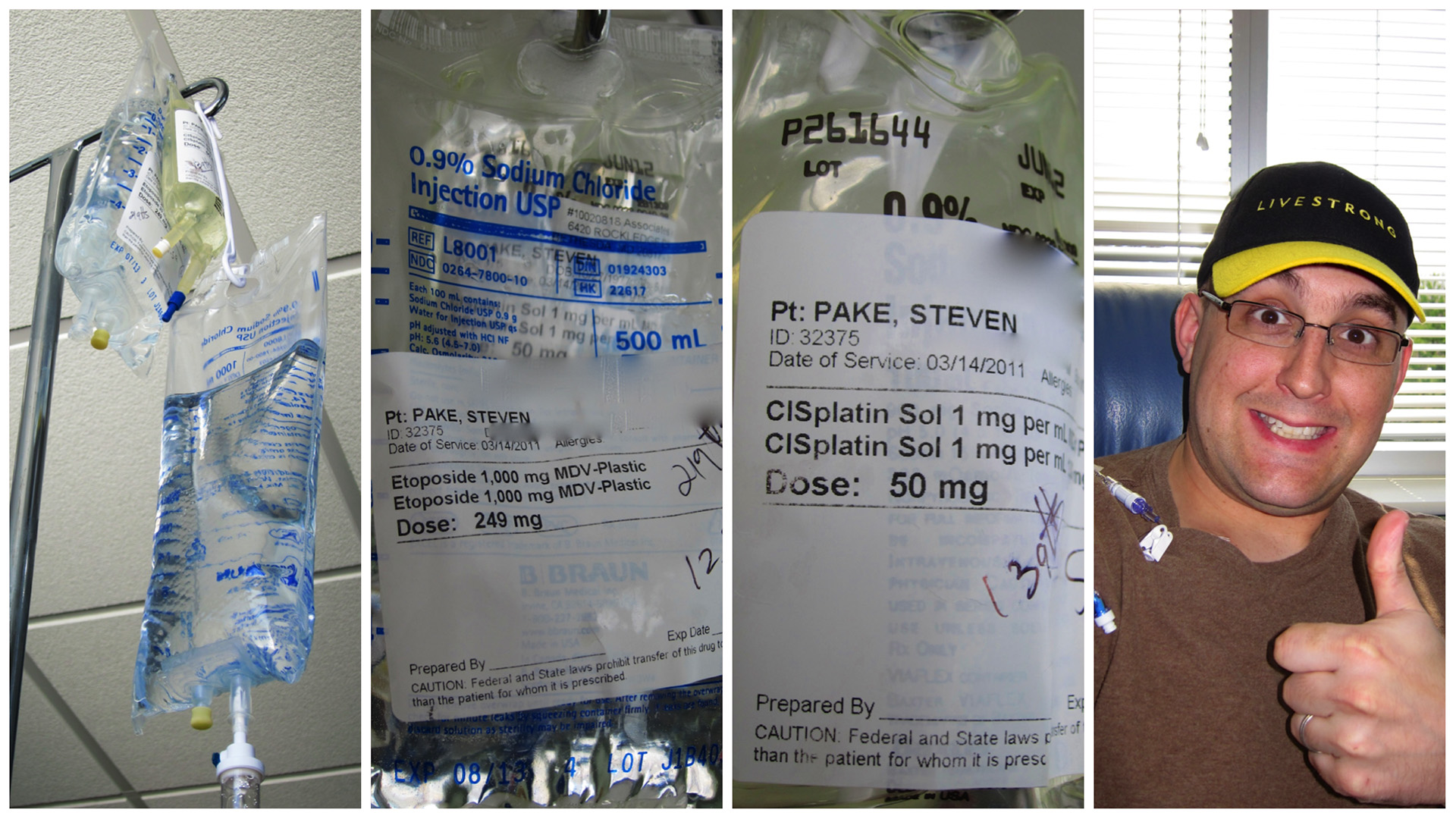
My chemo cocktail, Etoposide and Cisplatin for my first round of EPx4, March 2011. Yum yum!!
Testicular cancer is a pretty fast and aggressive type of cancer that can quickly overrun your entire body, but can also be cured completely if it's hit hard and fast. Chemotherapy protocols for testicular cancer are no joke. I'm now casually recalling the movie 'Star Trek IV - The Voyage Home' when Doctor McCoy gives the ailing patient in that San Francisco hospital a pill that miraculously fixed their failing kidneys. I wish it was, but it ain't like that!! The drugs of Cisplatin,Etoposide, and especially Bleomycin that many of us are familiar with are all very serious drugs. There are numerous warning labels right on the bags, and oncology nursing staff handle them with masks on under vented hoods for good reason! They certainly do an awesome job of killing cancer, but they're really not kidding when you read the datasheets for these drugs and look at the potential side-effects that can become long-term or permanent issues. Anybody facing chemotherapy after a testicular cancer diagnosis would be well advised to look at the potential side-effects and risk factors of these drugs, and evaluate them against your personal and family medical history with your oncologist. I did EPx4, and I can personally check the boxes for kidney damage, nerve damage and peripheral neuropathy, and muscle fatigue among other things, along with fertility loss from my RPLND surgery. There's increased risk of developing leukemia with the EPx4 protocol, as well. Potential risks with Bleomycin for the more mainstream BEPx3 protocol are blood vessel damage and Raynaud's, increased risk of heart disease, and potentially nasty effects to your lungs. It's rare, but there are cases of people having beaten testicular cancer, only to end up dying from complications due to Bleomycin. It's not uncommon to hear about cases for people with advanced stage disease who started with BEPx4, but ended up doing BEPx3 + EPx1 either due to complications from Bleomycin (drop in lung function, other severe side effects), or due to getting a good response and just to spare them from the additional Bleo exposure. These drugs are no joke!
In my case, I might have been able to avoid much of what I went through if only I were more aware of Testicular Cancer. I started having strange pains in my right testicle two months prior to my diagnosis, but passed it off until the pain finally got so bad that I couldn't even sleep at night. I had not even considered the possibility that this could have been cancer when symptoms were first noticed, because I simply wasn't aware of the disease. Had I checked myself into my primary care provider earlier, I might have been able to catch my cancer at Stage I rather than Stage II, and avoided much of the physical trauma to my body in the process of fighting cancer. And for others, it could mean the difference between life and death! I personally have fought off depression and have had PTSD flashback episodes from my chemotherapy experience that have played back in my head like the trailer for some horror flick, and the same for my RPLND experience. It's not just physical trauma that our bodies experience while going through our treatments, but emotional trauma as well. I certainly could do without such terrible memories of this hell that I've been through.
About the only thing that was more fun than any of this stuff was the Magnesium Citrate that I had to take before the RPLND surgery for "bowel cleansing". It didn't just cleanse my bowels before surgery, but during and for long after as well! It was the gift that kept on giving, but at least the effects were temporary. The havoc wreaked and damage done by the chemotherapy drugs can stick with you forever!

This stuff gave me diarrhea every 2 hours for 36 hours straight, AFTER my RPLND surgery. They thought it was Clostridium difficile aka "C. diff" but nope, just this stuff continuing to work its "magic".
It's by far the most important thing to simply survive cancer and to be a "1" on that spreadsheet as opposed to a "0", and it's certainly important to find the most cost-effective ways of treating and fighting cancer as well in order to extend our limited resources to as many people as possible. But early detection is also important for minimizing impact to quality of life after your fight with cancer and during cancer survivorship. Harsh treatments that weren't needed because a cancer was caught early can't traumatize your body. They can't traumatize your mind. They can't leave you with permanent and lasting side-effects. And they can't rob you of your fertility. If you manage to catch testicular cancer at Stage I and are able to just do surveillance, it doesn't mean that you won't still struggle because I know people who have. We all do in some way. But the less you have to go through to get that cure, the better off you're going to be down the road both physically and mentally. Cancer isn't just about curing the disease, but curing the person and the soul within as well. My cancer fight was a brutal 5 month affair that spanned from February through June 2011, but it wasn't until December of 2013, nearly two and a half years after my treatments ended, until my soul was finally cured of cancer too. As TCAF Founder Kim Jones put it, what comes after your cancer fight really is a "fight for survivorship".
I've made peace with all that my body has been through, and have accepted and know how to manage the various bodily dysfunction and limitations that I have after my caner fight, including having accepted the loss of my fertility. And I've made all of the significant mental adjustments that I've needed to make as far as my approach to life and my attitude as well, but none of this could ever be considered easy. I want the next me and the next you to have a much easier time with this, and spreading awareness about testicular cancer and how to do proper self-exams is exactly the way to go about achieving that. We can't prevent testicular cancer, and what exactly causes it is not even understood yet. So no matter which way you look at things, the earliest possible detection of testicular cancer when it does develop remains the key. It gives you the best possible shot at beating the disease, it minimizes the cost of treatment, and helps to minimize impact to quality of life during survivorship. A testicular self-exam takes less than a minute and is something that should be done at every annual physical, and can and should be done via self-exam once per month. The cost is practically zero. This knowledge and practice is the first line of defense against the most common form of cancer among men aged 15-35, and is hardly something that should be avoided. There's nothing to lose by spreading Awareness about Testicular Cancer and encouraging the practice of Self-Exams. It's a Win-Win-Win.

What I wish had been hanging in my shower in December of 2010, when I first noticed symptoms but ignored them.
StevePake.com