
Negotiating Surveillance and Long-Term Follow-up for Testicular Cancer
The National Comprehensive Cancer Network (NCCN) Guidelines for are the bible by which Testicular Cancer patients are treated and managed. The follow-up care recommendations within these guidelines only goes out to 5 years, and even within those 5 years, there's been some significant adjustments to the recommendations over time. It's entirely possible that if you were diagnosed with testicular cancer within the past few years, that you might be able to make some adjustments to your follow-up schedules in favor of fewer scans or appointments, but what do you do after that? It's up to you and can go on a case-by-case basis. Here are some answers.
The National Comprehensive Cancer Network (NCCN) Guidelines are the bible by which Testicular Cancer patients are treated and managed. The follow-up care recommendations within these guidelines only goes out to 5 years, and even within those 5 years, there's been some significant adjustments to the recommendations over time. It's entirely possible that if you were diagnosed with testicular cancer within the past few years, that you might be able to make some adjustments to your follow-up schedules in favor of fewer scans or appointments, but what do you do after that? It's up to you and can go on a case-by-case basis. Here are some answers.
Changes to NCCN Follow-Up Recommendations Within Years 1-5

The NCCN Guidelines are literally the most important guide for any cancer fighter or survivor to have, and the bible by which doctors should be treating their patients.
First off, there have been many, many changes to the NCCN follow-up recommendations since I was diagnosed with testicular cancer in 2011, and the latest testicular cancer guidelines (2-2017 as of this writing) states that "further study is required to define optimal follow-up durations." In other words, they just don't have the evidence to know what the best answer is here. What is too much and what's too little? Scan frequency has gone down quite a bit to minimize the risk of secondary malignancies from radiation exposure, especially from CT scans, but they don't have the evidence to know where the sweet spot is, thus making these follow-up schedules very much open to debate and negotiation. Yes, your follow-up schedules for testicular cancer are negotiable.
In my case, for Stage II non-seminoma good risk disease treated with both primary chemotherapy and the RPLND surgery, the changes to the follow-up recommendations have been significant. At the time of my diagnosis in 2011, the NCCN guidelines called for as many as 20 scans (chest x-rays) and follow-up appointments over 5 years. I was seen at Memorial Sloan Kettering Cancer Center (MSKCC) in New York who went above and beyond the guidelines, and I had a total of 27 chest x-rays over the years, with 18 of those coming in the first two years alone. Given I had the RPLND surgery, only one CT scan was needed 4 months post-op, and otherwise just chest x-rays for me.
As of 2017, how many scans are recommended by the NCCN guidelines for someone like me now?
SEVEN.
Just 7, with 8th and 9th scans in Years 3 and 4 being optional, and no scans at all in Year 5. Granted, I'd still need a total of about 16 office visits, but that's still a whole lot less stressful than twenty-freaking-seven. When I first saw how significantly the NCCN follow-up recommendations had changed and how many fewer scans they were recommending these days, I about fell out of my chair, and then needed to go sulk in a corner for awhile. This is really great news, as it shows that, yes, treatments for testicular cancer really are highly effective and completely curative most of the time, and that there really isn't a whole lot to be afraid of, despite the unavoidable and unimaginable amounts of worrying that it brings patients. Most people are just fine after treatments. Thanks to our collective piles of chest x-rays and CT scans that have never shown anything for most over the years, testicular cancer survivors will have far fewer scans to worry about after treatments today, and that's a very good thing.
Making Mid-Course Surveillance Schedule adjustments
A part of me regrets not questioning so many scans, especially now that not even a third of those scans are required today, but that's water under the bridge at this point. It wasn't easy, to put it mildly, but I got through them all. If you were diagnosed with testicular cancer a few years ago, there's a chance that you might still be on a more scan-heavy schedule. If so, you might be able to modernize your follow-up schedule after review with your doctors. Here's what you can do:
- Download the latest NCCN guidelines by registering for free at the NCCN website. Navigate to the Guidelines section, then to Cancer by Site, and then Testicular Cancer to get to them. Find the follow-up table that's relevant for your cancer about midway through the document based on type (seminoma or non-seminoma), and then stage, treatment path, and level of treatment received, and pay close attention to the super-scripted notes. Review what the current follow-up recommendations are now, against what you're actually doing. It might be quite different.
- Review With Your Doctor. With how many scans they've pulled from the follow-up schedules in recent years, chances are you might not need nearly as many now, or perhaps you could just do chest x-rays for scans and skip any further CT scans at this point, followed by the usual history and physical, and blood tumor marker checks? No more CT scans, wouldn't that be nice? If you look very closely in the guidelines you'll also see that scrotal ultrasounds are now mentioned as well. Sound like something worth doing? It was for me, and I'll get to that below.
- Do What's Best For You, with Your Doctor's Blessing. Whether you're at the point of cutting yourself free from oncology care if you so choose, or are making mid-course corrections between 1-5 years out, do what's right for you, so long as your doctors are on-board with your plan. There's both "scanxiety" from the follow-up appointments, but also anxiety from not having them. I don't know of a single person that actually enjoys getting CT scans done, but some might have more anxiety without them. Be true to yourself and your needs. If you're struggling, it can be worth it to make adjustments, and still meet the standards for care.
Of course, now that I've made it through 5 years and twenty-seven freaking scans, I have the moment of revelation that maybe I should have asked more questions than I did, but most of these scans were in the first two years, and before the NCCN started pulling back on the number of scans required. What's done is done, and I'm happy to have exited my 5 years of active surveillance.
How To Make Your Post 5 Year Follow-Up Plan
So, what to do after 5 years? Here's what I did.
You're the patient, you're the boss. You can do whatever you want to do after 5 years. If you feel like you're ready, you can opt to be formally discharged from oncology care, or if not, you can continue to be seen at whatever interval you're comfortable with. Your doctor will be more than happy to keep seeing you. It's up to you, and there's no right or wrong answer. The correct answer is whatever you're comfortable doing, with considerations for any specifics of your case, and that your doctors are on-board with.
For me, with good risk disease, primary chemotherapy and the RPLND which most people in my risk classification tend to skip, I just needed to be cut free. If I'd only had 7 to 9 scans and a dozen and change office visits over the years as opposed to 27 of them, maybe I'd still want annual follow-ups with my oncologist. Maybe I'd still want annual follow-ups had I skipped the RPLND, and I'm quite certain I'd still want them were I in a higher risk group. Instead, I've found myself totally and completely burned out emotionally from so many oncology office visits, and I just didn't want to have to keep going if there was no compelling reason to do so. I love my oncologist and he's a great guy, and my favorite oncology nurse (hello Trish!) has become a friend for life type with me, but I just needed to walk out of that office for once without another appointment scheduled. I really needed that like nothing else, otherwise everything would just keep perpetuating in my mind. I needed the closure of not having to go back, and so we developed a plan that supported that.
The first condition for my formal discharge from oncology care, both from my wife and from my oncologist, was the insistence that I have an annual physical exam done by my primary care every year. No problem there, and cancer survivors especially should have these done annually as it is. Next up, scans or no scans? For my stage of disease and level of treatments, one is more likely to see a false positive from a chest x-ray at this point than disease recurrence, and so I opted out of any more chest x-rays. I think 27 has been more than enough. Although my tumor markers (bHCG and AFP) had always been negative and resulting blood work not that useful, I elected to continue doing these. You're having blood work done at an annual physical anyways, so why not throw it in? Continuing with these tests are useful for catching a potential second primary testicular carcinoma that might have a slightly different signature, and that could be positive for these markers.
Testicular Ultrasounds. This is something that I'd highly recommend doing for every testicular cancer survivor out there at least annually. Testicular ultrasounds weren't in the NCCN guidelines when I was diagnosed with testicular cancer back in 2011 other than for initial workup, but they're included now for follow-up care as well, for obvious reasons. As with the above, testicular cancer survivors are at elevated risk for developing testicular cancer again on the other side versus the general population. If anything was ever going to catch this early, and give a heads-up that something is going on before there were symptoms or other signs, a testicular ultrasound is what could do it, and so this was a no-brainer thing to do.
Do a full hormone panel. It's not mentioned anywhere in NCCN, and not something that oncologists ever really pay much attention to, but get a full hormone panel done. Despite what doctors say about the other testicle "picking up the slack", there is literally no information out there to support that, and we survivors know very well that this isn't necessarily true. It's a given that we're far more likely to face hormonal issues as we age due to only having a single testicle. Almost nothing is known about male hormones, and we're pretty much on our own here. The more data points we have on ourselves, the easier it will be in the future to know what's going on, if and when hormonal issues do develop.
Why a full hormone panel and not just a testosterone level check? Some long-term testicular cancer survivors who are symptomatic of hypogonadism are finding not that their testosterone levels are too low, but rather that their estrogen levels are too high, and have had some success in being treated with estrogen inhibitors, rather than testosterone replacement therapies. Please note that this is all highly experimental reports from individuals within the testicular cancer community, and not from official studies, of which there are none to go on. The point is, just start collecting as much hormonal data about yourselves as you can now, as it will potentially be very useful later.
STICK WITH YOUR PLAN
Honor yourself, the doctors and nurses that helped you through your cancer treatments, and your family and friends that have been there for you as well, by sticking with whatever your agreed upon plan is. After the hell that so many of our bodies have been through fighting cancer, and the significant emotional investments made by so many supporting us, we owe it to ourselves to do everything we possibly can to maintain the best possible health for ourselves going forward. A big part of that is having an annual physical done, and should be a part of every cancer surveillance exit plan.
I'm happy to say that I just had my annual physical, and that it went very well. My cholesterol, HDL/LDL levels and ratio were all good, as was my blood pressure and fasting glucose levels. A few things that have been messed up since fighting cancer are still messed up, but stable. My creatinine levels have been 1.4-1.6 since cancer (normal was around 1.0 before), due to some damage to my left kidney sustained from chemotherapy, and then a complication from the RPLND surgery didn't help it out at all. My platelet levels also run low at around 100, which is due to some permanent bone marrow damage also due to chemotherapy. None of that has changed in years, and it's good to know that.
One thing in my CBC report has tracked a bit high, but that's always correlated with my weight, and I've vowed this year to finally lose every last "cancer pound" I'd ever gained. Before cancer, I was around 240-250 pounds, which was considered to be a good weight for me considering my significant height of 6'3", and my large frame. Because of how chemotherapy, steroids, and surgeries had all affected me while fighting cancer, I ballooned all the way up to 300 pounds as I exited MSKCC in New York after my RPLND surgery. Due to chronic post-cancer fatigue from chemotherapy induced peripheral neuropathy, I could never exercise hard enough in my first few years after cancer to burn that off. My weight has floated around 270 pounds for the past few years, but running helped me to get beyond my fatigue issues, and there's no excuse anymore.
I refuse to turn 40 later this year in anything other than the best shape of my life. When we Scorpios commit to something, we're either all-in 110% or don't bother, and so I'm all in with a gym membership and regular exercise, a strict diet and paleo foods, and all that. This will happen. Turning 40 will be the start of a new era and decade for me, and this baggage from cancer, including the residual flab on my sides, is not going to be a part of that.
At the time I walked out of my oncologist's office for hopefully the last time ever back in June of 2016 (knocking on wood), I wasn't able to really feel or appreciate that moment at the time due to so many other things going on in our lives. As I'm typing this now, over a half year later, I'm finally feeling that emotional release and tears of joy from this for the first time, and the relief of such an enormous burden in my life having been lifted.
I just couldn't accept having to keep seeing an oncologist every year for the rest of my life. I've finally made it. I know how quickly things can change, and am going to keep living my life exactly how I've learned to LIVE it after cancer, but this is done now.
I'm finally free, and I can't wait to see so many friends and connections I've made in the testicular cancer community finally reach this huge milestone, too.
StevePake.com


"Testicular Cancer Wasn't That Bad?"
I'm amused that the ink has hardly dried on my last blog titled "There Is No Easy Cancer," only to now see an article over at GQ titled, "I Had Testicular Cancer and It Wasn't That Bad." Oh my...

March 2011, sick as a dog after my first round of chemotherapy. Look, I still had eyebrows too!
I'm amused that the ink has hardly dried on my last blog titled "There Is No Easy Cancer," only to now see an article over at GQ titled, "I Had Testicular Cancer and It Wasn't That Bad." Oh my...
I applaud Jason Kessler, who wrote the story, for being open about his cancer experience, and that his treatments including the orchiectomy and BEPx3 chemotherapy weren't overly rough on him. It's actually encouraging for people to know that yes, you can and will get through this, except that the "end" of his story is getting a clear CT scan a month after his chemotherapy had ended. One of the biggest lessons that I've learned in nearly five years of having survived a Stage II testicular cancer very similar to Mr. Kessler's, is that the end of our cancer fights are really just the beginning of our journeys. As I look back on these five years, it's so clear that fighting my cancer was the easy part - everything that came after was so much harder.
Cancer survivorship is a rude awakening for so many of us. As I wrote in "Cancer Survivorship - The Fight After the Fight," there were so many new things that I had to deal with for the first time after cancer, that I was simply unprepared to even know how to handle. I developed secondary health and severe pain issues from the harsh treatments my body had to endure. There was so much anxiety about countless follow-up scans, I've suffered from depression and post-traumatic stress, issues with testosterone levels that were swinging back and forth, terrible muscle fatigue issues, and on and on. I too had almost thought that maybe what I went through wasn't so bad at one point a year after my cancer fight, but I unknowingly had kept all of my fears and emotions about everything bottled up inside of me. It wasn't until nearly two years later that the dam had burst, and all of this finally started processing. And when it did, it hit me like a load of bricks.
All of the uncertainty, and my life constantly being up in the air every other month with the latest round of scans and blood work, broke me as a person. I couldn't live like that anymore, and had to learn how to live my life all over again. This doesn't happen overnight. It's only now that I'm about to reach nearly five years out since cancer entered my life, that I finally feel like my life really has moved on after cancer. For many, cancer survivorship isn't an easy ride even with a so-called "easy" cancer like testicular cancer. There is no easy cancer.
A word of caution is also needed about medical marijuana usage, as marijuana use can also elevate the HCG testicular cancer marker in men. I've run across a few people over the years in total freak out mode that their HCG levels came back elevated on surveillance blood work. They had been in tears thinking their cancers had returned, unaware of the possibility of this marker being elevated due to marijuana usage. It's not a good situation to be in at all. I'm actually a proponent of legalized and/or medical use for marijuana. There's something to be said about medical marijuana usage and its ability to relieve certain side-effects both during and after fighting cancer, but one needs to be aware of this possibility in the context of a discussion about testicular cancer!
There's also no guarantee that one will feel any pain if they have testicular cancer, either. You're not necessarily just going to know! You're lucky if you do, as both I and Mr. Kessler were, because it means you can catch it at an earlier stage. Testicular cancer can be a silent killer, overrunning your entire body with no symptoms at all for months, until you suddenly find yourself in the ER one day coughing up blood, or with other bizarre symptoms due to organs starting to shut down! They don't even wait to do the orchiectomy or pathology in many of these cases. They start you on chemotherapy that day, because you might not have another day left! Plenty of advanced stage testicular cancer patients never had any pain to clue them off, and this is why awareness of the disease, and testicular self-exams are so important. Pain in a testicle isn't a sure thing, but you might be able to detect an abnormal lump on your own. There are also testicular cancer cases that are extragonadal, and don't even start in the testicles at all. It's not nearly as simple as Mr. Kessler made things out to be.
I genuinely pray that Mr. Kessler has a smooth and easy ride through his survivorship years. God bless him if he does, but he would be in a slim and incredibly fortunate minority. I know quite a few testicular cancer survivors, and so many of us are blindsided by the challenges we face in our lives after cancer. I asked a group of survivor friends for feedback on this article, and very few thought that Kessler's experience was representative of what a typical testicular cancer patient goes through, and a few thought that he was in denial about some things. One caregiver friend whose son had testicular cancer, was in tears about how dismissive the article felt in the face of what she, her son, and other friends had all been through fighting this disease.
Testicular cancer continues to be a real disease that kills real people every single day. Many have lost loved ones, husbands, fathers, and sons. For these people, seeing an article like this around the holidays while trying to get on without, is painful to say the least. For the majority of us that do survive, the high cure rates tend to be of little comfort when you're the one in the hot seat with strange pains in your body, and you're worried to death about your next set of surveillance scans. The challenges of life after cancer are not to be underestimated. Should Mr. Kessler find himself in a situation after cancer that he's completely unprepared to handle, he should know that there's a sizable community of fellow young adult cancer survivors waiting in the wings to support him through whatever he needs.
StevePake.com

There Is No Easy Cancer
On at least two occasions when I've mentioned my cancer story to new friends or acquaintances that hadn't known, I've received comments that were just short of dismissive that testicular cancer is an "easy cancer", alluding to the high cure rate. I'll be honest in saying that I haven't been offended by such comments, because I know that short of having been there in some way themselves, it's simply impossible for people to truly know what a cancer diagnosis feels like, nor all that one entails.
This is what I looked like after 5 months of hell fighting cancer and getting the massive RPLND surgery. I was all bald and bloated and disgusting feeling, having gained 30 pounds from the crazy ways in which the chemotherapy had affected my body. I had never been in more physical pain, nor more uncomfortable in my entire life, but believe it or not, this was the easy part of fighting cancer.
On at least two occasions when I've mentioned my cancer story to new friends or acquaintances that hadn't known, I've received comments that were just short of dismissive that testicular cancer is an "easy cancer", alluding to the high cure rate. I'll be honest in saying that I haven't been offended by such comments, because I know that short of having been there in some way themselves, it's simply impossible for people to truly know what a cancer diagnosis feels like, nor all that one entails.
Regardless of the type of cancer and early or late stage, the fact is, cancer turns your life upside down. Especially as young adults, we have so much of our lives left to live, and we wonder if we'll ever be able to live our hopes and dreams at all. Cancer forever casts a dark cloud over us, and it's a difficult adjustment to make when we're supposed to be brimming with optimism about our futures. There was nothing easy about the five months of toxic treatments and brutal surgeries that I had to endure, to get through my Stage II cancer. There was also nothing easy about the excruciating nerve pain and chronic muscle fatigue and weakness issues that developed, all due to the toxicity of treatments. I also suffered a loss of my fertility from a surgery that helped to cure me, which wasn't easy either. Fighting cancer left my body permanently scarred in dozens of ways.
The real scars however, were those within. It's tough to go from thinking that you have your entire life in front of you, to wondering if you're still going to be a free person, or have a life to live at all if your next round of monthly scans don't come back clear. We want to be free, and we want to know that our bodies are rid of our cancers forever, but you never really know. The uncertainty can eat you alive inside, and mental health issues such as depression are common. The anxiety about cancer tends to worsen in the years after fighting, because we live our lives constantly watching over our shoulders. We worry about every little pain in our bodies, because once you've had cancer, every such pain could mean the possibility that our cancers are back.
I became so spooked that my cancer had returned at one point, that it opened the floodgates to all of the terrible emotions that I had kept locked away when I was fighting cancer. I began suffering from post-traumatic stress, which puts the feeling of panic inside of you as though your house were on fire, except you have nowhere to go, and no avenue of escape. My body had betrayed me in the most terrible of ways, cheating on me with death at such a young age. I was terrified of living in my own skin and body. I wanted to run away from it all, but how do you run away from your own body? You can't escape it, or could you?
I was hurting so badly inside, that I contemplated suicide as a means of escape. My wife needed me. My children needed me. My family and friends needed me. I didn't do it, but I had to find a way to end this pain, and doing that wasn't easy either.
It took the support of the cancer community, some wonderful friends and mentors whom I will love for the rest of my life, the unconditional love of my wife who has never left my side, my family, and my two totally awesome children to help pull me through such a terrible ordeal. Not one single aspect of what I've been through could ever be considered easy. Everything has been hard, and I've had to reinvent myself and my life three times over since my cancer fight ended, all from an "easy" earlier stage "good risk" cancer with a 95% cure rate. A high cure rate is wonderful, but finding my way through these past five years after cancer have been the hardest five years of my life.
There is no easy cancer.
StevePake.com

Doctors Say, Keep Checking Your Nuts
In February 2015, Steven Petrow published an article in the Washington Post titled "Guys, here’s why it’s not worth testing yourself for a ‘lump’ down there", coming out against testicular self-exams (TSE) after having previously been supportive of them. What's surprising about the article is not just that such a view against testicular self-exams exists, but because Mr. Petrow himself is a twenty years and change survivor of advanced stage testicular cancer. I applaud and congratulate Mr. Petrow on reaching such a milestone. It's something that we cancer survivors take great pride in and stories like his are inspiring to so many of us, but I could not disagree more with his recommendation against TSE. Petrow thinks that it's "smarter" now to keep his hands to himself, but is it really?
In February 2015, Steven Petrow published an article in the Washington Post titled "Guys, here’s why it’s not worth testing yourself for a ‘lump’ down there", coming out against testicular self-exams (TSE) after having previously been supportive of them. His article responded to a "Today" show segment which aired late in 2014 featuring David Samadi, who is Chairman of Urology and Chief of Robotic Surgery at Lenox Hill Hospital, and is also a Fox News Medical Correspondent. On the "Today" show episode, Samadi gave testicular exams to anchors Willie Geist and Carson Daly on live television. What's surprising about the article is not just that such a view against testicular self-exams exists, but because Mr. Petrow himself is a twenty years and change survivor of advanced stage testicular cancer. I applaud and congratulate Mr. Petrow on reaching such a milestone. It's something that we cancer survivors take great pride in and stories like his are inspiring to so many of us, but I could not disagree more with his recommendation against TSE. Petrow thinks that it's "smarter" now to keep his hands to himself, but is it really?
Why Is there Even a Debate?
The original source of the recommendations against doing testicular self-exams comes not from Petrow, but rather from the US Preventive Services Task Force (USPSTF). The USPSTF recommended against testicular self-exams back in 2012, citing "moderate or high certainty that the service has no net benefit or that the harms outweigh the benefits". In his article, Petrow spoke with Kenny Lin, assistant professor of family medicine at Georgetown University Medical Center, who agreed. Lin said that even if self-exams were effective, that they'd have "little if any bearing on outcomes for those who are diagnosed." Lin went on to say that he thought the "Today" show episode was "a stunt cloaked as a health message." Petrow went through a brief discussion of benefits vs harm, but couldn't seem to find any benefits at all for the TSE. Much of the rest of the piece then focused on psychological biases as to why doctors (and patients) would still want such screenings despite there being "no benefits". Well, maybe they're looking at things the wrong way.
Problems with the Recommendation Against TSEs
One of the biggest problems with Petrow's article is the fact that no matter which type of cancer he was discussing, there was no mention whatsoever of cancer survivorship quality of life, or the overall wellness of a patient after cancer. He only looked at "surviving" cancer from the singular perspective of the net final outcome - whether the patient lived or died in the end. Because the "final outcome" isn't likely to change, don't bother with screenings or self-exams, goes this line of logic. If you get cancer, just go get chemotherapy or radiation, or whatever it is that you need, and get cured. As I wrote in my own lengthy blog post on this exact topic in June of 2014 titled, "The Value of Testicular Self-Exams and Early Detection from the Survivorship Perspective" this is a woefully incomplete, and dare I say even irresponsible perspective. We're so much more than just a binary "1" or "0" on someone's spreadsheet on whether we're alive or dead. We're very much analog creatures, and cancer survivorship itself is a million shades of gray.
Petrow stated in the article that he went through 4 rounds of chemotherapy and two surgeries to get cured, but didn't mention what, if any, long-term or possibly permanent side-effects he might have suffered as a result of this. As I wrote in my own blog last year, the potential for long-term health risks and permanent side effects when going through treatments for cancer are not to be underestimated. I've suffered a complete loss of fertility, for starters. Not having much if any feeling in my left foot is more minor and something that I've gotten used to over time, but more severe is the fact that I also suffer from chemo-induced peripheral neuropathy. I deal with chronic muscle fatigue issues to varying degrees every single day, and continue to have nerve pain issues that have never really gone away completely. Even after my cancer fight was over, I still had to keep fighting because one of my kidneys nearly failed due to a complication from the RPLND surgery that I went through. It took another year after my cancer fight, and tons of painful diagnostic procedures and stents to finally nurse my body and my kidney back to health. Even more troubling are the increased risks of developing a secondary cancer just from having been exposed to chemotherapy agents and/or radiation treatments. Patients who are exposed to either chemotherapy or radiation therapy have a two-fold increased risk of developing a secondary cancer compared to the general population, and a three-fold increased risk if a patient has been exposed to both types of treatments, according to studies. Mental health is also at stake. After fighting so hard, my mind eventually caught up with all that I and my body had been through, and I fell into a depression and suffered from post-traumatic stress for a year.
Testicular cancer tends to hit younger men, like myself, who have so much of their lives in front of them. They're going to have to live with these potential long-term side-effects of treatments for quite a long time, which is why it's so important to detect testicular cancer as early as possible. The earliest possible detection of cancer helps to minimize the amount of treatment needed, the potential trauma to both mind and body, and helps to maximize quality of life after cancer. It's important to be a "1" on that spreadsheet and to survive, but we can't take our eye completely off of the ball when it comes to the impact on quality of life that cancer treatments can have. Why would you not want to detect a cancer as early as you can via something as simple as awareness of the disease itself, and a virtually zero cost TSE? Is it really in the best interests of the general population to have people darn near on their death beds before being properly diagnosed? It doesn't make sense. Especially with testicular cancer, a rapidly advancing cancer, a pain or mass detected in the testicle via a TSE might be the only sign of testicular cancer one has before its had the opportunity to completely overrun one's body. This is why testicular cancer is sometimes referred to as the silent killer!
What Some Experts Really Think
One really needs to understand what's behind these USPSTF recommendations against many types of screenings. A trip across the Beltway and up the Baltimore-Washington Parkway from Georgetown, is The Johns Hopkins University in Baltimore. Philip M. Pierorazio is an Assistant Professor of Urology and Oncology at the Brady Urological Institute there, and Director of the Division of Testis Cancer (Pierorazio is also a member of the TCAF board of directors). Pierorazio weighed in on the USPSTF recommendations on his own blog in a piece titled "Testicular Self-Exam: Why There Is Nothing Wrong with a Regular Feel". He writes,
"It has to be conceded that there is no evidence that TSE is effective for the diagnosis of testicular cancer or helps find men at an earlier stage of disease. However, lack of evidence does not mean that TSE is not effective – it means that no study has effectively investigated the role of TSE in an at-risk population." Dr. Phil Pierorazio
In his summary, Pierorazio respectfully disagreed with the USPSTF recommendations, stating that the recommendations are themselves based on very little existing evidence. "While the cure rate of testicular cancer is wonderful, the burden of the disease is greatly under-appreciated. Even if a free, painless self-examination leads to an unnecessary doctor's visit, saving one man from advanced disease is well worth the "risks and costs" of TSE.", concluded Pierorazio. In case you didn't follow, the issue is simply that there just hasn't been a formal study done to prove the effectiveness of TSE. It doesn't mean that they don't work or aren't effective. It just hasn't been proven that they're effective via a study. Thus, in the absence of a formal study either proving or disproving effectiveness, the USPSTF recommendation to "discourage the use" of the TSE is based on very little evidence as well!
I had a chance to speak with David Samadi personally on Petrow's article, and that "Today" show segment. Samadi shared the sentiments of Pierorazio and myself but in a slightly more vocal manner, stating that he felt the USPSTF recommendations against the TSE and screenings for other types of cancers were "a terrible mistake". While some of these screenings might not be perfect, he and others believe they're still effective tools that can change the final outcomes for patients, and that it's always better to catch a cancer at an earlier stage to minimize the treatments needed to cure a patient. I shared my personal story with Samadi, and that I had missed being able to pickup on my symptoms of testicular cancer for a few months. If only I had been more aware of the disease and how to do a proper TSE, I potentially could have caught my cancer at an earlier stage, and spared my body and my mind from the harsh treatments that were needed for me to get that cure. Samadi's response? "Exactly." Samadi went on to say in a statement.
"Given how common testicular cancer is in young men, we should be urging them to perform monthly self-exams. Young women are encouraged to perform monthly self-breast exams. Why shouldn’t men? Early detection begins with the patient. If he is aware of the risk factors, he will care about prevention. Self-exams are a no cost prevention method and if something is discovered, a simple ultrasound can tell us what’s happening." - Dr. David Samadi
I agree with that this is a double-standard, and had mentioned it myself. Women are encouraged to get to know the shape and feel of their breasts, but men are supposed to keep their hands off of their balls?
There's no finer authority on testicular cancer anywhere in the world than Lawrence Einhorn, a Distinguished Professor of Medicine and Lance Armstrong Professor of Medicine at the Indiana University. "Einhorn" is a household name in the oncology world, and a man who needs no introduction. Einhorn's work at Indiana University 40 years ago experimenting with the Cisplatin drug is what turned testicular cancer from a death sentence into the greatest success story in modern oncology, having been compared with walking on the moon! Einhorn's work has literally saved the lives of hundreds of thousands of men with testicular cancer, my own included. I reached out to Dr. Einhorn and asked if he could weigh in on the USPSTF recommendations against the TSE, asking if "men should really be discouraged from doing testicular self-exams?" Einhorn's response? "Not really." He went on to express skepticism on the effectiveness of a national policy for TSEs, citing the low overall incidence rate of testicular cancer, but he couldn't have been more clear on the importance of knowledge and awareness of the disease.
"Men should be aware there is cancer that can start in the testis and the presence of pain or a feeling of firmness in the testis should not be ignored", stated Dr. Einhorn.
I don't think there's a finer endorsement to be had on the topic of testicular cancer awareness and the TSE than from Dr. Einhorn. Men need to be educated and aware of the possibility of testicular cancer, and how to properly feel for any abnormalities via a TSE!

Move Forward With Education & Awareness, Not Backwards with FUD
The solution to the potential downsides of TSEs, such as the cost of false positives and fear and anxiety, is not to forego TSEs altogether, but rather to help minimize them with education and awareness. This is precisely what organizations like The Testicular Cancer Awareness Foundation are all about. We teach people about the signs and symptoms of testicular cancer, which will help men of all ages to understand what to look out for. Knowledge of how to do a proper testicular self-exam will help to familiarize them with their own anatomy, and establish the difference between normal and abnormal. Knowing all of this can help to minimize unnecessary office visits and expense, and cut down on stress and anxiety.
As for the true costs when an office visit is needed, Pierorazio weighed in on this in his blog also, citing a University of Kansas Medical Center study. The cost to treat an advanced stage testicular cancer with both chemotherapy and the RPLND surgery is equivalent to hundreds of office visits to look at a worrisome TSE. When cancer is detected (and actual masses that are detected in the testicle are almost always cancerous), the costs to treat earlier stage cancer enabled by awareness of the disease and TSEs, is a mere fraction of the costs to treat advanced stage testicular cancer. A mass can't always be detected in the testicle by self-exam in testicular cancer patients (a proper study on the TSE would help to better understand this), but in my case I did, and I wished I had given it a proper feel a few months earlier when it would have been at an earlier stage. Instead, my cancer advanced for several months to the point that I had to be treated with both chemotherapy and the RPLND surgery, and at great cost both in terms of the dollars required, and the impact to my body. A few ultrasounds that turn out negative are a drop in the bucket.
The "Cost" of Getting to a Doctor Too Late When It's Cancer
If there's one thing that I think most all of us could agree with Petrow on wholeheartedly, it's the fact that many men, and especially young men and boys, can be just plain shy or too embarrassed to talk about potential issues with their bodies when they notice them. In Petrow's article, he shared the story of one of his own doctors, who developed a case of hemorrhoids. Even his doctor was embarrassed, and delayed getting it checked out. Samadi would agree with the reluctance of men to go see doctors as well, and says it's not men but rather women who end up being the ones who finally get men into his office. "If you want a job done right, you give it to a woman,” said Samadi in a Forbes article. "Women are the most proactive healthcare champions in the family and are the driving force in men’s health. Time and again, it’s women who make the final push for their husbands, fathers, and brothers to come see me.” But we're talking about cancer screenings here, not hemorrhoids. The consequences of not getting to the doctor on time for what could potentially be cancer can be deadly.
In a call for comments on this topic on a testicular cancer support group, there were no shortage of comments from those who had lost loved ones, or those whose quality of life had been impacted. If only they could have picked up on the cancer sooner with either more awareness about the disease or with self-exams, maybe their loved ones might still be here, or their quality of life might not have suffered as much. In one post, Melia Elliot shared the tragic story of her son, Ben. As Ben grew into puberty he had noticed that one testicle grew larger than the other. Ben 'Googled' that this could be normal, and then never said a word to anybody. When other symptoms started to appear, a sign of very advanced stage testicular cancer, he was unfortunately misdiagnosed for nearly two months by doctors in their hometown of Joplin, MO, even after an ER visit and two follow-ups. It wasn't until Ben became paralyzed from the chest down that doctors finally realized that he had testicular cancer! Not trusting the doctors in Joplin to care for her son, she got Ben up to Kansas City where Peter Van Veldhuizen, who is a Professor of Internal Medicine and Director of the Hematology/Oncology Division at The University of Kansas Medical Center, started Ben on BEPx4 chemotherapy for advanced stage disease.
It turns out that I had conversed with Melia personally during this time via one of the Testicular Cancer support forums on the web. It sounded like the BEPx4 might not have been working, and I recommended that she get her son under Einhorn's care at Indiana University STAT. Ben's case sounded so dire that I insisted that she call Einhorn's office that day, and that it couldn't even wait until tomorrow. Too many mistakes had already been made prior to Ben's diagnosis, and too much time had already been lost. She made the call to Einhorn's office immediately, and Ben was rushed to get started on high-dose chemotherapy with stem-cell transplant under Van Veldhuizen's care and with Einhorn's guidance. Melia stated to me in a comment that the quality of care between Van Veldhuizen and Einhorn was exemplary, but it was just too late. Ben fought a hard and courageous battle, but died tragically 10 months from his diagnosis.
Testicular cancer is curable, but it's also a killer! Someone dies of the disease every day, and on that day it was Ben. Early detection remains the key, and knowledge and awareness about testicular cancer is so important, especially with teenage boys!
Guys, Keep Checking Your Nuts
Pierorazio's statement bears repeating. "lack of evidence does not mean that TSE is not effective – it means that no study has effectively investigated the role of TSE in an at-risk population." The recommendations by the USPSTF are themselves based on very little existing evidence. When prominent doctors with expertise specifically in testicular cancer continue to believe in the TSE despite what the USPSTF has said, I think the message is pretty clear.
All of us in the Testicular Cancer advocacy world know what the true "cost" is when you're too late. For Melia Elliot and her son Ben, the price was far too great. Samadi sums things up well in his bottom line. "Encouraging men to be more aware and preventive when it comes to common cancers could be the only chance we have to save their lives.” Women especially know just how stubborn men can be. Along with Dr. Samadi, we encourage women to be proactive and get involved in men's health issues. Take the #SamadiChallenge for Testicular Cancer and make sure that the men in your lives including your children are aware of men's health issues that could affect them, encourage them to perform self-exams, and seek the care of a doctor immediately if they notice something abnormal. And most of all...
Keep checking your nuts!
The doctors who really know Testicular Cancer say to.
StevePake.com
Special thanks to Melia Elliot for her willingness to share the story of her son, Ben. Ben passed away on August 22, 2014.

The Value of Testicular Self-Exams and Early Detection from the Survivorship Perspective
There’s been some debate in recent years about the true value and effectiveness of certain types of cancer screenings.
There’s been some debate in recent years about the true value and effectiveness of certain types of cancer screenings. This is, of course, a perfectly reasonable thing to be doing both in the name of advancing medical science, and especially in an environment where there's so much downward pressure on the costs of healthcare. One of the types of cancer screenings that has been discussed are for testicular exams, and it's been surprising to so many of us in the testicular cancer community to hear that screenings for testicular cancer have actually come back as not recommended or not worth it by some prominent organizations. Consumer Reports magazine even gave the testicular cancer screening one of their infamous little solid black dots, as if it were bad for you and something to avoid! The rationale is that because testicular cancer has such a high cure rate even in advanced stages, that overall survival rates don’t budge significantly whether the cancer is detected early or late. Furthermore, not everybody who is diagnosed with testicular cancer will be able to detect any irregularities in their testicles, which can make it a bit of a hit or miss type of test. So don't worry about testicular exams, some say. If you’re diagnosed with testicular cancer, just go get chemotherapy or radiation treatment or surgery or whatever it is that you need, and get cured.
All of this is perfectly fine and rational from a business and financial analyst perspective, but is completely cold and missing the human cancer survivor perspective on this. We're so much more than just a binary "1" or "0" on someone's spreadsheet on whether we're alive or dead. We're very much analog creatures, and cancer survivorship itself is a million shades of gray. And I have to say, I personally was just a little bit taken aback and offended by the nonchalant manner in which I saw Dr. John Santa, Director of Consumer Reports Health Ratings Center, describing how curable testicular cancer was at any stage, to not worry about self-exams or screening, and to just go get chemo if you're diagnosed with testicular cancer on the Dr. Oz show last year. It made for good TV, and I could sense some pride in Dr. Santa's voice and body language when talking about how curable testicular cancer is these days, as TC is indeed one of the great victories in modern medicine. But it's still a real disease and a real cancer that kills real people. Somebody is diagnosed with testicular cancer every hour in the U.S., and someone dies of it everyday. A cancer warrior brother of mine who had been diagnosed with testicular cancer around the same time as me just happened to be in hospice care and living his last days as this particular Dr. Oz show had aired. To his credit, Dr. Oz defended the practice of testicular self-exams and said he still thought they were a good idea to do, but it was as if I had been punched in the stomach to hear how curable testicular cancer was "at any stage" as my friend was dying of it. And don't believe for a minute that chemotherapy is some sort of miracle pill, and that life will go on just as it had before when it's all done, as that's hardly the case for so many.
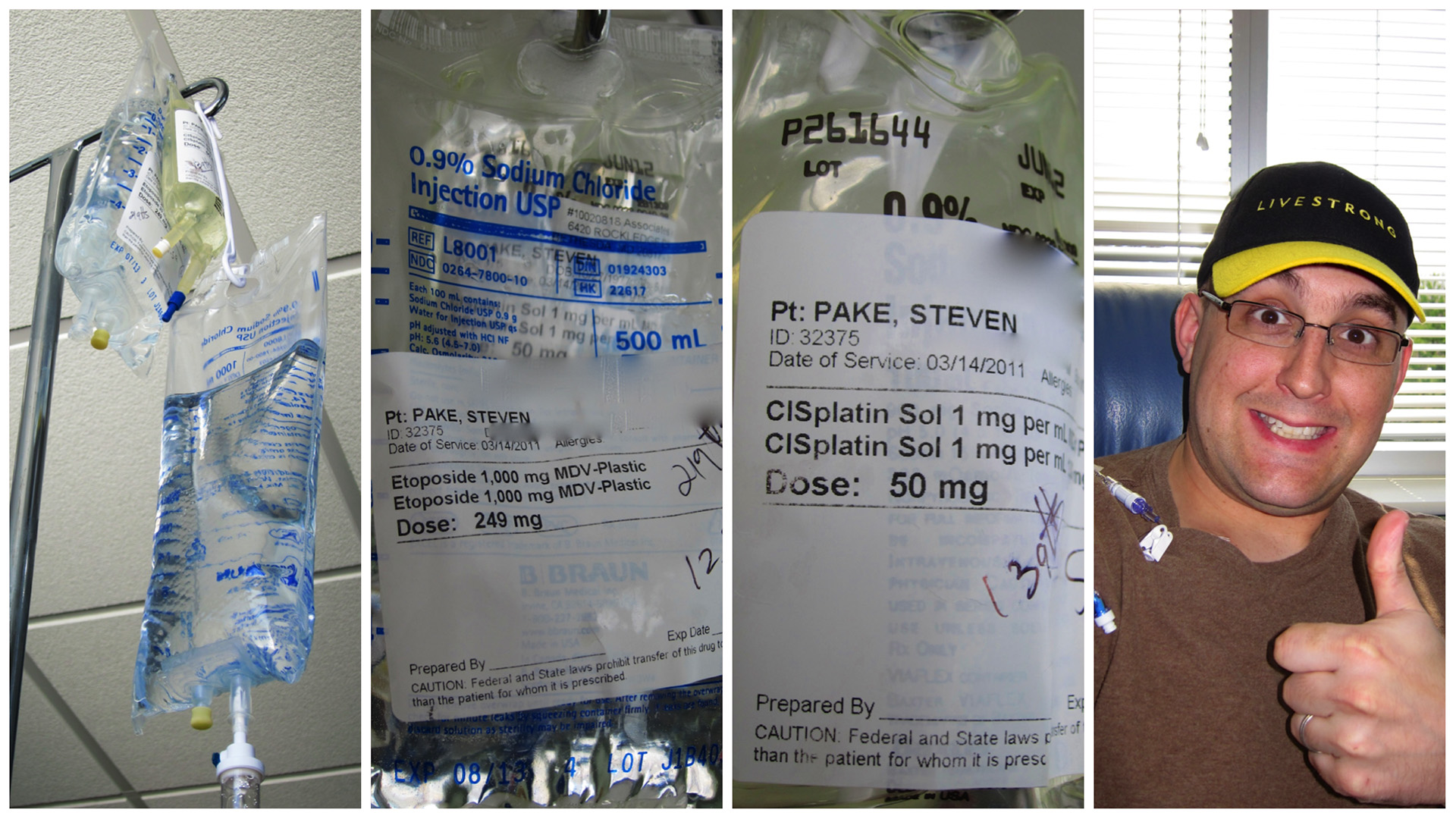
My chemo cocktail, Etoposide and Cisplatin for my first round of EPx4, March 2011. Yum yum!!
Testicular cancer is a pretty fast and aggressive type of cancer that can quickly overrun your entire body, but can also be cured completely if it's hit hard and fast. Chemotherapy protocols for testicular cancer are no joke. I'm now casually recalling the movie 'Star Trek IV - The Voyage Home' when Doctor McCoy gives the ailing patient in that San Francisco hospital a pill that miraculously fixed their failing kidneys. I wish it was, but it ain't like that!! The drugs of Cisplatin,Etoposide, and especially Bleomycin that many of us are familiar with are all very serious drugs. There are numerous warning labels right on the bags, and oncology nursing staff handle them with masks on under vented hoods for good reason! They certainly do an awesome job of killing cancer, but they're really not kidding when you read the datasheets for these drugs and look at the potential side-effects that can become long-term or permanent issues. Anybody facing chemotherapy after a testicular cancer diagnosis would be well advised to look at the potential side-effects and risk factors of these drugs, and evaluate them against your personal and family medical history with your oncologist. I did EPx4, and I can personally check the boxes for kidney damage, nerve damage and peripheral neuropathy, and muscle fatigue among other things, along with fertility loss from my RPLND surgery. There's increased risk of developing leukemia with the EPx4 protocol, as well. Potential risks with Bleomycin for the more mainstream BEPx3 protocol are blood vessel damage and Raynaud's, increased risk of heart disease, and potentially nasty effects to your lungs. It's rare, but there are cases of people having beaten testicular cancer, only to end up dying from complications due to Bleomycin. It's not uncommon to hear about cases for people with advanced stage disease who started with BEPx4, but ended up doing BEPx3 + EPx1 either due to complications from Bleomycin (drop in lung function, other severe side effects), or due to getting a good response and just to spare them from the additional Bleo exposure. These drugs are no joke!
In my case, I might have been able to avoid much of what I went through if only I were more aware of Testicular Cancer. I started having strange pains in my right testicle two months prior to my diagnosis, but passed it off until the pain finally got so bad that I couldn't even sleep at night. I had not even considered the possibility that this could have been cancer when symptoms were first noticed, because I simply wasn't aware of the disease. Had I checked myself into my primary care provider earlier, I might have been able to catch my cancer at Stage I rather than Stage II, and avoided much of the physical trauma to my body in the process of fighting cancer. And for others, it could mean the difference between life and death! I personally have fought off depression and have had PTSD flashback episodes from my chemotherapy experience that have played back in my head like the trailer for some horror flick, and the same for my RPLND experience. It's not just physical trauma that our bodies experience while going through our treatments, but emotional trauma as well. I certainly could do without such terrible memories of this hell that I've been through.
About the only thing that was more fun than any of this stuff was the Magnesium Citrate that I had to take before the RPLND surgery for "bowel cleansing". It didn't just cleanse my bowels before surgery, but during and for long after as well! It was the gift that kept on giving, but at least the effects were temporary. The havoc wreaked and damage done by the chemotherapy drugs can stick with you forever!

This stuff gave me diarrhea every 2 hours for 36 hours straight, AFTER my RPLND surgery. They thought it was Clostridium difficile aka "C. diff" but nope, just this stuff continuing to work its "magic".
It's by far the most important thing to simply survive cancer and to be a "1" on that spreadsheet as opposed to a "0", and it's certainly important to find the most cost-effective ways of treating and fighting cancer as well in order to extend our limited resources to as many people as possible. But early detection is also important for minimizing impact to quality of life after your fight with cancer and during cancer survivorship. Harsh treatments that weren't needed because a cancer was caught early can't traumatize your body. They can't traumatize your mind. They can't leave you with permanent and lasting side-effects. And they can't rob you of your fertility. If you manage to catch testicular cancer at Stage I and are able to just do surveillance, it doesn't mean that you won't still struggle because I know people who have. We all do in some way. But the less you have to go through to get that cure, the better off you're going to be down the road both physically and mentally. Cancer isn't just about curing the disease, but curing the person and the soul within as well. My cancer fight was a brutal 5 month affair that spanned from February through June 2011, but it wasn't until December of 2013, nearly two and a half years after my treatments ended, until my soul was finally cured of cancer too. As TCAF Founder Kim Jones put it, what comes after your cancer fight really is a "fight for survivorship".
I've made peace with all that my body has been through, and have accepted and know how to manage the various bodily dysfunction and limitations that I have after my caner fight, including having accepted the loss of my fertility. And I've made all of the significant mental adjustments that I've needed to make as far as my approach to life and my attitude as well, but none of this could ever be considered easy. I want the next me and the next you to have a much easier time with this, and spreading awareness about testicular cancer and how to do proper self-exams is exactly the way to go about achieving that. We can't prevent testicular cancer, and what exactly causes it is not even understood yet. So no matter which way you look at things, the earliest possible detection of testicular cancer when it does develop remains the key. It gives you the best possible shot at beating the disease, it minimizes the cost of treatment, and helps to minimize impact to quality of life during survivorship. A testicular self-exam takes less than a minute and is something that should be done at every annual physical, and can and should be done via self-exam once per month. The cost is practically zero. This knowledge and practice is the first line of defense against the most common form of cancer among men aged 15-35, and is hardly something that should be avoided. There's nothing to lose by spreading Awareness about Testicular Cancer and encouraging the practice of Self-Exams. It's a Win-Win-Win.

What I wish had been hanging in my shower in December of 2010, when I first noticed symptoms but ignored them.
StevePake.com