
40 And Moving On After Young Adult Cancer
As a newly minted 40 year old young adult cancer survivor, I've spent much of my 30's heavily engaged with testicular cancer advocacy, but there's other things I've aspired to do in my arc through life. If my life before cancer was my first act, and my life after cancer from the ages of 33 to 39 has been a second, then let this new decade of my 40's become my third. A new era in my life begins today.
Ever since my cancer diagnosis at the age of 33 in 2011, there's hardly a day that's gone by where I haven't been thinking about cancer. Having just turned 40 years old now on October 27th, that's a whole lot of days spent thinking about cancer! All the way back in 2011 and 2012 in the years immediately after my diagnosis and fight, I tried for awhile to just forget that it had ever happened and to move on. That's what everybody told me to try to do including my own doctors, but that never worked. How could you ever forget that somebody tried to kill you, especially when it was your own body? When it's your ass and life that's on the line at every scan, and every cough or strange pain in your body causes you to worry that your cancer has returned, and that your life will once again be over as you know it, it's impossible to forget. You can never forget that you had cancer.
Among my biggest fears throughout my 30's as a young adult cancer survivor were the fears of a life not lived, a family not enjoyed, and of the possibility of exiting this world very early without having had the opportunity to accomplish anything meaningful. It's the young adult cancer time warp, where you feel the need to accomplish things at all stages of life at the same time, when you feel like you might not have that much life to live. I've lived my life very well, and I'm proud of all that I've accomplished in my young adult years after cancer. I still have that year to year mentality and probably always will, but having turned 40, I now see my life as being on more of an arc, and that I'm probably past the halfway point of that arc. No cancer survivor ever believes that they're going to live that long.
The natural extension of this are the questions of what else one aspires to do in one's arc through life, and how and when can they make other things happen? There's other things that I've aspired to do that have been on my radar screen for quite a long time, since even before my cancer diagnosis. Some of these things will require just as much passion and dedication to achieve as I've focused towards the testicular cancer community throughout this latter half of the decade of my 30's. I'm not afraid of not having lived my life fully anymore, nor of not having accomplished anything meaningful. Now the fear is of missing opportunities to do other things that I've long sought to do. The Universe works in mysterious ways. I had just been lamenting with a friend that I didn't know when I'd ever be able to make these other dreams of mine happen with all of the commitments I've made in the testicular cancer world, when a little something happened that proved to be just the nudge I needed to move in another direction.
My 40's Will Be A New Era In My Arc Through Life
Today I'm announcing my resignation from the Board of the Testicular Cancer Awareness Foundation, and from all associated roles that I've had within the organization for the past few years. My engagement with an amazing non-profit organization such as this, and the difference I've been able to help make in so many people's lives has been a life purpose fulfilled in so many ways. I'm proud of all that I've achieved for and with TCAF over the years, and if ever I was going to step away to chase other dreams of mine, why not now?
I'm grateful that TCAF granted me my first official audience for my blogs, and from there my writing has spread to CURE magazine, IHadCancer.com, The Mighty, and The Cancer Knowledge Network, where it's reached hundreds of thousands if not millions of people across all of these platforms. My writing has been a very powerful tool not just for myself, but for others as well. It doesn't matter what type of cancer one has, nor one's gender, age, race, class, or caste. The experience of cancer is very much a shared human experience, and it's been a truly enlightening experience to see how people from all across the world and from all walks of life have been able to connect with my writing.
Among my major projects during my time at TCAF has been the brand new from the ground up TCAF Ambassadors program. This program is unique within the testicular cancer community, and is designed to help support, educate and empower other testicular cancer survivors and co-survivors to get out there and make a difference for others, and to help bring awareness to the public about the cancer that no one seems to ever want to talk about. I look forward to seeing new leadership develop for this program, and for all the good things that I envisioned for this program to continue to become a reality.
Working completely independently from TCAF, I got together with 40+ year testicular cancer survivor, Ron Bye, whom I had met by pure chance in Singapore earlier that year, to co-found the first ever international Testicular Cancer Summit. I'm grateful that TCAF once again believed in me and chose to support this completely grassroots and individual survivor led and initiated event in having become the primary sponsor and fiduciary for the event. The event was an incredible success, and TCAF did a masterful job of executing our vision. With a special tip of the hat to Mike Craycraft at the Testicular Cancer Society who was also on our planning committee and contributed not one but two of the amazing speakers for this event, Dr. Ajay K Nangia and Sean Swarner, we had a truly unforgettable weekend.
I hope that the Testicular Cancer Summit is seen as a huge source of inspiration for the testicular cancer community in that you can reach out to this community as an individual when you have an amazing idea, and find the support you need to make your dreams and visions a reality, and for amazing things to happen on behalf of this community. If the 2017 Testicular Cancer Summit ends up being the last and best thing that I've done for this community, then I'm proud to leave on this note and to have that as my legacy.
I Will Always Be a Testicular and Young Adult Cancer Advocate
I'm sorry to those that might be disappointed or let down by my decision to step away. I want to reassure everyone that I will always consider myself a testicular cancer and young adult cancer advocate, that my website and my writing isn't going anywhere, that I'll continue to write and advocate on behalf of our community, and that I'll always be accessible to it. I will just do so now on a purely independent basis and in my own time and leisure, and not in formal connection with any organization, such that I'll be free to start chasing other dreams of mine that have long been side-tracked.
I wish my friends at the Testicular Cancer Awareness Foundation all the best. I'm proud of all that we've achieved together over the past few years, despite the darkest and most challenging of times, and wish you the greatest success in the future. After a grueling few years, I have no immediate plans other than to enjoy a lot more time with my family as the year winds down, to sit on the porch a lot more at our beautiful new home, to get back into the gym a lot more, and to just allow inspiration find me again. Oh, and we're getting a puppy!!! :-) I'll never be too far away.
Best,
Steve Pake


Andrews Air Show 2017
Here in the Washington, D.C. area, we only get an air show every other year at Andrews Air Force Base (Joint Base Andrews) due to DoD budget cuts, which makes the biennial Andrews Air Show a must-see event. This year I went with just my son, and it was an amazing day!
Here in the Washington, D.C. area, we only get an air show every other year at Andrews Air Force Base (Joint Base Andrews) due to DoD budget cuts, which makes the biennial Andrews Air Show a must-see event. This year I went with just my son, and it was an amazing day!

Air Show Snobs
I missed getting the primo VIP Flight Line Club seats online by a hair, so I made sure to get to the show as early as possible and arrived at FedEx Field just after 8am when the busses started. There was no wait through security and we got right on a bus. As soon as we stepped out on the tarmac, I made a bee line for the VIP area, and luckily was still able to purchase the Flight Line Club seats for my son and I. What does that give you? An amazing view right at show center, plenty of seats and space to move around, picnic tables with umbrellas and shade to rest under along with some tents to really stay out of the sun or cool down if you need to, along with free food and drinks, and a bit mobile bathroom facility that's actually air-conditioned and clean! Actual admission to the show is FREE including transportation to and from Fed Ex field where you have to park, and it's fully open to the public. The box seats and flight line club stuff are all optional.

William is pure B-O-Y. His favorite aircraft is the A-10 Warthog, and it's the first one he wanted to see! BRRRRRRTTT!!!!!
After scoring our club seat package on-site, we walked around and checked out all of the static display aircraft before the crowds picked up and it got too hot. By the time we were through all of that, it was 10:30am and time for the aerial demonstrations to start, so we went and checked in at our VIP Flight Line Club and enjoyed the rest of the day under a nice shaded umbrella.
William checking out the F-16C. We actually talked to the crew chief for a few minutes since there was hardly anybody there yet, and no huge line with other people waiting. Definitely pays to get to the show EARLY if you want to check out the static displays.
I finally got to check out the F-15E Strike Eagle. I'd actually never seen one of these in person either. It was hidden in the back at the 2015 show, and by the time I saw it we were already at the other end of the tarmac and on our way out.
The F-15 was my favorite aircraft growing up. Anybody else remember playing the Activision F-15 Strike Eagle II game for 286/386 era PCs? :) I had no idea how much bigger the F-15 was than the F-16! Wow!! That is one big aircraft!
I have to say, it was amazing seeing a B-17 Flying Fortress and a B-29 Superfortress fly. I'd only ever seen these aircraft in museums before, but getting to see both of them fly, especially the B-29, was a pleasure! I can only imagine the time, dedication, and money that it takes to keep these old warbirds in the air, and the same goes for many of the other aircraft from this era. The heritage flight of the P-51 Mustang and the F-22 Raptor was beautiful, as was the F4U Corsair and P-51 Class of 1945 flights.
B-17 Flying Fortress
B-29 Superfortress
P-51 Mustang and F-22 Raptor Heritage Flight
Shockwave
Class of 1945, P-51 Mustang and F4U Corsair
Shockwave racing a stunt plane! LOL
Having been to the previous shows in 2012 and 2015, I've seen the F-22 Raptor a few times, and this was my second time seeing the Air Force Thunderbirds flying F-16C Vipers (Fighting Falcons). They're amazing. That's all I can say. The Raptor is a fifth-generation air superiority fighter that still doesn't have a viable adversary, and it's been flying for nearly 20 years. And the amount of skill required to fly six F-16's in such tight formations and incredible maneuvers is mind-boggling. Best to see it in person to not just see, but hear and FEEL these things whizzing through the air.
F-22 Raptor
USAF Thunderbirds flying F-16's.
Photography Gear
Canon 7D Mark II with some extra batteries and an empty card.
Canon 100-400mm L II IS lens
Tokina 12-28mm ultra-wide
Fuji X100F
Last year I brought my Canon 7D Mark II and Canon 100-400mm L II lens, and then my old Canon Rebel T2i with an ultra-wide for the wider shots. I ended up taking a zillion photos with the 7D2/400 combo, and only a handful on the ultra-wide in comparison, so this year I decided to just go single body and switch lenses as needed. If you get to the show early like I did, you can just stick with the ultra-wide when you get there for all of the static display aircraft, and we were able to get through most of them before the aerial demonstrations started where you'll want the long lens, which minimized lens switching. After demonstrations, pilots taxi their aircraft past the show line, and my Fuji X100F in a side pockets proved to be the perfect solution for capturing these, without having to pull the 400 off of my 7D2 body. This setup worked very well, and didn't kill my back!
The magic shutter speeds for the prop aircraft are....
Use about 1/60s for a Huey or other helicopters.
WWII military aircraft (P-51, F4U Corsair, etc) use about 1/250s
Performance stunt planes use higher RPM props and you can get away with 1/500s.
The trick with that is holding a long lens steady enough while tracking fast moving aircraft to freeze their motion and your own body and hand shake blur looking so far away, but using a shutter speed that's still slow enough to get some prop blur, so that it doesn't look like the engine has stalled out and the plane is going to drop out of the sky. The goal is to freeze the motion of everything in your frame, except the prop! Lol. My 3500 photos were easy to sort through, because most of them had one of the above types of blurring, and weren't usable photos. No complaints about the weather, but the lighting was a bit challenging, which binned plenty more photos.
For the jets, I parked it at about 1/2000s most of the time, or 1/4000s or faster for crossing maneuvers. For the head on crossings with closing speed up near 1000 mph, I set it to the max, 1/8000s, and still had a little blur!!! Lol!!! 😆
Other Camera Settings
I used the Canon 100-400mm L II lens in Stability Mode 1, and set the focus limiter to the far range, so that when you inevitably lose lock, the lens won't spend as much time hunting and will get back on target faster. I used Ai-Servo (continuous) autofocus mode, and mostly I used center group select AF. The 7D Mark II is capable of frame rates of up to 10 frames per second, but I tend not to use that mode too often, as it just results in an unbelievable number of photos to sort through. I have my normal continuous shooting frame rate set to 5 or 6 fps I think, but did crank it all the way up to the "machine gun" 10 fps mode for the Thunderbirds, and especially the high speed crossing shots.
The Fuji X100F
I used my Fuji X100F to take photos of various aircraft after they had landed and were taxiing by on the tarmac, but I still wanted to use a slow shutter speed to get some some prop blur, but it was bright out and engines were now at idle! A shutter speed of about 1/60s and the camera's minimum aperture of f/16 was too bright and resulting in overexposure, but no problem! The Fuji X100F has a built-in 3-stop neutral density filter, which I actually have programmed into one of the function buttons, and that let me get ground photos and still have some prop blur with a proper exposure. Viola! I missed hitting that function button in time for one photo that I really liked, which resulted in overexposure, but the Fuji sensor has so much dynamic range that it was still an acceptable shot and made it into the keeper pile.
In line for the busses to take us back to FedEx Field. No parking allowed at Andrews AFB, so the show and busses are all FREE.
Skipped watching the last Thunderbirds maneuver to bee line for the busses, because I realized the wind direction had changed and...
...we wouldn't get to see them taxi so close right by the VIP Flight Line Club area. Well guess where they did taxi through? The opposite end of the tarmac near the bus lines! Probably saved us an hour of wait time getting on a bus with that maneuver right there. :)
All in all a great day! Fortunately it never got too hot, and we had plenty of shade and cold water to keep us hydrated. William enjoyed the show so much more this year in 2017 than he did in 2015, probably from army and war related iPad games!! Haha!
Prize Shot: The transonic F-22 Raptor pass. It's just stunning! This was right over our heads at a focal length of only 135mm, so my cheap 18-135mm kit lens could have gotten this shot! It helps to have top notch equipment, but you don't "need" to have exotic super telephoto lenses to get great photos!!!
My son and I had a great day out, and it was another great air show. Looking forward to 2019!
There are TWO Albums
Be sure to check out BOTH!
StevePake.com


Approaching 40 as a Young Adult Cancer Survivor
I have 4 draft Facebook page posts, and a half dozen draft blogs on my website just trying to capture all of the thoughts running through my head, and I've finally gotten a handle on what's been going on with this crazy Scorpio mind of mine, as I approach 40 as a young adult cancer survivor. As I approach this huge milestone, I'm remembering all of those times that I was so spooked and convinced that this day would never come and missing out on so many life experiences, but at the same time I'm also remembering how I made it through those times, how I overcame it all, and all of the amazing people that I found or who found me along the way that were able to help me in this journey, and such deep love and gratitude that I feel for so many.
I have 4 draft Facebook page posts, and a half dozen draft blogs on my website just trying to capture all of the thoughts running through my head, and I've finally gotten a handle on what's been going on with this crazy Scorpio mind of mine, as I approach 40 as a young adult cancer survivor.
My wife has been through just as much in her own journey as I have in mine, but here we are smiling and hand in hand on the boardwalk at Rehoboth Beach back in June. <3
You have to understand that for years and years after being diagnosed with testicular cancer at the age of 33, it was simply accepted in my mind that I would never make it to 40. My cancer would come back, it wouldn't be curable, and I would die. I would never live to see this day, I just didn't know when. It doesn't matter how "good" the cancer or the prognosis is, you always feel like you're going to be the one, and I've seen that happen to people I've cared about. We all fear we're going to be that person, and that's the fear that lives inside of almost every cancer survivor out there.
As I approach this huge milestone, I'm remembering all of those times that I was so spooked and convinced that this day would never come, and missing out on so many life experiences, never growing old with my wife, never seeing my kids grow up, and all of the pain that came along with that. But at the same time, I'm also remembering how I made it through those times, how I overcame it all, and all of the amazing people that I had or found along the way who were able to help me in this journey, and such deep love and gratitude that I feel for so many.
One minute I'm feeling so wounded from all of these traumatic life experiences of the past, and the next I'm overwhelmed with love for all those that helped me through these dark times. I also have tremendous love for and pride in myself, because I never stopped believing in myself and kept getting back up and trying again, when there were plenty of times when it would have been so easy to just let go. Sometimes I feel all of this, both extremes, all at the same time. When you've been to such a dark place that you've contemplated suicide, you never forget that. And when you find just the right people you need to help pull you out of that, you also never stop feeling the eternal love and gratitude that develops for those people.
Nobody else can see this, only I can feel it, this almost constant Category 4 hurricane of emotion running through this deeply emotional Scorpio mind of mine. It's been a long time since I've been this fired up emotionally about cancer, but fortunately it's almost all good things that I feel. I've long processed all of the pain from this experience of having cancer as a young adult, but I've never really felt victorious. Huge milestones at 2 and even 5 years had both felt so hollow. Even walking out of my oncologist's office for (hopefully) the last time ever last year without a follow-up appointment or any scan orders in hand didn't really seem to register, perhaps because I was on my way to the Celebration of Life for another person I knew that had passed? Now I feel it though, all of it, a victory and an exit to this madness of young adult cancer survivorship.
A lot of people struggle with turning 40, but I'm feeling nothing but joy towards it. Perhaps turning 40 is the finish line that my sub-conscious mind has had in mind all along. Forget about those 2 year or 5 year clinical milestones - they only mean things to doctors, and never felt like anything to me as a patient. Finally reaching the "big four-oh", the unbelievable, the age my mind had been so thoroughly convinced it would never reach, and leaving behind a very turbulent young adulthood with it. Closure at last? Maybe or maybe not, but at least right now, that's how it's finally starting to feel in the place that it really counts.
My wife has asked over and over again how I want to celebrate. Part of me wants to throw a huge party, but I've become far too superstitious for that, as if it'd be tempting fate. It will not be too different from past years, a modest cake and some nice dinners out with family and friends that have really meant something to me through this. I always try to do something more meaningful, and under the radar, that makes these occasions more special. Turning 40, it needs to be something very deeply meaningful to me and extra special. I've been thinking about this for a long time, and for my 40th, I finally know what I'm going to do.
StevePake.com
Do You Own Your Photography, Or Does Your Photography Own You?
Do you own your photography, or does your photography own you? A classic age old question, that's often a bit of a balancing act that requires a bit of experimentation!
Are We Taking Too Many Photos? A friend posted this article on their social media, which I thought was pretty interesting.
Our Kyoto meltdowns. Are we all just photo-clicking monkeys? What’s travel about?
Here's my tangential thoughts.
If you can take photos without having to think about taking photos, and what settings or what lens you need and all that crap and just do it, you're going to get great photos and not miss a single thing or moment. And as a benefit to other people who want to get nice photos of a location too, you won't be in their way in the "good spot" for a second longer than necessary, which will keep everybody moving.
Don't Bring Too Much Junk!
The key to nice travel and vacation photos, and photos in general, is is not taking too much junk. The more camera gear junk you bring, the more you have to think about what lens or what camera body you might need for a particular photo, and the more distracted you become from actually enjoying your vacation. On one of our earlier trips to Taiwan to visit my wife's family many years ago, I brought an entire backpack worth of photo gear, and spent most of that trip thinking about what lens I should be using. I did get some amazing photos from that trip, but it surely was a distraction having that much stuff, and I ended up using only a few different lenses.
Since then, I've wised up. When we're traveling these days, everything has to fit in my small ThinkTank Retrospective 5 bag. Anything more than that and it's either going to be too much gear and a distraction, or too heavy to want to lug around. Photo blogger, Ken Rockwell, has a great article on his website titled, "How To Carry Less", which is a great read too.
Shoot What Works For You
It's also important to have a camera or camera system that works "for you", and that you understand. If you're not going to put the time and effort in to learn how to use a DSLR camera system to the point that it's second nature, you're either not going to get very good photos with it, or you're going to be distracted and not enjoying your vacation, or both! Maybe stick with a phone, or a basic point and shoot camera that's not as complicated.
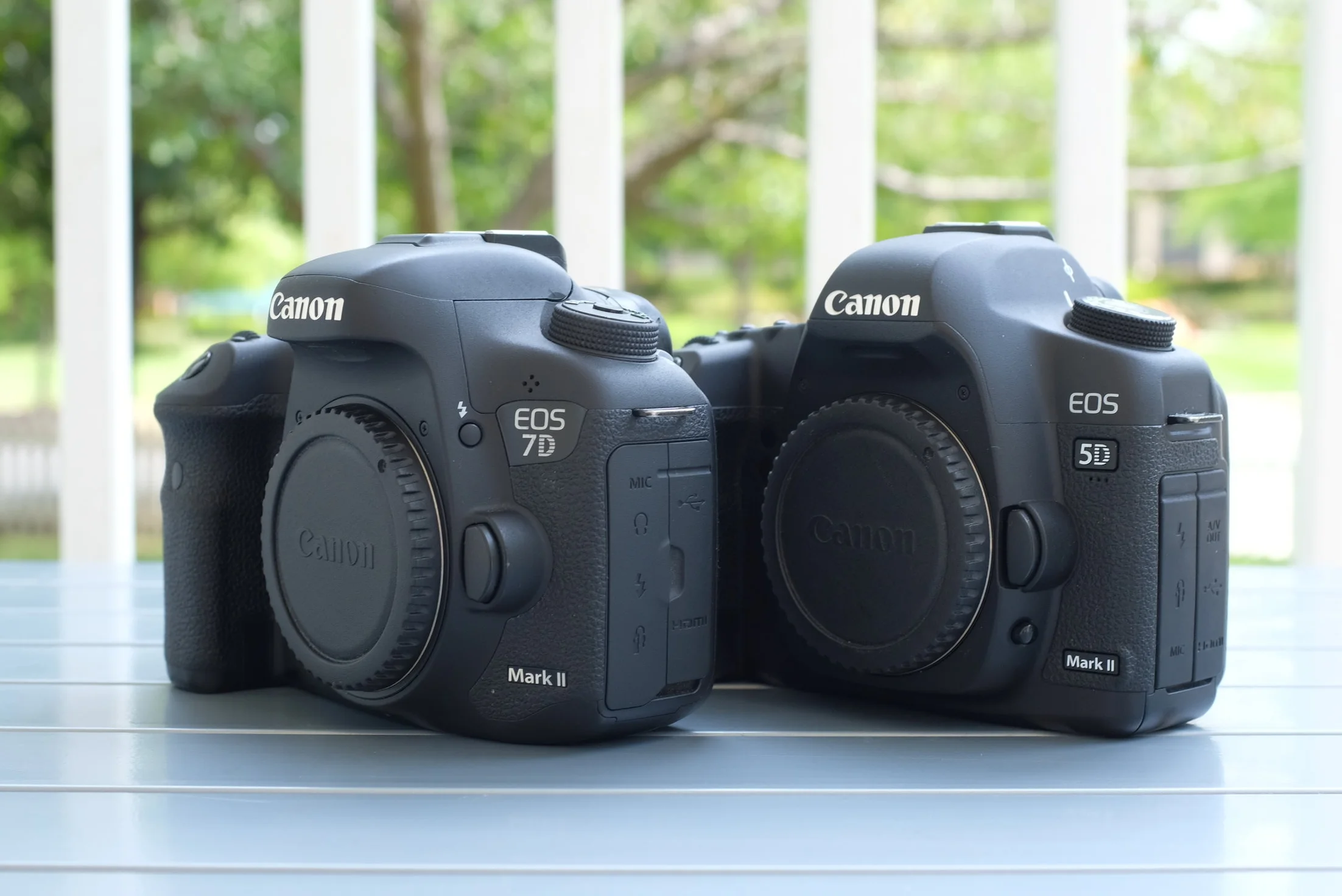
My current DSLR workhorses, the more modern Canon 7D Mark II high-performance APS-C body on the left, and my older Canon 5D Mark II full-frame body that I use for portraiture and more artistic type photos on the right.
This is part of the reason why I switched from the Nikon to Canon DSLR system back in 2010. One second I'm shooting a nice landscape scene, the next second my kids are doing something cute and I switch to a portraiture or action photo type mode, and the next I have challenging backlighting to deal with and need good fill flash performance, all of which require drastically different settings. Nikon had never given people a way to quickly and easily save and then recall all settings on the camera for different types of shooting, whereas Canon had that figured out long ago with their total recall memory banks. I custom program C1 for Landscapes, C2 for action or portraiture, and C3 for fill flash or reverse-handed selfies exactly to my liking, and then I never have to think about it again. It's easy as pie. I never have to think about what I'm doing while on vacation and just shoot, or at most make one or two incremental adjustments from the baseline I have those custom modes set for, and that's it. When I switch back and forth, the camera is always back to my known and defined baseline, without worrying about missing a setting and screwing up photos, as I always did with Nikon!
Today, Nikon has finally figured that out, but their insistence on micromanaging features between cameras means not all of them have it when they should. The latest Canon 7D Mark II camera body, which has been my primary workhorse over the past few years has three of those total recall memory banks along with a pop-up flash, whereas Nikon's latest equivalent D500 has neither? Why?? The answer is Nikon micromanagement of features yet again, and deciding for photographers which features and modes should be available to them, rather than allowing photographers to decide what they'll use for themselves. There's other things that drove me crazy about Nikon too. My brain just speaks Canon better, and the system does what I want it to do better and easier for me than Nikon, and that's why I shoot what I shoot. The system lets me achieve my goal of getting stunningly good photos, yet also being able to enjoy my vacation and travel at the same time and not miss moments.
You Don't Need To Lug Pro Camera Gear Everywhere To Get Great Photos
Once you obtain some professional level camera gear, there's a tendency to want to take it around everywhere, but you don't have to. Once upon a time on a particular camera gear forum, a member was posting their photos of a particular European city with all of the fancy lenses that they owned. I couldn't resist my temptation to troll them by posting my own photos of the same city, but with my basic 18-55m "kit lens", which was all I had at the time. Not that the other members photos weren't awesome, but many of mine were just as good if not better, which shows that the most important aspect of photography is what's six inches behind the camera.
Via "The Secrets To Getting Great Photos", my shot of the Eiffel Tower in Paris with my first DSLR, a Nikon D80, and its 18-55mm kit lens. I was at exactly the right place at exactly the right time, lucked out with some amazing atmospheric effects as the sun set, and that made this photo more than having one lens or another did.
These days my photography has taken a decidedly more casual turn. I don't need 1000+ photos every time we go to the beach, not just because that was always excessive before, but because I didn't have time to sort through all of them then, and especially don't have time to sort through a huge photo catalog like that right now. If I can't pick out a few photos that I like right off of my "good camera" and dump them straight over to my phone and onto social media over peer-to-peer WiFi or Bluetooth, the photos just aren't going to get posted or even sorted. Our lives have become way too busy, too complicated, and just plain too crazy, which has required me to streamline my photography workflow even more, and cut down on my photography. I'll never stop taking photos, but I'm definitely more selective with what I shoot these days.
I enjoyed some front yard camping with my son this weekend. All of these, with the exception of the moon shot at the upper right of the first collage were taken with that Fuji X100F. For the moon shot, I broke out the "big gun" Canon 7D Mark II and 100-400L II lens at 400mm. The moon would have been just a tiny spec with my Fuji X100F, which has a 23mm lens in it. You need a camera that's capable of capturing what you want to capture. For normal life photos and vacation shots, the Fuji (or even your phone!) is perfectly capable, but they're not going to reach to the moon.
I really like my new Fuji X100F a lot! I had to pack away all of my DSLR gear while we moved, and I still haven't really taken them out and am still using just the Fuji X100F for the most part, with the exception of that moon shot. No, it doesn't do everything that I need it to, but for a more casual "just be present and enjoy life" camera, it's perfect. It's a single lens, so your mind is never occupied about which focal length or what lens to use, and your mind is just glued to that perspective without wonder or thought, much like a phone. There's value in simplicity, yet this is an amazingly sophisticated camera with a lot of advanced features if you drill down. You don't have to use them, though.
For my more casual photography as of late, this Fuji X100F has been all I've needed. It's much smaller and lighter than a single DSLR body without a lens, and you still need to pack lenses for the DSLR cameras!
We're going to the Outer Banks for a week at the end of August, and I think I'm still just going to bring the Fuji X100F. The secondary question you have to ask is, is part of the purpose of your vacation actually getting over the top awesome photos that will knock people's socks off? If yes, bring the good stuff! If you just want to be present and enjoy the moment, you don't need to. We're so worn out, beat up, and burned out, that we just want to relax, be present, and enjoy. I want to get great photos of my kids on their boogie boards though, so maybe I'll end up bringing my big camera and the 400mm lens afterall.
Now the Joint Base Andrews Air Show in DC in September, yeah, I'll be going full tilt craziness with my Canon 7D Mark II and my hot rod Canon 100-400mm L II lens for that for sure, along with an ultra-wide lens. Which gear you bring is often a balancing act. Ask yourself what you're trying to accomplish, and don't bring too much or too little camera for what you're trying to achieve. we can't wait for the air show. Nothing is more spectacular than a 400mm photo up the afterburners of an F-22 Raptor demonstration, an ultra-wide shot standing underneath a B-1B Lancer supersonic bomber, or of the Air Force Thunderbirds streaking across the sky. There's a time and a place for the big guns, and an air show, or a once in a lifetime trip someplace all definitely qualify, but even then you don't need a whole backpack worth of photo gear.

Joint Base Andrews Air Show 2015, click the photo for the blog.
Just for grins and while we're on the topic, here's a photo of my Canon 7D Mark II with a fully extended Canon 100-400mm II lens, right next to my Fuji X100F. It's a beast, and it's still pretty big with just an 18-135mm all-purpose zoom lens, and still a lot bigger with just a 24mm f/2.8 pancake lens.
Conclusion
Do whatever you want. These are just my ramblings, but I know what works for me. Your mileage may vary.
We're loving our huge new house, and I can't wait to start decorating the walls with amazing photos that I've taken all over the world, and of people that have been along for the ride with us and that have meant the world to us. I couldn't imagine going to a beautiful place and not taking some really nice photos of it, or going out to dinner with friends that have meant a lot to us and not snapping a few photos of both the cuisine and the company, but that's just me. It's just a question of what gear I bring, and finding camera gear that you understand and that works well for you. It might take a little experimentation.
There's not much I can't do with my Barcelona setup of a Canon 7D Mark II, an 18-135mm all-purpose zoom, a 12-28mm ultra-wide lens, and then a 24mm f/2.8 pancake lens for close quarters and dinner photos. It works extremely well for me, I don't have to think too much about my photography so that I can enjoy the moment too, and I can get in and out of "the spot" in an instant so that other people can get their photos also. For more casual photos, the Fuji is all I need and beats the heck out of a phone, while not being much bigger than one. I can squeeze that 7D Mark II and 18-135mm and 12-28mm combo in my ThinkTank Retrospective 5 bag, and then the Fuji X100F rather than the Canon 24mm f/2.8 pancake lens into the side pocket and have an even better setup with extra capabilities, while still being amazingly portable and lightweight.
There's not really any right or wrong answers in photography. Just do whatever works best for you, but please try not to be a douche like some of the people in that Kyoto blog! LOL!
StevePake.com

The World Needs You
We were out for dinner tonight, and eventually a beautiful young woman in her 20's walked in and sat down at the table across from us with some friends. Out of the corner of my eye, I spotted a semi-colon tattoo down her side, and all I could do was just smile, happy that she didn't do it, happy that she was able to overcome her demons and that she was still here, and what a waste it would have been.
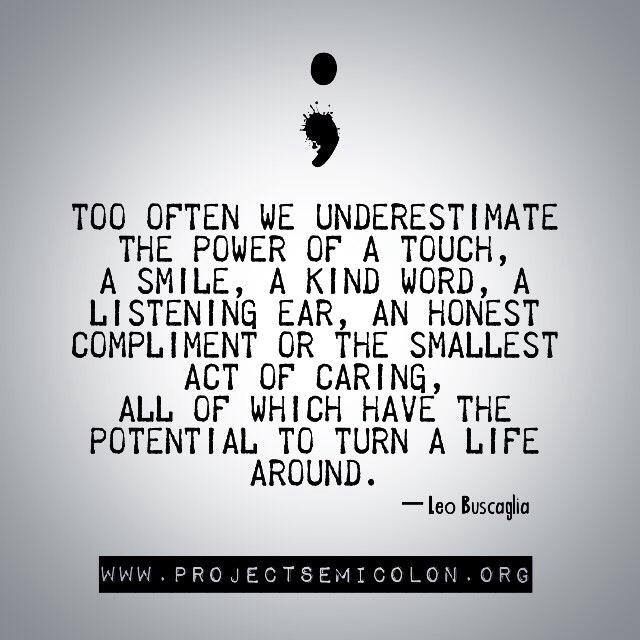
We were out for dinner tonight, and eventually a beautiful young woman in her 20's walked in and sat down at the table across from us with some friends. Out of the corner of my eye, I spotted a semi-colon tattoo down her side, and all I could do was just smile, happy that she didn't do it, happy that she was able to overcome her demons and that she was still here, and what a waste it would have been.
The greatest gift that I've ever received are the angels in my life that helped to pull me back into the light, when my own post-cancer demons had gotten the better of me. The greatest gift that I've been able to give, is to have been that light for others facing the same.
You are beautiful. You are unique. You are worthy. To believe anything else is betraying yourself. When you can't feel that and you're hurting like this, help is always out there. Talk to someone. Talk to me. Or call the National Suicide Prevention Lifeline '1-800-273-TALK (8255)' right there. The world needs you. <3
StevePake.com


Is That A Leica? Trial by Fire with the Fuji X100F at Rehoboth Beach, DE
I've wanted a Fuji X100 since the line first came out in 2010, but had just blown my wad on a new at the time full-frame Canon 5D Mark II camera, and was acquiring lenses for the Canon system after switching from Nikon. The first X100 was intriguing, but seemed a bit rough around the edges. Fuji made some nice improvements to the camera with the X100S successor a few years later, and I still wanted one. Then they made yet more improvements with the third generation X100T, which had finally become a very well-rounded camera, but still didn't get one. Now they've just released the fourth generation X100F with yet more improvements, and I finally bit the bullet and got one.
We love going to Rehoboth Beach so much that sometimes we end up going twice a year, so whenever that's the case and I already have a zillion photos, I always like to try new things. This year, I only brought one camera with its one lens, the new Fuji X100F.
Warning. This blog is a bit tech heavy. It'd take too long to fully explain some things unless you're already a photog and know, so if you have no idea what the hell I'm talking about here, don't worry about it and just enjoy the photos. :)
I've wanted a Fuji X100 since the line first came out in 2010, but had just blown my wad on a new at the time full-frame Canon 5D Mark II camera, and was acquiring lenses for the Canon system after switching from Nikon. The first X100 was intriguing, but seemed a bit rough around the edges. Fuji made some nice improvements to the camera with the X100S successor a few years later, and I still wanted one. Then they made yet more improvements with the third generation X100T, which had finally become a very well-rounded camera, but still didn't get one. Now they've just released the fourth generation X100F with yet more improvements, and I finally bit the bullet and got one.
I'd actually been patiently waiting for the new full-frame Canon 5D Mark IV to come down in price to replace my aging 5D Mark II. That camera still takes phenomenal photos, but it's starting to show a bit of "digital rot" without built in WiFi, and also only takes big clunky CF cards rather than SD, which means I'm continually tied to not just taking my laptop everywhere if I want to get photos off of the camera, but to also rememberingto bring my external CF card reader on top of that, which I sometimes forget! There's absolutely nothing wrong with a camera like the 5D Mark II as far as the photos that you can make with it even today, but I'm hooked on the modern tech in my Canon 7D Mark II. The optional W-E1 WiFi adapter is fast and the app works great, which means I'm no longer tied to my laptop, and the far more modern autofocus and a zillion other things about the camera are just "better", even though it's "only" a crop frame APS-C camera. But is that really a bad thing these days?
As much as I love the look that you can get out of full frame cameras, APS-C just seems to work better for me as a format. DSLR sensors have really matured, and you no longer "need" to buy a full-frame camera if you want great looking photos even in low light or at high ISO. Modern APS-C crop frame sensors are like turbocharged 6-cylinder engines. No, they're not quite as sexy as a V-8, but for all intents and purposes, they're just as good, while costing a lot less and saving weight. I still remember my APS-C Nikon D80 and D200 cameras from the late-2000's. They looked good up to about ISO 400, or if you really wanted to push it, you could maybe get decent looking photos up to about ISO 800, but beyond that good luck. The full-frame Canon 5D Mark II that I switched to from the same era looked great all the way up to ISO 3200, but these days cameras like my APS-C Canon 7D Mark II can still give you perfectly usable photos all the way out to ISO 16,000 or more. It's not just mature sensor technology, but the matured image processing engines (the ASICs) that they put into camera as well, that are putting together the photos from the raw data off of the sensor.
I have some secondary issues with the full-frame format, also. Ergonomically, Canon omits the pop-up flash on their full-frame cameras to keep the profile lower. I'm big on fill-flash, and the fact that the Canon's don't even have a quick and dirty pop-up flash for daylight fill means means having to dork around with clumsy external flashes all the time, which is a pain. A few Nikon full-frame cameras do have pop-up flashes, but there's too many things that drive me insane about the Nikon system to want to go back, so that's not an option. Another issue I have is that I also like taking a lot of food photos. Get a full frame camera at or near close focus on a plate of food, and trying to keep any of it in focus at all due to the thin depth of field that you get on larger format cameras is an exercise in futility. It just doesn't work, unless you buy a pricey tilt-shift lens that I'm not going to buy, so that's that.
The bottom line is that I don't really "need" a Canon 5D Mark IV enough to warrant buying one, and it wouldn't work well enough for me to pay north of $3000 for one either, so I've kinda gotten cold feet on getting one, and am glad I figured this out before I dropped three large on one! There's the Canon 6D, which is Canon's somewhat feature stripped entry-level full-frame camera. It's an "old" camera now, but has a slightly newer sensor from the 5D Mark III vs my 5D Mark II, and it also has GPS and WiFi built-in. It could work pretty well for me, except for the existing challenges I have with the format, and always needing to carry around an external flash and big heavy lenses again. I'm on the fence about getting a 6D Mark II, but it's tough to make a judgement call on something that isn't even out yet, meanwhile I still hadn't gotten myself a birthday, anniversary, or Christmas gift from last year, because I was saving my money for a camera that I wasn't even sure that I wanted anymore!
Well, enough of that.
Here's my new Fuji X100F, and everything that I love about it so far.
Yes, somebody really did ask me if this camera was a Leica at the beach. It does look just like an old rangefinder film camera!
Basically Unlimited Flash Sync Speed
Back in the day when I shot Nikon, I had a little D40 among other DSLRs, and a unique feature of that camera was that it had a faster 1/500s flash sync speed vs. 1/250s or 1/200s for many of Nikon's other cameras including their professional ones. A 1/500s flash sync speed vs 1/200s made a huge difference for when you were trying to get some fill lighting on people's faces during the middle of the day, when the sun is directly overhead and creating deep shadows on people's faces. If your eyes are already glazing over and you have no idea what the hell I'm talking about, photo blogger Ken Rockwell as a nice article about flash sync speed and what it means at his website, and why faster flash sync speeds are so useful.
Because of its leaf shutter design, the Fuji X100 basically has an unlimited flash sync speed of anywhere from 1/1000s to 1/4000s depending on aperture setting. That's awesome, and lets the camera's tiny little built-in flash work more effectively than massive external flash units on other cameras that are limited to much slower typical 1/200s flash sync speeds.
1/680s, f/2.8, ND Filter On, perfect fill flash against harsh backlighting. With a much slower 1/250s exposure, there's already so much exposure contribution from the natural environment and you're already at such a small aperture as a result, that it's just about impossible for even a big flash to work, and then you're in Photoshop making heavy lighting adjustments afterwards. But even small flashes work great when they can sync with the exposure to much faster shutter speeds than 1/250s!
Skin Tones
See below. Need I say more? I've never had a camera that renders nice and vivid colors, yet still has such natural looking skin tones all at the same time. Now I do. The first two photos below are in Velvia mode +4 saturation, and it still delivers decent looking skin tones. The bottom two are Standard color +4 saturation, and skin tones are looking even better there. My wife is already in love with this camera because it makes her skin look natural, rather than more orangish. DSLR color palletes just aren't optimized for skin tones, but the Fuji is, and it really shows.
Dynamic Range
Almost every DSLR camera I've ever owned including the new ones, all love to blow out highlights, which results in really ugly and nasty looking backgrounds if you're not careful. Sure, you can engage the special hack modes if you can figure out how to use them, or shoot in RAW and do HDR stuff, but who has time for that? Not me. Between daddy, husband, engineer, and young adult cancer advocate and non-profit director, I already have way too many hats to wear as it is. As they say, "don'ts gots no time for that!" It really just needs to work, otherwise it's no good to me.
In the extreme example below which is heavily backlit, you can still see yellow accents from the setting sun at the bottom, and then blue accents from the sky elsewhere and especially at the upper left. I've never had a camera that looks more "film like" than this Fuji, which I guess makes a lot of sense considering that Fuji still does make a ton of film! There's a huge film "shoulder" here that you can use, and this is actually causing my brain to retrain itself back to how I shot when I shot film. Depending on the film you were shooting and the look you were going for, you could easily go +1 or +2 EV exposure compensation and have a really nice looking photo, and you can do the same with this Fuji.
The Perfect Social And Foodie Camera
Another issue with DSLRs is that they just don't work well in many social situations. They're big and clunky things as it is, and most of the lenses for them make them even bigger and clunkier, which is awkward in close quarters.
We're foodies and love to go to nice places to eat, and I take pictures of it all for the memories and to share with friends. You can't park a DSLR and any typical lens on a table for dinner without it being in the way somehow, which is why I have the Canon EF-S 24mm f/2.8 pancake lens for my Canon system. That setup actually works pretty well and it can usually sit on a table without it being in the way, but then I run into another issue in that I can't actually dial down the power of the pop-up flash enough for it to work well on a plate of food. You end up looking like a complete idiot with a massive flash going off, which can disturb other guests, so that's not cool.
When it comes to getting balanced fill lighting on dinner guests and friends, good luck with that too. Canon's flash system just isn't very smart. I'm sure if you fiddle around with settings for long enough you can get what you want, but by that time the moment has passed, and you've missed it. Plus if you're out at a Michelin Star rated place with friends, do you really want to spend a ton of time wrestling with your camera to get optimal photos, or would you prefer to use one that just "gets it" and does what you want automatically? This Fuji is brilliant here.
Mechanical + Electronic Shutter AND a Built-In ND Filter
A common issue at the beach is that you're going to have a lot of distracting elements in the background. Ideally you'd want to run as large of an aperture as possible for less depth of field to keep distracting elements out of focus, but at the same time it's very bright at the beach, which forces you to use smaller apertures which will give you more depth of field, and not less! Even setting the maximum shutter speed of your camera, typically 1/4000s, you might only be able to use a maximum aperture of f/4 or f/5.6, which isn't large enough to yank backgrounds and distracting elements out of focus.
The mechanical leaf shutter in the Fuji X100F does max out at 1/4000s, but then it has a secondary electronic shutter that goes all the way up to 1/32,000s if you need it. Or if that isn't enough and you still want to run flash at a large aperture in bright conditions, the lens has a trick switchable 3-stop ND filter that you can turn either on or off. I actually programmed the ND filter to the front function button, and loved the flexibility of being able to instantly switch it in or out, depending on what I was doing.
If you have no idea what in the hell I just said, like I said, don't worry about it and just enjoy the photos! :)
1/16,000s at f/2, Electronic Shutter, ND Filter OFF

1/2200s, f/2, Mechanical Shutter, ND Filter ON. The people in the background aren't in focus enough for your eyes to be drawn to them, making for a much better photo!
I like to do motion blurred and panned photos also, but it can be tricky to get the shutter speed slow enough for that in daytime conditions, even at the minimum aperture of the lens and base ISO. Here, the switchable 3-stop ND filter is a great help too.
1/8s at f/16 and Base ISO of 200, 3-stop ND Filter ON. Without the ND filter, that would have put the shutter speed up at 1/60s, which would have been too fast for a nice motion-blurred shot in this situation. (I hadn't figured out how to drop the ISO down to 100 (L) yet, but that would have helped too, by letting me get the shutter speed even slower at 1/4s.)
So What Don't I Like?
No camera is perfect, and this one isn't either. For starters, you can knock the battery door open by mistake way too easily. As some reviews have said, the EVF auto brightness is defective, and gets way too dark in indoor conditions. The camera apparently won't let you add the custom EVF brightness setting menu to the quick menu either, or I haven't figured out how, so there's no quick way to adjust it when you need to. The color palette of the camera is clearly optimize for great people photos, but landscapes can look a bit pastel like as a result. They're not bad, just different, just like different films gave different looks back in the day. Fuji's menus are pretty messy because the camera is loaded with way too many features, and it's not always intuitive that certain features or functions of the camera won't work when certain other modes are engaged. I nearly went crazy trying to figure out how to get the camera into center-weighted metering mode, only to realize later that only matrix metering was allowed if you had face detection turned on. What?? And then the AF Assist beam ended up being way too bright, washing out my subject in dark conditions, and actually jammed the autofocus system. I got better indoor low light autofocus results without the AF assist light. Uhh... that's not how that's supposed to work! LOL!
I have to dedicate an entire paragraph just to the disgraceful WiFi, because it sucks that bad. It's disgracefully slow at transferring photos, and the phone app is junk. It can take 30 to 60 seconds just to transfer one image, and even dropping the camera down to only transfer downsized 3MP images over the air doesn't seem to speed things up very much. And there's no ability to sort photos by rating or date on the app. So if you rate a bunch of photos quickly on your camera, there's no ability to select just the rated images through the app, and just transfer those images. And good luck going from a single photo view on the phone app and then back to a grid view. Half of the time the app crashes when you do that, and you're out of business, which means you have to select the photos that you want to transfer from the tiny thumbnail views, which you might not be able to see clearly enough. In comparison, the little Canon W-E1 WiFi card for my Canon 7D Mark II is professional grade. Transfer speeds are 10x faster, and you'll have a few dozen full-sized images on your camera in just a few minutes. The app gives you the ability to sort photos by specific date ranges and ratings also, and allows you to pre-select all 5-star rated images from a certain date for transfer, and then transfers them with just one more tap. Viola. Fuji, take note. This is how it should work. I won't say the X100F's WiFi isn't usable, but it's just barely usable. I'll probably just get the Lightning to SD card dongle for my iPhone 6s Plus, rather than having to futz around with the really pathetic WiFi functionality on the X100F.
APRIL 2019 UPDATE: As of a new version of the Fuji phone app, WiFi transfer speeds seem to have improved a bunch, but I haven’t used it enough to know for sure. Will update this blog when I find out, but things seem to be better on the WiFi now.
FEBRUARY 2020 UPDATE: No complaints with WiFi transfer speeds since the above update. My complaint now is the limited functionality in the app, and not being able to pre-select and only transfer 1-start or better rated photos, for example. Canon’s functionality is much better, but at least you’re not waiting hours for photos to transfer anymore.
So Fuji didn't get everything right, but who ever does? There's tons of features, yes, but the feature quality isn't always there, and occasionally is completely absent. A feature isn't much good if it doesn't actually work. It has been and still is a bit of a quirky camera, but I really like what you can do with it, it can do things that other cameras can't at worst or would really struggle to at their best, and am incredibly pleased with it as a whole, and the photos that I can make with it.
Click the banner below for the full album from Rehoboth Beach. Enjoy! :)
NEW FUJI X100V, and “F” FOllow-Up Review
February 2020: Fuji has just announced the fifth-generation X100V.
Based on Ken Rockwell’s preliminary review, there doesn’t seem to be anything all that compelling about the new camera, then again this is still basically the same camera since the original X100 came out in 2010. It’s been the norm to just see minor tweaks from one X100 generation to the next, and that you’ll typically need to go 2-3 generations with this camera line to see meaningful changes and improvements. The same could be said of DSLR cameras these days also, as digital sensor technology has reached a state of maturity for quite some time now. So I plan to keep plugging away with my X100F, which I still love and find incredibly useful. If I happen to drop it in the ocean, I’d definitely buy a “V”, or a discounted “F”. :)
Hot tip. Buy these with their respective Fuji XC-100F or XC-100V fitted leather cases. It truly makes them go anywhere cameras that you can just toss in your bag or backpack, and not worry about it getting scraped up. Being able to USB charge them for the last few generations now means for the most part you don’t even need to bring an extra battery or a separate charger. Most people already have portable recharger “bricks” for their phones, so you can just recharge your camera with one of those on the fly as well.
A couple of years later, I still commonly use this camera and enjoy it. It’s definitely quirky and at times a bit frustrating, but is an absolutely brilliant camera and a very useful tool to have. You definitely need to know what you’re doing to use one of these effectively, hence it being called “the pro’s fun camera”. If you’re that type and want one of these to get some seriously good photos with for the times that you don’t want to lug around your big heavy pro gear (or where it isn’t appropriate), don’t hesitate to buy one of these. They’re great cameras!
StevePake.com
PS: Oh funny! Literally today as I'm wrapping this blog up, Canon has finally announced the long-awaited update to their 6D, the 6D Mark II, and it looks like a pretty nice camera too with an introductory price of $1999. I just can't justify a 5D Mark IV for my needs and usage, so this is probably what I'll get next year sometime to replace my old 5D Mark II.
(2020 Update: LOL, I never did buy the 6D Mark II, but rather the new full frame mirrorless Canon EOS RP instead, which I’ve been incredibly pleased with as well.)

Memorial Day Weekend in New York City
We finally did something that we hadn't been able to do for the past six years - we went on a trip to New York City, for fun!
We finally did something that we hadn't been able to do for the past six years - we went on a trip to New York City, for fun!
NYC had been off limits for me for a few years, due to posttraumatic stress issues after cancer, having been treated in at Memorial Sloan-Kettering Cancer Center in NYC. My treatment and care were all top notch, but it definitely left a mark on me, and this just isn't a place that I could go for a few years. That's all solidly in the past now, and my wife and kids had all wanted to go for awhile. We finally made it, and had a fantastic time.
We drove up super early on Saturday morning, leaving Maryland at 6am, and started off at the famous Soup Nazi, then swung through Central Park and the MET, and met my testicular cancer survivor "twin brother", Jason for dinner. On Sunday, we saw the Statue of Liberty, the Brooklyn Bridge, and Ground Zero in the morning, and then the ladies went shopping while the boys went to check out the USS Intrepid Aircraft Carrier Museum. That was a lot of New York crammed into two days, so we were pretty pooped after that, but still managed to walk down to Times Square Sunday night, before leaving Monday morning.
Full album link below, or for a few quickies, keep scrolling.
My travel kit as of late has been my Canon 7D Mark II, Tokina 12-28mm f/4 ultra-wide lens, a Canon 18-135mm IS STM lens all-purpose zoom, and then my trusty Canon 24mm f/2.8 pancake lens. You won't miss a shot with this combo, although it does lack the sexiness and "pop" that you can get with a full-frame camera. Try taking food photos with a full-frame camera though. The depth of field becomes so thin that it's just ridiculous, and the full-frame cameras tend to not have a pop-up flash either. I'm big on fill flash, and hate having to mess around with clunky external flashes, so just stick with the APS-C format cameras for travel.
Soup Man!
The MET

Of course we swung by Laduree's for macaroons!

Dinner with my testicular cancer survivor virtual twin, Jason.
It was great to see the Statue of Liberty again. I hadn't been here since I was around my kids age, but who knew that tickets to go up into the crown sell out 4 months in advance now?? Times change thanks to the Internet!
I'd never seen Ground Zero before. Powerful is all I can say. We didn't go into the 9/11 Memorial Museum. Will save that for another trip when our kids are a bit older, and regretfully come to understand what terrorism is.
Brooklyn Bridge Selfie
The USS Intrepid
We of course did a bit of foodie stuff. Totto Ramen, OMG!!! This was actually Totto Ramen "Next Door" because there was a huge wait at Totto Ramen, but could get right in here. It was amazing! You can't beat food in NYC
Times Square of course!
StevePake.com

Testicular Cancer Summit Honorary Speaker - Dr. Lawrence Einhorn
Dr. Einhorn, or "Dr E" as he's affectionately referred to within the TC community, is a man who needs no introduction. Many of us would not even be here were it not for Dr. Einhorn's pioneering work in the 1970's that led to a once in a generation leap in the oncology field, and the cures for many cancers including Testicular Cancer.

Dr. Einhorn, or "Dr E" as he's affectionately referred to within the TC community, is a man who needs no introduction. Many of us would not even be here were it not for Dr. Einhorn's pioneering work in the 1970's that led to a once in a generation leap in the oncology field, and the cures for many cancers including Testicular Cancer! It was a great honor to be the first Testicular Cancer centric group to host the man who invented the cure for this disease! Why hadn't this been done before? Well it has now.
"Lawrence Einhorn, MD, has been on the IU School of Medicine Department of Medicine faculty since 1973. His field of expertise includes clinical trials and supportive care, with focus in the areas of lung and testicular cancers. Dr. Einhorn has also been involved in the clinical development of new drug therapies. Studies chaired by Dr. Einhorn at IU School of Medicine in the area of testicular cancer led to the FDA approval of cisplatin, etoposide and ifosfamide. In addition, his groups conducted the pivotal studies that led to the approval of both gemcitabine and pemetrexed in non-small cell lung cancer.
A major current area of focus for Dr. Einhorn is supportive care and survivorship, especially as it applies to patients who are cured with platinum-based chemotherapy for testicular cancer. He has been a long-standing member of the Multi-National Association for Supportive Care in Cancer (MASCC).
Dr. Einhorn's clinical interests include solid tumor oncology, specifically within the fields of genitourinary and lung cancers. His legacy will forever be linked with revolutionizing testicular cancer treatment. Prior to Dr. Einhorn's research in the area of platinum combination chemotherapy in patients with metastatic testicular cancer, the survival rate of the disease was approximately 10 percent. Now, due to Dr. Einhorn's monumental findings, the current survival rate for metastatic testicular cancer is at 80 percent.
Dr. Einhorn rose to even greater prominence when he used his novel treatment paradigm to treat Lance Armstrong, cancer advocate and seven-time winner of the Tour de France. With Dr. Einhorn's treatment, Armstrong survived stage 3 testicular cancer that initially presented with abdominal, brain and lung metastases. Like Armstrong, Einhorn remains dedicated to raising cancer awareness. He was appointe the first Lance Armstrong Foundation professor of oncology in 2006."


Testicular Cancer Summit Panelist - Dr. Clint Cary
At the Testicular Cancer Summit, we will have not one but two amazing testicular cancer doctors on hand to answer your questions in two hour-long "Ask the Oncologists Anything Q&A" breakout sessions, Dr Phil Pierorazio of Johns Hopkins Medicine, and Dr Clint Cary of Indiana University! You've already been introduced to Dr Pierorazio, but here's a bit about Dr Clint Cary!
At the Testicular Cancer Summit, we will have not one but two amazing testicular cancer doctors on hand to answer your questions in two hour-long "Ask the Oncologists Anything Q&A" breakout sessions, Dr Phil Pierorazio of Johns Hopkins Medicine, and Dr Clint Cary of Indiana University! You've already been introduced to Dr Pierorazio, but here's a bit about Dr Clint Cary!
Dr. Cary completed his urology residency at Indiana University and then went on to complete a two year urologic oncology fellowship at the University of California, San Francisco. In addition to his fellowship, he completed a Master of Public Health Degree from U.C. Berkeley with a concentration in epidemiology. His clinical interest is in urologic oncology with a focus on the surgical management of advanced testicular cancer and bladder cancer. His research efforts focus on health services and outcomes research in testis and bladder cancer.
How many times have you been in your doctor's office and have felt so rushed, or like you didn't have enough time, or forgot what you were going to ask, and then you're left kicking yourself and wondering for the next month or until your next appointment? And then the same thing happens all over again!! It happens to all of us! These Oncology Q&A panel discussions will be the perfect opportunity for so many of us to sit down outside of a clinical setting, and finally just pick the brains of these amazing doctors to our heart's content!
Dr Einhorn will be Friday only, but Dr Pierorazio and Dr Cary aren't going anywhere! We're locking the doors, and looking forward to enlightening discussions for patients, survivors, and cancer advocates alike. This will also be an amazing opportunity for the doctors themselves to learn more about their patient populations and the advocacy world. We're looking forward to it!
Steve Pake
Co-Founder & Chair, Testicular Cancer Summit

Testicular Cancer Summit Keynote Speaker - Dr Phillip M. Pierorazio, M.D.
I am an urologist at Johns Hopkins in Baltimore, Maryland and a passionate advocate for our testicular cancer patients. I am a member of the National Comprehensive Cancer Network Guidelines Committee for Testicular Cancer and considered among the experts in robotic and open retroperitoneal lymph node dissection. There is no cancer like testicular cancer, it affects young men and because of the high cure rate, can have lasting effects for decades after successful treatment. For those reasons and more, there is no patient population like testicular cancer survivors – and there is no more rewarding group for whom to care.
I am an urologist at Johns Hopkins in Baltimore, Maryland and a passionate advocate for our testicular cancer patients. I am a member of the National Comprehensive Cancer Network Guidelines Committee for Testicular Cancer and considered among the experts in robotic and open retroperitoneal lymph node dissection. There is no cancer like testicular cancer, it affects young men and because of the high cure rate, can have lasting effects for decades after successful treatment. For those reasons and more, there is no patient population like testicular cancer survivors – and there is no more rewarding group for whom to care.
Thanks to giants in the field, like Dr. Einhorn, the overall cure rate for testicular cancer is 95%. However we still subject many men to side effects from chemotherapy, radiation therapy and surgery without completely understanding or imparting the long-term “toxicities” of these treatments. I, and others, think it’s time to stop patting ourselves on the back for curing 95% of men and start moving the bar higher to minimize the side effects of our treatments. While we are not willing to budge on the excellent cure rate, the newest generation of testicular cancer providers is keenly focused on improving the lives of our testicular cancer patients. I look forward to giving the medical perspective of Testicular Cancer Survivorship at the TC Summit and interacting with like-minded TC advocates from around the world!
Dr Phillip M. Pierorazio, M.D.
Assistant Professor of Urology and Oncology
Director, Division of Testis Cancer
Brady Urological Institute at Johns Hopkins University

Testicular Cancer Summit Keynote Speaker - Dr Ajay K. Nangia, MBBS
The Testicular Cancer Summit also pleased to welcome Dr Ajay K. Nangia, MBBS. Dr Nangia is a Professor of Urology at the University of Kansas Medical Center, and has expertise in the areas of male infertility and testosterone deficiency, of direct relevance to many testicular cancer survivors!

The Testicular Cancer Summit also pleased to welcome Dr Ajay K. Nangia, MBBS. Dr Nangia is a Professor of Urology at the University of Kansas Medical Center, and has expertise in the areas of male infertility and testosterone deficiency, of direct relevance to many testicular cancer survivors!
About Dr Nangia:
"Dr. Ajay K. Nangia is Professor of Urology at the University of Kansas Medical Center. Dr. Nangia received his medical degree from St. Thomas and Guy's Hospital Medical School in London, U.K. He completed two years of research at Yale University prior to residency. He completed his Urology residency at the University of Pittsburgh Medical Center and a Male Infertility and Microsurgery fellowship at the Cleveland Clinic Foundation in Cleveland, Ohio. Dr. Nangia was at Dartmouth-Hitchcock Medical Center in New Hampshire prior to coming to Kansas and the Kansas City area. Dr. Nangia is a fellowship trained male infertility specialist in the metropolitan Kansas City area with 14 years of experience and national involvement in the field. He is one of the leading male infertility specialists nationally and in Kansas, Missouri and the Midwest region. He has extensive experience in male infertility, urological microsurgical reconstruction, including vasectomy reversals in the Kansas, Western Missouri, Oklahoma and Nebraska region. He also specializes in Men's Health issues as they relate to sexual and reproductive health, especially male contraception, testosterone deficiency, erectile dysfunction and ejaculatory problems. He and Dr. Broghammer have one of the largest practices in surgical correction for erectile dysfunction (penile prostheses) in the region. He also specializes in fertility and sexual dysfunction issues related to spinal cord injuries and pre- and post-cancer treatment. Dr. Nangia is a leading national specialist in the field of vasectomies and complications from vasectomies. He also has a secondary specialty in stone disease. "
You can read Dr Nangia's full bio here.
We look forward to hearing from Dr Nangia at the Testicular Cancer Summit.

Testicular Cancer Summit Panelist - Emily Cox-Martin, PhD
The Testicular Cancer Summit is pleased to have Emily Cox-Martin, PhD as a panelist! "I am a Clinical Psychologist and Assistant Professor in the Division of Medical Oncology at the University of Colorado School of Medicine. Working in the field of Psycho-Oncology, I help patients improve coping and adjustment around their diagnosis. I focus on the difficulties that emerge at the intersection of cancer and mental health across the cancer continuum, from diagnosis into survivorship.
I am a Clinical Psychologist and Assistant Professor in the Division of Medical Oncology at the University of Colorado School of Medicine. Working in the field of Psycho-Oncology, I help patients improve coping and adjustment around their diagnosis. I focus on the difficulties that emerge at the intersection of cancer and mental health across the cancer continuum, from diagnosis into survivorship. Cancer is a disease that not only impacts our bodies, but our psychosocial functioning as well, including our mental health, our relationships, and how we take care of ourselves. At the Testicular Cancer Summit I hope to highlight that for cancer survivors, understanding and addressing the psychological impact of your disease is critical for your health, as well as your overall quality of life.
Emily Cox-Martin, PhD
Clinical Psychologist, Medical Oncology
University of Colorado Cancer Center - Anschutz


Testicular Cancer Summit Guest Speaker - Mike Craycraft
I am excited to have the opportunity to be a guest speaker at the Testicular Cancer Summit but more importantly, for the opportunity to meet so many other survivors and caregivers face to face and learn of your experiences. Whether we are a survivor, caregiver or healthcare professional we have each traveled a unique path to where we are today. I look forward to being able to share ways that we can continue to move forward and get back to living life. After our experiences, life may never be the same as it was before we were affected, but I hope that we can all find ways to embrace the “new normal.” I look forward to seeing you all in Denver.
I am excited to have the opportunity to be a guest speaker at the Testicular Cancer Summit but more importantly, for the opportunity to meet so many other survivors and caregivers face to face and learn of your experiences. Whether we are a survivor, caregiver or healthcare professional we have each traveled a unique path to where we are today. I look forward to being able to share ways that we can continue to move forward and get back to living life. After our experiences, life may never be the same as it was before we were affected, but I hope that we can all find ways to embrace the “new normal.” I look forward to seeing you all in Denver.
Bio
Mike was diagnosed in 2006 and is the founder of the Testicular Cancer Society, which also oversees the TC-Cancer.com Forums. Besides being a survivor he is also a clinical pharmacist by trade. He is a Mentor Angel with Imerman Angels, a 4th Angel Mentor with The Scott Hamilton CARES Initiative at the Cleveland Clinic and a survivor mentor for myCancerConnection at MD Anderson Cancer Center. He is a Research and Community Outreach Fellow for the Men's Health Initiative, serves as the Testicular Cancer Community Leader at MedHelp and volunteers for Love Hope Strength. As a Huffington Post Blogger he contributes on issues relating to adolescent and young adult oncology.
Mike Craycraft
Testicular Cancer Society
Cincinnati, Ohio

Testicular Cancer Summit Guest Speaker - Torsten Koehler
Fantesticle news - Guest speaker at the Testicular Cancer Summit! Being a cancer survivor we all of have story to tell. I like to focus on something “different”. I’m looking forward to share the challenges of a testicular cancer mission in South Africa where besides cancer and its horrible side-effects people have to deal with: no or limited access to clinics and doctors, language barriers, witchcraft, cultural taboos, stigma, rejection, lack of funds, lack of medication and lack of knowledge to name but a few.
Fantesticle news!
Guest speaker at the Testicular Cancer Summit! Being a cancer survivor we all of have story to tell. I like to focus on something “different”. I’m looking forward to share the challenges of a testicular cancer mission in South Africa where besides cancer and its horrible side-effects people have to deal with: no or limited access to clinics and doctors, language barriers, witchcraft, cultural taboos, stigma, rejection, lack of funds, lack of medication and lack of knowledge to name but a few. As the summit is not a one-way street I’m looking forward to hear, learn and get inspired by fellow survivors. It will be fantesticle!
Bio
The founder of Love Your Nuts campaign was diagnosed with testicular cancer in 1995 whilst educating young teenagers about ‘sex education’ at a school and being in his early thirties himself. His journey of survival started by openly confronting in his book his thoughts and emotions, relate the reactions of his friends, family and not least, his students, who provoked him without reserve and in doing so, gave him enormous help and hope. His book “Love your nuts” was published internationally in 2011 in English (German version was published in Germany in 2004 already). "He has won, he lives and he loves. He is showing everybody how valuable they are and how fantastic life can be" (a reader's words) and therefore has a passion for this campaign.
Born in 1965 and grew up in Namibia. He studied teaching and was a teacher for 15 years in Namibia. This 15-year span was interrupted three times and in the years 1991, 1997/8 and 2006 he toured through 45 countries on all the continents. He has been a Cape Town resident since 2007. Followed his passions – photography and design – until the end of 2016 after leaving the teaching profession in 2005.
Since 2017 he is working full time for his foundation with the best job description ever: talking balls and saving lives.
Greetings from sunny Cape Town
Torsten
Love Your Nuts
Cape Town, South Africa


Testicular Cancer Summit Guest Speaker - Nancy Balin
The Jaimeson Jones Memorial Scholarship has two missions: Providing scholarships to families who have experienced childhood cancer, and preaching early detection of TC by teaching its signs and symptoms. JJMS is dedicated to changing the culture of silence about men’s health and heightening people’s awareness about testicular cancer, and to do that, we get them where they live: with humor. We are beyond honored and thrilled to be attending the first-ever Testicular Cancer Summit.
The Jaimeson Jones Memorial Scholarship
In 2005, 14-year-old Jaimeson Jones had a secret. Not a good secret, though – a deadly one. The ninth grader had increasingly painful swelling in his left testicle, and he had suffered in silence already for more than a year. When he finally couldn’t stand the pain any more, he landed in the ER, where he was diagnosed with Stage IV (now known as Stage IIIC) poor-prognosis testicular cancer. After in-person consultations with the great Lawrence Einhorn, M.D. and his expert panel of surgeons, multiple rounds of chemotherapy in Seattle and four major surgeries at IUPUI, Jaimeson’s cancer went into remission late that year.
While he was in remission, he tellingly explained to a high school friend, “It just kept getting bigger and bigger, but I was too embarrassed to tell my mom.”
In 2009, when Jaimeson was 19, the cancer recurred, and he endured even more extreme treatment, including high-dose chemotherapy with two stem cell transplants (chillingly, prophetically, known as “salvage therapy”) and two major lung surgeries. This time, though, he couldn’t be saved, and he died at age 20 in 2010, leaving a devastated family and community.
Jaimeson bequeathed his college savings to his two younger sisters, then 12 and 18, because he understood the financial devastation his illness had caused the family.
Jaimeson Jones died of embarrassment, like so many other young men with TC. Testicular cancer is the “perfect storm” of a disease, despite Dr. Einhorn’s monumental work in the 1970s. This is not because there is no successful treatment, but because the target demographic most likely to get it (men ages 15-35) feel invincible, hate going to the doctor, feel embarrassed about where their symptoms are, and don’t realize that those symptoms may indicate cancer. So, they wait. And wait. Just as Jaimeson did.
JJMS is dedicated to changing the culture of silence about men’s health and heightening people’s awareness about testicular cancer, and to do that, we get them where they live: with humor. The annual Seattle-area Family Jewels 5K (get it?) raises scholarship funds, and JJMS educates that captive audience with their “30-second lecture” about testicles: “Shouldn’t hurt! Shouldn’t have lumps or bumps! Shouldn’t be (way) different sizes! And if there’s a change – GO SEE A UROLOGIST!” Nut Notes along the route gently pester men to do self-checks: “Too chicken to check your nuggets?” “Check your ‘nads, lads!” “Don’t be slackers, check your knackers!” “Carpe Scrotum!” Family and friend groups jog by, laugh, and learn – and we save lives.
The Jaimeson Jones Memorial Scholarship has two missions: Providing scholarships to families who have experienced childhood cancer, and preaching early detection of TC by teaching its signs and symptoms. We are beyond honored and thrilled to be attending the first-ever Testicular Cancer Summit.
Nancy Balin
Jaimeson Jones Memorial Scholarship

Testicular Cancer Summit Guest Speaker - Jason Greenspan
Jason is looking forward to the Testicular Cancer Summit because it is a great way for all members of the Testicular Cancer community to come together and interact. He will be able to share his story with others, but also learn from other Testicular Cancer survivors as well! There will be survivors from all over the world and many Testicular Cancer foundations, as well as world renowned doctors who specialize in the treatment of Testicular Cancer. With all these elements and this being the first event of its kind anywhere in the world, the event is sure to be a major success! Jason will be speaking about his cancer journey as a student in high school and the impact it had on his life. He will also be discussing what young men can do to be more active about Testicular Cancer awareness in their own communities.
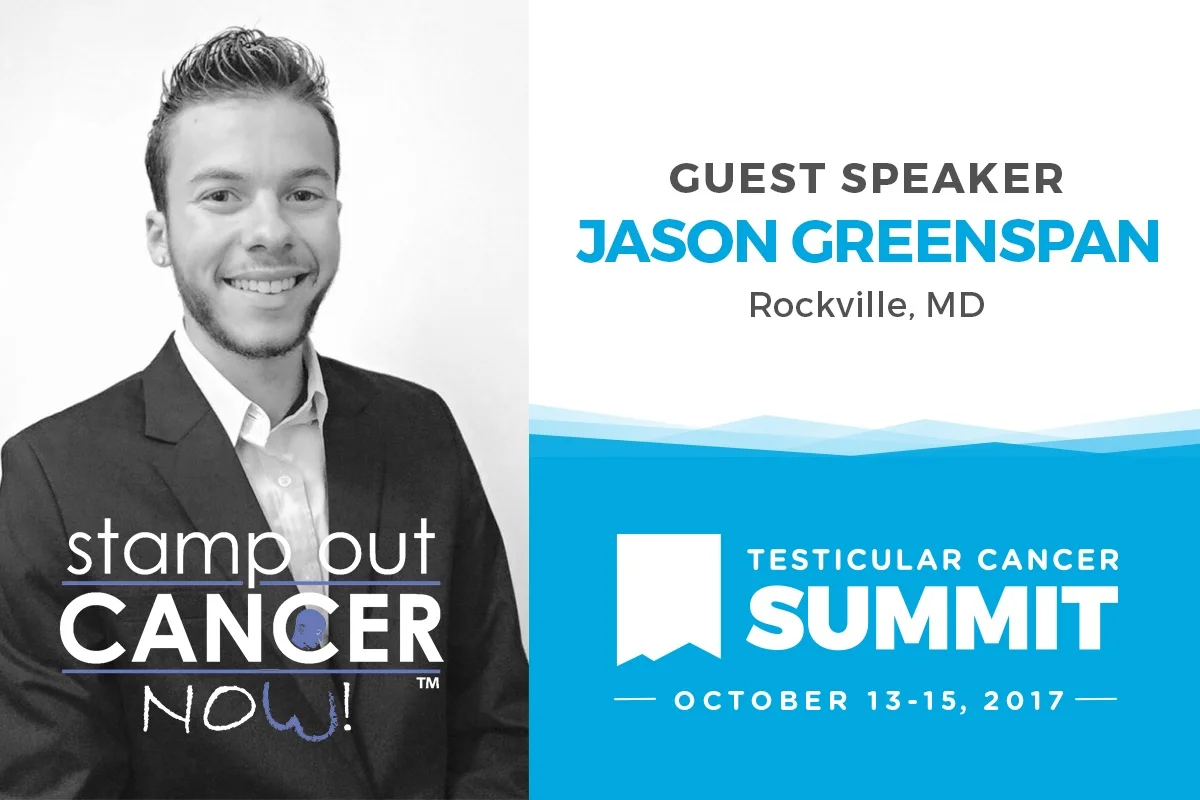
Jason Greenspan, the founder of Stamp Out Cancer Now! was diagnosed with Testicular Cancer when he was 18 years old in his senior year of high school. Stamp Out Cancer Now! is a fundraiser and Testicular Cancer campaign designed to bring more awareness of this type of cancer to young men and college students. Jason has been able to share his story by appearing on numerous television news segments, local talk shows, newspaper & magazine articles, and even the radio. He regularly attends fundraising events and is often a guest speaker, speaking about his own cancer journey. Jason is a Marketing major at Shippensburg University, graduating in December 2017.
When Jason was diagnosed, he was planning for his prom and awaiting graduation. This was supposed to be the time of his life: enjoying time with friends and finishing high school before entering the real world. Just before his prom, while he was watching television, he had an itch that ended up being the most important itch he would ever experience. After visiting his doctor a few days later, he got the news that would change his life forever. The doctor told him that he had Testicular Cancer and was going to need surgery to remove the tumor. Jason felt like his life was now on hold. He was supposed to go to his prom, graduation, and then college in the fall. After his surgery, he needed to have nine weeks of chemotherapy which became some of the most difficult days of his life.
Since he was diagnosed, Jason has made a strong presence in the cancer community. Within weeks of being diagnosed, he created his own fundraiser called, Stamp Out Cancer Now! In his first year of college, he became Sponsorship Chair for the Colleges Against Cancer club. Each year he has increased his position, landing him as the current President of the club. This summer, Jason became a Board Member of the Testicular Cancer Awareness Foundation while interning at Johns Hopkins Hospital with another TCAF board member, Dr. Phillip Pierorazio. He researches about Testicular Cancer and plans survivor events.
Jason is looking forward to the Testicular Cancer Summit because it is a great way for all members of the Testicular Cancer community to come together and interact. He will be able to share his story with others, but also learn from other Testicular Cancer survivors as well! There will be survivors from all over the world and many Testicular Cancer foundations, as well as world renowned doctors who specialize in the treatment of Testicular Cancer. With all these elements and this being the first event of its kind anywhere in the world, the event is sure to be a major success! Jason will be speaking about his cancer journey as a student in high school and the impact it had on his life. He will also be discussing what young men can do to be more active about Testicular Cancer awareness in their own communities.
Remember TWO Check!
Jason Greenspan
Stamp Out Cancer Now!
Rockville, MD

Testicular Cancer Summit Guest Speaker - Thomas Cantley (Mr.Ballsy)
After being diagnosed with stage 3 Testicular Cancer that spread to my lymph nodes (because I put off going to the doctor), I got inspired. Two years ago, I created a campaign that received worldwide attention - I pushed a giant inflatable testicle across 2 countries and over 8,000 miles to raise awareness for this cancer. Yes, you heard that right, a giant NUT!
After being diagnosed with stage 3 Testicular Cancer that spread to my lymph nodes (because I put off going to the doctor), I got inspired. Two years ago, I created a campaign that received worldwide attention - I pushed a giant inflatable testicle across 2 countries and over 8,000 miles to raise awareness for this cancer. Yes, you heard that right, a giant NUT!
Mr.Ballsy in New Mexico, September 2014 via Facebook.
I wanted men to be ballsy by talking about their health and to stop ignoring it because they're too proud/shy/embarrassed (you fill in the blanks). And I definitely got people talking! This amazing journey has made me recognized globally and quoted as one of the most outspoken voices in Testicular Cancer awareness in the world. I have gained hundreds of hours of media coverage for this worthy cause. But best of all, I met amazing people who I inspired to be ballsy about their health and who also inspired me.
Look out for my film documenting this amazing experience this year! My mission is to inspire them to live well physically and mentally. Often times, after men seek physical treatment for their issues, they ignore their mental health. 50% of what I do is talk to men about mentally preparing for a diagnosis and helping them wrap their heads around recovery from a diagnosis. Mindset is key - healthy mind equals healthy body.
I have an awareness COMIC coming out this November, and a Documentary in 2018. I am so glad to be a part of a great summit like this because it brings together people from all over the world that share one thing - cancer. It's a great way to connect , educate and learn. The TC community is a family and a bond like no other, I have built relationships with a lot of people attending and speaking that I've known for years and am so excited to finally meet. That is why events like these are important.
Thomas Cantley
Mr.Ballsy

Top 5 Things to Know About the Testicular Cancer Summit in Denver
It’s coming this Fall 2017! Mark your calendars for October 13-15th in Denver, Colorado for a first of its kind Testicular Cancer Summit, featuring Dr. Lawrence Einhorn as an honorary guest speaker!If you’ve been wondering what’s going on and what this is all about, here are the Top 5 things you need to know about the Testicular Cancer Summit.

It’s coming this Fall 2017! Mark your calendars for October 13-15th in Denver, Colorado for a first of its kind Testicular Cancer Summit, featuring Dr. Lawrence Einhorn as an honorary guest speaker!
If you’ve been wondering what’s going on and what this is all about, here are the Top 5 things you need to know about the Testicular Cancer Summit.
Who’s Running the Show and How Did This Get Started?
The Testicular Cancer Summit is a grassroots and survivor initiated summit, co-founded by testicular cancer survivors Ron Bye, Steve Pake, and Mike Craycraft.
Ron and Steve met by pure chance in Singapore back in 2016, and it had been one of the few times in Ron’s incredible 41 years of surviving testicular cancer that he had met another survivor. Little did both Ron and Steve know at the time, that each had wanted to get a larger scale testicular cancer summit going like this for a while. A “let’s do this” phone call from Ron to Steve at the end of 2016 about getting a Testicular Cancer Summit going for 2017 was all it took. “He had me at hello.” Fellow testicular cancer survivor, Mike Craycraft, was a mutual friend of both who it turned out had similar aspirations of his own, and quickly hopped on board to get things rolling from there.
Ron Bye – Co-Founder, 41 year survivor of testicular cancer, and author of the book, “Memoirs of a 30 Year Cancer Survivor”
Steve Pake – Co-Founder and Chair, 6 year survivor of testicular cancer, author of the award-winning Cancer Blog, Young Adult Cancer Survivorship by Steve Pake at www.stevepake.com. Steve also serves as a Director at the Testicular Cancer Awareness Foundation
Mike Craycraft, Co-Founder and Committee Member, 10 year survivor of testicular cancer, Founder of the Testicular Cancer Society, and owner of the popular TC-Cancer.com web forum.
Planning a large-scale summit such as this is much more than a one or even a three person job, and so we’re very grateful for all of the support and invaluable contributions from the rest of our planning committee as well, as follows.
Kim Jones, Committee Member and Primary Sponsor/Fiduciary, and Founder of the Testicular Cancer Awareness Foundation.
Dr Phil Pierorazio, Committee Member and Medical Advisor, Director of the Testis Cancer Division and Assistant Professor of Oncology/Urology at the Johns Hopkins University hospital.
Steve Fillmore, a 2x Testicular Cancer Survivor and motivational speaker, and author of the website www.stevefillmore.com
Scott Joy – Committee Member – 13 year survivor of testicular cancer, and a Senior Livestrong Leader at Livestrong.
What Is Our Mission?
Our mission and purpose is very simple. We all just want to put together the best possible testicular cancer specific summit that we can, for as many people that care to join us, regardless of our various affiliations with different testicular cancer organizations and missions. When it comes down to it, we’re all on the same team of helping to raise awareness about the most common form of cancer in young men, and helping them through their cancer fights and survivorship journeys afterwards. Despite being the most common form of cancer in younger men, testicular cancer is still considered to be a rare cancer, and thus the best way to achieve critical mass for a testicular cancer summit is to combine forces, followings, and resources. We could not be more grateful for the enthusiasm and support received thus far.
Dr. Einhorn Will Be There
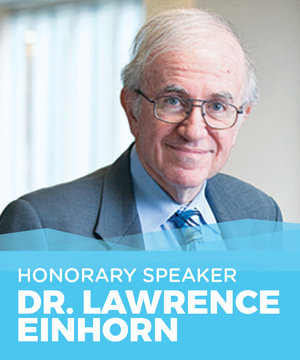
Yes, Dr. Einhorn will be there! We are extremely grateful that the man who developed the modern cure for testicular cancer will be in attendance to help kick off this summit. Dr. Einhorn’s landmark work in the 1970’s on the Cisplatin drug and the first “PVB” chemotherapy protocol literally turned testicular cancer from a death sentence to one of the most curable cancers. Dr Einhorn will deliver an hour long presentation about testicular cancer on Friday afternoon, and will then be available for a brief Q&A and meet and greet session afterwards.
“Dr. E”, as he’s commonly known, is an angel. To this day at 75 years of age, he still consults with testicular cancer patients and oncologists all over the world via email, per his own free will and outside of his role at Indiana University, often responding within an hour. Dr. E has touched the lives of millions all over the world not just through his landmark work, but as a public figure that has always made himself accessible to the public on the topic of testicular cancer.
So many of our lives have been touched by Dr. Einhorn, even if we were never actually patients of his! If you’ve ever wanted to meet Dr. Einhorn in person, this Testicular Cancer Summit will be your chance. Dr. Einhorn will only be available for the Testicular Cancer Summit on Friday afternoon, October 13th, so plan your travel accordingly! We’re most grateful that Dr. Einhorn will be attending this first of its kind Testicular Cancer Summit!
It Will Be More Than Just Dr. E
It will be more than Dr. E in attendance. We’re working hard putting together a great list of guest speakers and attendees from both the testicular cancer oncology and urology worlds, and from the testicular cancer advocacy and non-profit arenas, to educate and inspire attendees. Look for announcements throughout the summer leading into the fall summit in Denver. We have nearly a dozen people of significance lined up to speak, deliver keynote addresses, and to lead breakout sessions. Dr. Einhorn is just the start of a steadily growing list. You’re going to be both amazed and impressed! We’ll make it worth your trip to Denver.
This Will Be a Life Changing Event
Testicular Cancer is a small world, but for one weekend in October, we’re going to bring as much of that world as possible under one roof in Denver for a life-changing event and summit.
If you’re involved with testicular cancer advocacy or just want to understand more about this disease, it will be an incredible opportunity to pick the brains and learn from some of the best minds in testicular cancer oncology and urology, that we never seem to have enough time with during office visits. So many of us have a desire to give back in some way, and the Testicular Cancer Summit will also be the perfect opportunity to learn about different testicular cancer centric advocacy and non-profit missions across the world, and to learn about the volunteer opportunities that are available to you, or even what you can do on your own! Last but certainly not least, is networking. The opportunity to network is one of the core features of this summit. It’s the perfect opportunity to finally make those in-person connections with so many that you might have only known online through the Internet and social media for so long – so many of us will finally get those handshakes and hugs we’ve long sought. There’s nothing like being face to face, and for one weekend, we all will be!
Connect, Learn, Network, and Enjoy!
On behalf of the Testicular Cancer Summit Planning Committee, we hope you will join us and look forward to seeing you in Denver, October 13-15th.
Steve Pake
Co-Founder and Chair
Testicular Cancer Summit
TestesSummit.org


Cancer Survivorship at Six Years
Six years after my cancer fight, I still GRIEVE the loss of my life as I once knew it sometimes, thinking that everything would always be okay, that my family would always be healthy, and friends that I truly love and care about will always be around. I want to believe that, but know it's just now how things work. Why do I get so sappy and emotional? Because I love you, and I want you to know that now, today, because I know that you might not be around tomorrow, or maybe I'm the one that might not be around.
Yesterday, a friend told me that an old friend of hers from high school just lost her 25 year old son to testicular cancer. He was diagnosed hardly a week ago, but the cancer was so far advanced that there was nothing that could be done, and he just passed away this week. Sigh. 💔
We ALL live in this world, where people that you love and care about today can be gone tomorrow in the blink of an eye, and without warning. It's not right and it's not fair, but it's how life really is. I've been here in a way, feeling like my own death was imminent not just once but several times. Luckily I'm still here, but I'll never get that innocence about life back again. It's a part of me that died. Other things have grown in its place, but it doesn't mean that I don't miss it. What I wouldn't give at times to just feel like forever is really going to be forever again, and to have that peace and certainty inside of me again. But I know that I can never have that again in this lifetime, and that maybe I wasn't meant to have that.
Six years after my cancer fight, I still GRIEVE the loss of my life as I once knew it sometimes, thinking that everything would always be okay, that my family would always be healthy, and friends that I truly love and care about will always be around. I want to believe that, but know it's just now how things work. Why do I get so sappy and emotional? Because I love you, and I want you to know that now, today, because I know that you might not be around tomorrow, or maybe I'm the one that might not be around. Ask me one thing that I feared during the times I felt like I was dying. Things that were left unsaid. How do I find peace today? By leaving nothing unsaid.
I'm turning 40 in October, and for years after my cancer diagnosis at the age of 33, this was just a pipe dream. I never thought I'd make it. I figured out why I'm so restless this year. It's because there's a part of my subconscious mind that still believes that, and that maybe my day is still coming soon. And how do I know that it isn't? That innocence is gone forever, and the persistent feeling of vulnerability remains.

Six years later I'm still spooked by this. I can feel that fear deep inside of me, but I'm at peace with it all. It's what drives me and pushes me forward, and sometimes we need that. Even as a cancer thriver, you might still be afraid. How else do I find peace in my life? By channeling this energy into meaningful things. Make each day count for something. Be a part of something larger. Create something of your own. The best way to live when you feel like life might be catching up with you again, is to never waste a moment! The best way to survive cancer is to LIVE! Get out there and make today happen!
Here's to SURVIVORSHIP!
Related Posts:
National Cancer Survivors Day 2016 - The Rush to Evolve After Cancer
Happy National Cancer Survivors Day 2015
StevePake.com
Cancer Survivors Are Grieving Too
One day I was reading my friend's website, and my jaw hit the floor when I read a post about grief. It was the first time I'd ever seen a "grief chart." I had no idea there even was such a thing, and I could easily identify myself at every single step of this big curve as a cancer survivor. I had been writing and sharing in my cancer journey for a few years at this point, and it had never occurred to me even once that this entire process and all that I was going through, was all really one massive grief curve.

My good friend, Hanssie, writes about the very painful divorce that she went through on her website. I've always enjoyed reading her thoughts, as she writes about her divorce in almost the same exact ways that I've written about my cancer experience. It's comforting in a way to know just how similarly we can experience and process traumatic events in our lives. I've really found myself in some of my friend's writing despite such different situations, and being at opposite ends of the country from one another, and never having actually met in person yet at that point, and being different genders. What does that tell you? It doesn't really matter what traumatic life experiences we've had, as we're all human inside, process things in all of the same very human ways, and that we're never alone. To struggle is human.
One day I was reading my friend's website, and my jaw hit the floor when I read a post about grief. It was the first time I'd ever seen a "grief chart." I had no idea there even was such a thing, but I could easily identify myself at every single step of this big curve as a cancer survivor. I had been writing and sharing in my cancer journey for a few years at this point, and it had never occurred to me even once that this entire process and all that I was going through, was all really one massive grief curve.
Mind blown.
It's pretty obvious and intuitive that when you experience something such as a divorce, that you're grieving the loss of your marriage, and someone you had loved. Similarly, if you've lost someone that you love to cancer, or a disease or some tragedy, no one needs question if a grieving process is taking place or not. Duh. When it comes to cancer survivors though, it's completely counterintuitive, and nobody really seems to understand, that cancer survivors are grieving too.
Everybody seems to think that cancer survivors are just supposed to be happy. Our doctors are ecstatic when they can actually cure someone, because plenty of cancers aren't curable. They think we're just supposed to go on with our lives and be over the moon, because we beat cancer. Our families and friends tend to think the same. Yes, they'd been through a little something, but emerged victorious and ought to be feeling like a million bucks. I'm telling you, it ain't like that. So what are we grieving?
Cancer Survivors Are Grieving The Loss of Their Lives As They Once Knew It
Nobody gets married thinking they're going to get divorced, and so a divorcee is grieving the loss of their marriage, the loss of someone they had loved, and are now facing the entirely new challenges of single life, and single parenting or co-parenting, all of which had been previously unimaginable. I know a few mothers, fathers, and wives who have lost someone that they've loved to cancer, and are now facing the challenges of a life that they couldn't possibly have imagined either, while missing their loved one every single day. All of these are naturally understood, but cancer survivors are grieving in much the same way. We too are grieving a "loss" - a loss of our lives as we once knew them - and are facing new lives as cancer survivors that we couldn't possibly have imagined, either.
Related: Cancer Survivorship - The Fight After the Fight and All of its Firsts
We were invincible and nothing could possibly happen to us, until something did, and now we know just how vulnerable we all are. We were in the best shape of our lives, and then cancer beat us down to nothing, and we have to start all over again. We thought we had control over everything, only to realize we don't, and now we feel so powerless. We were worry free, but now every cough brings the worry that our cancer has returned, and that there won't be a cure the next time. We're overwhelmed and afraid. It's all too much to handle, and we fall into depressions for weeks or even months at a time, when previously we had always been upbeat about everything. We find ourselves sitting in a corner one day, in tears and scared out of our minds, because our eleventieth follow-up scan is the next day, and we're petrified that "this is the one" where they're going to find something. We worry that our cancers have returned, that we've just lived our last good day (again), and that we're not going to be so "lucky" this time. We feel so alone as all of our friends are continuing on with their lives like business as usual, while we're perpetually fearing death and stuck dealing with all of this crap.
This is not the life we had expected for ourselves, facing cancer and all of this misery - and much like the divorcee, we couldn't possibly have imagined the lives we're having to live now if we had tried. The divorcee, the widower or someone that's lost someone, and the cancer survivor, all have something in common - the loss of their lives as they once knew it, and the completely unforeseen challenges of an entirely new life that they couldn't possibly have foreseen nor imagined. We all grieve. It's all the same process of loss and loss adjustment, just about different things.
How Do Cancer Survivors Grieve?
Going Down
I know some people in their 60's who have recently been diagnosed with various cancers, and many of them are in shock and disbelief, thinking they're too young for this. How do you think I felt at 33? That's right, nobody ever thinks they're going to get cancer, even those right at the median age for the diagnosis of many cancers. When I was diagnosed with cancer, I felt everything on the left half of that grief curve all at once. I was in shock, I was in denial, I was angry, and I cried for days. I was terrified out of my mind and thought for sure that I was going to die, and was in complete disbelief about everything. How could this be happening to me? I'm only 33! What about my children? We had just brought them into the world, and here I was on my way out already? Searchings, Disorganization, and Panic. I had just been laid off from my previous job in the months before I was diagnosed with cancer, so I can tell you a few things about loneliness and isolation, too. That was like being kicked when you were down.
Everybody is a little different, but during my cancer fight I went entirely numb. I shut down emotionally and just put a brave face on for my family and my children. If daddy looked like he was going to kick this cancer's ass, my family wouldn't worry as much. I didn't want them to. My children were so young and didn't know anything about cancer, but they understood that daddy's back went out once in awhile. We just told them that daddy had spiders and ladybugs in his back, and had to get some really nasty medicine for a few months to kill them all, and then I'd feel better. We eventually told them that I had cancer, and that I write this website to help other people find their way through this really rotten grief curve that nobody seems to think cancer survivors should be experiencing. Maybe they will after this.
The actual grieving process can easily look much more like the one on the right than the left. This is not necessarily a linear process at all, but you get the idea.
Rock Bottom
After cancer, I was back to life, got a new job and was back to work, back to kicking ass again, and I was energized and motivated. I loved my new job, loved my new colleagues, and loved having money in the bank again. Know what was awesome? Just having money to go out to lunch with friends, which was a helluva lot better than sweating every penny because I was out of work for six months due to a layoff and fighting cancer at the same time. We're one of the few people that actually kept a six month buffer of living expenses in the bank, because I had been worried about losing my previous job. That did happen, but who would have ever thought we'd need every bit of that to fight cancer, too.
For my first year and a half after cancer, I thought I was doing great, but still didn't have even the slightest clue what had hit me, nor what I had been through, but it all started catching up to me. Monthly scans were starting to get the better of me, and when my body acted up I worried, but nothing makes cancer more real than when friends you had made started dying of theirs. It's almost like my subconscious mind really did want to believe that my cancer was just a really rotten case of the flu, but watching friends die suddenly made it all real. This is cancer, not the flu. People die of this, and families are torn apart by this, and watching this happen to people I cared about is when the emotional floodgates finally opened on me.
I nearly lost my mind. In fact, I did lose my mind for awhile. I always had this rock solid confidence about me, but now I didn't know up from down, and spent every waking moment of 2013, two years after my cancer diagnosis, trying to stay one step ahead of PTSD. I fell into a terrible depression, I withdrew from friends, and I withdrew from my colleagues, and to this day have never really re-engaged fully. I know why, but that's a story for another day, having to do with complex trauma issues. About the only people I could be around at all were my wife and my two children, and my world became very small for a while. I thought I had everything figured out, but here I was adrift like a kite in a thunderstorm, two years after my cancer fight.
"Re-Entry Troubles" to the max.
Finding My Way Up
Related: Steve Pake's Top 10 Guide To Surviving a Young Adult Cancer
It took me a year, but eventually I figured life out and wrote the above essay, not for others but for myself. When one finally emerges from a long struggle, there's this moment of clarity where you have an intimate understanding of all that went right and why, and all that went wrong and why, and how you got through it all. This is the very first essay about cancer that I ever wrote, and I wrote it for myself because I wanted to remember, and because I never wanted to hurt like this again in my life. God forbid if that day ever came, I wanted to be able to read my own writing, so that I'd know what to do if I had forgotten. I just couldn't hurt like that again. Ever.
This essay to this day has been shared and read thousands of times on social media, and within hours of its publishing I had a few offers to join various cancer non-profit organizations. From that point forward, it just became a mission for me in my life to do everything in my power to help others through not just their cancer fights, but these challenging survivorship years after. I joined the Testicular Cancer Awareness Foundation and started blogging for them, because it just felt like the right place for me to be, and I got all of the right vibes and energy from the family that founded it. I made a lot of new friends in the non-profit arena, and there's so many similar people on similar missions that just like me, have grieved loss in their lives, and wanted to do good for others.
New relationships and new strengths, and all of the right people that I needed in my life.
I wasn't out of the woods yet, but I finally knew how to take care of myself, and how I needed to live my life after cancer. I enjoyed the hell out of every day the best way I knew how, I ran like the wind because it gave all of the anxiety I had freewheeling inside of me a healthy way to exit, and I bled into my keyboard to give all of that dark energy inside of me a healthy way out, too.
New patterns and hope.
My wife would often see me at my computer in tears, and asked me why I wrote if it hurt so much. The answer was not that I was hurting because I writing, but rather that I was writing because I was hurting inside, and my writing gave that pain a healthy way out of me, just as my running gave my anxiety issues a healthy way out of me as well. The PTSD that I experienced two years after my cancer diagnosis came far closer to killing me than the actual cancer ever did. That was so painful to experience that it took me another three years to even start opening up about it, but I felt so much better after I did. My writing has helped me release so much pain, and it's helped so many others find their way through their own.
The Top of The Curve
You know that you've done something really amazing and worthwhile when you have someone tell you that your writing has saved their lives, because they were so lost and afraid after cancer that they were ready to end it all, just like I was. They had found my writing and another person suffering like they were, and just knowing that they weren't alone, weren't truly crazy, and that other people deal with this shit too, was enough to keep them going. That's just amazing.
What if I told you that I've been told such things more than a few times now?
Mind blown.
I'll tell you that recently becoming a Director at the Testicular Cancer Awareness Foundation, and having launched an entirely new from the ground up TCAF Ambassadors program that I've created and am really proud of is all fine and good. Having won an award for my writing, and being able to say that I'm an award-winning cancer blogger is a pretty cool thing to be able to say too, but all of this pales in comparison to those moments like the above. When someone reaches out to me to let me know just what a difference I've made, and that they might not be here today if it wasn't for what I've been working so hard at over the years, that's what matters, that's what counts, and that's why I do what I do, bleeding all over my keyboard for the past few years.
I still have some days here and there when I feel like something's once again gone or going terribly wrong in my body, and knowing that I've done some good in the world with my time here helps me to still feel at peace.
Affirmation, Helping Others, and Full Loss Adjustment.
I'm finally there. It only took me the better part of five years, and I've never had to work harder nor for longer at anything than I have at this, but I'm there.
I look back on this long grieving process of cancer survivorship, and tear up at some of these dark times I've experienced. It's not right, and it's not fair, but that's just how life is sometimes. No matter where you are on this grief curve after cancer, I'm here to tell you that you're going to make it, even if your body isn't. Our bodies are fallible, but souls are immortal. I'm all-in on believing that even if you don't, because it's the only way I could stop being afraid of cancer, and I refused to live my life in fear anymore. Otherwise, I wouldn't have gotten to where I am today. I'd be perpetually stuck somewhere back on that grief curve around re-entry troubles and depression, and I just refused to accept that that's how things were going to be. No f****** way!
You just head straight past Go, and onto New Relationships, New Strengths, and New Patterns (including thinking patterns and beliefs!), because that's the only way you're going to get past where you are. You have to evolve. My motto is this. So long as you're not hurting yourself or anybody else, it's all fair game.
Now tell me again that we're just supposed to be happy after cancer. The next time you run into someone who thinks this, send them my way. I don't think my friend is fully over her divorce yet, just as I don't believe that deep inside I'm fully over having had cancer yet, either. I don't think my friends that have lost husbands or sons to cancer will ever fully be "over it" either, but we grieve and we evolve slowly but surely, and maybe one day, we can eventually reach that plateau of full acceptance and loss adjustment.
Related post: Longing To Feel What I Know I'll Never Feel Again After Cancer
There's still some days like the above when I once again find myself grieving about all of this, but I accept it now. Cancer survivors are hurting inside, just like a divorcee hurts, or someone that has lost someone hurts. We hurt about very different things, but it's all the same human process inside. There's nothing wrong with you. Cancer survivors are grieving too.
StevePake.com