Thunder Over Dover Air Show 2019
We were so upset that we got rained out going to our hometown Andrews Air Show this year, that we drove all the way to Dover, DE for the Thunder Over Dover air show, and had a great time. We saw a lot of planes that we hadn’t seen nor even heard of before, and got to see some military demonstrations that we hadn’t ever seen either. Overall the Dover AFB Show was awesome. We look forward to going again next year!
Living in the D.C. area, we’ve greatly enjoyed the local Joint Base Andrews Air Show over the years. We’ve attended the past three previous shows in 2012, 2015, and 2017 until the inevitable finally occurred this year — we got rained out for 2019!
Related Photo Blogs:
JOINT BASE ANDREWS AIR SHOW 2015 | ANDREWS AIR SHOW 2017
The Saturday at Andrews in 2019 wasn’t great and they just barely got some of the aerial demonstrations up, but we had a schedule conflict that day and couldn’t go, and then Sunday when we could was rained out completely and the whole show was cancelled. This was truly awful for us avgeeks in the D.C. area, because we only get the Andrews air show every other year. So….. to Dover, DE we went about 2 hours away to get our air show fix this year! :)
This is the first time we’ve ever attended the Thunder Over Dover Air Show, and I think a lot of people in the D.C. area might have had the same idea as us, because we saw a lot of MD and VA plated vehicles parked in the parking lot. It was great to be able to drive right on base and park there, but we arrived a tad later than intended, and it ended up taking an hour and a half to get through the security checkpoint. Once inside though, it was a great show. The weather was couldn’t have been more perfect. It was nice out and not too hot, and the mix of clouds allowed the performers to run their high shows, made for great photography, and also helped to keep the temperatures down on the tarmac.
C-5M Super Galaxy
I’ll start with William’s favorite of the show, which was getting to see the C-5 Galaxy takeoff and land. Dover AFB serves as the home to the Air Mobility Command, so plenty of these aircraft are stationed here. This is the US Air Force’s largest transport aircraft, and one of the largest cargo aircraft in the world. To see such a huge aircraft takeoff and land in such short distances was impressive, although in reality they’ll gobble up every last bit of 10,000 foot runways carrying heavy loads to and from all parts of the world.
Photos best viewed on a desktop.
The C-5M “Super Galaxy” aircraft now in service all have upgraded GE CF6-80C2 engines that are derated to about 50,000 lbs of thrust each, because of structural limitations of the aircraft. The 43,000 lb thrust TF39 engines that originally powered the C-5 Galaxy were revolutionary in the 1960’s, and were the first high-powered high-bypass turbofan engine ever developed. Considering that the smokey and inefficient turbojet and earlier low-bypass turbofan engines that were powering many airliners at the time typically had a maximum thrust of under 20,000 lbs, and sometimes required water injection systems for takeoff, you can see how an engine cranking out over double the thrust was quite revolutionary indeed, and enabled such a huge aerial lift capability. The TF39 was developed into the civilian CF6 engine, which has found its way into many of the commercial airliners in service today, and which is now used on the C-5M Galaxy itself.
The much more modern GE CF6-80C2 that powers the C-5M Galaxy today. So modern, powerful, quiet, and efficient. In other words, booooooring! :)
The only thing that’s not so modern about the TF39 today is that it’s LOUD, and sounds like it’s ripping the sky to shreds. It’s quite a thing to hear! Pretty much all turbojet and turbofan back then were like this, leading to the far quieter jet engines we have today because of FAA noise regulations.
The modern CF6 engine is much more powerful and efficient, and so much quieter that you can’t even hear the aircraft in the pattern any more. It was a regular sound over Dover for years to hear TF39 powered Galaxies that sounded like they were tearing the sky in half. So the Galaxy is far more impressive than it ever was before, but doesn’t sound like it’s ripping the sky to shreds like it used to, so feels like a part of it is missing in a way! Lol!
No worries. There’s YouTube (headphone user warning!)
The Jet Waco
By far the most impressive aerial demonstration was the “Jet Waco”, which is a 1929 replica bi-plane, dual-powered by both a Pratt & Whitney R-985 radial piston engine delivering about 1500lbs of thrust, and then a GE J85 turbojet engine with about 3000 lbs of thrust!! The aircraft and everything it can do is such an assault on your senses and expectations. You see and hear a little bi-plane zipping around, and the next thing you know you hear the roaring of its turbojet engine being firewalled, and the aircraft accelerating into a straight vertical climb! It’s truly incredible to both see and hear, and really boggles the mind!
YouTube: Jack Links jet WACO "Screamin' Sasquatch" - Oshkosh 2017 - Thursday
MiG-17F
We’d also never seen a MiG-17 fly before either, which was another truly impressive flight demonstration. This was the first generation of fighter aircraft to have an afterburner, which always makes for a great air display! Despite what you might think with its swept wing design and its afterburning engine, the MiG-17 was not yet a supersonic aircraft, but merely transsonic, as the “all flying tail” needed for supersonic flight wasn’t implemented until the fully supersonic MiG-19. So the MiG-17 could approach Mach 1, but couldn’t exceed it because the aerodynamics to allow this hadn’t yet been fully sorted. But the afterburning engine definitely allowed it to accelerate and climb much more quickly, which is what made it a menace to its adversaries.
The MiG-17 proved to be effective against Vietnam era U.S. fighters such as the F-105 Thunderchief, and the F-4 Phantom II, and it’s easy to see why. American fighters may have been Mach -2 class and faster, but dogfights never happen at those speeds. The MiG-17 was far more maneuverable at the subsonic speeds where they do, and was able to down more than a few U.S. aircraft and pilots.
The MiG-17 delivered some great high speed passes, along with tight turns and steep climbs, which was amazing to see of an aircraft that’s around 60 years old!
We got to meet Loco!
Another great highlight of the Dover Air Show was actually getting to meet and shake hands with “Loco”. Maybe we just always missed them, but I never recall the demo pilots walking by the flight line to say hello to people at the Andrews Air Shows. I recognized Major Paul “Loco” Lopez immediately when he came by as the F-22 Raptor Demonstration Team pilot, and made sure to get a photo of him with William.
YouTube: U.S. Air Force: Maj Paul Lopez II, F-22 Pilot
There’s a truly amazing avgeek community on Instagram, and these guys are all on there. Follow Loco at @f22demoteam on Instagram.
By the time “Loco” was in the air with the Raptor, William had tired out after walking and standing around all day and wanted to head back to our car, so we made the long trek back down the runway where our car was parked. I got a nice takeoff roll shot of Loco and the Raptor, but was far away from show center, but still managed to get some nice photos. At one point Loco banked the Raptor into a hard left turn over all of the parked cars, probably in full military power, and set off a zillion car alarms! Lol!
Heritage Flight
As you might have guessed, I’m a bit of an avgeek. Although not a pilot myself, as an engineer I have a very deep appreciation for the engineering that goes into aircraft both old and new, love reading all about them, and having a little flight sim fun when I have time, which is not often these days. So of course I love the Heritage Flight, featuring the North American P-51 Mustang with its glorious Rolls-Royce Merlin V-12 engine, and the Lockheed F-22 Raptor. The most elite of both old and new. It actually takes a lot of training to be able to fly such dissimilar aircraft in close formation like this. Everything is an art in aviation, which is another thing I love about it all.
Without further adieu, here’s a few snaps of the Thunder Over Dover Heritage Flight.
We Loved Thunder Over Dover!
All in all, Thunder Over Dover was a great show, and I think we’ll definitely be back next year, especially since our closer to home Andrews Air Show is only every other year and the next won’t be until 2021. That’s much too long for us!
Here’s some additional random cool photos.
The cockpit of the F-15E Strike Eagle
F-15 Strike Eagle on the tarmac
The business end of the Eagle’s Pratt & Whitney F100 engines.
The C-17A Globemaster III, another of which performed an aerial display.
“Panchito” the B-25 Mitchell.
MQ-9 Reaper drone
William’s favorite, the A-10C Warthog, for all of the “freedom” it can deliver!
This hawg has seen some action.
GAU-8: “BRRRRRRRRT!”
The F-16 Viper, the aircraft that most resembles William. Small, lightweight, super fast and agile, but very little fuel tank!
The B-52H Stratofortress!
Speaking of old school engines, the B-52 still languishes today with ancient 1950’s technology Pratt & Whitney JT3D turbofan engines. There’s been several failed attempts to upgrade the B-52’s engines to something a bit more modern, but haven’t worked out due to flawed studies or schemes.
Another C-5M Super Galaxy with cargo doors open.
An A-10 Warthog on a takeoff roll.
We got a flyby of two Hawgs, but no demo. There is actually an A-10 Demonstration Team and a certified pilot, but we haven’t managed to see it yet.
“Panchito” on taxi.
Black Daggers Parachute Team
Matt Younkin Beech 18 Aerobatics was very impressive!
Brent Handy and Todd Farrell 2-ship Pitts Aerobatics was amazing too!
C-17A demonstration lining up for takeoff.
The C-17 demonstrating a tactical departure, climbing as quickly as possible to escape small-arms fire.
The C-17 did a figure-8 around the field, demonstrated a missed approach and go-around, and then came in for a landing.
As the F-22 and P-51 Heritage Flight was winding down, we beat the rush out and got on the road, and made it down to Rehoboth Beach, DE 45 mintues away just in time to grab the next to last table at our all time favorite, Henlopen City Oyster House, followed by a little outlet shopping.
Photography Gear Chat
Okay, so no photography blog would be complete without at least a little gear chat, so here we go.
I brought my full-frame Canon EOS RP mirrorless camera, just because. I’d never shot it at an airshow before, so had no idea how well it would do and wanted to try. For lenses, the obvious, I brought my Canon 100-400mm L II lens for the telephoto zoom (my wrist was finally feeling up for it), and then the Canon 17-40mm f/4L ultra-wide lens. I also brought my Fuji X100F as a secondary camera, which came in handy!
Fuji X100F, Canon 17-40L ultra-wide, and the Canon 100-400mm L II lens attached to the tiny EOS RP!
If you’re shooting the popular Canon 100-400mm lenses in either variant, full-frame is definitely the correct choice for air shows. The reason is because the 1.6x multiplication factor of crop frame cameras, like my excellent Canon 7D Mark II, makes the 160mm equivalent view too long at the widest end of the lens. 160-640mm equivalent on a crop frame sounds awesome, except 640mm is total overkill much of the time, and you’ll commonly need wider than 160mm. 100-400mm works more naturally, and you can always crop from 400mm if something was a bit further away.
I’ll give the EOS RP a mixed review for air shows.
It got the job done, but…. The biggest issue I had with the RP wasn’t insufficient reach with the 100-400L II or inaccurate autofocus, but rather the very slight delay in bringing the electronic viewfinder picture back up as you’re bursting photos as aircraft are zipping by. It definitely made smooth tracking of aircraft difficult, which is especially important when tracking propeller driven aircraft, and using a slower shutter speed to get enough prop blur. Tracking is much easier with a DSLR and its ground glass viewfinder, because as soon as the shutter re-opens you have an instant real-time look at whatever you’re tracking right through the lens, without any electronics getting in the way.
So between a DSLR and a mirrorless camera, I’d definitely prefer a DSLR for tracking aircraft at an airshow, or my dog zipping around where I’ve had the same issues. But for an airshow with the 100-400L lens where you already have plenty of reach, I’d prefer full-frame over a crop-body where I won’t have issues with 160mm equivalent at the widest on a crop frame camera being an issue when aircraft are closer. As long as you have 20-30MP resolution or more on a full-frame, you can always crop as needed to recover the “reach” that you don’t have with a full-frame vs. a 1.6x crop frame, but you can’t back up or go wider when you’re too close.
Thus, the best camera for airshows is one that I don’t have - the Canon 5D Mark IV full-frame DSLR. Between my full-frame RP mirrorless and my crop-frame 7D Mark II DSLR, it’s a tough call, but I guess I prefer the RP very slightly. The RP’s 5 fps frame rate was more than enough, and I actually took a manageable number of photos this year — only around 1700! Yeah, you can turn it down, but with the 7D Mark II it’s all too tempting to machine gun away at the full 10 fps frame rate, and I’ve ended up with over 3000 photos to go through, which I don’t have time to do!
One pro-tip on the RP for air shows. Don’t bother with the 1.6x crop mode in camera for the long shots. Just shoot at full-frame and 400mm or whatever your longest is, and crop in post when needed. What will happen is that you’ll switch to 1.6x crop mode for a longer photo, but in the blink of an eye aircraft will be coming right back before you have a chance to switch back to full-frame, and you’ll end up at 120mm in 1.6x crop mode and getting only a 10MP photo, whereas if you were in full-frame mode you could have shot at around 200mm and gotten the full 26MP on the RP. So I wouldn’t bother with the crop mode on the RP for things like this.
One thing I wondered about the EOS RP is how the tiny little battery would do driving the much bigger AF motors in the 100-400L II lens, and it did fine. I shot for most of the day and went through one full battery, and then only about one-third of another, so no worries. My 7D Mark II chews through much larger batteries much faster at airshows, but clearly that’s more because of machine-gunning at 10 fps and having double the number of pixels to process, the crazy autofocus system in that camera, and less because of the power demands of the lens. At the 2017 Andrews Air Show, I had gone through two full EN-EL6 batteries and was onto my third, but had also shot double the number of photos because of the ridiculous frame rate of the camera. Another pro-tip. 10 fps is total overkill for air shows. You can turn it down to 5-7 fps and you’ll be just fine and won’t miss anything, unless you’re trying to get that absolutely perfect “crossing” shot, in which case yes, keep it cranked up all the way. Otherwise anything around 5-7 fps is more than enough for us mere mortals.
And that’s a wrap! I hope you enjoyed the blog. We hope to go again next year.
Be sure to check out the full albums below.
StevePake.com


When You Suffer From Post-Cancer Chronic Fatigue But Can Still Bust Out A 30 Minute 5K
Just because you suffer from post-cancer neuropathy and chronic fatigue issues, doesn’t mean you can’t push yourself and get out there and kick some ass. You’re looking at a guy who just a few years ago struggled to run more than 2-3 blocks at a time because of terrible chronic fatigue issues, now coasting into the finish line in 30 minutes in a 5K race, and feeling great while doing it!
Every day that I’ve woken up since cancer, and every moment I’m alive, I feel this low-grade burning and aching sensation throughout my body, and it’s because of the chemotherapy that I went through many years ago. Chemotherapy induced peripheral neuropathy (CIPN) be thy name, and my primary symptoms have always been chronic fatigue issues. It took me nearly two years after my cancer treatments to notice this, long after any pain from treatments and surgeries were gone, and basic physical rehab was completed, that this low grade aching and burning in my body was a “new normal” that wasn’t ever going to go away.
I had a choice of either BEPx3 or EPx4 chemotherapy for my Stage IIB good risk testicular cancer back in 2011. I was seen at Memorial Sloan Kettering Cancer Center in NYC, and was personally in favor of doing the RPLND if I needed one. MSKCC favors the EPx4, which also reduces some of the risk of doing the RPLND surgery because Bleomycin isn’t used, so that’s what I went with. But that extra round of Cisplatin exposure compared to BEPx3 really did a number on my entire nervous system, and there’s not a day that goes by that I don’t “feel the burn”. I’ve just gotten used to it, but long-term studies have shown that testicular cancer patients who do BEPx3 tend to have a lower cumulative burden of morbidity than EPx4 patients, with the extra exposure to Cisplatin being the primary culprit. BEPx3 patients also have a very slightly higher but statistically insignificant cure rate, but it’s always been within the margin for error, so the two protocols have been considered equivalent.
It’s water under the bridge to me at this point, but this is why I generally recommend the more universally accepted standard of BEPx3 for good risk testicular cancer patients, despite having done EPx4 myself. It’s literally a matter of picking your poisons, and with my luck I probably would have been one of the ones that made it into the medical studies with terrible side effects from the Bleomycin drug.
All that matters is that I’m here, so I have no regrets, and what’s done is done.
My Chronic Fatigue has Been a Long road that’s difficult to maintain
I’ve come a long ways. For my first few years after cancer I woke up everyday just happy to be alive, but never felt like I had anything more than a half tank of fuel for the entire day. I really suffered physically in the aftermath of cancer, and emotionally. I “looked fine” but it felt like I had aged several decades, and it was demoralizing barely being able to keep up with my young family. Only I could feel this, and I struggled physically for years.
Related: Running From Cancer
I refused to accept that this was how I was going to feel for the rest of my life, so I took up running and pushed myself hard. I could never run more than a few blocks at a time for years, but my body finally responded and “rebooted” itself, and I’ll never forget the day when the chains came off and I finally managed to do a 5K run in 30 minutes, and without even needing any walking breaks. I was so overwhelmed with joy that I wept for 30 minutes in my back yard and texted a bunch of friends who knew of my struggles all too well. I’ve never been a good runner and probably never will be, but in that moment I finally felt alive and like I had just discovered the fountain of youth, thanks to years of running and pushing myself hard.
Back in 2015, the day the chains finally came off and a day I’ll never forget!
Trying to keep myself in good physical condition has always been my weapon against my chronic fatigue issues, but it’s very much a damned if you do, damned if you don’t affair. If I don’t exercise regularly, I’ll fall out of shape and feel like total crap. My energy levels will plummet and a lot of other things can tend to go south. If I do exercise regularly, I’ll be exhausted from working out and pushing my limits. But regular exercise serves to push those limits outwards and helps me to feel better and like I have more energy on average throughout each day. It turns out that keeping my body in “30-minute 5K ready form” is a pretty good fitness baseline for the point at which I’ll feel like I have all the energy I need and almost like a normal person.
Now about maintaining that…
Life Always Seems to Get In The Way
Our lives over the past few years has been crazy and chaotic, with so many twists and turns. We’ve had to take on a disabled family member full-time who has special needs, had to move into a bigger home that needs a lot more upkeep and maintenance, and got a dog just for good measure. I’ve also never been busier at my job, and have never had to travel more for work than I have in recent years, all at the same time. It all adds up and really takes a toll, and also tends to obliterate any attempts at maintaining a fitness routine. The past few years have been a blur, and it’s so easy to completely fall out of exercise and fitness routines or just not exercise at all, but I can’t allow that to happen. Every time it’s the same thing. I’ll feel fine for a few months after not exercising, but eventually my body falls flat on its face, I have no energy, no libido, no nothing, and just feel like a miserable lump.
The first part of 2019 was a great example. Despite a strong start to the year with a great new gym opening just down the street from our home, between March and April I was so busy at work and having to travel so much that I didn’t even make it at all. Between urgent business trips to one place or another, and then back-to-back week long trade shows in different time zones, by the time this busy period was done my chronic fatigue set in so hard that I almost couldn’t move through most of the month of May. I’d never felt so awful in my life, but forced myself to get moving again.
5K RACE TRAINING
It’s been our tradition to make our first beach trip of the year on Father’s Day weekend. We go to Rehoboth Beach, DE, and one morning a few years ago we woke up and strolled outside to see runners everywhere and a 5K race going on! We had no idea, but I had been into running, and William was still pretty young but wanted to race too, so we decided we’d do it the next time we came.
That was last year, but it always seems to be the same thing. A crazy work and travel schedule, and hardly any time to train or get to the gym. In fact, last year around this time I had actually quit our previous gym because it was too expensive and never had time to make it! I had also been traveling so much for work that I’d actually developed bilateral ear infections, so ran last year’s Rehoboth Beach 5K still on antibiotics and a steroid pack, and could only hear out of one ear. William and I both ran in the 32 minute range, but little did I know William was a little sandbagger and had so much more than the pace we had trained at, so this year it was on. :)
My first training run in May was a not too bad 34:24, and then I followed it up with a 33:15, and a 31:31 that I was really pleased with, but then things went downhill with a 32:53. I was struggling and couldn’t progress at all.
Detox Your Life and Get Enough Rest
I came to realize that my body was totally hooked on caffeine and dysfunctional without it, so that was the first thing to go. It was painful, but I went with just water for a week. A disastrous 37:09 run during that time, along with another that I aborted after a mile, serves to illustrate just how powerful an effect caffeine addiction can have on us and how awful withdraw is, but I felt so much better afterwards. I also cleaned up my diet and cut out all of the junky foods, went with a high protein breakfast, and usually a homemade wedge salad or something non-carby for lunch. I’ve always had a low metabolism, and can typically skip dinner and be just fine so long as I eat properly and the right foods during the day. I kept getting into the gym, on the elliptical, on the fitness bike, into a few spin classes and the dreaded stair machine, and also did some weight training. Before I knew it, I was back in business with a much better 31:14 the week before our race that actually felt good to run, and like I had more.
Another thing you can’t overlook is getting enough sleep. Our bodies need rest, and mine especially does whether my chronic fatigue has been acting up or not. Between all of the business travel, bouncing between different time zones, eating terribly and almost literally living on caffeine, and more than one hotel bed that was just plain rotten, massively disrupted sleep patterns and not enough rest was probably the biggest single contributor to my chronic fatigue meltdown the month after all of this craziness.
If you’ve just been through cancer treatments, don’t underestimate how much sleep you might actually need - I needed 9-10 hours per night my first few years after cancer! Turn the TV/computer/phone off, put the books down, and just rest. Even today, I can’t do the 6-7 hours of sleep per night that I could when I was younger, and before cancer. A solid 8-9 hours is what I need, and anything less than that will eventually catch up with me.
RACE DAY AT REHOBOTH
I wasn’t expecting much on race day not because of a lack of training or a good final run, but rather because of some mild food poisoning or a stomach virus that both my wife and I managed to pick up a day or two before our race. There’s always something! But as the race got going, I felt good, my pace was good in the 9:30 range, and just kept going. William tends to struggle on hills, but if there’s an actual race and his adrenaline gets flowing he takes off like a little rocket ship, and Rehoboth Beach is a flat course so I knew he’d be fast (he’s about 2 minutes faster than me on average).
William coming into the finish in the 28 minute range! He’s fast!!
And his old man 2 minutes behind!
I had to take a few very brief walking breaks, but other than that I was stoked with my sub-10 minute per mile pace, and ended with a chip time of 30:24 which was awesome. A 30 minute and change 5K! Hallelujah! And William, who’s only 10, did a 28:05! We were both pooped afterwards, but really pleased with our runs and our times.
Exercise Can Be a Big Mental Boost
Whether it’s running or any other activity, exercise can be a huge confidence booster when you’ve worked hard and struggled, but then see positive improvements and better results. That’s exactly what I felt getting back into my 30 minute 5K zone, and it’s encouraged me to stick with it and keep going for other races my son and I will do in the fall. Life is way too short to spend it feeling awful. I’m finally close to the state I need to be in, my work won’t be quite as hectic this year (that hasn’t been the case!!!), and our new gym is right down the street, so there’s no excuses for me. Let’s see if I can keep it together this year, finally hit my goal weight, and get a timed 5K run in under 30 minutes. If this big old barge that suffers from chronic muscle fatigue can do it, you can too.
See our full Rehoboth Beach Father’s Day 5K 2019 Race Photo Album here.
William and I ran the Seashore Striders Rehoboth Beach Father’s Day 5K for the second year in a row, and this is our third timed race together. William (10) did great and set a new personal best of 28:05, and I ran a very solid 30:27. We were both really happy with our results, and then proceeded to stuff our faces with all of the delicious food at Rehoboth Beach. We’re going to keep training through the summer for some fall faces to stay on top of our game. :)
When Will I Do More Than a 5K?
People have asked me when I’ll do more than a 5K, and the answer is not any time soon. For starters, I don’t have anything to “prove”. Just being able to do a 5K in 30 minutes or less is a huge accomplishment for me, but there’s not a doubt in my mind that I can do more, and eventually I’d like to do at least a half marathon (13.1 miles) someday. But for someone like myself where the chronic fatigue issues are always lurking, it’s a lot more time to train, and a lot more time away from my family that I just don’t have at the moment. I can disappear and get a quick 5K training run in and nobody will ever know I’m gone, but disappearing for hours on end while doing half or full marathon race training just isn’t in the cards for me at this point. When the time is right, and other demands in life subside enough to free up the time, I’ll make it happen, and you’ll be able to read about it here. :)

New AUA Guidelines for Early Stage Testicular Cancer
I’m pleased to see that the new American Urological Association Guidelines on the Diagnosis and Treatment of Early Stage Testicular Cancer have finally been published, and it was a great honor to be a small part of this!

I’m pleased to see that the new American Urological Association Guidelines on the Diagnosis and Treatment of Early Stage Testicular Cancer have finally been published, and it was a great honor to be a small part of this!
Link: https://www.auanet.org/guidelines/testicular-cancer-guideline
Unlike the National Comprehensive Cancer Network NCCN Guidelines for Testicular Cancer which covers all stages and treatments, this new AUA guideline is focused specifically on earlier stage patients up to and including Stage IIB.
As stated in its purpose, “A priority for those patients with low-stage disease is limiting the burden of therapy and treatment-related toxicity without compromising cancer control. Thus, surveillance has assumed an increasing role among those with cancer clinically confined to the testis. Likewise, paradigms for management have undergone substantial changes in recent years as evidence regarding risk stratification, recurrence, survival, and treatment-related toxicity has emerged.”
And with that, these AUA guidelines for earlier stage Testicular Cancer patients were born, at the Johns Hopkins University Evidence-based Practice Center in Baltimore, MD.
Why Early Stage Specific Guidelines Matter
As a Stage IIB patient diagnosed back in 2011, I ended up having to go through the wringer for treatments, and suffered quite a bit in the aftermath from chemotherapy induced peripheral neuropathy pain (CIPN), and from chronic fatigue and pain issues, among other things. I had nightmares about everything I had been through for years, and suffered from PTSD symptoms at times, and other mental health issues as well. To this day, I still experience regular physical - but tolerable - pain that can be attributed to my cancer treatments 8 years ago, which is why I’ve always tried my best to help educate the testicular cancer community about the potential ramifications of treatments, and that the focus shouldn’t just be on getting cured, but to also minimize the potential burden of treatments. These chemotherapy drugs are a miracle and why I’m still here to write this, but they’re no joke as far as potential long-term effects to our bodies and quality of life. We only have one body to make it through our entire lives, and testicular cancer tends to strike younger men who will have to live with whatever permanent effects there might be from treatments for much longer than the typical cancer patient who is diagnosed much later in life. This is why it’s so important to focus not just on achieving a cure, but doing so with as little collateral damage as possible “without compromising cancer control.”
As I wrote in my blog about the RPLND surgery, if I had done that surgery first as the primary treatment, and then followed up with chemotherapy afterwards, I likely wouldn’t have suffered a loss of fertility from the RPLND surgery, because it’s a far easier surgery to do prior to any chemotherapy (which makes preserving the ejaculatory nerves much easier), but I also likely only would have needed half of the chemotherapy and probably wouldn’t have suffered nearly as much of the neuropathy pain and chronic fatigue issues that I did for years. These things have all had non-trivial impacts on my quality of life after cancer in addition to my fertility, and all of that matters to the earlier stage testicular cancer patients who will have numerous decades of life still in front of them in the vast majority of cases.
Presentations by both Dr. Phil Pierorazio and Dr. Lawrence Einhorn at the first Testicular Cancer Summit back in 2017, gave me hope that things were headed in the right directions as far as managing testicular cancer treatments and the patient population. Both “Dr P” and “Dr E” and other amazing doctors present proved through both their words and the compassion the displayed, that they truly understood the lives of their patients and their challenges after cancer. These AUA guidelines for earlier stage testicular cancer patients are a perfect embodiment of their visions laid out for the future of testicular cancer management.
Hello there! :)
The AUA Testicular Cancer guidelines were authored and then reviewed by dozens of doctors and testicular cancer experts both internally and externally to the AUA. It was a great honor to be one of just three non-MD reviewers of these guidelines, along with my friend and fellow survivor Mike Craycraft from the Testicular Cancer Society, and Sam Gledhill, who runs the Global Testicular Cancer Programs for Movember Foundation. Admittedly, much of what’s in these guidelines were well above my pay grade, but serving as a non-medical external reviewer was an invaluable opportunity to provide patient and survivor community feedback on various issues to the world’s foremost experts on testicular cancer, to which I took full advantage. Just having my name on the same page as Dr. Lawrence Einhorn, the father of the cure for testicular cancer, is a huge honor, and a nice way to cap off my years of advocacy work in the testicular cancer community.
The AUA early stage Testicular Cancer guidelines are written more for medical professionals and are not exactly patient friendly to read, but there’s a wealth of information present in them. For a more patient friendly guide to testicular cancer, check out the National Cancer institute’s guide to testicular cancer (linked below), where they also have a more advanced medical professional version linked as well. The latest NCCN Guidelines for Testicular Cancer are another must read if you’re really serious about understanding testicular cancer treatment paths through all stages, and are available online for free after registration at the NCCN website.
Links
AUA Early Stage Testicular Cancer Guidelines (PDF)
NCCN Testicular Cancer Guidelines
National Cancer Institute - Testicular Cancer Patient Version (Medical Professional Version)
I’m not very active on social media and support groups these days due mostly to a lack of time, but am always happy to talk to anyone about anything related to testicular cancer through my contact link, which will go straight to my phone. Whether you’ve just been diagnosed with testicular cancer and are trying to understand different treatment options, or you’re struggling with life after cancer, I’m always available for the testicular cancer community, even if I haven’t been very visible as of late. Definitely drop me a line! I’m always here.
Thanks again to the AUA Team for the opportunity to serve as an external reviewer of these guidelines.
Best,
Steve Pake
Why You Should Shoot Fast Prime Lenses at the Beach
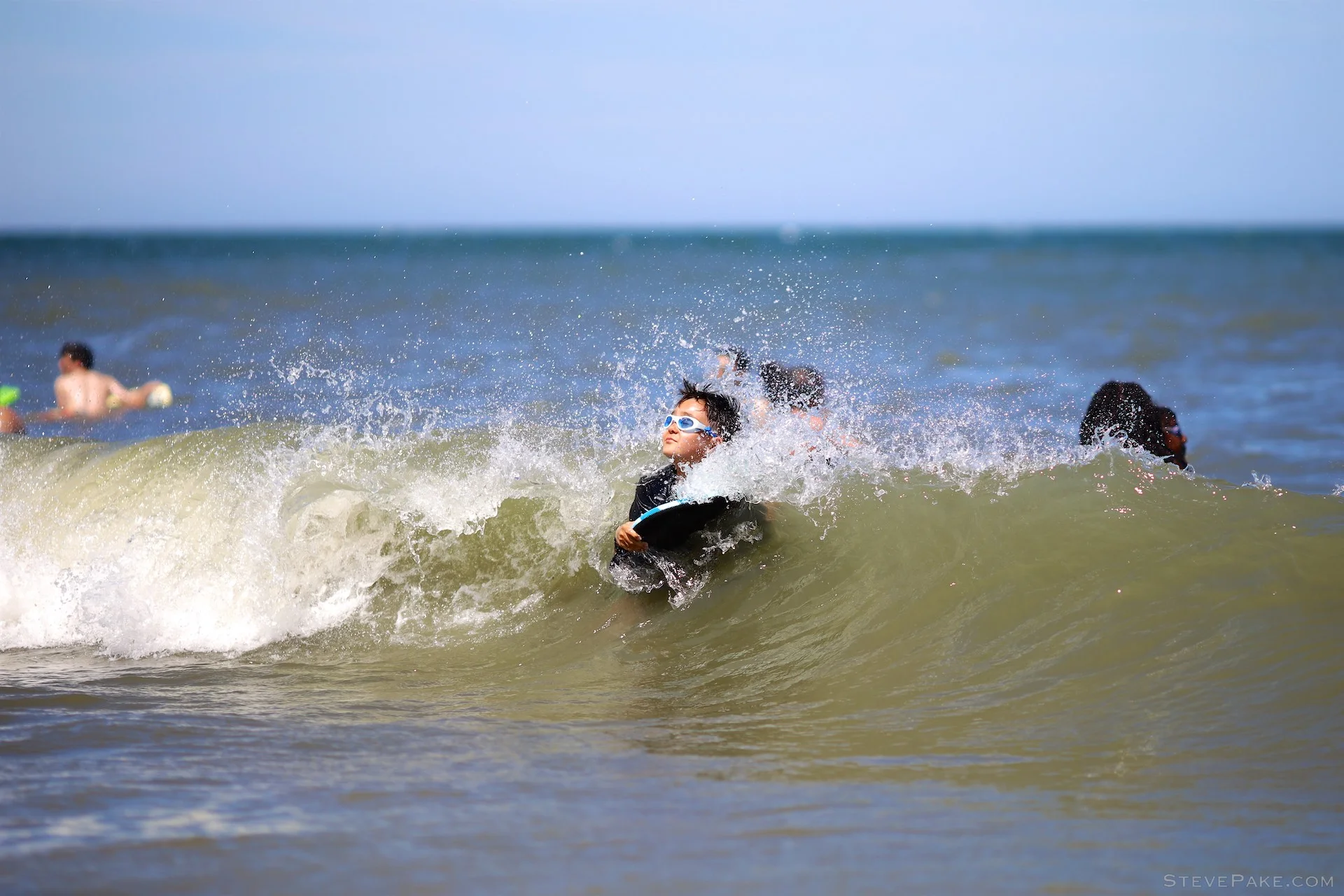
When it comes to crowded summer beaches with zillions of people, there’s nothing better than fast prime lenses to help keep your photos focused on your subjects, and not on other beachgoers! Beach photography with my Canon EOS RP and Canon 35mm f/1.4L and 135mm f/2L lenses.
The dynamic duo back in their natural element, the Canon 35mm f/1.4L and 135mm f/2L lenses on a proper full-frame camera, the Canon EOS RP.
Now that I’m back to shooting full-frame with the Canon EOS RP mirrorless camera, I’m overjoyed that all of my lenses make sense again, and especially my Canon 35mm f/1.4L and 135mm f/2L fast primes. I adored these lenses on my old full-frame Canon 5D Mark II, but as digital rot set in on those bodies, I longed for something newer and with a zipper frame rate and autofocus. I found that the successor 5D Mark III was just too much money for a professional non-professional enthusiast level photographer, and that the new full-frame Canon 6D (Mk I at the time) seemed like more of a side-grade or even a step down in various respects versus my 5D2, so I went with the crop frame APS-C 7D Mark II instead (and don’t ask me about Canon’s model naming convention). The 7D2 was and still is a brilliant camera, and probably one of the most well-rounded cameras I’ve ever owned with its much more modern tech, crazy fast autofocus system, and blazing fast 10 fps frame rate. I loved everything about it and still have it, except that it’s just not a full-frame camera. My high-end lenses didn’t work as they should, and it just doesn’t deliver the “look” that a full-frame camera does.
Canon EOS RP with 35mm f/1.4L at f/1.4, 1/4000s, ISO 50 at 2PM at the beach. Check out the natural vignetting. I love it and it gives a much more “organic” look than the totally flat rendering that you’d get with a crop-frame camera.
I can and do walk around all day with a wide-normal prime lens like the 35mm f/1.4L, which is why the Fuji X100F with its built-in 23mm f/2 lens and a 34.5mm equivalent focal length is such a great fit for me. But that 35mm lens on a crop-frame camera suddenly becomes a 56mm equivalent, which just feels awkward to me. The 135mm f/2L is a brilliant medium telephoto lens on a full-frame camera, but becomes too long most of the time at 216mm equivalent on an APS-C. In addition to the crop frame equivalent focal lengths ending up being awkward, given that you’re only utilizing the center of the image circles of these lenses on a crop frame camera, you lose all of the glorious vignetting that really adds character and another dimension to your photos that you get when shooting with them on a full-frame camera. As brilliant of a camera as I’ve found my 7D Mark II to be, it’s always had a very flat and dull image rendering that I found lacking, and it’s entirely due to the format.
Some people will think I’m crazy or old-fashioned, but I love all of the vignetting and distortions of the “older” lenses that were originally designed back in the film era when shot on full-frame cameras, and feel that modern lenses are over-corrected. A lot of people disagree with that blog, but I don’t, almost wanted to scream from my rooftop when I first read it because I thought I was the only one, so I really don’t care what other people might think or how many times its been “debunked” on the Internets. I’ve always found it crazy that people spend thousands of dollars on the latest over-corrected lenses, just to add things like vignetting and various distortions back in in post-processing! How crazy is that? My “old” full-frame lenses do that all by themselves, and if you don’t like it just stop down a bit. There’s definitely some niche areas of photography where the latest and greatest super corrected modern lenses can help you and might make more sense, but for the most part I think it’s just splitting hairs or pixel peeping, and I’m quite happy with my old film era designed lenses.
Enough Gear Talk, The Beach!
Related: TURKS AND CAICOS WITH MY NEW CANON EOS RP
Anyways, this is about the beach. I’ve already been to the beach with the Canon EOS RP, but that was to Turks and Caicos with my 17-40mm f/4L ultra-wide and 70-200mm f/4L telephoto zoom lenses, and places where there weren’t going to be a million people. Rehoboth Beach, Delaware in the summer after schools have just gotten out is a very different place, and the thing that’s always irked me about trying to get good photos of my kids at the beach is just how many people always end up being in the background of my photos. Without fail, whenever I manage to get a really awesome shot of my kids, either there’s some hot girl in a bikini in the background and I get slapped on the shoulder by my wife and accused of actually trying to take a photo of the girl (it’s happened!), or something closer to the exact opposite of that. Either way, crowded beach photography can be a total pain in the ***!
135L at f/2.5, 1/2500s, and ISO 50
You’re never going to be able to frame your subject at a crowded beach such that there’s nothing distracting in the background, and cropping isn’t always an option either. The solution is to just shoot a fast prime lens, keep your kids in focus, and then yank whatever else is out there as far out of focus as possible. You can do this with a 70-200mm f/2.8 zoom also, but those are massive hulking lenses that are a pain to lug around. Something like the Canon 135mm f/2L lens is a fraction of the size and weight, so much more fun to shoot with, and you get a stop of additional speed and subject isolating ability with it.
Yes, you can shoot fast primes at the beach, and no you don’t necessarily need an ND filter. With my old Canon 5D Mark II, this was a piece of cake. You could drop it down into its special ISO 50 mode, and then with a top shutter speed of 1/8000s you could practically shoot at f/1.4 in broad daylight at the beach. That was always a little overkill, and shooting at f/1.4 while keeping a dynamic and moving subject in focus at all was virtually impossible, so f/2 to f/3.2 or so tends to be the sweet spot. The Canon EOS RP has a top shutter speed of 1/4000s, so not quite as good as the top cameras, but it still has a trick ISO 50 mode so I had no trouble shooting at large apertures at all. One of my old Nikon cameras used to have a base ISO of 200, and a top shutter speed of only 1/4000s. That’s where you’ll struggle and really need an ND filter in bright conditions if you’re trying to shoot at large apertures, but as long as your camera can do at least a 1/4000s shutter speed with a base ISO of 100, you should be good most of the time to shoot in the f/2 range.
I’ll just let the results speak for themselves, and say that even in restaurants I find something like the 35mm f/1.4L to be amazing with its ability to yank other tables and parties in the background so far out of focus that you don’t even know that they’re there.
William Hits The Waves
This series of photos were all taken with the Canon 135mm f/2L lens, which is one of Canon’s classics and very best, and at least to my eyes these photos all have one thing in common. They’re not distracting at all and keep your eyes focused on the subject, despite having potentially distracting elements in the background. The other beach goers in the background are far enough out of focus that your eyes aren’t drawn towards them, and the natural vignetting of the lens shot at or near full aperture further helps to center your eyes on the proper subject.
135L at f/2, 1/2500s, ISO 50. If my camera only had a base ISO of 100, the needed shutter speed for this photo would have been 1/5000s, above the top shutter speed, so I’d have had to stop down to about f/2.2. Big deal. For the most part I was okay without the special ISO 50 mode, but it was handy to have for situations like this and not have to dork around with ND filters.
135L at f/2, 1/2000s, ISO 50.
135L at f/2, 1/2000s, ISO 50.
135L at f/2, 1/2000s, ISO 50
135L at f/2.8, 1/2000s, ISO 50
135L at f/2.8, 1/2000s, ISO 50, cropped. You can always shoot at 135mm and crop a bit if needed, but if you’re already at 216mm equivalent on a crop-frame with this lens, it’s often already too long and you can’t make it wider! The 85mm f/1.8 is a better option for crop-frame cameras.
The depth of field is so thin with an f/2 medium telephoto lens that just your subject ends up being the only thing in focus, and everything else just melts away. It’s glorious! And this little 135mm f/2L lens is a joy to take anywhere, and isn’t a hulking beast like the 70-200mm f/2.8 lenses which are a stop slower. I used to own a Nikon 70-200mm f/2.8 VR lens when I shot Nikon. It was a glorious lens, except it was so big and heavy that I never wanted to take it anywhere! The 135mm f/2L is so small and light in comparison.
35L at f/2.8, 1/2000s, ISO 100.
35L selfie at f/3.5, 1/2000s, ISO 100.
The Rehoboth Beach Father’s Day 5K
The auto eyeball grabbing autofocus system in the EOS RP is good enough that I can hand my wife or kids the camera with one of these lenses on it, and it’ll generally be smart enough to grab focus on the proper subject. I had her take a few of us with the 35L lens, and then swapped the camera over to the 135L so that she could get race photos of us coming in to the finish line.
35L at f/1.6
35L at f/3.2
The 135mm f/2L prime is super handy for my wife! I don’t know why she does this, but she’s just so used to her iPhones after all these years, that she no longer understands zoom lenses. As many times as I’ve told her to ZOOM IN with any of my zoom lenses, she’ll burst a hundred photos of one of us at the wide end of a lens while we’re still a mile away and just a tiny spec in the viewfinder, leading to totally useless photos. With the 135mm f/2L prime, she’s PRE-ZOOMED and cannot “zoom out”, and was finally able get some nice race photos of us! :)
The Hulk coming into the finish! I ran the 5K in a 30:24 which is pretty freaking good for this hulking 6’3” 270lb giant who still suffers from post-cancer chronic fatigue issues!
William is 10 and ran a 28:05. He’ll be going out for track in middle school, which is why I’m holding onto my Canon 7D Mark II and Canon 100-400L II lens. :)
Banner tow plane at 135mm and f/2. What you’re seeing here is the natural vignetting of the lens.
Sand castles at 135mm and f/2.
ROWR!!!! Here’s the one hot babe I can photograph at the beach and not get in trouble for! 135mm f/2L at 1/3200s, ISO 50, and f/2. Yes, there’s people in the background here on both sides who may or may not have been distracting in some way, but there’s so far out of focus that you almost don’t even realize they’re there, which is why you want to shoot these lenses at the beach.
Dinner Time
Our fav! Henlopen City Oyster House in Rehoboth Beach is so good that we’ve come here during the off season just to eat here. Yes, it’s that good. See the full album for food photos.
Father’s Day. Slight boo-boo. There wasn’t quite enough depth of field here with the 35L at f/2 to keep Katie in focus. Oops! You definitely need more shot discipline when shooting full-frame, but it’s worth it. f/2.8 probably would have done the trick.
The 35L at f/2.
35L at f/2
35L at f/2
35L at f/2
Evening Stroll on the Boardwalk
Moonrise with the 135L at f/4, 1/160s, and ISO 250.
35L at f/1.6 - the other guy in the background is already falling well out of focus.
Morning Catch on the Beach
135L at f/2.5, 1/2500s, ISO 100.
135L at f/2, 1/2000s, ISO 100.
35L at f/2, 1/2500s, ISO 50
35L at f/3.2, 1/2500s, ISO 50, +1.33EV and then pushed in post. I was trying to see how well the Canon EOS RP would do with a contre jour type backlit photo, and the answer is not nearly as well as my Fuji X100F, although I probably could have exposed it better.
Fess up to the f*ck up. 35L selfie and even at f/4 William is way too far out of focus. LOL. You can definitely get away with sloppy technique much better on APS-C. Full-frame is much less forgiving.
35L at f/8
35L at f/8
35L at 1/4000s and f/2
135L at f/2, and the people in the foreground are melted out of focus. Some people might dislike it or find it distracting, but I took an identical shot at f/8 and much preferred this one.
135L at f/2.2, 1/3200s and ISO 100.
Fess up to the f*ck up. This is the ONE photo I took with my 17-40mm f/4L ultra-wide, the family selfie before leaving, and of course I messed it up. Somehow the lens got bumped from autofocus to manual focus mode, and didn’t focus properly. Oh well.
Versus the Fuji X100F
Related blog: IS THAT A LEICA? TRIAL BY FIRE WITH THE FUJI X100F AT REHOBOTH BEACH, DE
I’ve previously brought just my Fuji X100F to Rehoboth Beach, and I know it’s a totally apples to orange comparison, but I still like both cameras for various things. The Fuji has killer flash capabilities with its virtually unlimited flash sync speed, you can do some pretty neat tricks with the built-in 3-stop ND filter which is switchable at the push of a button. It’s also the best food camera I’ve ever had with its close focus ability and ease of fitting on a crammed dinner table. It also looks cool in nice restaurants. That said, I still prefer Canon colors a lot more in comparison to the Fuji’s “fun house” like color palette. And of course, the fixed wide-normal lens on the Fuji isn’t going to get cool photos of my kids riding the waves.
The Fuji X100 line is a master of its own universe and fills a nice niche for photogs with the know-how when they just want to relax and shoot more casually, but it won’t ever replace a full camera system. It’s a great compliment to an existing system, or as photo blogger Ken Rockwell has described, the pro’s fun camera. I’ve thought of selling my Fuji X100F to help fund some more Canon RF mount lenses, but it serves its purpose well and I’ll continue to use and enjoy it.
The Basics Are All You Need
Related: THE SECRETS TO GETTING GREAT PHOTOS
As I wrote in the above blog, The Secrets To Getting Great Photos, you don’t need to have dropped tons of money on super high end lenses to get great photos, but you do need the right tools for the job. I have and shoot the best because photography is a great hobby for me and something that I love to do, but you can get very much the same photos with lenses like Canon’s 50mm f/1.8 and 85mm f/1.8 lenses. The 50mm f/1.8 prime lens* for $125 will serve as a nice short telephoto lens on an APS-C crop-frame camera, and the 85mm f/1.8 for just $349* on rebate at B&H is a steal, and will provide the same medium telephoto view on a crop frame camera like my 7D Mark II or a Rebel as the 135mm f/2L does on a full frame. It doesn’t quite have the “magic” of the 135L on a full-frame camera, but believe me when I say it’ll deliver a helluva lot better results than most crappy zoom lenses. The Canon 40mm f/2.8 “pancake” lens is a handy little lens also, but since I was already bringing the 35mm f/1.4L on this trip, it was redundant and stayed at home.
* Note that my website is entirely personal and non-commercial, and paid for out of my own pocket. I make nada dollars selling anything and don’t have affiliate links anywhere. This is purely free and personal photography advice from “that dad” at the beach, so take it for what it’s worth, but you can’t go wrong with lenses like these. They’re absolute gems, and way better than the zillions of boring slow f/5.6 zooms out there which often cost MORE money!
Related: PETE & MARNIE - OCTOBER 2015
I did a sort of post-wedding engagement shoot of my friends Pete and Marnie, which I guess is the last pro-style photo shoot I’ve done, and I used my two Canon 5D Mark II cameras with these same 35L and 135L prime lenses. Their rendering is amazing and timeless, and anybody who says otherwise is nuts!
Anyways, I hope you enjoyed this blog and some of our beach photos. You can check out the full albums below. I split the beach photos and our 5K race photos into two different albums. We’ll be going to Virginia Beach later in the summer where I’ll again bring these two lenses, but add my Canon 100-400mm L II lens to the bag, as there’s a lot more distance shooting opportunities at that beach with the long sand bar.
Drop me a line if you want to talk about photography at all via the contact button below.
We made our annual trip to Rehoboth Beach, DE for Father's Day. The weather was perfect and we all had a great time after schools had just gotten out. William and I also ran the Father’s Day 5K race (see other album), and then celebrated by stuffing our faces with all of the delicious food at Rehoboth Beach, and of course had some fun at Funland! All in all a great trip, and a great start to the summer! :)
William and I ran the Seashore Striders Rehoboth Beach Father’s Day 5K for the second year in a row, and this is our third timed race together. William (10) did great and set a new personal best of 28:05, and I ran a very solid 30:27. We were both really happy with our results, and then proceeded to stuff our faces with all of the delicious food at Rehoboth Beach. We’re going to keep training through the summer for some fall faces to stay on top of our game. :)
Enjoy!
Steve

Memorial Day 2019 at Shenandoah National Park
We went to Shenandoah National Park over Memorial Day weekend this year. Unlike in the past where we’d enter at Thornton Gap and just stick around the central district, this time we entered at the north end of the park in Front Royal, and made our way almost all the way down to the south end of the park at Mile 80. Our kids are all a bit older now at 10 and 12, so they’re capable of a lot more than they were even a few years ago, and our dog has proven to be quite the hiker as well, so our trip to SNP was a lot of new adventures for us in an old place.
We went to Shenandoah National Park over Memorial Day weekend this year. Unlike in the past where we’d enter at Thornton Gap and just stick around the central district, this time we entered at the north end of the park in Front Royal, and made our way almost all the way down to the south end of the park at Mile 80. Our kids are all a bit older now at 10 and 12, so they’re capable of a lot more than they were even a few years ago, and our dog has proven to be quite the hiker as well, so our trip to SNP was a lot of new adventures for us in an old place.
My photography lineup for the trip was my new Canon EOS RP full-frame mirrorless camera. I was going to keep it simple and just bring the Canon 35mm f/1.4L prime lens, but it just felt wrong for some reason, so i went ahead and stuffed my bag with the 17-40mm f/4L ultra-wide and 70-200mm f/4L telephoto zoom lenses as well, along with my newly acquired used Canon 320EX flash.
I have to say, I really liked hiking with the 35mm f/1.4L lens. I think what I’d really want is the EF 24mm f/1.4L II which I could pickup cheaply used, but I’m in a bit of a wait and see mode right now with the new Canon RF mount, seeing what new native RF mount lenses they end up releasing for it, and their prices. While hiking in the wood, you run out of light pretty quickly, and can also have distracting backgrounds, so I really loved the ability of the 35L lens to get some nice mid-hike photos.
Hiking Portraits with the Canon 35mm f/1.4L
The best part of these photos besides the thin depth of field is that you still end up at a very low ISO. A slow lens and especially an f/5.6 would have needed ISO 1600 to 3200 or more for many of these.
The last two photos of William and Katie were at 1/500s and ISO 3200 and 1000 respectively. I’m not sure you’d want to go slower than 1/500s while grabbing mid-hike candid portraits, so the extra optical horsepower of the fast glass really pays off when you’re deep in the woods.
A Great Change of Scenery
Shenandoah National Park was beautiful, as always. There’s never a bad time to go.
I’m a big fan of actually using a flash when needed, but I hate big flashes unless I absolutely must. They’re heavy and take up a ton of space that could otherwise be used for a lens, and just annoying and clunky to use, so I’ve always been a fan of the mini flashes.
I used to have a Canon 270EX, which had a handy head that would flip up for bounce flash and also had two zoom settings, but with only 2-AA batteries it took way too long to recycle at full power, and overall just didn’t have enough power and sold it. I picked up a used Canon 220EX flash which takes 4-AA batteries and definitely recycled more quickly at full power, but fixed 28mm angle and no bounce flash. it definitely worked better than the 270EX, but I found it lacking for larger groups of people where you need some fill flash during daylight. So yet another flash! I recently picked up a Canon 320EX used from KEH.com, and I’m pretty pleased with this one. It has 4-AA batteries again and a handy LED light if you’re doing video or want steady illumination for the all important food photos, but it also has a manually zooming head with 28 and 50mm settings, and now it finally has proper fill power for people that might be further away. I didn’t use the flash all that much on this trip, but I was pretty pleased with it. It did as good of a job here as my big Canon 580EX would have done at only half the size and weight, and that’s what you want when you’re out hiking - just enough to get the job done without any extra weight.

Nice even illumination on faces despite the mixed lighting thanks to the Canon 320EX flash!
We always love the change of scenery up in the mountains. Sorry for the lack of more annotations on WHERE exactly each photos was taken at and settings. No time and really just wanted to get a nice photo blog up, but if you’re really curious, hit my CONTACT link and I’m happy to chat photography or what to see and do in Shenandoah National Park with anybody. :)
Overall, we had a great trip, and the weather was perfect for us with only a few very brief rain showers that we didn’t get caught in. The Canon RP is an awesome camera, although i’m definitely looking forward to getting some native RF mount lenses to drop a bit of size and weight. I’ve always loved the look of full-frame photography more, but not the size and weight of all of the gear. The mirrorless camera body itself is significantly smaller than something like a 5D or 6D full-frame body so helps a ton by itself, so once more full-frame mirrorless lenses are available, it will really start to mature as a new camera system. Can’t wait to blow more money!
You can see the full photo album at the link below.
Living in the D.C. area, we love making the hour or two drive out to Shenandoah National Park in Virginia. Now that our kids are a little older and can do a little more, we’ve started venturing out, and started at the North end in Front Royal, and went all the way down to Mile 80 in the South end of the park, taking in much more of Skyline drive, and doing a bunch of hikes that we’d never done before. It was a great way to spend Memorial Day weekend.

HyperFest 2019
William and I made our way all the way down to Virginia International Raceway (VIR) in Alton, VA, a 4 hour drive from the DC area, for HyperFest 2019 and a boys only weekend. It was a blast to see all sorts of cool cars blasting around, and getting to camp out at the track.
William and I made our way all the way down to Virginia International Raceway (VIR) in Alton, VA, a 4 hour drive from the DC area, for HyperFest 2019 and a boys only weekend. It was a blast to see all sorts of cool cars blasting around, and getting to camp out at the track.
Along with the tons and tons of Bimmers, there were lots of Corvettes, Ford Mustangs, and Chevy Camaros, and miscellaneous other cars. We saw a few Dodge Vipers, a MkIV Toyota Supra drift car (which broke), and some Nissan Silvia (aka 240SX) drift cars, most of which were converted to V8’s. There were also a number of Hondas and Acuras, a ton of Mazda Miatas and some RX-8’s with their screaming rotary engines, and a few Porsches racing around. Strangely missing, I saw absolutely zero Nissan Skyline R35 GT-R’s on the racetrack, which seems pretty bizarre considering there are a lot of these cars around now, and that Nissan is the course sponsor. The only Nissan Skyline I saw was an old R32 which I don’t think was a GT-R, with an instructor on board. We managed to spot the Honda Manufacturing Odyssey race van, so there were more (bleeping) minivans on the track than there were GT-R’s. What a travesty! :)
Not that I’m biased or anything but, my personal favorites were the BMW Spec E46 and Spec E30 cars, which had started out their lives as regular production spec BMW 3-series models, but now converted by their owners into race spec machines. Seeing these old Bimmers tearing around the track with their Straight-6 engines screaming was a sight and sound to behold. The drift cars were also pretty amazing to see and hear (and smell!) as well, so of course I had a ton of fun taking pictures of all of them.
A Spec E46 car blasting away from the South Paddock, and probably one of my favorite captures of the whole weekend.
Spec E30
If any Spec E46 or E30 guys happen to see this, drop me a line because I have tons of photos of y’all.
Gear
I brought my new Canon EOS RP with the 17-40mm f/4L ultra-wide lens, and then my 70-200mm f/4L non-IS lens, but I knew two things in advance. I wasn’t sure if either the autofocus or the frame rate would be up to the task of capturing race cars at varying angles, and I was also quite sure that just 200mm on a full-frame body was probably not going to be long enough. I had the option of bringing my Canon 100-400mm L II lens, but it’s a tank of a lens and this was supposed to be a fun weekend with my son, and it was also forecast to be in the mid-90 degree range, so didn’t want to commit to carrying too much when I’d also have a backpack full of drinks and possibly carrying chairs around the race track! The big 400mm lens also wouldn’t have done anything about any autofocus or frame rate deficiency on the RP, so rather than bring another big heavy lens, I brought my Canon 7D Mark II instead. It has has unquestionably good autofocus and a blazing fast 10 fps frame rate that ought to capture anything, and also weighs half of what that 100-400L II does. And since the 7D2 is a crop frame camera (1.6x), the 200mm becomes 320mm equivalent, so there’s the extra reach I needed.
I could have just brought the Canon 7D Mark II, but wanted to play with the new RP also!
Having a second camera body also solved another potential issue in the form of power. Although I had pretty good battery life in Turks and Caicos, shooting sports and action rather than landscapes is a totally different thing, and I wasn’t sure the two tiny little LP-E17 batteries were going to make it through the weekend without recharging. I didn’t feel like bringing my big external power station and A/C inverter, and it’d also be a colossal waste of energy to use the AC outlet in my truck, which requires that the engine be running just for a tiny little battery. The best option here for field recharging the new Canon EOS RP is a portable USB battery recharger that most everybody has these days, but there’s a catch. Unlike my Fuji X100F that will recharge off of standard USB charger, the EOS RP needs a PD spec charger, which I don’t have yet. So to make a long story short, bringing my Canon 7D Mark II along let me kill three birds with one stone in that two fully charged Canon LP-E6N batteries would be more than enough for the weekend. In hindsight, I could have just brought the 7D Mark II, but the point was to try out the new toy and put it through its paces. :)
Photographing Race Cars
The trick with photographing moving objects is to make them actually look like they’re moving. You can go out and shoot shutter priority (Tv or S mode) at 1/1000s and you’ll definitely get nice, sharp photos that are free of any hand shake or motion blur. The problem is, then your speeding race car actually looks frozen on the track and like it’s not moving at all. Not good. Photographing propeller driven aircraft is similarly challenging in that if you use a fast shutter speed, you’ll freeze the propeller, and make it look like the engine has stalled and the plane is going to fall out of the sky. Of course, there’s a catch.
The longer (slower) the shutter speed you try to use, the more shots you’re going to lose that are just too blurry to be usable at all. To keep a speeding race car sharp while dragging the shutter at a slow speed, requires you to track the object that you’re tracking in thew viewfinder as precisely as possible, so that the subject remains nice and sharp and blur free, while everything in the background blurs away as you pan with the subject.
1/80s
We got to the track, and I saw these beautiful looking and sounding BMW SPEC E46 and E30 cars blasting out of turns 5a and 6, whipped out my camera and fired. The panning blur at just 1/80s was great and looked fantastic, but then ask me what my keeper rate was. Not good, and most of the photos were lost completely to excessive blurring.
1/125s
1/125s gave me a noticeably better keeper rate while still having nice looking panning blur in the background, so I stuck with that.
1/125s at Turns 5a/6
1/125s at Turns 5a/6
1/160s between Turns 4 and 5.
This blue E46 M3 was gorgeous. 1/160s between Turns 4 and 5.
1/125s, Front Straight
1/125s, Front Straight
We camped out on top of the hill here, but managed to make our way to the other side of the track to take a look from various vantage points.
The Rally course was fun to check out too. William can still get motion sick pretty easily, so we didn’t give it a try. With the rally cars you’re already getting a big sense of motion from all of the dirt they’re flinging around, so this was at 1/500s.
Drift Cars
Here’s where I really struggled with the EOS RP. The autofocus was fine, but the camera kept wanting to display the image review in the electronic viewfinder between when the cars were at the top of the hill, and then in full opposite lock sliding right past us a few seconds later. Trying to show the image review would cause me to lose track of where the cars were through the viewfinder, and there’s a noticeable lag that’s less than a second but long enough to be a distraction, between when the camera gets back into live view mode again through the EVF. This is something that I just wasn’t used to or prepared for from being used to shooting a DSLR with a straight optical viewfinder. Oops. I can easily disable the image review in my “C2” bank for Sports/Action, but didn’t want to mess with it while busy shooting. 200mm also wasn’t long enough to get to the top of the patriot course, and the frame rate is only 4 fps with autofocus and exposure running and not 5, so it’s honestly a pretty pokey camera if you’re used to more. And that’s why I brought the 7D Mark II. :)
I love all of the stuff that newer technology lets you do, but there was nothing like going back to a ground glass optical viewfinder on my DSLR when shooting these high-performance drift machines, with an absolute no nonsense real-time view.
I shot at about 1/1000s for a nice sharp view of the cars far away and up the hill, and then spun the control wheel down to around 1/200s or less as they slide past us in full opposite lock with tires blazing to get some nice panning blur in the background. Yes, that’s some sort of drone with a GoPro mounted to it tracking the Corvette!
They had a 500hp BMW E70 X5M with a fully rigged out camera car to record the drift cars, which was pretty neat to see as well. It has to be fast enough to keep up!
Full Course Drift
At the end of the day, they had a full course drift for the drift cars. William and I were setup near Roller Coaster (Turn 15) for the power wheels downhill competition. Check the full album for those.
HyperFest 2019 in Review
Overall, HyperFest was a blast, and VIR is a truly incredible track. There’s not too many tracks where you can have multiple configurations running at the same time, which is how they had the track spec cars running on the full course, and then the drift spec cars on what’s called the Patriot course, so there’s always a lot going on and a lot to see.
William and I both loved it and we had a fun time camping out, but it was definitely way too hot at 94 degrees! We’d love to go again next year, but not if it’s that hot, and it’d be fun to bring some friends along to help make the long drive a bit more entertaining. Even the cars and the drivers were definitely suffering as the day wore on due to the heat. We kept ourselves well hydrated, but still had to hop into our living room - I mean Suburban - with the A/C running twice for 30-45 minutes each time, just to cool down a bit and avoid heat stroking. After getting up at 5am to leave from Maryland and after walking around in the heat all day, we were too tired to watch the burnout competition, even though it was just 100 yards or so away from our tent. Also, ear plugs are definitely required if you want to get some sleep. This isn’t like Cub Scouts campouts - there’s not really a such thing as quiet hours. Some people had pretty noisy generators running all night, and of course some people nearby had other music playing all night “to help them sleep”, which of course kept us both up, so ear plugs are a must.
Photography Wrap-up
Photography wise, sports and action just aren’t the Canon EOS RP’s forte, but I was well aware of this when buying it. There’s a huge difference between 10 fps and just 4 when shooting sports and action like this, so clearly the 7D Mark II did the much better job, and has the autofocus and frame rate to keep up. I still love the look of full-frame more, but for photos like these it didn’t really matter. I’ve disabled the image review on my RP’s “C2” bank that I have setup for sports and action now, so that will help a bit keeping the viewfinder engaged on the subject, and not switching between that and image review mode where there’s some lag, and then you can lose track of your subject. If we go again next year, I’ll probably just bring the 7D Mark II.
Transportation
The Suburban was, of course, a fantastic road trip machine. It was super comfortable the whole way there and back, and with the optional 3.42 gears that I insisted on getting, it never needed to downshift out of top gear even once though the southern VA foothills. It managed a pretty incredible 23 mpg overall, which included the 1-2 hours of time spent idling with the A/C running, a few full throttle passes around morons, and two minor traffic jams. I wasn’t just impressed, I was blown away, because this was nearly as good as my old Toyota RAV4 V6, which would never seem to do anything better than 23-25 mpg overall on road trips despite being half the size. Minus sitting with the A/C running and WOT passes, it probably would have done 24 mpg. Our old BMW X5 turbodiesel could do 26-27 mpg pretty consistently, but again it’s much smaller, and diesel fuel can tend to get pretty pricey also. A vehicle the size of your living room getting 23 mpg is really freaking good, and after just over 500 miles it still had enough fuel leftover to go another hundred, for a legit 600 mile cruising range. I’m sure some of your minivans will do better per mile if not outright cruising range, but you know how I feel about minivans, so piss off. :)
Two final things to checkout:
Don’t miss my photo album below.
HyperFest 2019 Full Photo Album
Also, this dude with a sweet GT350R put up some cool YouTube videos that are worth checking out. I actually just got a GoPro Hero 7 Black, but have barely even taken it out of the box yet, haven’t even powered it on and have absolutely no clue how to use it, so didn’t bother. My brain doesn’t speak video very well at all, I’ve always been more of a stills guy, but if we go again next year I’ll bring that for sure, along with a decent mic to capture the amazing sounds these machines make as well.
Hope you enjoyed the blog!
StevePake.com

Why I Don't Give A (Bleep) About Cancer Anymore
I was diagnosed with testicular cancer at the age of 33 and thought my life was over, but today I’m an 8 year survivor of the disease, and at the age of 41 I’m not even a young adult anymore. Times change, perspectives change, we all grow and evolve not just as cancer survivors but in life itself. At this point I just don’t give a (bleep) about cancer anymore. Here’s why.
I was diagnosed with testicular cancer at the age of 33 and thought my life was over, but today I’m an 8 year survivor of the disease, and at the age of 41 I’m not even a young adult anymore. Times change, perspectives change, we all grow and evolve not just as cancer survivors but in life itself. At this point I just don’t give a (bleep) about cancer anymore. Here’s why.
Because I’m Not Afraid of My Body
It was only fitting that I spent my 8 year cancerversary back on February 14th with disconcerting pains in my healthy remaining left testicle, but it didn’t faze me. There’s only so many times that you can freak out about “strange pains” in your body until they’re no longer strange at all, and don’t freak you out. As a big and tall guy with a history of bilateral inguinal hernias, and a body that has attempted on more than one occasion to tear itself in half, “strange pains” in this area of my body are a regular part of my life. Only one time out of literally thousands has it ever meant cancer. In my early years after cancer, strange pains like these had me huddling in that corner in tears, but I’m long past that and am just not afraid of my body any more.
Because Life Moves On After Cancer
The truth is, life just plain moves on after cancer, for better and for worse, in good ways and in bad, and whether you’re ready or not. The painful reality for many young adult cancer survivors is that there’s far more in life that we’re going to have to face, some of which might be just as shocking, painful, unfair, or as horrifying or heartbreaking as our cancer fights had been. Just because you had cancer doesn't meant that life, and its associated drama and messiness, stops happening. Nobody else is really going to care that we had cancer earlier in our lives, nor try to make things easier or roll out the red carpets for us. Not that I was expecting that, but I wasn’t expecting something closer to the opposite either. It’s almost as though the powers that be in the Universe saw how well my wife and I handled cancer together, and then said “hold my beer” while doubling down on us. There are so many things in our lives since my cancer fight that have been unbelievable, unconscionable, and completely unthinkable, and we’ve had to rise to all of them. My life has moved on completely from cancer at this point because I’ve had no other choice but to, with so much else to face in our lives.
The flip side of tremendous challenges elsewhere has been the potential for tremendous growth. It’s been another challenge in and of itself to stay on positive paths in the midst of so much, and never for a minute has it been an easy ride. Learn to let go and disconnect, and to forgive and forget. Your past isn’t happening right now, so don’t let it spoil your future, and never stop living your lives.
Because I’ve Always Put my Family First
I do work my tail off at my paying job, but I always take all of my “earned” vacation, and never let much if any of it go to waste. Work hard, play harder. As a young adult cancer survivor, I felt for many years that I would never make it to 40, and that I might not have much of a future. Nothing was certain for me - I wanted to enjoy every minute of time with my family that I could, and that’s what mattered most to me. If that means I won’t be considered a “top performer” at my company or will miss out on some promotions because other people are slaving away, working even harder and hardly taking any of their vacation, so be it. I’d much rather have the memories of so many fun times and grand adventures with my family than be the next level or two up in my career.
I do regret that I’m no longer doing the nonprofit work that I used to do, but that too had evolved into another full-time job on top of a very demanding full-time job and a busy family life, and just wasn’t sustainable anymore. My wife felt abandoned and like she didn’t have a husband anymore, and my children were at the age where they really needed my presence in their own lives, and not in others. I would have found a way to continue what I was doing in the nonprofit world on a much more time limited basis, but suddenly finding myself in the crosshairs of over-sized egos and greed, while being subjected to a barrage of insults and completely false and disparaging comments by the very organization that I had made so many sacrifices of my and my family’s time for was one of the greatest shocks of my life. To be so insulted and falsely accused after all I had done and the huge sacrifices I had made, was a moral red line that never should have been crossed. Anyone with even an ounce of self-respect would have immediately walked away, and that’s exactly what I did.
My family has been supportive of everything I’ve ever done, but enough was enough and the appropriate decisions were made. It’s a shame how easy of a decision it was, but we’ve been through far too much to ever tolerate anyone else’s (bleep). Now my time is spent exactly where it should be, entirely dedicated to my family. My family will always come first, and you’ll never have any regrets when that’s your priority.
To be here in this moment after all my family and I have been through is the only victory I need.
Because I’ve Lived a Good Life
Truthfully, I really don’t have too much to complain about. I’ve been blessed with the love of a beautiful woman and soulmate in my life for over half of my life. We’ve been together for 23 of our 41 years, which is amazing. We have two awesome kids and an equally awesome dog, and stable jobs that have afforded us a comfortable lifestyle that has allowed us to enjoy the world we live in.
Yes, I had cancer earlier in my life, and there are numerous other aspects of our lives that have been completely (bleeped) up beyond all recognition, but things could always be so much worse. We could be living in Venezuela, where people have nothing to lose risking their lives by rioting in the streets, because their country has been mismanaged into complete collapse and they’re hungry. We could be living in one of the many areas of the world torn by war, terrorism, or totalitarian regimes where people literally have nothing, or have lost everything. Or we could be characters in Game of Thrones. Or maybe I might not have ever found any of what I have. Or I could have died of my cancer.
I’m not going to trivialize the other challenges we’ve had in our lives as “first world problems” because they’re not, and because some of them have been even more horrifying and heartbreaking to deal with than my cancer fight ever was. I’ve come to accept that it’s just life, that it was never supposed to be fair or make sense, and we’ve managed to live a good one with so many great times and grand adventures despite what life has put us through, and we’re proud of that.
We’re very blessed and fortunate despite all that we’ve been through.
Because I’m Proud of What I’ve Achieved
You don’t need to be a millionaire, have a verified social media account, or have a New York Times best selling book to have made a difference in the world. Young adult cancer and especially testicular cancer is a relatively rare thing, and differences are made on a smaller scale. I’m proud of all of the writing that I’ve done and the difference it’s made for thousands if not millions across the world that have found it in various places, and how its helped them find their ways through their own cancer and life journeys. To serve as a young adult cancer mentor and guide for so many others has been a great honor and purpose to have served.
I’m proud of the Testicular Cancer Summit that I co-founded with Ron Bye, that helped to bring so many survivors, advocates, and experts from across the testicular cancer world together under one roof for the very first time in a way that had never been done before. What an honor to introduce Dr Einhorn at this first Summit, to an audience that for the most part wouldn’t be alive were it not for his work. What an honor to meet so many other testicular cancer advocates from across the country and across the world, and to meet so many people face to face whose lives I’d had a chance to impact in a positive way. What great moments, so many of which all came together at the first Testicular Cancer Summit.

I’m very proud of everyone who helped make the original Testicular Cancer Summit of 2017 happen.
It’s really too bad about what happened after the Summit, that over-sized egos and greed got in the way of such a great thing continuing, the blatant lies, dishonesty, and fraud, that lawyers had to get involved, that bridges were burned all over an event meant to “unite” people, and that the very people I was hoping would most benefit from the event choose to completely betray literally everything I had ever done for them instead. As they say, no good deed goes unpunished. The Summit itself was amazing, despite having become a victim of its own wild success. It was a truly great accomplishment for myself and all involved, the community I continue to serve is far better off that this happened than had it not, and I’ll forever remember and cherish all of those great memories and moments.
Because I Accept the Inevitable, and That Anything Can Happen at Any Time
I accept that eventually we’re all going to die of something, and it could be sooner or it could be later, we just never know. My cancer could come back, or I might get another cancer, or develop some disease or health condition, and I accept that. I just got a really nasty spider bite that was so bad I almost had to go to the ER for it, but what if it was fatal and I had died on the spot? I fly a lot, and don’t think I never think of the possibilities there, either. You just never know what’s going to happen, but there’s nothing that wakes you up more to life’s uncertainties than facing a health crisis very early in your life. I live my best life because I know and accept that nothing is a given, and that anything can change tomorrow.
Dogs understand something that way too many human beings don’t. Loyalty.
The same unfortunately applies to anyone in your life that you love and care about, extending far beyond just the potential for health issues. Family members, friends, and people that you have dedicated years of your life to and gone to ends of the Earth to support, can suddenly turn on you in an instant and become your enemy tomorrow, for no reason at all. If you have people in your life that you genuinely love and care about today, enjoy their presence today, because it can all change in the next. At this point in my life there’s just not that much that surprises me anymore. It should be of no surprise to anybody that knows us well just how much we’ve come to love our dog, after some of the truly rotten and disgusting human beings we’ve had in our lives.
The bottom line is that great moments in our lives and with others never go unnoticed or unappreciated, because everything in life is subject to change without notice.
Because I Know My Place
As I look back on really the past 10 years of our lives, I’ve long since given up on ever being able to understand of even half of what we’ve been through, far beyond just cancer. It’s been tough enough to find peace with this history of cancer in my life, and there’s been so many other ups and downs, twists and turns, and tragedies and triumphs along the way. I don’t think life is supposed to make any sense, but I know my place and have reset my expectations.
“The purpose of life is not to be happy. It is to be useful, to be honorable, to be compassionate, to have it make some difference that you have lived and lived well.” - Ralph Waldo Emerson

Life isn’t like the movies.
Often times the biggest difference we make is through a terrible tragedy, and not a great triumph. That euphoric feeling of victory like in the movies is often going to elude us, but it doesn’t mean that no difference was made. Life isn’t like the movies. We also can’t solve other people’s problems for them, plenty of which are experts at creating their own. All too often in our own lives, the best possible way to resolve a problem with someone is to simply walk away, when there will never be a common ground or understanding. True victories in this world are rare. The rest is about survival, making a difference, serving a purpose, and finding ways to be useful, to be honorable, to be compassionate, and to have it make a difference that you’ve lived and lived well. That’s all you truly need to claim a victory, and I have plenty to look back upon there.
I’ve said many times that I’ll never make up some (bleep) about how “I’m glad I got cancer”, but in a strange twist, cancer gave me a way to serve that higher purpose and to make that difference through my own personal tragedies, and for that I’m grateful.
Because My Worst Fears About Cancer Will Never Be Realized
My worst fears when I was diagnosed with cancer weren’t about dying. It was about never having truly “lived”, it was about never having had an opportunity to make a difference in the world, and my absolute worst fear, my children growing up without ever having truly known their father. My children were just 2 and 4 when I was fighting cancer, but now they’re 10 and 12 and getting so big. What a blessing to have been there for them all these years. No matter what happens in the future, no one will ever be able to say that I haven’t lived a good life, that I haven’t achieved anything or made any sort of difference in the world, and that my children never had a chance to know their father.
My worst fears about cancer will never be realized, and that’s why I don’t give a bleep about cancer anymore.
Young adult cancer survivors live their lives on a different time scale than everyone else. These past 8 years since my cancer diagnosis have been like a time warp that have flown by so quickly. They’ve been filled with numerous other challenges, but we’ve overcome them all together, and have lived great lives while doing it. I’ve come such a long way and have evolved so much.
As cancer survivors, various flavors of fears, uncertainties, and doubts about our lives and our futures are always going to persist. There’s never going to be a euphoric moment of victory, but managing to outlive the worst of my fears after cancer is a great privilege and about as good as it gets. I pray I’ll be around for many more years and to see many more milestones, but I know that my worst fears about cancer will never be realized, and that’s why I don’t give a bleep about cancer anymore.
StevePake.com

Turks and Caicos with my new Canon EOS RP
A photo tour of our trip to Turks and Caicos in the British West indies with my new full-frame Canon EOS RP camera. Enjoy!
It’s not often that I ever get around to actually writing a photography blog, but when I do it’s probably because we either went somewhere or did something amazing, or I got some new photog gear to write about. In this case it’s both, Turks and Caicos island with the new full-frame Canon EOS RP, dubbed the “World’s Best Mirrorless Camera” by independent (and infamous) photo blogger Ken Rockwell.
Turks and Caicos 2019
My workhorse camera over the past few years has been the “crop-frame” APS-C Canon 7D Mark II, along with a Fuji X100F for more casual photography, but I’ve been longing to get back to full-frame photography for quite some time. Crop-frame cameras are great, but they’re just not the same as full-frame. I won’t bore anyone in this blog with gear rationale, going from full-frame to APS-C and back, or from DSLR to mirrorless and blah blah blah, because then I’d never get to the actual photos or our Turks and Caicos vacation. So for now, simply enjoy some fantastic photos of a stunningly beautiful place along with some “pro-tips”, and I’ll get to the system building and transitioning stuff another day!
Getting Back to Island Time
Debbie and I in St Lucia in 2012, shot with my Canon 5D Mark II, 24-105L IS lens at 35mm, 1/50s, f/4.5, ISO 1600, natural light.
The last time we’d been to the islands was just Debbie and I to St Lucia in 2012. This was our first real getaway together after my cancer diagnosis and fight in 2011, and it was exactly what we needed, and another stunningly beautiful place. It’d been far too long, so we were all really looking forward to this as a larger group. Between hectic work and travel schedules and being pretty burned out, we uncharacteristically had zero advanced day-to-day itinerary planned as far as where to go and what to do. That’s pretty unusual for us, so I brought a bit more photo gear than usual and planned to just trim down as needed based on whatever we planned to do on a given day.
This right here was all I really needed. Luckily I’m already pretty much set for lenses, as I used to shoot full-frame with the Canon 5D Mark II from 2010 to 2015, until I switched over to the crop-frame 7D Mark II. My Canon 17-40mm f/4L ultra-wide zoom and Canon 70-200mm f/4L (non-IS) telephoto zoom covered 90% of the photos on this trip, with the little Canon 40mm f/2.8 pancake lens able to cover the rest, along with a compact Canon 220EX flash as needed. All this fits perfectly in my ThinkTank Retrospective 5 bag, doesn’t stick out like a sore thumb, and isn’t so heavy that you’ll tire of carrying everything. I’ve always liked high-performance yet lightweight photography setups not just because heavy gear isn’t any fun to carry, but because for years after my cancer fight I suffered from chronic fatigue issues, and physically couldn’t carry that much without it wearing me out! This setup right here was no problem at all to carry, and delivered extremely pleasing results!
The new full-frame Canon EOS RP with the EF to RF adapter, Canon grip, and then the Canon 17-40mm f/4L, 70-200mm f/4L non-IS, 40mm f/2.8 pancake lens, and then an old used Canon 220EX flash, all of which fit nicely into a ThinkTank Retrospective 5 bag.
Turks and Caicos actually consists of 8 main islands, but because of numerous family members being prone to motion sickness, we elected to stay only on Providenciales (Provo), and didn’t do any half or full day excursions via either boat or air to the other islands. Maybe another time, but there’s plenty to do in Provo!
Long Bay Beach
After some initial recovery and dinner the first night with a friend who happened to be in Turks and Caicos at the same time, our first order of business was to hit the beach, obviously! We slept in the first full day, but for some reason Debbie was thinking that it was “too hot” to go out on the beach after lunch when we finally came to and needed to wait. Nonsense! It was only in the low-80’s, and there was a nice breeze which made it feel just about perfect.
Canon EOS RP with the 17-40L, Aperture Priority, 20mm and f/5.6. See the natural vignetting? I love that! It adds another dimension to your photos that’s totally lacking without post-processing on crop frame cameras, and this is half the reason I wanted to get back into full frame photography again. Just stop down to f/8, or turn on the in-camera vignetting correction, and it goes away.
Long Bay Beach was spectacular! We’d never been to a beach where the water was crystal clear like this and seemingly went on for miles off shore. We saw people easily a mile offshore standing in this same water, and this is actually one of the premier kite sailing places in the world with tons of open space and water just 2-3 feet deep. It was spectacular. St Lucia further to the south and east in the Caribbean was stunningly beautiful in its own ways, but if there’s one thing not to like about St Lucia it was that it just doesn’t have nice beaches like these as a volcanic island.
Canon EOS RP and 17-40L, Aperture Priority, 19mm and f/8, Landscape Picture Style +2 saturation, Vignetting Correction OFF.
Canon EOS RP and 70-200mm f/4L, Shutter Priority, 1/500s, 200mm and f/4.5, "Auto” Picture Style and +1 or +2 saturation.
Canon EOS RP and 70-200mm f/4L, Aperture Priority, 78mm and f/8, 1/400s. This is another reason I wanted to get back to full-frame, because 70mm ends up being too long most of the time on a crop frame, whereas the 70-200 range is “just right” on a full-frame.
Canon EOS RP and 70-200mm f/4L, Shutter Priority, 1/1000s, 149mm and f/5.6. Long Bay Beach in Turks and Caicos is one of the premier kite surfing places in the world due to the length of the beach, and miles of water that’s only 2-3 feet deep. I would have loved to try, but I have hernia issues both from being a big and tall dude, and from cancer surgeries. My body doesn’t need to take a rough fall, so I’ll just watch and take photos!
Canon EOS RP and 70-200mm f/4L, Aperture Priority, 81mm and f/8. This beach goes on for miles, and the 2-3 feet water goes offshore for miles. Amazing.
Selfie, Canon EOS RP and 17-40L, Shutter Priority, 28mm, f/5.6, 1/500s, and Full Auto AF, no flash.
Sunset Dining at magnolia restaurant and wine bar
For dinner after our first full day on Turks and Caicos, we went to the Magnolia restaurant for dinner since it had a nice sunset view off of their deck. The food was excellent, but check the full photo album for those. The view was great, especially right at sunset.
Canon EOS RP and 17-40L, Aperture Priority, 22mm, 1/60s, f/11, and Canon 220EX flash ON.
Canon EOS RP and 70-200mm f/4L, Aperture Priority, 200mm and f/8, 1/250s, Auto ISO 125. My 70-200mm lens isn’t stabilized, so I have to keep the shutter speed up as the light fades. The Auto ISO takes care of this for you.
Canon EOS RP and 70-200mm f/4L, Aperture Priority, 70mm and f/22, 1/80s, Auto ISO 200. You don’t really get much of a sunstar effect by going to a tiny aperture with the 70-200mm lens, but you can get a little bit of it.
Canon EOS RP and 35mm f/1.4L, Aperture Priority at f/2.8. I was taking some dinner portraits with the 35L (in the album) and took this landscape photo with it also. The 40mm f/2.8 pancake would have done about as well. Going to full aperture on the lens definitely helped yank other dinner parties out of focus better, but I could have left the lens home and just used the 40mm. I’m planning to get the Canon RF mount 35mm f/1.8 macro lens, which will serve my travel purposes better than both, since it can focus more closely for the all important food photos, and its also stabilized. :)
Sunrise at Long Bay Beach
I couldn’t be out on the islands with a brand new camera and not get up early for some sunrise photos, so I got up at 5:45am twice and wasn’t disappointed. Long Bay Beach was just a 5 minute drive from our AirBnB and on the proper side of the island, so very easy to get to.
6:04am: Canon EOS RP and 17-40L, Aperture Priority, 19mm, f/5.6, 1/60s, and ISO 3200. No big deal that my old 17-40L isn’t stabilized or that I didn’t break out my tripod, because ISO 3200 still looks great. You can hardly even tell you’re not at base ISO, the colors still look great, and there’s plenty of dynamic range.
6:28am: Canon EOS RP and 17-40L, Aperture Priority, 20mm, f/4, hand cranked ISO to 400 to get 1/1250s. The winds were at 20-25 knots, so I wanted to keep the shutter speed fast to help freeze the palm trees.
6:34am: Canon EOS RP and 70-200mm f/4L, Aperture Priority, 70mm and f/4, 1/800s, ISO 100.
6:41am: Canon EOS RP and 17-40L, Aperture Priority, 22mm, f/4, and 1/1250s, ISO 100, again to freeze the palm tree branches, otherwise they would have been a blurry mess from the wind.
It would have been fun to have my Canon 100-400L II lens for both the sunrise and sunset photos, but it’s absolutely no fun to lug that beastly lens around on vacation when you’re just trying to relax and unwind. In comparison, the 70-200mm f/4L is a faction of the size and weight, and absolutely painless to carry around, so that’s what I went with. If I want tighter crops on any of the telephoto shots, 26MP on the sensor is plenty to work with in the vast majority of cases, so I didn’t miss my 400mm for this.
Grace Bay at Seven Star Resort
Since we rented an AirBnB type place for all six of us, which was way cheaper than a trio of hotel rooms, we didn’t have access to any amenities at any of the resort areas, but you can get day passes at area resorts when space is available that give you access to everything a regular resort guess would have except a room. These tend to be pricey, but at $100 per adult and $50 per child, the Seven Star Resort day pass in Grace Bay was pretty reasonable by Turks and Caicos standards.
Canon EOS RP and 17-40L, Aperture Priority, 19mm and f/4, 1/1600s, ISO 100. I intentionally shot this wide-open at f/4 to get the vignetting, but probably overdid it a bit. Another photo I took at f/8 looked too flat and boring, so about f/5.6 probably would have been ideal.
Canon EOS RP and 70-200mm f/4L, Aperture Priority, 84mm and f/8, 1/400s, ISO 100.
Canon EOS RP and 17-40L, Aperture Priority, 40mm and f/8, 1/500s, ISO 100.
Canon EOS RP and 17-40L, Aperture Priority, 21mm, f/11, 1/640s, and ISO 400. The idea here with these beach foam photos is to get low, wide, and close. Since you want the foam from the waves to be in focus, but also hopefully what’s on the horizon, you need to be shooting at a small aperture for maximum depth of field, f/11 or f/16. But since the wave is moving, you also need to be shooting with a faster shutter speed, 1/500s or faster. That means cranking up the ISO a bit off of base even in broad daylight, in this case ISO 400.
Canon EOS RP and 17-40L, Aperture Priority, 22mm, f/16, 1/80s, and ISO 100, Canon 220EX flash on. I stopped down to f/16 here because it was super bright out, and didn’t want to risk an overexposed photo with the limited 1/180s flash sync speed of this camera. Looks like f/11 still would have been okay. Notice how the shadows on our faces aren’t so bad? That’s because of the fill flash! :)
Canon EOS RP and 17-40L, Aperture Priority, 38mm and f/11, 1/500s, ISO 400. This was actually an action shot because of the 20-25 mph winds, so needed to use a fast shutter speed and bump the ISO a bit.
Canon EOS RP and 17-40L, Aperture Priority, 20mm, f/8, 1/400s, and ISO 100.
Chalk Sound
I saw Chalk Sound from out the window of our Southwest flight on the way in to Providenciales and didn’t even know what it was, but thought it looked fantastic. It’s a large lagoon that’s mostly less than 5 feet deep that has this beautiful turquoise color to it, so a drive through Chalk Sound Drive was definitely in order. Let’s just say that land development in Turks and Caicos isn’t always coordinated. Private luxury homes and a lack of official look out points make it difficult to see, but it’s worth it for sure. I know I’ve seen the view in the first two photos below in some magazine before.
Canon EOS RP and 17-40L at 33mm and f/8, 1/320s, ISO 100.
Canon EOS RP and 70-200mm f/4L at 200mm and f/8, 1/320s, ISO 100.
Canon EOS RP and 17-40L at 21mm, f/13, 1/160s, ISO 100.
Canon EOS RP and 70-200mm f/4L at 70mm and f/8, 1/320s, ISO 100. I love that the 70-200mm lenses are just wide enough on a full frame camera to get nice short telephoto landscapes like these. 70mm is way too long on a crop frame camera, which makes this lens more difficult to use.
Canon EOS RP at 17-40L at 29mm and f/8, 1/640s, ISO 100.
Sunset at Leeward Beach
After taking in Chalk Sound and a failed attempt to find out how to get to Taylor Bay Beach, we had lunch and then took naps, and went over to Leeward Beach, which has a nice view towards the west to take in the sunset.
Canon EOS RP and 17-40L at 25mm and f/8, 1/250s, ISO 100.
Canon EOS RP and 17-40L at 40mm, f/14, 1/180s, Canon 220EX flash on, Lightened with Nik Color Efex Pro 4. This was a tricky photo to pull off, and I should have been in full manual exposure mode, and should have had the flash set manually to go full power each time. Chalk it up to being a newbie with the camera though, I didn’t know how or where to set it. This would have been easier with my full-sized 580EX flash, which you can set to full power manually right on the flash itself rather than fiddling around in menus. Either way, I really love how this photo turned out!
Canon EOS RP and 17-40L at 28mm, f/11, 1/125s, and ISO 100, Canon 220EX flash on.
Canon EOS RP and 70-200mm f/4L at 81mm, f/8, 1/3200s and ISO 100.
Canon EOS RP and 17-40L at 24mm, f/8, 1/400s, and ISO 100.
Canon EOS RP and 70-200mm f/4L at 200mm and f/6.3, 1/320s, ISO 200, cropped to about 350mm equivalent or so. Even with only a 200mm lens, there’s still more than enough resolution to crop pretty heavily if needed and get a nice sized print.
Taylor Bay Beach
Taylor Bay beach is pristine, and when you finally find your way to it you almost feel like you’re on some deserted island beach in the south Pacific somewhere. It just feels special, which is probably why the locals try so hard to keep the general public and commoners like us out of it. While all beaches are public in Turks and Caicos, the wealthy homeowners in this area have blocked off all of the land access, have signs threatening to tow cars away, and have blocked paths down to the beach. Google satellite view helped us find our way down, and once we were there it was spectacular.
Canon EOS RP and 17-40L at 26mm, f/11, 1/160s, Canon 220EX flash on.
Canon EOS RP and 17-40L at 24mm, f/16, 1/160s, ISO 100, and Canon 220EX flash on, lightened in the center a bit more with Nik Color Efex Pro 4. This is where cameras with faster flash sync speeds come in very handy, like my Fuji X100F (or old Nikon D40), as being able to use a faster shutter speed allows you to proportionally capture more of the flash lighting and less of the ambient light, which makes your flash more powerful. Only 1/180s flash sync speed isn’t the best, but most cameras these days aren’t much different. My 220EX flash just barely got the job done.
Canon EOS RP and 17-40L at 21mm and f/8, 1/400s, ISO 100.
Canon EOS RP and 70-200mm f/4L at 200mm and f/8, 1/500s, ISO 100. These people don’t want us on “their” beach, but it’s not technically their beach anyways! :)
Canon EOS RP and 70-200mm f/4L at 70mm and f/8, 1/500s, ISO 100. Again, here’s where a full-frame camera can make full use of the 70mm wide end of the 70-200mm lenses. This would have been way too long on a crop frame camera.
Canon EOS RP and 17-40L at 27mm, f/11, 1/180s, and ISO 100, Canon 220EX flash on, and some additional fill lighting added in Nik Color Efex 4 Pro. Why not just skip the flash and just do the fill lighting all in post? Because the closer you get it straight out of the camera, the better and more natural it will look in the end, and with less noise.
Canon EOS RP and 17-40L at 24mm and f/5.6, 1/500s, and ISO 100. Again, I love the vignetting with full-frame. Way too many times I’ve taken a photo like this on crop frame and it just looks flat and boring, and then I have to waste time adding some sort of vignette in back in post, that never seems to look quite as good or as natural as you can get right from the camera with a full-frame camera! This looks perfect to me. Had to use a slightly quicker shutter speed to freeze the motion of the palm tree branches in the wind.
Canon EOS RP and 70-200mm f/4L at 140mm and f/8, 1/500s, ISO 100.
Canon EOS RP and 17-40L at 23mm and f/11, 1/640s, and ISO 200. This is another low, wide, close and fast beach foam style photo.
Canon EOS RP and 17-40L at 19mm and f/8, 1/640s, ISO 100. This is one of several massive piles of limestone that the locals probably piled in to stop people from getting down to Taylor Beach. Granted, there’s no “parking area” down there and not safe except for off-road vehicles, but the locals clearly don’t want tourists and other people on “their” beach. Tough. If you see these, you’re on the right track for Taylor Bay Beach. Hot tip. Use Google Maps Satellite view and it’s very easy to find these unmarked paths to get down to the beach. :)
Dinner at Coco Bistro
For our last night in Turks and Caicos, Debbie and I went on a “date night” to Coco Bistro while her sister watched our kids for us (they really don’t need much watching anymore). I don’t think anybody goes to Turks and Caicos for the food, but there’s actually some pretty good places to eat on Provo, even if prices are pretty high. This was one advantage of renting an AirBnB place, because it had a full kitchen that let us do some cooking and our own meal prep, so we really only ate out once per day.
Canon EOS RP and 17-40L at 19mm, 1/60s, f/4, and ISO 10,000. As this is a brand new full-frame camera, high ISO photos look great of course! The color and range still looks great at ISO 10,000.
40mm f/2.8 pancake lens at f/2.8
40mm f/2.8 pancake lens at f/2.8
Canon EOS RP with 40mm f/2.8 pancake lens at f/8, 1/160s, ISO 2000. Unlike the 24mm pancake lens that I was used to on crop frame, the 40mm variant for full-frame doesn’t focus nearly closely enough for good detailed food photos. It will focus on a full plate, but not on individual pieces. Pro tip: switch the camera into 1.6x crop mode, and it’s about as good. Sure, you only have 10MP vs 26MP, but are you really going to print food photos three feet wide? If not, then this is still more than good enough. I’ll probably buy the native RF mount 35mm f/1.8 macro lens anyways.
Canon EOS RP with 40mm f/2.8 pancake lens at f/8, 1/160s, ISO 2500.
Canon EOS RP with 40mm f/2.8 pancake lens at f/8, 1/100s, ISO 12,800, iPhone flashlight lighting. Another pro tip. Using continuous lighting from your phone in flashlight mode is usually enough light to get nice food photos in dark restaurants. Some flashes can’t dial down enough at close range like this, and it’s also less disturbing to other dinner guests.
Canon EOS RP with 17-40L at 24mm and f/4, 1/60s, ISO 1000, Canon 220EX flash.
And that’s a wrap! Be sure to check out the FULL ALBUM below.
We finally made it to the islands again for the first time since St Lucia in 2012. It’s been way too long. Turks and Caicos was truly spectacular, the weather was perfect, local food was wonderful, and each beach we went to was even more beautiful than the last. What a fantastic place! Don’t miss the blog.
capsule Review of the Canon EOS RP
I love it! It’s a brilliant camera, and I love shooting full frame again. The ranges of all of my full-frame lenses make perfect sense again and I get to experience them in all of their glory. I love the look of a full-frame camera with the older generation of lenses developed in the film era.
My full travel kit for Turks and Caicos with the addition of the 24-105L IS and 35L lenses, all packed into my larger ThinkTank Spectral 10 bag.
When I first got the RP with the free introductory Canon promo EG-E1 grip I couldn’t believe how tiny it was, but after shooting with it for a month now I can’t believe what a massive brick my 7D Mark II feels like! The tiny LP-E17 battery and battery life in general was a big concern for me, but I managed all day battery life while out and about by keeping the rear LCD turned around and closed, and just using the EVF, which is actually better battery life than my 7D Mark II with the bigger LP-E6N.
I love being able to get the exposure and color exactly the way I want it in the EVF, and being able to review accurately and instantly even in bright conditions, something that’s nearly impossible with a DSLR. I don’t have much if any time to sit and post-process images, so being able to get things exactly right much more consistently right in the EVF as I’m shooting is a huge plus.
I’m definitely missing the joystick controller for driving AF points, which I’m used to from both my previous 5D Mark II and 7D Mark II cameras for the past 10 years. I’m having trouble developing the muscle memory for the RP method of using the top and rear control wheels to drive the AF sensors, but I’ll get it with time. The autofocus definitely isn’t good enough to keep up with our dog and other fast action type situations, so I’ll probably be holding onto my 7D Mark II for situations that require better autofocus performance and faster frame rates.
I’ll write more in the future about the RP and slowly rebuilding my Canon system around it, but for now I’m just happy to have a full-frame camera again. The Canon EOS RP is fantastic!
StevePake.com

The Best Cancer Milestones Are The Ones You Hadn’t Thought Of
My youngest turning 10 has been an unexpectedly big deal for me in my cancer survivor life, and it’s as though some massive box that I never knew about has suddenly been checked. My biggest fears about cancer were never dying or a life not lived, but rather not being around for my family and my children. They still have a lot of growing up to do, but with both now 10 or over, they’ll never be able to say that they never knew their father, and that’s a great moment for me.
My youngest turning 10 has been an unexpectedly big deal for me in my cancer survivor life.

I was diagnosed with cancer on February 14th, 2011, just a week before my son, William’s, birthday on the 21st. He was only turning 2 back in 2011, and my daughter, Katie, would turn 4 on April 3rd. They were just tiny little things. I adored them both, but I was absolutely terrified thinking for sure that this was it for me, and that I wouldn’t get to see either of them grow up. Debbie and I had finally settled down together after so much sacrifice and being apart for years. We were finally living our dreams, finally had our own home, finally started the family that we had always wanted, and now cancer was threatening to take it all away and it was all so unfair.
Here I was, bald as can be in June 2011. I’d just finished EPx4 chemotherapy and was on deck for the RPLND surgery after a week at the beach.
As it turned out, I was lucky. Very lucky. I’d actually had pain in my right testicle that tipped me off that something wasn’t right when a lot of people don’t. That let me catch my testicular cancer at just Stage II, and early enough that I had a >95% cure rate. Make no mistake, there’s no such thing as an “easy cancer”. My treatments and surgeries were brutal, and I went through complete hell to get that cure and in the uncertainty of the years after, but what a blessing to still be here and to see these kids of mine grow up just a bit.
My biggest fear through all these years was neither dying nor a life not lived, but rather not being around for my family, and my children never knowing who their father was. In my darkest days of doubt in the years after when I was being savaged by PTSD, I woke up every morning for a month in tears, and I went to bed every night for a month in tears. Do you know what I prayed for? I prayed, “Please God let me live for my children,” over and over and over again. And I lived, and for whatever reason this milestone feels even bigger than turning 40 did, an age I never thought I’d reach.
These kids still have a lot of growing up to do, but it’s been a great honor to have been along with them this far, and it’s a great moment and milestone for me both as a cancer survivor and a father. I pray that I’ll continue to be around for them for many more years to come, but having had 10 years with both just feels special in a way that’s painful to explain, because of all the people I know who never had the opportunity. I know that anything could happen tomorrow, next week, next year, or who knows when that could cut that time short, but no time has been wasted, we’ve had so many great times and adventures together through these years, and neither will ever be able to say that they never knew their father.
My worst fear about cancer will never be realized, and that matters to me more than anything in the world. I can’t think of anything better in this moment, and am just taking it all in. I’m so lucky and blessed.
For William’s 10th birthday, I gathered a collection of our favorite photos of him from the past year. For Katie, I did a special photoshoot of her when she turned 10. You can check out both albums below. You can also checkout William’s 10th birthday blog HERE.
Written in memory of Michael Atkins, Clint Miller, Byard Bridge III, and all of the fathers up in the heavens who could no longer be there for their families due to cancer.
StevePake.com
Our First Pinewood Derby Car - "Coupe De Will"
William and I built our first ever Cub Scouts Pinewood Derby car together. We just wanted to build a cool looking car that we could be proud of and would hopefully be fast, but we had no idea that our “Coupe de Will” would be so competitive that it would be in serious contention to win the entire event! Here’s the story of how we built our totally rookie but fiercely competitive Coupe de Will Pinewood Derby car
William joined the Cub Scouts last year and has been having a lot of fun in it and making lots of new friends. We just had an incredibly successful Pinewood Derby car event, so I figured I’d share our rookie entry, “Coupe de Will”. I never did Scouts as a kid and this is William’s first year, but “Coupe de Will”, named after the famous Cadillac Coupe de Ville, managed to win 3 of its 5 heats and placed 2nd in the other two, so it was a pretty hot car!
YOU’RE AN ENGINEER, YOU SHOULD BE ABLE TO FIGURE THIS OUT
RIght! Lol! You don’t need to be an engineer, just an understanding of high school physics is good enough - somebody knowing you’re an engineer just adds pressure is all. So what to do? Well, let’s just say that I’m typically neck deep in electronics that don’t actually work in my day job, and that when I come home I just like things to work for a change, so woodworking and tinkering projects like these aren’t really my thing. While the performance of Coupe de Will spoke for itself in that we got a lot of the engineering things right, numerous missteps while putting it together really spoke to my lack of experience as a hobbyist of this nature, which I felt would make for an interesting blog, so here we go. Classic Jeremy Clarkson: “How hard could it be?”
MINIMIZE AERODYNAMIC DRAG AND FRICTION
First things first, the only power these cars have is gravity pushing them down a ramped track, so you need to minimize all sources of friction including aerodynamic drag. A nice thin and flat streamlined shape is your friend, and while you can make a perfectly flat car like this, we wanted to build something that actually looked like a real car. William said he wanted to build a Lamborghini of course, so we got to work.
It quickly became apparent that just using coarse sand paper to shape the car was going to result in worn out arms long before we ever got anything looking like the car we wanted, so off we went to my office machine shop where we have a nice band sander and a band saw. Both are rarely used and thus not well maintained. The band sander had no material left on it and was basically useless, and the band saw was so dull from doing some metal work that it could barely trim through the pinewood block, but managed to get some cuts made and saved us a few hours of time. (I’d have just gone to Home Depot and gotten a jig saw or called up some friends to see what I could borrow!)
I ended up trimming way too long of a hood for a mid-engined Lambo (oops!) but had a really good coupe shape going so stuck with that. At home, I used a sharpie to mark about the shape we wanted, and then worked on it with some leftover pieces of sandpaper from an old painting job, and then fired up my Dremel’s sanding bit to do the rest of the shaping.
PAINTING AND DECORATING
Once we were satisfied with our shape, we got to work painting - “Lambo Yellow” of course. :) The lighter colored paint didn’t at all cover over the grain of the bare pinewood, so we ended up needing not two but three coats of paints done over two days, and then just a single coat for the dark blue windows, and a bit of red for the tail. While I was at it, I put on a bunch of the little vinyl decals, half of which fell off or were broken as we continued to handle the car through various things. Oops. Yeah, maybe save the decals for last, and the painting for next to last? Totally wrong order, but that’s just how we did things.
WHEELS AND AXLES
What’s next? Wheels and axles? Well, maybe not that either, but that’s what we did. There’s a bunch of companies out there that will take as much of your money as possible in building these cars, most of which I feel is a complete waste of money. One thing that I felt was worth it was this trick axle aligner tool I found at a local hobby shop for $15. It has a guide tool that’s perfectly shaped to get your axles inserted dead-on, which will help minimize friction going down the track. It made getting the nail axles inserted a piece of cake, and everything lined up and rolled perfectly.
While I was at it on the wheels, I opened up my tiny tube of graphic dry lubricant. Never seen it before, had no idea what it was, and quickly found out. It’s tiny graphite shavings that get literally everywhere, and basically act as mini ball bearings between the plastic wheels and the metal nail axle. Pretty decent idea, except that’s probably the absolute last thing you should do rather than in the middle of a bunch of other things!
WEIGHT PLACEMENT
A big consideration for a top performing pinewood derby car is your total weight, and also where you place it. You’re allowed a maximum weight of 5.00oz, and yes you’ll need weights to be competitive because the bigger (heavier) they are, the harder they’ll fall and the faster your car will go. So you’ll actually want to be right at the maximum allowed weight, but where do you put it?
Physics will tell you that the more weight you have higher up, towards the rear of the car as it’s pointing down the ramp, the more potential energy you’ll have to convert into kinetic energy going forward. So you actually want to have most of the weight towards the rear of the car to maximize potential energy, or as much as you can get without having the car pop a wheelie.
The axle placements for the standard Pinewood Derby kit are asymmetrical in that one has a shorter overhang and the other a bit longer. It wasn’t a coincidence that I used the one with the shorter overhang as the rear axle for the car. That way as you’re stacking your weights on the rear of the car, you’ll have less of it behind the rear axle trying to flip the car into a wheelie, and more of it between the two axles to help balance. Simple weight distribution physics in action.
After that I went back into the garage with my Dremel to start carving out our holes to stick our weights into, and quickly realized how ridiculous it was to have done the wheels and axles and dry lubricant already when wood dust from the Dremel with a sanding bit went everywhere, including into the wheels and axles! Sigh!
My initial plan was to use these flexible weights picked up at the Scouts of America store and drill holes for them through the back of the car. Problem was, I had shaved down too much of the trunk area and was going to risk cutting into the rear axle area, or they’d be sitting on top of the trunk and totally ruining the look of the car and it’s coupe shape. What to do, what to do. I took the Dremel and started hollowing out the rear of the car behind the axle for two “weight exhausts” which I thought would look pretty slick. I went for two at first, but realized I had enough space for a third, so hollowed out a bit more with the Dremel and made it a triple exhaust.
As for the rest of the weights, I hollowed out space for them in front of the rear axle and wheels and tried to make them look like side exit exhausts. Triple rear and triple side exit exhausts on both sides? Hey, what can I say, the “Coupe De Will” is a fast car! :) I cut the third side exit exhaust weight slightly shorter so that the car would end up at 5.00oz per regulation, but didn’t take into account all of the weight I was removing from the car by Dremeling out cavities to stick the weights in. Lol! Oops! Another rookie error. I didn’t want to risk grinding up the wheels with my Dremel or not leaving enough material near the rear axle area, so just put the last bit of weight closer to the front axle of the car. To test things out, I found some painter’s tape I had sitting around to tape all of the weights into place, and the car seemed well balanced going down the rear window of one of our cars. No wheelie popping issues.
GLUING IN WEIGHTS
Next up, gluing in weights. These were literally on the underside of the car with nothing to hold them there but the glue. These cars go flying down a huge track and crash and go flying around at the end, which makes whatever you use to glue the weights to the bottom of the car a critically important decision. So I just used whatever I had sitting around. :)
Hot glue guns are generally recommended. I think we might have one of those but have no idea where it is, and while I knew I had one at my office workshop, I didn’t feel like going back and rummaging around to find it so I just used the bottle of Gorilla glue I had sitting right in front of me. Like most special purpose glues in my house, I remember that I bought them for a reason but can’t remember what, and so there they sit. It’s always important to read the instructions though, because adhesive compounds have a zillion different variations, some need special prep, and there are huge variations in time to handling strength and time to being fully cured. I looked on the back of the bottle, and sure enough it wasn’t what I was hoping for, but it was what I had to work with. Need I mention I was also sick as a dog with the flu this whole week and terribly fatigued, so I was having to muscle through this big time and didn’t exactly have the energy to hit Home Depot.
For this glue to work, one surface had to be lightly dampened with water, and then the glue is applied to the other. Then you have to clamp them together for 1-2 hours. Crapola. 1-2 hour time to handling strength wasn’t what I was looking to hear, but it’d have to do. The glue fully cures after 24 hours, so considering this is “Gorilla Glue”, I assume you get a rock solid bonding strength compared to hot glue. I’m not sure I’d trust hot glue to hang weights off the bottom of a Pinewood Derby car like this, but the Gorilla glue ended up working great. The glue “foams” and expands 2-3x so you need to make sure you have some extra room for it to expand, and pressure applied to keep your objects in place while that’s happening. I glued in all of the weights, and then found small objects to sit on top of them for the night. When I came back in the morning, one bit of glue had foamed out underneath the bottom of the weights, so I just sanded that bit down with the Dremel so that it wouldn’t disturb aerodynamics.
CLEAN UP, DECALS, AND A FINAL GRAPHITE LUBE
I didn’t want all of the wood dust from hollowing out the space for the weights with the Dremel to end up mucking up the wheels and causing friction there, so I took the car back to my office workshop and used our high pressure air hose on it. If you don’t have a compressor and a high pressure air system, one of those cans of compressed air that you can get at Home Depot or most office supply stores will do. I’ve even seen those at Costco. After cleaning the car up, then it was back home for another round of dry graphite lubing, and finishing touches.
We initially had some flame decals on the hood and long pinstripes down the side, all of which were just not very robust and got broken from handling, so ended up pulling those off. William wanted to sticker it up NASCAR style, and the smaller and less complicated decals proved to be much more sturdy and applied easier as well. These aren’t “stickers” but rather vinyl decals that you have to cut out, and then press on, and that was that.
Our car was done, and my scale said it was dead on at 5.00oz.
HOW I REALLY SHOULD HAVE DONE IT
Cut and sand the pinewood block to the shape we wanted.
Drill holes and/or hollow out areas to place weights.
Painting.
Attach Wheels.
Attach Weights
Apply Decals.
Graphite Lube Wheels and Axles.
Got the engineering bits right, and everything related to the process completely wrong or backwards, but we got there! :)
CHECK-IN AND QUALIFYING
If you’re using the Pinewood Derby kit officially used by the Scouts organization, compliance with the rules is largely “baked in” to the template wood block, so you don’t need to worry about length, width, or wheel spacings so much. It’s mainly the weight you have to watch out for.
The bit of sanding of material under the “front” hood, and then just forward of the rear axle are areas where I did a bit of Dremel work to get the car right at 5.00oz.
Of course when we showed up to check-in the car and get it through its regulation checks, it was over on weight by 0.04oz. My scale showed “5.00oz” exactly, but it actually only weighs in 0.05oz increments, and the “official” scale is the only one that counts. I knew the car might be overweight, but nothing that a Dremel can’t fix. To get the car back in line on weight, I simply hollowed out a bit more of the underside of the car near the nose, which dropped it down by 0.02oz. A little bit more behind the rear set of weights and in front of the rear axle brought it down to 5.00oz exactly and it was good to go.
I blew all of the wood dust off the car once again, and then re-lubed the wheels and axles with the dry graphic lube for a third time, did a final check that it was still 5.00oz, and the car was officially ready to race, and race it did!
COUPE DE WILL KICKED BUTT!
I was ecstatic to see that not only was “Coupe de Will” a fast car, but it was actually one of the fastest in the entire pack! It WON three of its five heats, and placed 2nd in the other two. On the track that Pack 1450 has, most cars could do between 2.800-3.000 seconds. The faster cars could run in the 2.7xx second range, but only the absolute fastest cars were cracking into the 2.6xx’s, and Coupe de Will was one of them, and hitting a “scale speed” of 190 mph while it was at it! Yeehaw!
There was one other car that I saw hit a 2.67s at least twice, and one of the “sibling” cars was an obvious ringer, “Unicorny”, which hit 2.65s and set a new track record! Lol! I don’t think that one counts officially, so while I’m not sure if “Coupe de Will” was the fastest overall, it was definitely one of the top few cars and we were blown away!
I just wanted to help William and I build a fast car that looked pretty cool that we could both be proud of. I was sick as a dog with the flu the whole week, didn’t have time to think much (hence all of the missteps) and was really just winging it never having done this before, so I about fell over at the event when I realized that our Coupe de Will was in contention for possibly being the fastest car in the pack! Pretty exciting!
Cliffhanger
Sorry to leave this one on a cliffhanger, but the official results will be announced at the Pack’s Blue & Gold Banquet in another week. I’ll update this blog then, but for now just wanted to share a fun story and some cool photos of the event, and also some lessons learned on what NOT to do while building a really fast pinewood derby car for the first time ever!
Official Race Results
A picture speaks a thousand words!
1st Place - Craftsmanship, Webelos 1 Den
1st Place - Speed, Webelos 1 Den
2nd Place - Overall, Pack 1450
WOW! Coupe de Will managed to take home both 1st place trophies in his Webelos 1 den for both Craftsmanship and Speed, and finished 2nd place overall in the entire pack! What an amazing result for a totally rookie effort! William is so proud! I knew we probably had a lock on the Speed contest within the den, but had no idea we’d win for Craftsmanship as well, which was a total shocker. Pack 1450’s Cubmaster described “Coupe de Will” as a very well-rounded entry for this reason.
But wait, there’s more! The 1st place speed winner in each pack qualifies for the district wide competition, so there will be a Part 3 to the race results here. I’ll have to check and see if we’re allowed to modify the car in any way before the district competition, because I’ll want to shave down that area just in front of the rear axle so that I can move that weight back a tad to hopefully pickup a few hundredths of a second more.
Stay Tuned…
I believe districts are in March (they were May!)
Potomac District Pinewood Derby Competition
The Potomac District Pinewood Derby competition was held on Saturday, May 11th. As expected, Coupe de Will did well and was at the upper-middle pack level, but was never going to compete with the purpose built totally streamlined cars. That’s where you get the extra few hundredths of a second from along with probably some other tricks, but William had the fastest pinewood derby car that actually looked like a real car. It was fun to watch and we definitely learned a lot. They raced all of the cars by den level, and Coupe de Will finished 7th out of 19 out of all of the Weblos 1 cars in the district. Pretty good!
I’ll let William decide what he wants to build next year, and whether it will be more about design and look, or more about speed, or a combination of the two like we did this year. Coupe de Will will now be retired! Enjoy the photo albums of both the Pack level and the District level competition below
Click Below For the Full Photo Albums
Our first totally rookie Cub Scouts Pinewood Derby car, “Coupe de Will” was an amazing success! It placed first in his den for both speed and design, and was the 2nd fastest car in his entire Pack! You can read about the entire build process at the blog.
So having performed amazingly at his Pack level competition, William’s “Coupe de Will” competed in the Potomac District on Saturday, May 11th. Don’t miss the blog.
Thanks to all of the volunteers for Cub Scouts Pack 1450 in Rockville for making this happen. We had a great time!

World Cancer Day 2019
It’s sobering to look back through my long list of cancer blogs and all the hell that young adult cancer put me through, but it’s an honor to still be here, an honor to have a voice, and to serve as one of many beacons of light to help guide and inspire others to find their way after cancer.

It's World Cancer Day once again, and it's just sobering to me when I look back at this huge list of blogs in my archives, over 100,000 words worth, including a few about previous World Cancer Days.
See also:
Cancer Is Not Just Rogue Cells - And Not Just Inside The Patient (World Cancer Day 2017)
There's no succinct way to put into words what it was like to have been a 33 year old invincible young adult male with two young kids at home, and then suddenly being diagnosed with testicular cancer and having to fight for my life, and then being afraid for my life in the years after because you never really know if it's truly gone or not. But here's 100,000+ that describe it all!
Over the years I finally taught myself to not allow my past to haunt me - we learn very quickly how fleeting and uncertain life can be as cancer fighters and survivors, but I don't really think about the future much either. I've learned to just live in and stay focused on the present, to enjoy my life and my family as much as possible, and whatever's going to happen in the future is going to happen. Could my cancer going to come back? Could I going to get another cancer? Could something else going to happen? We’ve just learned to expect the unexpected in our lives in so many other ways than cancer, and I don't ask myself questions like these anymore, because the only thing they ever succeeded in accomplishing was to terrify me and cause myself needless anxiety and spoil my present. The answer is yes, and of that could happen, but it might not, and I've made peace with never knowing and have stopped being afraid.
Scrolling down this long list of blogs is haunting and sends chills down my spine, knowing full well where I was when I wrote them all, commonly in tears with a bottle of wine next to me. I just have to remind myself that I overcame it all, and that it's all in the past and not happening NOW. That keeps the PTSD at bay, stops the depression from happening, and keeps me on an even keel. It’s sobering to me that this has been my life, but also sobering to know that so many cancer “survivors” continue to suffer in such ways even decades after their cancer fights. You would be shocked to know how many cancer survivors out there remain trapped in post-cancer depressions, cannot overcome their anxieties nor even post-traumatic stress, and never manage to escape it. It’s no way to live a life, and not so easy to just “switch it off” when much of it is in the realm of our subconsciousness, which we have no conscious control over.
Most every single day, random bursts of shooting nerve pain down my legs and into my feet serve as constant reminders of the hell I’ve been through, permanent side effects of four rounds of Cisplatin based chemotherapy that cured me 8 years ago. This random physical pain is a small burden to carry in comparison to having a clear mind and soul that’s free of the chains of PTSD, and other mental health issues that I suffered from for years after cancer. That was the greatest burden of all, having far exceeded the actual physical fight against the cancer itself, and it’s a challenge of our generation to help show others the way forward to thriving after cancer. It’s why I continue to put myself out there and to share my story as a cancer survivor and a mental health advocate, in the hopes that my words will resonate, and that others will be able to free themselves of these post-cancer burdens as well.
Wishing everyone clear scans and tests, and a happy and healthy 2019!
StevePake.com

FULL REVIEW: How The Hell Do You Go From Driving a BMW 335i to a 2018 Chevy Suburban
My review of our new 2018 Chevy Suburban Premier 4x4, how the hell I transitioned to driving one of these from my low-riding 2011 BMW 335i convertible, and comparisons to minivans, larger crossover SUVs, and of course the Ford Expedition Max for our family of five plus dog and occasional add-ons!
I knew we needed something not just a little bit bigger than my wife’s beloved 2012 BMW X5 35d with the special order only three row seating, but rather a lot bigger, but what? Every man is allowed to own a big truck at least once in his life, and you don’t need permission by mere virtue of the fact that you’re a member of the male species. I’ve always wanted a truck, preferably something American, and preferably with a V8 before they go extinct, so here’s my new 2018 Chevy Suburban Premier 4x4!
This is a pretty far departure from my previous 2011 BMW 335i convertible, which we still own and my wife drives now, but we’re no longer the family of four that we once were. Now we’re a family of four, plus my wife’s adult brother who is disabled that we care for. That necessitated a bigger house that I commonly need to haul things for, and then came the dog, and my folks aren’t getting any younger and really need to be driven around when we go places together, rather than taking two cars and trying to follow. We’re always going somewhere and doing something and travel a lot, and we’re always piling into the airport at least a a few times a year also, possibly with an “extra”, so I think you get the idea…
Life has taught us to expect the unexpected and to be prepared for almost anything, and I don’t think there’s a more appropriate vehicle for that than a Chevy Suburban.
How Does It Drive?
Well, the Suburban doesn’t drive like my classic E9x BMW 335i, or even our traded E70 BMW X5, but damn if it isn’t too far from the latter. You don’t have to make excuses for this thing - it doesn’t just drive well “for such a large vehicle”, it drives well period, handles well, turns well, and is pretty quiet and has a comfortable ride despite the 22-inch “dubs”. Many of the reviews you’ll read about these GM behemoths (Yukon XL and Escalade ESV also) will commonly mention that they feel much smaller to drive than they really are. It’s true, and a lot of different things go into that.
The steering is just about perfect. It’s very accurate, there’s no slop or on center dead spot, and the variable weighting is on point. It’s easy to turn in parking lots, and stiffens up nicely when you’re taking turns at speed, all of which allows you to pilot this 6000lb hunk of steel down the road with confidence while keeping it pointed and tracking exactly where you want it to. If only the electric power steering in modern BMWs were this good, none of the BMW fanboys would have been complaining, myself included.
The Magnetic Ride Control adaptive suspension in the LTZ/Premier trim keeps body roll to an absolute minimum, automatically softens on rough roads and stiffens in corners, and overall really transforms the truck. This is the same suspension system used in the Corvette and a number of Ferrari’s and other high-end vehicles, and I can see why - it’s amazing and works extremely well! I have numerous family members that are prone to motion sickness which can be from body motion among other things, and there have been no issues even with the 22” wheels. Although the ride is a bit on the stiff side, we’re quite used to it coming from taut but compliant European suspensions. A test drive of a few rental Suburbans with the standard “Premium Ride” passive suspension was a no-go, however. They were much too floaty and had insufficient damping, and even I got a bit motion sick in them. The Magnetic Ride suspension comes as standard on the LTZ/Premier trim trucks, and unfortunately isn’t an option on any of the lower trims.
The Suburban is no screamer performance wise, but 0-60 mph in around 7.2s and a 15.5s quarter mile time with the optional 3.42 gears is no slouch and more than adequate, which was all I was looking for. I don’t need a three-ton SUV to be as fast as my 335i. Its overall powertrain calibration is clearly geared more towards comfort and smoothness which is fine, and the 6L80E 6-speed automatic transmission “granny shifts and doesn’t double-clutch like it should”, especially on 2-3 upshifts, but don’t let that fool you. The 355hp 5.3L V8 roars to life when you put your foot down, and this “Trump truck” will haul ass and move with authority when you need it to. When you need to stop, the brakes definitely aren’t as good as the effortless autobahn grade brakes on our Bimmers, but overall braking performance and feel all seem just fine to me, even if instrumented tests have shown braking distances to be a bit long.
Finally checked the box. My first V8! Yeehaw! It’s a GM L83 5.3L V8 with 11.0:1 compression, direct injection, cylinder shutoff capability, and dual-equal style variable valve timing on the single block mounted cam. 355hp and 383 lb-ft of torque on regular grade fuel, and 22 mpg highway in this 6000lb 4WD beast. Not bad for an “antiquated low-tech pushrod” engine.
Numerous reviews have really knocked the GM Hydramatic 6L80E transmission. I agree that it’s nothing special these days, but a 6-speed automatic is hardly “antiquated”. The laws of diminishing returns start to kick in once you get past 6 forward gears, so are they suddenly outdated just because there are other transmissions out there with more forward gears? Both of our Bimmers have had German ZF 6-speed automatics, which work brilliantly. I’ve sampled the gold standard ZF8HP 8-speed successor many times in BMW loaner vehicles, and for the most part it just seems like they have a bunch of unnecessarily extra overdrive gears. An extra gear or two might be helpful if you’re routinely towing or hauling heavy loads, but otherwise the 6-speed is fine, especially when paired with an engine with a very broad powerband. Be careful what you wish for, however. There have been widespread issues with lots of these 8-10 speed “super” transmissions as far as erratic shift mapping, “excessive shifting”, and rough shift quality or feel. The more complicated something becomes, the more difficult it is to make it work well. The 6L80E is probably about as close as you can get these days to a simple, drama free, and bulletproof transmission, which I think is a good and often overlooked “feature” to have.
Truth be told, most engines have more than enough power these days, and it ends up being the transmissions and their gearing that really make or break the driving experience. Auto manufacturers have pretty much tapped out horsepower marketing, so now they’re using number of gears in their transmissions as the next best marketing tools. An extra cog or two might feel a bit more luxurious to drive, but considering the issues GM has had with their half-baked clunking and jarring 8-speed automatic (and their new GM/Ford 10-speed hasn’t been problem free either), I’m more than happy with the lowly 6L80E and don’t feel like it detracts from the driving experience. Remember that it was 6-speed automatic transmissions that arguably finally leveled the playing field in terms of performance and efficiency versus manual transmission equipped vehicles. There’s nothing wrong with a 6-speed automatic, and sometimes less is more.
On the topic of transmissions and gearing, one thing you really need to get especially if you’re a former ‘ahole’ BMW driver with expectations like myself is the aforementioned optional 3.42 final drive ratio, which can be had in the Max Trailering Package for $500. The 3.08 gearing is fine in a thousand pound lighter Silverado pickup that isn’t going to do much towing or in a RWD Tahoe, but are just too long when it comes to the Suburban. I mean, 2nd gear will wind all the way out to nearly 80 mph with the 3.08 gearing, which is ridiculous. Low speed corner exit performance is also unacceptable with the 3.08 gears, leading to a lot of awkward 3-2 and totally annoying 2-1 kickdowns. What the hell? GM should have just made the 3.42 gearing standard, but I guess then they wouldn’t have been able to up-charge you for them. There’s no reason to not get the 3.42 gears and there’s not even a fuel economy penalty either. The 3.42 gears still only have the engine at 1800 rpm at a 75 mph cruise, so this is still pretty long gearing which is also right on the bottom edge of the engine’s torque band. The 3.08 gears are even longer and have the engine revving even slower on the highway, and there just isn’t enough rock bottom end torque to pull these way long gears well in such a beast. It leads to a lot more downshifts while going up highway grades and less cylinder cutoff V-4 operation as well. The 3.08 axle ratio just isn’t a good match for the 6000lb Burb, so unless you absolutely don’t care or live out in the plain states where there’s no hills to contend with, be sure to get one with the 3.42 gears.
The easiest way to tell if a 2015-2019 Suburban or Tahoe has the 3.42 gearing is to look for the optional Max Trailering Package equipment, which includes the trailer brake controller and an option for 4 LO on the transfer case control, to the left of the steering wheel and next to the light switch.
Suburbans (and Tahoes and Yukon/XL’s) with the Max Trailering Package and the 3.42 gears are easy to identify, because they’ll have extra dash-mounted controls to the left of the steering wheel for the trailer brake controller, and will have both 4HI and 4LO options on the transfer case control since you get a 2-speed transfer case as part of the deal also. 6.2L V8 equipped trucks all have a 3.23 axle ratio, and enough extra oomph that you won’t care.
What’s It Like Inside?
It’s more like an apartment than a car. The amount of space inside is incredible of course, which is why you buy a Suburban. Some casual car shoppers seem to think that the Suburban actually has the same cramped 3rd row seats as the shorter wheelbase Tahoe and just more cargo space, but that’s not true at all. The Tahoe is on a 116” wheelbase and is 204” long overall, vs. the Suburban on a 130” wheelbase and being 224” long. That’s a lot of extra floorplan in the Suburban. First and second row legroom is identical between the two, but the Suburban has 34.5” of third row legroom vs 24.8” in the Tahoe, and 39.3 cubic feet of cargo space behind the third row of the Suburban vs. 15.3 cubic feet in the Tahoe, both of which are huge differences if you’re routinely using three rows of passengers.
Cutaway image via Chevrolet.com, Cocoa/Dune Interior
There’s tons of space up front obviously, and it’s plenty comfortable for long drives. The 2nd row captain’s chairs don’t adjust other than the pitch of the seatback, but there’s plenty of space and legroom there as well, and more than enough room for me to sit behind myself at 6’3” tall. You can also get a 2nd row bench seat if you want which gains you an extra seat, but this tends to make the cabin feel a bit claustrophobic for that many passengers. The 3rd row seats three full-sized adults, and while the outboard seats won’t be the first choice for super tall people, you can definitely fit three 6-foot tall adults back there, with unlimited legroom for the center-rear seat passenger with the space opened up from the 2nd row captain’s chairs. If you have a dog, the space opened up from the 2nd row captain’s chairs are the ideal place for them to hang out while on the road.
The seats are supportive and comfortable, and the interior materials are decent enough, but they’re not going to compare to the luxury brand SUV’s also in this price range. You’re paying for more metal and a much larger vehicle with your money, not for top-notch materials quality. And it’s a Chevy. That said, there’s nothing that I find offensive. There’s no options for 37-way adjustable massaging seats, although you do get heated and cooled seats. There’s also no option for fancy exotic leather that’s straight off a coddled European calf fed all organic meals. You have to step up to the Cadillac Escalade for that, but we’ve all been on hours long road trips in our “Canyonero” and nobody has had any complaints.
Image via Chevrolet.com, Cocoa/Dune Interior
Driving position and overall visibility are also pretty darned good, and there’s just not a sense that you’re sitting up high or are in some massive vehicle. On some vehicles you can get completely lost in the hood lines, or lack of lines, and have no idea where you even are on the road. That isn’t the case with the Suburban, and it’s easy to keep visually aligned, including while parking. The side view mirrors seem a bit small, unbelievably to help with aerodynamics, but I’m used to smaller mirrors from my 335i and so it hasn’t been an issue for me. You’ll definitely want to get the optional blind spot warning system in the Burb, though.
I actually like the steering column shifter. It clears up so much space in the center console area, and unlike these small rotary knob shifters, and potentially dangerous “return to center” and ridiculous push button shifters they’re coming out with these days literally trying to reinvent the wheel (the shifter), the old school GM column shifter is easy to find and use by feel alone, and otherwise just says the hell out of your way. I think only GM could do this, and that for every other automaker it’s considered a faux pas or something. I like it and think it works well, but because it’s how GM does it, everybody else has to do it differently. I don’t care. :)
Cruise control set at 75 mph, near following distance (far is like a 1/4 mile away it seems like), and the HUD is sweet.
If there’s one thing I’m OCD about, it’s the instrument cluster. It needs to look “right” to me, and if it doesn’t I can’t buy the vehicle. The standard “midlevel” instrument cluster even on the Premier model just seemed about 10 years out of date to me, so the upgraded “Enhanced Driver Information Center” (Enhanced DIC, lol) cluster with the digital gauges that also comes with the heads-up display are nice, and the adaptive cruise control takes away a whole lot of the fatigue of long distance driving. Checking this option, which is the only one I wanted on the Premier trim, also gets you Forward Collision Alert with automatic braking, whose functionality works off of the adaptive cruise setup. This stuff really ought to be standard at this level, but I’m not going to complain. Chevy is nothing like how the Germans bend you over on the up-charges.
The infotainment setup is well-sorted and very easy to use, it’s not overly complicated or a long reach, the touch screen works well, and there are enough dedicated controls for commonly used functions that no one will have any complaints. Bonus, I’ve fallen in love with SiriusXM and have never had it in a vehicle before. You can enjoy the same stations no matter where you are, which is great on long trips.
The ride is generally quiet, but unfortunately you don’t get a German vault-like experience. This generation of Suburban is known for some odd cabin vibration and resonance (humming) issues that you can read all about on various Internet forums. It’s definitely worse with the 22” wheels, but is mostly due to the factory BridgeSTONE tires. This truck has a mild case of that, but fortunately it’s not bothersome enough to cause any complaints. The best fix is to replace the factory tires with Michelins, or go down to 20” wheels.
Beware of potential noise and cabin vibration issues especially with the 22” wheels, but mostly has to do with the tires. Be sure to thoroughly test drive including up to highway speeds to check.
On my truck, you’ll notice some low speed shuddering over bumps, but it’s quickly damped and not a bother. There’s one “bad speed” where the resonance hits a peak at around 63 mph (and 66 when the tires are still cold). It almost sounds like the steady humming on an aircraft, but it’s easy enough to just avoid cruising steadily at that speed with the heads-up display, and otherwise nobody notices or cares. So I’ll save my money for now and just burn up the factory Bridgestone tires, but will eventually replace them with the Michelins.
If you’re shopping for one of these vehicles, be sure to take it for a very thorough test drive to check for this, including up to highway speeds, and especially if equipped with the 22” wheels! My truck is okay, but there have been a lot of complaints about this on the Internet and far worse examples and horror stories, especially in the 2015-2016 models. Most all of the production tweaks that were made to mitigate the vibration issues were done by the 2017 model year, which is also a reason why I always try to avoid the first few model years of a brand new vehicle. I’ve always preferred to buy mid-cycle refresh models that have all of the kinks worked out, optimizations made, and the extra features added in that should have been there in the first place, but before all of the cost-cutting that tends to occur in the last model years of a vehicle’s production cycle! Hey I’m just an engineer, what do I know? :)
Furniture Hunting
I think it’s like a right of passage or something that as soon as you buy a Suburban, you have to go find a couch to shove in the thing, and that’s exactly what we ended up doing! :)
After Christmas, we sent our kids and dog packing up to Pennsylvania with their grandparents, and did a little furniture shopping while they were gone. No issues squeezing couches, bed frames, chairs, and other things inside. It paid for itself that month just in all of the delivery fees we saved. On the way up to PA to pickup our kids and dog, we swung by another furniture outlet and found a matching leather chair and ottoman we wanted. The Suburban swallowed them both, and still had plenty of space leftover for the kids luggage, the dogs crate, and a bunch of other stuff, and we all drove comfortably back home to Maryland with zero complaints from anybody. “We’ll never need anything this big”, she said! Bwahahahah! Glorious! I love my truck. :)
Our new couch and leather chair, “free” delivery courtesy of the Suburban. We managed to find another matching leather chair and an ottoman a few days after this, and also picked up a new bed frame. What delivery fee? :)
But What About Parking?
You would be shocked at how tightly this thing can turn, and how maneuverable it is in parking lots. That said, you’re still definitely going to want to back in most of the time, as you’ll have a lot more maneuverability that way. The standard backup camera and auto-tilt down feature on both side view mirrors makes it easy to get lined up and dead nuts on in your space, which is important because the Suburban will take up ALL of most parking spaces, but not a square foot more. There’s no 360-degree parking camera available on the Suburban (or Yukon XL), but the combination of the backup camera and auto-tilt down mirrors work well enough together that it’s a non-issue. If you really want a 360-degree camera, you can get one on the Escalade.
Parking a Suburban is more a matter of trust. There’s no reason you can’t get it into most any spot you want, but if you see cars in adjacent spaces that are all crooked, or especially Toyota’s with bashed in bumpers and long scrapes down their sides, which is every other Toyota where I live, maybe you should move on. Just because you have the skill to park a behemoth like this doesn’t mean that others have the skill to maneuver around you while reversing out. How do you think they got those long scrapes down the sides of their cars and bashed in bumpers in the first place?
Do yourself and everybody else a favor and just park out of most people’s way if you can, and back in if possible not just for your own maneuverability, but so that they only have to peer over your hood while backing out and won’t have all of their side vision blocked with the massive trunk area, too. You can also let the Suburban’s long tail hang out over the grass, which will make it even easier for people around you to get out.
The one situation where you’ll have trouble parking is when the parking lanes are narrow enough that two cars can barely get by. Pulling in front first here will be impossible, and even backing in can be challenging if other long cars are parked nearby and hampering your maneuverability even further. This is rarely the case, and most parking lots have more than enough space, but it does have its limits.
JUST REMEMBER It’s Nearly 20 Feet Long
Most cars at most wheelbases and lengths are proportioned such that as soon as you clear an obstacle from the driver’s seat, like a concrete pillar in a parking deck or another parked car, you can start turning and you’ll be okay. The Suburban is NOT like that! You need to be aware that this is a long vehicle at nearly 20 feet long, and to pull out a little more, turn a little bit later and more sharply, and to “square off” your turns while in tight quarters. Just because you’ve cleared the concrete pillar of the parking deck or the car parked next to you from your driver’s seat, doesn’t mean that the rest of a Suburban will if you immediately start turning!
If you have a brain that can naturally process three-dimensional space awareness then you’ll get this, but if you have no idea what the hell I just said, maybe you shouldn’t drive one of these things. Isn’t it funny how every other Toyota I see has bashed in bumpers and long scrapes down the sides of their cars, but almost every Suburban I see is pristine? Funny how that works. Some people shouldn’t be driving period.
But Why not the…
We ended up buying a bigger house before we bought a bigger vehicle, which then punted the new car down the road another year. Then we finally got a dog to go with the bigger house, which increased the amount of space we’d need and had to rethink a bit. All of that left lots of time to consider options in a nearly 2 year long car shopping process. We take our time and try to get exactly what we want the first time, because buying the wrong car and having to trade in the near term can be a pretty costly affair. Literally every larger vehicle on the market was considered.
So first up, the obvious question…
Why Not A Minivan?
I’m sorry, a what?
Listen, we’re just not minivan people, okay? I just can’t. I’d rather slit my wrists than drive one, and Debbie has similar thoughts on that front. Yeah, they’re a ton cheaper, more fuel efficient, can haul lots of people and bulky cargo, and the sliding doors make a ton of sense and are super convenient, so it’s a shame that we’ll never own one of these. I even rented one on a road trip once upon a time and thought it was great! I almost could have bought a Chrysler Pacifica, but only if we traded both cars and got a Dodge Challenger R/T at the same time going full MOPAR. Debbie was horrified of being seen in either vehicle however, so that was that.
And let’s be honest, going from a BMW 335i “sex machine” convertible to a freaking minivan is just plain cruel and inhumane, but a full-sized SUV with a V8 is doable. :) Minivans make a ton of sense for most people, but not everything in life needs to make sense, and we’re not “most people”. So there. Enjoy your minivans. I’d rather get run over by one than drive one myself.
Next?
Why Not A Larger Crossover SUV?
No matter what large crossover SUV you’re looking at, they all have one thing in common. While many can haul 6-7 adults in relative comfort, they tend to have almost no cargo space when the 3rd row of seats are in use. That’s nice if you’re taking you and your friends into the city for a nice swanky dinner, but we’re an active family that goes places and does things. We need to have room for people and cargo at the same time.
The Mercedes-Benz GLS (top) and the BMW X7 (bottom)
The Mercedes-Benz GLS class is considered by many to be the top large SUV, but it has a totally inadequate 16.0 cubic feet of cargo space with the 3rd row in use, versus the Suburban’s cavernous 39.3 cubic feet. The brand spanking new BMW X7 is even more pathetic with only 11.5 cubic feet with the 3rd row up, which is barely enough to go to the grocery store. The Honda Pilot matches the GLS with 16.5 cubic feet, but has a terrible 3rd row seat that’s literally on the floor and results in your knees being in your face. It’s just awful. The new Volkswagen Atlas is packaged much better than the Pilot and has a far superior 3rd row seat, but still only has around 20 cubic feet of cargo space. It’s more reasonable and I can see why a lot of people are buying them, but just isn’t going to cut it for us. The Toyota Highlander? 13.8. Meh.
The Chevy Traverse Near Miss
Unlike a lot of mid to large sized crossover SUVs, there’s actually a fair amount of vertical space behind the 3rd row seats to stack bags in.
The recently redesigned Chevy Traverse and its long wheelbase platform twin, the Buick Enclave, came pretty darned close and are almost in a class of their own. The Traverse is what I had actually intended to buy for awhile, and it has a much more useful and respectable 23.0 cubic feet of space behind its third row, not including a useful sub-trunk area where you could shove another duffel bag or two. I’d still have needed an external cargo carrier of some sort for many of our road and beach trips, or have needed to fold down one side of the third row seats, but a couple of things turned me off.
First, and not that I’m even really a stickler for color combinations, but the interior and exterior color options on the Traverse were a complete mess. I couldn’t find even a single interior and exterior color combination that I liked or that my wife would accept, and the two-tone gray and tan interior is an abomination. Next, how does the standard AWD system not have an “auto” mode? It’s either FWD or AWD, but you have to switch it yourself with a hidden knob, which just seems backwards. There were also some extremely cheap bits in the vehicle that just seemed out of place, but the final nail in the coffin for the Traverse was the realization that the 3rd row seating is really only two and a half seats wide and not three. While we could have gotten away with it for now, our kids aren’t getting any smaller, and we’d once again be crammed for space sooner rather than later which took it out of the running. I wanted whatever I bought to be a 10+ year drive it into the ground type of vehicle, and not something we’d ever grow out of. Suburbans are pricey, but if you can get 10+ years of use out of them as many people do, they become a good investment.
I like the Traverse and think it’s a really nice option for many, but just felt like we’d either outgrow it, or our lives would change once again and I’d have been kicking myself for not just buying the Suburban. After hauling furniture AND people at the same time in our Suburban over the holidays, the Traverse would have already proven to be too small for us, so the point has already been made and I’m glad I didn’t get the Traverse. The Traverse is big enough for what you can plan for, but we’ve learned to expect the unexpected in our lives, and I like having a more vehicle.
Why Not The Ford Expedition Max?
The Suburban’s most natural and only true competitor is the Ford Expedition Max, (previously the Expedition EL), but it had an immediate deal-breaking issue that prevented it from from even being considered. Somebody is lying out their you know what’s about cargo space, and I personally think it’s Ford.
A rental “Chevy Suburban or equivalent” 2018 Ford Expedition Max.
Ford claims a practically identical 36.0 cubic feet of cargo space behind its third row of seats to the Suburban’s 39.3 cubic feet, but I can’t get over just how little cargo space the brand spanking new Ford Expedition “Max” has, and it ended up being a non-starter because of that. Go look at them yourself back to back at an auto show, or bring all of your luggage to dealerships and there’s just no comparison. I think maybe Ford meant 26.0 cubic feet and made a very convenient typo, but either way the Suburban has way freaking more cargo space!
Just a couple of things from Costco and the Expedition Max’s trunk space is already almost completely consumed! Umm, there’s just not a lot of space here??
I rented a “Chevy Suburban or equivalent” one weekend which ended up being a new Ford Expedition Max, so I’ll just let the pictures do the talking. Here’s the Expedition Max with our 5 large medium to large sized rigid bags for our international travels. Normally there’d be another small duffel bag or two, a few backpacks, and my camera bag also, but I stuck to just the large items to avoid the clutter and having to find them all.
Expedition Max trunk space completely consumed with just 5 large rigid bags.
That’s it! There was no more space to squeeze the extras in after our main travel bags! I could have squeezed the small duffel in, but what about the backpacks and my camera bag? It just wasn’t going to fit, and then I’d have had to fold down one of the third row seats which I might have needed for passengers on some of our trips.
Below are the exact same bags in our 2012 BMW X5, and unlike the Expedition Max, I have plenty of room to squeeze in our small duffel, the couple of backpacks, and then my camera bag. Unbelievable. There’s no optical illusions or tricks of different angles going on here, the Expedition Max just has totally inferior cargo space.
Our 2012 BMW X5 with the same five international trip rigid bags, with room to spare for all the extras!
The lack of cargo space in the Expedition Max ruled it out completely, so when I finally had my new Suburban in my driveway I did the same test. The Suburban has so much more space than the Expedition Max that I could fit my son in there along with the little extras! Just 3 cubic feet difference, my ass! Either Chevy is understating their cargo space or being extremely conservative with it, or Ford is overstating. You know what I think.
My 2018 Suburban with all three rows of seating deployed.
With the same 5 bags, there’s tons of space leftover for even one or two more rigid bags, and more than enough space for our usual complement of duffels, backpacks, and my camera bag.
There’s so much more cargo space in the Suburban that I could squeeze my son back there and STILL fit all of the extras. There’s just no comparison. The Suburban has far superior cargo space despite the similar specs.
I really don’t know what to say, but I think there’s reasons why Ford went out of their way to conveniently crop out or try to obscure the cargo space of the Expedition Max in press and brochure photos, and why they’re visually marketing external cargo carriers for the Expedition as well, because they know the cargo space is lacking. How it is that a vehicle that has practically the same overall length and wheelbase as a Suburban is lacking in cargo space is beyond me, so Ford really screwed this up in my view. The Expedition Max might have a bit more passenger space with its sliding 2nd row seats, but none of us felt like the Burb is lacking for passenger space and accommodations while also having far superior cargo space, so that sealed the deal for us.
The rest of the Expedition was nice enough. It definitely needs their optional suspension system, because the body roll with the standard suspension was excessive, and my wife said it felt like it was going to tip over. I wasn’t nearly as much of a fan of the 3.5L EcoBoost V6 as I thought I’d be, which sounded and felt like a combination of a vacuum sweeper and a blender, and actually felt quite rough at times. It had nowhere near the sound, character, or overall refinement and smoothness of our beloved turbocharged and turbodiesel Bavarian Inline-6 engines, which Mercedes-Benz has started making again now too. Power wise the Expedition is definitely faster, but really didn’t feel all that much better than the 5.3L V8 in the Chevy. Apparently if you brake-torque the Expedition to get the twin-turbochargers on boost before launch, you can get a high-5 second 0-60 time, but who the hell is going to do that in a freaking Expedition? With a normal street start from idle it felt about the same, and matting it on the highway felt about the same, too. And let’s face it, who the hell cares? Nobody buys these things to race.
The 10-speed automatic mostly skipped gears, but at times it went through them sequentially one-by-one, almost like shifting a multi-speed bicycle while jerking you in your seat a little bit on each shift, much of which just felt totally pointless and annoying. When you’re to the point that you end up skipping gears most of the time, you have to realize that a 10-speed automatic is really just for bragging rights and marketing, and that there’s not really much of a point to one while also making things far more complicated than they need to be. GM uses this same transmission design, as it’s a jointly developed transmission between the two. I haven’t driven it in a GM vehicle yet, but from what I’ve read it’s supposed to be a little more transparent, but not without “issues”, either. See what I mean about transmissions?
If you buy based on paper specs, the Ford Expedition Max should be the obvious choice because it has more horsepower, more torque, more gears in its transmission, it’s faster, can tow more, and and has more “sophistication” in its design, but it just didn’t add up for me. It felt much more clumsy than even a standard suspension Suburban, felt much bigger to drive either way, and the more flexible interior somehow led to totally insufficient cargo space despite similar specs and dimensions.
Numbers do lie because humans manipulate them and have different ways of measuring them, and you really just have to go test drive these things and try them out for yourself. You can hardly shop based on specs that manufacturers bend or stretch the truth about, and while I’m not going to say that a 6-speed transmission is “better” than the new 10-speed, the 6-speed sure is less annoying to drive and doesn’t have any of the annoying issues that tend to find their way into many of these 8, 9, and 10 speed transmissions. Don’t even get me started on CVTs. The best place to drive a vehicle with a CVT transmission is off a cliff!
Why Not A Yukon Denali XL, Suburban RST, or Cadillac Escalade ESV?
You’d think a former ‘ahole’ BMW 335i driver would want max power. You can get the Corvette derived 6.2L V8 with 420hp in the 2019 Suburban RST, or the GMC Yukon XL Denali, which is a pretty big upgrade over the standard 355hp 5.3L V8 in the Suburban. Why not?
Two words: Running Costs.
The Suburban gets a “respectable” 15 mpg city, 22 mpg highway, and 18 mpg overall on regular grade fuel, all of which I can vouch for in my own driving. The 31.5 gallon tank is massive, and the 27 gallon fill-ups from when the low fuel warning light comes on ends up being around $60 based on current fuel prices. That’s not too bad. As appealing as that 6.2L V8 might sound, fuel mileage drops to 14 mpg city, 20 mpg highway, and 16 mpg overall, but on premium grade fuel, and now your cost to fill the tank goes all the way to around $90, and you’ll be filling it more often. Ouch. So how badly do you need your 6000lb SUV to be as fast as your BMW 335i? For me, not nearly enough.
19.1 mpg overall on our first Thanksgiving road trip of 538 miles, including all local driving, a few country two-lane full throttle passes, and an hour or so of idling at various places with 5 people and a dog and luggage on board was seriously not bad at all!
Technically you don’t have to put premium grade fuel in the bigger engine, which also runs a slightly higher compression ratio of 11.5:1 than the 11.0:1 in the 5.3L V8. It says right in the book that you can put regular 87 octane fuel in the 6.2, but that it will detune itself. If you’re going to do that, then why get the 6.2? Listen, I’m an engineer. If something is designed for higher octane fuel, there’s reasons for it and that’s what I’m going to put in it. I’d never feel right putting regular grade fuel in the bigger 6.2L V8 with 11.5:1 compression, and had absolutely no interest in paying thousands more for a truck and then thousands more in fuel costs, all for performance that I didn’t really need or have much of an interest in. If I really want to go fast I can still take the 335i for a spin, which unlike these land yachts, actually has true sports car like cornering ability, and the overall handling and braking ability to back up the straight line performance. If I had something heavy to tow regularly that would be one thing, but otherwise it’s just looks and one-upsmanship in my opinion. :)
Focus On Running Costs, Not Just Fuel Mileage
In the grand scheme of things, the overall running costs of something like a Suburban are actually not that bad. No, it won’t beat a Chevy Traverse or a minivan, but it actually compares favorably to most any mid-sized or larger “luxury” SUV. What do the BMW X5 40i, BMW X7 40i, Mercedes GLS450, and the Volvo XC90 T6 (non-hybrid) all have in common? They actually have higher running costs than a Chevy Suburban! They might all have slightly better EPA fuel mileage ratings than the Suburban, but when you factor in that they all require premium grade fuel, any advantage in running costs just went away. The Volvo XC90 PHEV Hybrid will beat out the Suburban in running costs, but it’s as expensive as one too, and still not nearly big enough for us. Boo!
The Suburban actually has LOWER running costs than other large SUVs.
It’s a shame that diesel never really caught on in the U.S., and that the VW/Audi diesel emissions scandal broke all of the momentum right when diesel finally seemed to be getting there. Our traded 2012 BMW X5 was the turbodiesel model, and it was fantastic. Gobs of torque helped it feel very zippy around town, and the superior efficiency of diesel engines kept both fuel consumption and running costs lower, despite the wide price range through which diesel fuel can vary. A lot of these large SUVs are absolutely screaming for diesel engines, but between strict emissions requirements, the overall tax structure here in the U.S. including fuel taxes, and the VW/Audi diesel emissions scandal, there have just been too many headwinds in the U.S. for true mass market diesel acceptance here.
GM had actually developed a “baby” 4.5L Duramax V8 turbodiesel engine with 310hp and 510 ft-lbs of torque, which would have been ideal for their full-sized trucks including the Suburban, but scrapped production when the financial crisis hit in the late 2000’s. In a parallel universe I’d be driving a Suburban with one of those, but oh well.
Overall
Overall I love my new truck and have no regrets after 3 months and nearly 4000 miles, which is good because we’re broke after buying this thing! :) It’s definitely a luxury to be able to haul whomever and whatever I want, whenever I want, and not having to constantly ask Debbie to borrow her SUV, and then getting the riot act about not scratching it up or getting it dirty. It’s not a “chore” for me to drive or park, and it’s very easy for me to see why tons of people drive these, both male and female. I’ve never felt like I should have gotten the 6.2L V8 either, as the 5.3L and 6-speed automatic have both proven themselves without a doubt after some country two-lane passing maneuvers with a loaded truck. The Trump truck moves!
The Suburban is, of course, a beast in the snow even with all-season tires. The truck-based no nonsense 4WD system has locking differentials and just goes. With winter tires and a leveling kit and/or pulling off the front lip spoiler, it would basically be unstoppable in the snow, but we don’t have winter weather severe or long enough to warrant that here in the D.C. area.
You can tell that GM has really done their homework with these trucks, and engineered out as many reasons as possible that somebody might have for not buying one. You’d think it might have rough “trucky” ride or be uncomfortable, but it actually rides very smoothly and quietly. You’d think you’d never be able to drive something this big, but it actually feels much smaller to drive than it is. You’d think you’ll never be able to maneuver it or park in tight parking lots, but it actually turns quite sharply and is easy to maneuver and reverse into a space with very little practice. You’d think it’s going to be a dog to drive, but it’s actually reasonably zippy (with those 3.42 gears), and you can upgrade to the 6.2L V8 if you really want more power. You’d think it’s going to cost you a fortune in fuel to keep running. Well, that it might, but it actually has lower running costs than many luxury SUVs thanks to it’s lower stressed naturally aspirated V8 engine and only needing regular grade fuel. A lot of vehicles these days are ridiculously overcomplicated as well, with dozens of different driving modes, transmission modes, and AWD system modes to adjust just about everything. The Suburban has none of that and just goes, and yet everything feels just about right to me. The Suburban also has engineered simplicity, and I like that as well. Things don’t need to be so complicated.
Although I didn’t factor in or even foresee work hauling needs in buying a Suburban, I’ve recently needed to haul a bunch of test rigging and gear for work. The Suburban has come in extremely handy for that and really saved our butts as well, and whatever I can’t fit inside I can tow.
This might sound crazy, but I don’t actually miss driving my convertible at all. I loved it and enjoyed it and drove the hell out of it for 7 years after my cancer fight as a young adult. It was the right car for me to have at the time, but the painful truth is that the D.C. area is home to some of the worst drivers in the entire country, and the car might as well be invisible. Everybody is looking for a big SUV or a minivan and just don’t see small cars like these, especially with the top down. I could hardly go a day or two without having somebody nearly run me off the road, and it just got old after awhile, and made it difficult to enjoy such an amazing car when you had to be constantly on the lookout for the next moron that was going to try to run you off the road. The people here are absolutely terrifying to drive around, and it’s even more terrifying when you’re in a smaller vehicle.
My beloved 2011 BMW “E93” 335i convertible. It’s truly a glorious machine and literally the last of its breed with BMW’s classic hydraulic power steering, before they muddied their driving experience with over-electrified cars. I’m glad we kept this one.
There’s also a lot of passive aggressive types who are either jealous of a nice vehicle or otherwise mental in some way, assume the person driving it probably has money that they can sue for and have nothing to lose themselves, and then intentionally try to cause an accident with totally reckless maneuvers. Don’t think it doesn’t happen because it does, and that’s exactly why I put dash cameras in both of our vehicles! Debbie and I have both been “targeted” on the road numerous times in our Bimmers, and in ways that never happened when we were driving our Toyota’s.
On that note, I love that the rate of accident avoidance type BS has gone way down in the Suburban. Most people are smart enough to just stay the f*ck out of your way in this thing and not do anything stupid around you, which is exactly what I wanted and another reason why I just got the ‘Burb. I can always count on totally idiotic and oblivious Toyota drivers to pull completely boneheaded maneuvers around me, but other than them I can finally drive in peace for the most part. I like that.
We miss our “his and her” Deep Sea Blue BMW pair! My wife’s 2012 X5 was a great vehicle that served us well, but our lives have changed and moved on, and even the new X7 wasn’t going to serve our needs.
I left it up to my wife on which one we traded, and she elected to keep the convertible and trade her X5, so for now she’s enjoying it and not having nearly as many issues. For whatever reason, I’m just a magnet for total sh*thead drivers, which also went into the decision matrix in buying my “Trump truck” Suburban. It was a sad day to turn over our keys and paperwork and leave the X5 at the dealership. It was a great vehicle that served us very well, but life has moved on for us and it was long past the time for a change.
I hope you enjoyed this review and that buyers of the 11th generation 2015-2019 Suburban find this helpful!
There’s always someone bigger than you, lol!
StevePake.com

Have I Mentioned How Important Regular Exercise Is for Cancer Survivors?
Actually I have, more than once, but I need to practice what I preach too!
Actually, I have mentioned how important exercise is for cancer survivors a few times below.
Post-Cancer Fatigue and the Importance of Exercise
Running from Cancer
Regular exercise isn’t just important for cancer survivors but for anybody. My post-cancer chronic fatigue issues were pretty heavy, and the only way to keep my body up and running and to have any energy at all was to push it hard. I don’t think my running story is all that special or glorious, but all things considered, finally being able to do a 5K run in under 30 minutes after years of pushing myself might as well have been like completing a full marathon for me. Some personal heroes of mine, like my friend Jonathan Barr in the UK, kept doing regular 4 miles runs or walks during treatments, and then ran the full 2015 New York Marathon just 10 weeks after EPx4 chemotherapy in only 5 hours and 5 minutes despite being in his 50’s! It was great to meet Jonathan and his lovely wife Lauren who is also a runner at the original Testicular Cancer Summit in 2017. Couple goals and fitness goals all in one!
Don’t miss Jonathan’s amazing post-cancer running story here: Defying All Odds
Meeting my personal fitness and couple goals heroes, Jonathan and Lauren Barr at the original Testicular Cancer Summit in 2017. This is the guy who ran a full marathon just weeks out of EPx4 chemotherapy!!!! Simply amazing!
Anyways, to say that 2018 was a disastrous fitness year for me would be a gross understatement. A combination of my job being totally out of control busy with numerous fires to put out every single day, and then having a new dog to care for at home left absolutely zero time for exercise. Even if I did have time to exercise, I was approaching 50% travel for work at times throughout the year, all of which continually threw wrenches into developing any sort of fitness routine, and you always tend to overeat or just not eat properly while traveling for work, especially when your company paying. While I managed to do some running and a few 5K races with my son William, who’s 9 years old and kicked my butt both times, in general I felt like total crap in 2018, the pounds piled on, and my energy levels plummeted, and I was back to struggling for every bit of energy I could muster just to get through the work day, with nothing left for anything else.
Our first Father-Son Father’s Day 5K at Rehoboth Beach, DE will be a new tradition for us. We both did 31 minutes, but William kicked in his afterburners at the end when I was huffing and puffing and beat me by just under 20 seconds!
For our second 5K of 2019, we did the Rockville 5K which runs right through our neighborhood. I just never had time to really train and did another 31 minutes, but William hauled and did a low-29 minute time. He’s a natural! So proud! :)
A big problem was the fact that the previous gym I was a member of was a 20-30 minute out of the way roundtrip just to get to. If you’re trying to make it to the gym for a solid workout 3-5 times per week, that adds up to over 2 hours of time in the car just getting to the gym and back, which is time I simply didn’t have. I managed to figure out that I did have time exercise, but not time to get to the gym also, so I very sadly discontinued my gym membership and just pounded the pavement with running and walking in my neighborhood, and then quit that too when the weather turned too cold. My neighborhood community center has a decent set of exercise equipment, but with zero ventilation in the room and flickering lights that bring on migraines, it’s truly a miserable experience working out in that small room. I could never commit, and so I fell completely off the fitness wagon for a few months, and of course the chronic fatigue hit me hard.
Luckily for me, a fantastic brand new gym has opened just a few blocks away that’s less than a 5 minute drive for me now, not really out of the way at all, and at a fraction of the cost of my previous gym. I got in on opening day December 31st, 2018, and I already felt a million times better after just the first workout, and after a solid week in the gym I’m already feeling like I’m back to my old energetic self. The fatigue has all but vanished, I’m sleeping better, I have plenty of energy in the morning now, and am no longer struggling for energy at all.
The new Onelife Fitness in Rockville is fantastic, and just a few blocks away. I’m not endorsing this gym over any other. The best thing about this gym to me is that it’s very close by and I can get to it without losing any time.
It’s funny how our bodies work and how counterintuitive they are. If you sit around all day or never exercise, you’ll feel fatigued and like you can’t move, which discourages you from moving at all, and only makes the fatigue worse! Get your ass into the gym and get a solid workout in, and all of a sudden your body is charged up and you feel like you can conquer the world. Well, maybe that’s a bit of an exaggeration, but it’s a night and day difference for sure.
Check out some photos of the new gym! This place is sweeeeet! The pool will be opening sometime later.
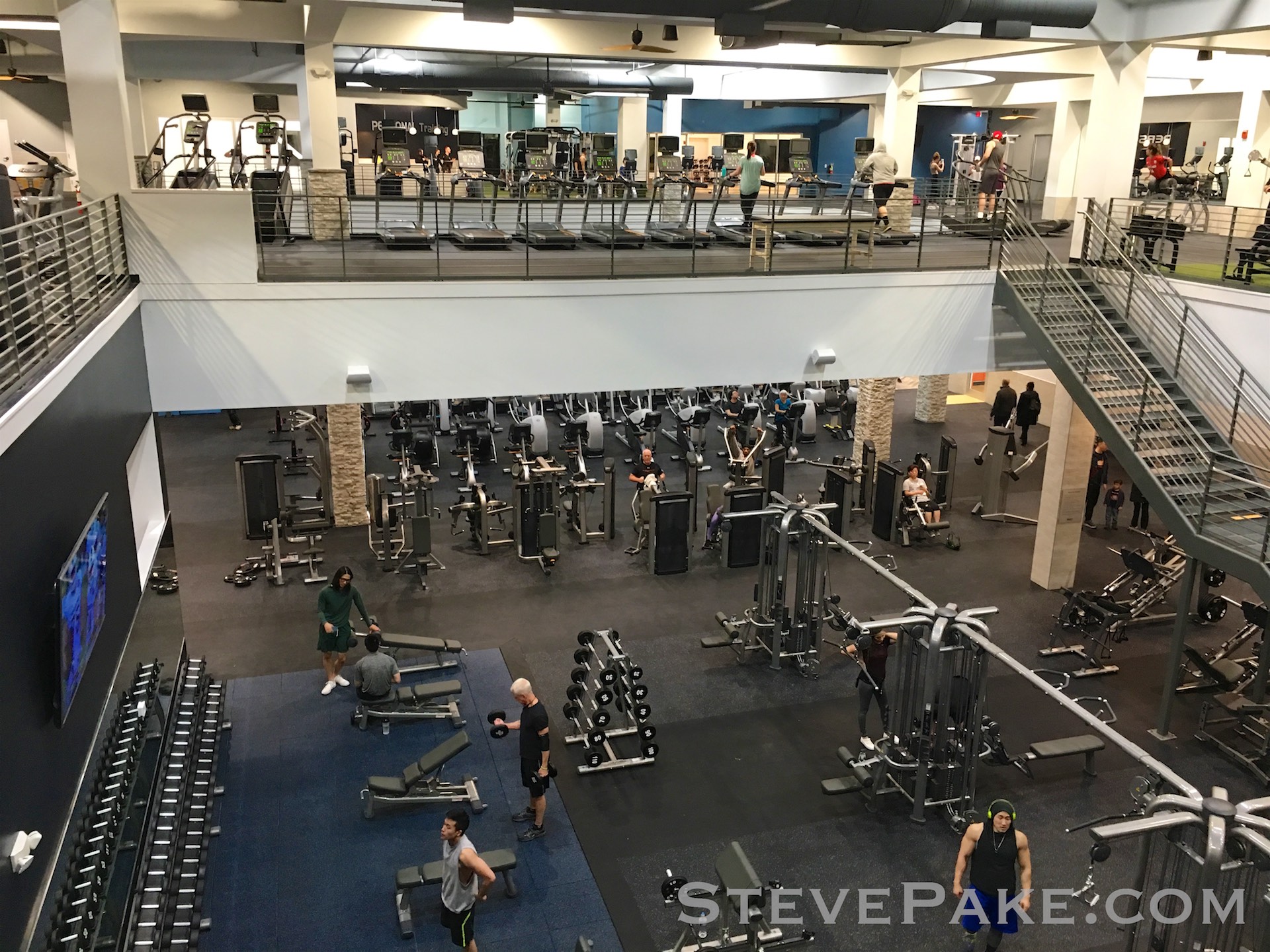
I know it and I’ve lived it, and I cannot allow life or work schedules to interfere with my physical health and getting regular exercise ever again. If I have one New Year’s resolution for 2019, it will be that, oh and lose the 20 pounds I managed to pickup and get back down to my goal weight (again). There’s a lot of “best things” that I’ve done for myself as a young adult cancer survivor and best practices that I can and have passed on, but surely regular vigorous exercise is at the very top. Maybe a lot of people can get by just fine without ever exercising, but I cannot after cancer. Regular exercise is what keeps my chronic fatigue issues at bay, and I can only go so long before my fatigue issues will start to rear their ugly heads again and my body starts grinding to a halt.
You don’t have to run marathons like my friend Jonathan. Just get out there and get moving and do whatever you can do. Your body will thank you for it, and it will be a huge boost in mental confidence as well when you can do just a little bit more each time, cancer survivor or not.
Happy 2019!
StevePake.com


Happy 1st Birthday Puffles
Is it October 10th already? Yes it is! When we heard from Amy Lane at Fox Creek Farm that our puppy had been born on October 10th, we knew it was fate and that we were meant to have him, because October 10th (ten-ten) is also National Taiwan Day every year, and we’re a Taiwanese family.
Happy 1st Birthday to our amazing, adorable,
and beloved mini goldendoodle, Puffles!
Is it October 10th already? Yes it is! When we heard from Amy Lane at Fox Creek Farm that our puppy had been born on October 10th, we knew it was fate and that we were meant to have him, because October 10th (ten-ten) is also National Taiwan Day every year, and we’re a Taiwanese family. By the way, a “Puffle” is a tasty Asian egg waffle ice cream treat, which given his fluffy and “puffy” coat and birth on National Taiwan Day, all just made for the perfect name for him.
While I’m at it, here’s some recent photos of Puffles along with us on the 3 mile hike around Hawksbill Mountain in Shenandoah National Park. He did great and loved the hike!
It sure has been a lot of work becoming a dog family, but Puffles is the absolute perfect doggy in every way. He’s so unbelievably smart, playful, and energetic, yet still so cuddly and happy to roll over on his back for some belly rubs all the same. He has such a wonderful personality, and its such a blessing to have him in our lives. He’s made us all better humans, too.
We ended up celebrating his birthday a day early on the 9th, because our daughter Katie had a special school trip of a few days to go on starting on the 10th. I got him out to the park twice, once over lunch and then right after I got home from work and let him chase his favorite ball around off leash. He’s not very tall, so he always loves it when the grass has just been mowed, and always has the biggest smile on his face when I’m about to let him off leash to go run at maximum speed. We still remember when he was just a tiny little puppy and most of us could outrun him, but not anymore! He’s super fast now, and had such a great time at the park.
We spoiled him with a special doggy birthday cake from Okra & Molly, which he loved! After having two pieces of it and licking up the crumbs, he stood at attention looking at all of us and just looked so happy and content. We’re so glad he loves his family! He’s so worth it, and brings so much love and joy to all of us. What a special soul to have in our lives.
HAPPY 1ST BIRTHDAY PUFFLES! :)
More about Puffles
SEE ALSO: Our Mini Goldendoodle, Puffles
Puffles Main Page: PUFFLES
Puffles Latest Photos: PUFFLES LATEST


Our Mini Goldendoodle, Puffles
After living in our crammed townhome for 10 years, we finally upgraded to a single family home with a nice sized yard last year, and got a dog to go along with it. It's been a pretty big transition for all of us to become "dog people" and we're still getting there, but Puffles has been awesome and the perfect dog for us. Puffles was born on October 10th, 2017, and we picked him up and brought him home on December 5th.
After living in our crammed townhome for 10 years, we finally upgraded to a single family home with a nice sized yard last year, and got a dog to go along with it. It's been a pretty big transition for all of us to become "dog people" and we're still getting there, but Puffles has been awesome and the perfect dog for us. Puffles was born on October 10th, 2017, and we picked him up and brought him home on December 5th.
Our son, William, actually has terrible dog allergies, so we specifically bought a multi-gen Goldendoodle from Fox Creek Farm in West Virginia. A Goldendoodle is a Golden Retriever and Poodle mix, and Fox Creek Farm breeds multi-gen Goldendoodles, which are 100% hypoallergenic. We went to check out the dogs in the Fall of 2017 and had William pet them, and then had him rub his face and eyes and he had no issues at all, so we felt safe buying a dog from them. You have to be careful with some goldendoodle breeders. F1 breeds (first crossing of a Golden Retriever and a Poodle) only have a 50/50 chance of being hypoallergenic, but F1b (bred back to a Poodle, so 75% poodle), or F2/F2b, or multigens like what Fox Creek Farm breeds, are all pretty safe for those with allergies. Puffles does not shed at all! You can get Goldendoodles in all sizes, but we went for a Mini (15-30 lbs) as we thought it'd be a good and manageable size for us, and it looks like Puffles is going to top out at right around 20 lbs.
Puffles is the perfect little doggy. He's exceptionally smart and can easily figure most things out on his own, and is very easy to train, and took to his crate very well. He's also very well behaved in that he doesn't get scared or have any anxiety, even when he's left at home for awhile. We just happened to start a major kitchen renovation (a complete gutting) in the spring after we got Puffles, and he was not even the least bit skittish or alarmed with all of the noise, and does just fine with vacuum cleaners too. He's also very cuddly and playful, and he has a great temperament and personality overall. It was definitely tough picking up a new dog in December, but we've all gotten to know him, he's all gotten to know us, and he's a great addition to our family.
I'm lucky enough to work about 5 minutes from home, so we never had to leave him in his crate for too long even when he was a puppy. He's never had an accident in his crate at all, and to date, we can probably count on our two hands the number of times he's had an accident in our house, and most all of the time it's because he wasn't managed properly by his humans (we don't count the times he pees on the floor a little because he's so excited to see us! LOL) Now that he's just about full-sized, we fence off a small area around his crate for him to play in so that he doesn't have to be stuck in his crate all day, and leave some classical music running on the TV and he does just fine. If I can't make it home to let him out over lunch or if I'm away on a business trip, Debbie's brother, who is disabled and lives with us full time, can let him out and take him for a walk too. So Puffles is pretty spoiled in that he never has to be crated or left in his fenced off area for more than about 3-4 hours at a time.
There's nothing cuter than this little fur ball coming at you at full speed! :)
I'll be completely honest. Debbie and I have had one too many crazy, neurotic, abusive, self-destructive, or otherwise toxic people in our lives, and I think we're just plain burned out from other human beings to the point that we've become almost totally anti-social, and hardly want anything to do with anyone else these days. It feels sad to even be saying anything like that, but if you know you know and you'll totally get it, and if you don't know, don't ask!! The simple and uncomplicated love of a dog has really been a breathe of fresh air for us, and we've all fallen in love with Puffles. Coming home from our day and seeing this little fur ball charge at us at full speed so that he can jump on us and give us all sloppy wet kisses while wagging his tail is the highlight of our day. He's such a sweet and perfect little dog. He's a blessing in our lives, and we're so glad he's ours because we really needed him. :)
Don't let all of the pictures of him with our daughter, Katie, fool you. He's totally a mama's boy!!!!!! He follows Debbie all around the house, and has to be close to her all the time. He can't get enough of her, despite the fact that she has zero responsibility for his care! Go figure!!! And smart boy!!! Lol! Of course Debbie secretly loves it, even if she's annoyed that he's constantly following her and stalking her at all times. She loves the attention too, and Puffles will never grow up or talk back to her either! He'll be her baby forever! LOL!
I needed to pick Puffles up a minute after this so that Debbie could get off of her hammock, and he actually growled at me! Doesn't want to leave his mama! LOL!
Although I do have a doggy Instagram setup for Puffles (@PrincePuffles), I just don't have the time, patience, or the energy for social media these days, so the very best place to keep up with Puffles is on his dedicated web pages! I have a main page that indexes all of his photo albums, and then a "Latest" page which is like a highlight reel. As his Latest page is now, you can see highlights from his entire first year with us from the time he was a little puppy until now. It's really cute. You can also navigate there from my home page menu at StevePake.com > Fun Stuff > Puffles. Be sure to check it out! :)

If you're a Goldendoodle owner and happen to be in the Washington, DC area, or better yet in Montgomery County, MD (we live in Rockville) and would like to get in touch or meet up for a doggy play date, you can get in touch with us at the button below. :)


The 7 Year Cancer Survivor Itch
At 7 years out, I'm very lucky and blessed that I don't really have to think about cancer too much anymore. There's no reason that I have to, and I don't. Testicular Cancer is a cancer that you fight like hell and either beat completely within a few months or a year, or it very quickly takes you with it, and I’m still here. My cancer fight seems like ancient history at this point - a tiny spec in the rear view mirror, and life has moved on.
I try to write a little something about my thoughts as a cancer survivor at annual anniversaries or the ending of treatments. I don't really celebrate "all clears" anymore as I elected to stop having annual scans done, although I do need to have an annual "balltrasound" done, which I suppose is the only scan I'll get going forward. I wasn't compliant last year because I've become a "bad" non-compliant patient, but I'll get it done this year.
Some related previous blogs:
Five Years And A Day Since Cancer
Cancer Survivorship at Six Years
Top 5 Lessons Learned in Five Years of Cancer Survivorship
Life Moves On After Cancer
At 7 years out, I'm very lucky and blessed that I don't really have to think about cancer too much anymore. There's no reason that I have to, and I don't. Testicular Cancer is a cancer that you fight like hell and either beat completely within a few months or a year, or it very quickly takes you with it. Recurrences and clinically late recurrence are possible, but at 7 years out for someone that had "good risk" disease treated with both primary chemotherapy and the RPLND surgery which was elective in my case, it's far more likely that I'd develop another cancer or have some other health problem, than experience a recurrence of my testicular cancer from 7 years ago. My cancer fight seems like ancient history at this point - a tiny spec in the rear view mirror, and life has moved on.
Full Acceptance of Cancer
I'm not really afraid of cancer anymore because I fully accept that cancer can happen to anybody, at any time, and with no ability for myself or others to ever truly stop or prevent it. There's nothing wrong with me. I'm not cursed or "special" in any way, I'm merely a human being, and cancer is a part of our reality and humanity. Cancer has been around in human beings for far longer than I have, and it will still be around long after I'm gone. What happened to me could just as easily have happened to somebody else, and although it's sad, it's no longer even the least bit shocking or terrifying to me when I learn of friends or friends of friends that have been diagnosed with cancer. Cancer is reality.
Time Not Wasted
Fully accepting cancer into your reality, and realizing just how fleeting and finite our lives can be is what allows you to truly immerse yourself in every moment. It's what makes every moment spent with others that are near and dear to you so precious, because you never know what's next. When I see a friend that I might only see once or a few times per year, I know that it could be the last time I ever see them healthy or alive. It takes our life experiences to another level when moments become so much sweeter. No time has been wasted over these past 7 years, other than time lost to fear and worrying (and there was more than enough of that!). The best way to push back after cancer is to live in the moment and to live your best life every damned day that you have.
Living My Best Life Has Brought Me Peace
I still have my moments when my body is once again doing funny things or I have strange pains, but I'm less afraid of cancer now because of how much I've grown personally and spiritually, and because I know I've been living my best life. I've traveled to some amazing places, and have done some amazing things. I have a beautiful family, a beautiful wife, and some amazing friends that have really been there for me through the worst of times. I'm thankful for all of that, for the opportunity and blessing to still be here at all, and am proud of the difference that I've been able to make for so many other cancer survivors. When I've had scares and dark thoughts recently, I've had reassuring feelings that if this is my time that I've done well, and can rest easy because I have plenty to be proud of and haven't wasted my life away.
Other Things Happen in Life
Honestly, my wife and I have had much bigger problems to sort out in the past few years than my cancer fight ever presented. We don't like drama, drama just finds us, and all of that has been just as exhausting. We've lost family members and friends in tragic and unconscionable ways, have had numerous legal issues to sort out, and have had to take over the care of a disabled adult. We've both been extremely busy at our jobs, and we've both had some pretty serious issues with our workplace environments at times. I've also had to travel for work a lot more than I ever used to which has made managing the family schedule difficult if not impossible, and just for good measure we got a dog too, because our lives haven't been complicated enough. (It's a good thing he's a really awesome dog!!!!!) It's a damned good thing that I managed to settle everything relating to cancer in my mind when I did, because unbeknownst to me, other serious challenges in our lives were right around the corner.
The Goal Isn't To Be Happy
“The purpose of life is not to be happy. It is to be useful, to be honorable, to be compassionate, to have it make some difference that you have lived and lived well.”
Ralph Waldo Emerson
I'll stop short of saying that I'm "happy" about my cancer diagnosis, because even after 7 years that still doesn't pass my sniff test. The wisdom of Emerson has taught me that perhaps it was the wrong target to be shooting for. I think that if you've faced cancer and can get to the point where it's no longer causing you any unhappiness, and if you've managed to do some honorable and compassionate things with it to make a difference for others while living the best life that you can for yourself regardless of happiness, that that's as much of a positive overall outcome as one could reasonably expect. I have a deep appreciation for my changed life perspective and for all of the personal growth that I've experienced as a cancer survivor, but I've also been terrified out of my mind and sitting in corners in tears more times than I care to remember, and will never again feel secure about my life. I think it's taken striving for and experiencing all of the positive aspects of life after cancer just to reach a neutral buoyancy point to balance out all of the negative. That's fine, and about as much closure as one should expect after cancer.
It's still unnerving that a part of my life story was having to cheat death at 33 when my kids were just turning 2 and 4 years old, but I've been able to walk away from it all as a much better person that I ever was before, it's no longer causing me any unhappiness, and I'm proud of that and in a much better place today. I wouldn't have things any different today, but I don't think I'll ever say that "getting cancer was a good thing", because it just plain wasn't. There's no such thing as a good or easy cancer period.
CLOSURE FROM YOUNG ADULT CANCER

One part life and another part fate have pulled me in different directions these days. I'll never be too far from the testicular cancer and young adult cancer communities and will consider myself an advocate for life, but it's nice to feel the closure that I need to move on and finally start chasing other dreams and aspirations of mine.
It's important to be able to find the closure after young adult cancer, because inevitably there's other things that we're going to have to face in life. Knowing that I had cancer as a younger adult and went through chemotherapy and a few nasty surgeries is just the tip of the iceberg as far as the young adult cancer experience is concerned. Behind these smiles are other 'icebergs' in our lives, other sources of pain, other stories, and other stories behind stories. I plan to start writing about all of these, and not necessarily in blog format, in the hopes that I can heal and move on from these in much the same way that writing helped me to move on from cancer, and perhaps it will in turn help others that have faced similar situations in life (you're never alone, no matter how isolated you might feel.)
What's Next
This isn't my last cancer blog. I actually have a half dozen or so draft cancer blogs on various topics that I intend to publish this year, some of which have been sitting around for ages, but beyond those I consider my cancer blogging to be a done deal. At over 70 blogs and 100,000 words at last count, it's been quite a ride. :-) Most of what I'll be publishing from here on out will be about cross sections of other aspects of our lives, and a whole lot more fun material as well to balance it all out. Never stop believing in yourself, and never stop living your best life no matter what it is that you're facing.
Best,
Steve Pake
Young Adult Cancer Class of 2011

July 4th Fireworks 2018
Last year we were too exhausted from moving to enjoy any fireworks, but this year we had a great time! The city fireworks where we live our right in the park in our neighborhood, so we can just walk about a mile for a really nice show.
Last year we were too exhausted from moving to enjoy any fireworks, but this year we had a great time! The city fireworks where we live our right in the park in our neighborhood, so we can just walk about a mile for a really nice show.
I used my Canon 7D Mark II on a tripod with a remote shutter release, and the Tokina 12-28mm ultra-wide lens. You have to do everything manual style. I let the autofocus system focus at infinity on a distant water tower before it got too dark, and then switched the lens to manual focus mode and didn't touch it. If the autofocus system tries to work when it's dark out and fireworks are going off, you'll never get anything. You also have to set manual exposure. I set the camera for 4 second exposures at f/8, and ISO 200 earlier on when there was still some light in the sky, and then ISO 400 as it got a bit darker. A remote shutter release is needed because if you're trying to press the shutter release on the camera itself, you'll introduce vibrations into the camera and tripod setup and will end up with blurry photos when using a 4 second exposure. I left the camera positioned horizontally, and then just cropped to vertical in post-processing. Voila! Not much to it. :)
Click Or Tap the Image Below for the Full Photo Album
















































The Pake Family Summer Kickoff Color Party of 2018
It only took a few months due to all of the rain, but we finally managed to have our annual summer kickoff color party on July 4th, 2018!
It only took a few months due to non-stop rain, but we finally managed to have our Summer Kickoff Color Party on July 4th, when we normally try to have it the weekend before Memorial Day. It was a great time as always, but it hasn't gone unnoticed that a lot of the rebellious teens and pre-teens seem to be growing out of this or are already no longer interested, so I think we're going to recalibrate a bit for next year and get a dunk tank too! :)
Click or tap below for the full album.
Looking forward to doing this again next year! :)

The Truth About Electric Lawn Mower Horsepower
Who knew that one day I would get so pissed off at lawn freaking mower manufacturers, that I would feel the need to sound off about all of the shenanigans and totally deceptive and misleading marketing practices going on in the industry. Really? You can’t just walk into a store to look at lawn mowers without being fed a bunch of BS? Good grief!
For the first time in nearly 20 years, I finally have a real yard to maintain at our new house, after living in apartments since 2000 and then our yardless townhouse since 2007. I've been having both fun, and frustration, purchasing lawn and garden equipment! Who knew there would come a time where I'd get so annoyed with lawn mower manufacturers that I'd feel the need to write a blog about them. All I'll say is that considering the overall topic of my website, cancer support, I guess it's nice to have some first world problems for a change!
Why Is It So Hard To Shop For An Electric Lawn Mower?
When we moved into our new home in July of 2017, the grass was growing and a lawn mower was the last thing I had time to think about on top of all of the logistics of moving and hectic work schedules. I figured I'd try to be green and buy an electric mower, and save myself the trouble of oil changes and maintenance and all that. Our lot is big for our area at 8800 sq ft, but still relatively small in the grand scheme of things, so how are you supposed to know what you really need with an electric mower?
What makes it difficult to shop for electric lawn mowers is that they only advertise the voltage that the battery and electric motor run at, and not how much power they actually produce. These are two different things. How are you supposed to know the differences between how 20V, 40V, 56V, or even 80V electric lawn mowers perform, compared to what actual gas powered lawn mowers with anywhere from 3 to 6 horsepower will do? It's apples to oranges, and then you get to the issue of endurance. This is a non-issue with gas mowers, as they typically have more than enough internal fuel capacity for even larger yards, and if you run out you can just refill the tank and keep going. With an electric mower, if you can't finish mowing your yard on a single battery charge, you either need a very expensive additional battery, or have to wait an hour to recharge the first, which can be a major inconvenience.
Claims of "gas-like power" or "torque of gas", enough battery capacity to cover "90% of yards", and run times of "up to" 60 minutes or whatever are all incredibly generic weasel words, and highly prone to interpretation and misinterpretation. I guess I thought in my mind that a middle of the range 40V electric lawn mower ought to be enough. Was it? Well, I think you might know where I'm going, but read on to find out!
A 4HP Self-Propelled Gas Lawn Mower BASELINE
Image via Google search, not my exact mower but close!
In the 1990's, Homelite was a very reputable company that produced a full range of highly rated gas powered lawn and garden equipment. They don't have the full line of products that they used to, but they're still around, and I still remember my Homelite HSB21P4C mower. That's Homelite Super Bagger, 21", Self-Propelled, with a 4HP gas engine, and a blade Clutch that allowed you to just idle the engine with the blade stopped while you emptied the bag without having to restart the engine. Don't ask me how the heck I remembered that, but when you're a kid and can't even drive yet, getting a new lawn mower is pretty exciting. It was a pretty darned good mower, too. I was worried that 4 hp might not be enough when there were 5 to 6.5 hp mowers out there, but it was never lacking for power. It propelled itself up hills with a heavy bag filled with clippings just fine, and although it may have bogged down at times in taller grass that might have been a bit wet or required you to slow down a tad, it always kept going and never quit. It had just the right amount of power, not too little and not too much. I guess this was what I was expecting out of my 40V electric lawn mower, which wasn't even self-propelled, and so all motor energy would be going straight to the blades and none to the wheels. Surely this must be enough, right?
MY 40V/4AHr Electric Lawn Mower
First time mowing with my new electric lawn mower. Branding has been intentionally photoshopped out. There are industry wide shenanigans going on, so the point was not to single out any one manufacturer.
My wife knew I was looking for an electric lawn mower as we were moving. She saw this one come up on Amazon Prime Day on July 11, 2017 for just $199 last year and told me about it. It looked good enough to me, and heck for only $199 why not? I took a leap of faith and just blindly hip-fired the mower and jumped on it, hoping it would be enough. Honestly, it's a great 3 in 1 mower for the money (rear bagging, side discharge, or mulching), but unfortunately it just couldn't get the job done.
One of the first things I noticed was that it would shut down in heavier grass, and I was constantly tilting it on its side trying to clear all of the clippings out from under the deck in mulching mode. It just couldn't maintain the blade RPM needed and would "stall" all the time, and overall didn't do the greatest job of mowing. Not only did it not have the power to really mulch well, but it also didn't have the suction to stand our mix of grass and weeds up straight enough to get a clean cut either. It would always leave rows of grass and weeds that would just get knocked over more than cut, and I'd have to end up going at certain areas again from the opposite direction to get a better cut. Even more frustrating was the lack of manual power control combined with all of the irregularities of our lawn. It would leave itself in high power mode as I exited thick grass, and would drop itself down to normal power mode right as I was hitting thick stuff again, and couldn't stay in sync. What it really needed was a High, Normal, and an Auto power control lever, but didn't have one.
As far as yard size and capacity, our house is on an 8800 sq ft lot with a front and rear portion, about half of which is mowable lawn. In the late summer and into the fall when the grass wasn't really growing that much, it would finish the whole yard on its 4 AHr battery with about 25% or less charge left. I knew this was pretty marginal, and I wondered how it would do in peak growing season or as the battery aged and lost a bit of its natural capacity? The answer came this past spring when the grass started growing like crazy. This forced the mower into its high power mode almost all the time, and then it could only do just over half of our yard on a single charge! I had to wait an hour for it to recharge before finishing the backyard, which was annoying. There's a slot for a second battery right on the mower itself, but they really kill you on these batteries. $100 for another 40V 4AHr battery was a bit steep for me, especially when the mower was already under-powered and not mowing that well in the first place.
Overall I was pretty disappointed. Clearly I needed "more mower", and decided to just cut my losses and get another one.
Dead battery and still plenty of lawn to mow! Well ****! >:-(
Because everybody loves waiting for a lawn mower battery to recharge and finishing mowing in the dark, right? Had no choice! Rain was coming!
THe electric lawn mower Marketing Weasel Words
Total BS on display.
I love all of these claims about "gas-like power" and "torque of gas" for electric mowers, and how even the lower end gas mower manufacturers are playing stupid games by only advertising the peak "gross torque" of their gas engines. None of this tells you a damned thing, and since since when did the lawn mower market become so ridiculous with such deceptive marketing? Really? You can't just be straightforward with freaking lawn mowers? What on earth??
Hey, I have "torque of gas"! If I apply my entire 260 pound weight to a bicycle pedal with a 1 foot long crank, I'm making 260 ft-lbs of torque. Sweet! So I can power a car, right? Ha! No, because how quickly can I spin that pedal while applying that force to get actual work done? Not that fast. Just like electric motors, human beings make "peak torque" at 0 RPM, and then our torque curves rapidly fall off from there. How much "power" can I really produce?
This isn't rocket science. There's a very simple formula for this.
Horsepower = (Torque x RPM) / 5252
Lets say I could still apply 10% of that torque at 100rpm. How much power am I making? Per the formula, (26 ft-lbs x 100 rpm) / 5252 = 0.5 HP!! Right. That's not powering a car, or even a lawn mower. If I go all out in spinning class at the gym, I can hit a little over 1000 watts for a brief and glorious few completely unsustainable seconds, which is 1.34 horsepower (746 Watts = 1 horsepower). In that burst of glory, that comes out to about 54 ft-lbs of torque at 130 rpm (or 47 ft-lbs at 150 rpm). In reality, most professional cyclists can sustain an output of about 280-300 watts for hours on end, which is around 0.4 horsepower.
"Gas torque" doesn't mean that you have gas horsepower. And what does "gas-like power" even mean? If an electric mower really had "gas power" they could just advertise the horsepower of the electric mower, right? But they don't, so obviously they're hiding something. If you hit a patch of thick grass at a given speed, you need a certain amount of power (not torque) to get through it. If your lawn mower doesn't have enough power, it's going to bog down or even stop, unless you reduce your power demands on the mower by slowing down, possibly to a crawl, such that the rate at which you're demanding power to mow isn't exceeding the amount of power your lawn mower can deliver.
Lawn Mowing Is An Endurance Race, Not A Drag Race
There's an old saying that horsepower sells cars, but torque wins races. Well, that can be true for automobiles if we're talking about runs down the drag strip, and getting a nice hole shot off the line thanks to a mountain of torque (and traction). Watch most any Tesla Model S P85D or higher at the drag strip destroying tons of exotic cars, and you'll see what I mean. Maybe that's what the lawn mower manufacturers want you to think, and are preying upon consumer ignorance here by advertising "gross torque" and not even net torque, and are constantly trying to hide the actual horsepower output! Torque alone tells you nothing.
But we're not talking about drag racing here. We're talking about steady state mowing with very small engines or motors running at their maximum operating speeds. Horsepower is what's going to win this race and get your lawn mowed, without having to slow to a crawl to avoid your engine stalling. What happens to electric cars at higher speeds or from 50 km/h rolls? They make a ton of torque (and power) up to a given speed, but after that they just fall off like a rock and get walked all over by cars that don't necessarily have more horsepower, but that maintain higher levels of horsepower to higher speeds, and thus "can do more work at higher speeds". Horsepower is what you need for mowing your lawn, not "gas-like power" or "torque of gas". That's total BS!
/rant1
How Much Horsepower Does This THing Really Have?
When it comes to actual mowing performance, all I can say about my 40V electric mower is that it's nowhere close to my old Homelite 4 hp gas mower that I used growing up, which I guess is kinda what I was expecting or hoping for. To be fair, the manufacturer, which I'm not singling out here or even identifying, never made any horsepower claims about this mower, but it doesn't even mow like a "low end" 3 horsepower gas mower would either. A 3 hp lawn mower will bog down when you start running it through thick grass, but will keep going if you're gentle enough. This electric mower doesn't bog down in heavy grass, it just stops. It can't handle it at all. It will get it done, but you have to be exceedingly gentle with it. So based purely on how it mows, I'd say this 40V electric lawn mower has a best of just 2 horsepower!
I'm an engineer, so I figured I'd try to be a little more scientific than just run what ya brung type "butt dyno" (grass dyno?) type testing. We can get a ballpark estimate of how much power this thing is cranking out based on the energy content of the battery, and how quickly it can drain itself. The battery is a claimed 40V and 4AHr battery which means it should be able to deliver 4 Amps of current for 1 hour at 40 volts. However, while pretty solidly in high power mode, it will actually go through an entire battery in a matter of 15-20 minutes. Let's say that it has an endurance of 15 minutes in high power mode. That means it's drawing about 16 Amps of current. 40V x 16 Amps = 640 Watts of power.
1 Electrical Horsepower is defined as 746 Watts,
so 640 Watts is not even 1 HP!!!!
Umm, Houston, we have a problem here.
I haven't precisely measured how long the battery will drain if the mower is at high power mode the entire time. Maybe it's 10 minutes? That would be 24 Amps of current and let’s say a peak power of 1000 Watts, or 1KW. And more than likely, 40 volts is just the nominal rating of the battery, and it's probably running more like 45 volts. And maybe the battery is really more than about 4 AHr, or there's a variance to the high power mode that you can't really tell to give it an extra boost when needed, and assume 100% efficiency all around which isn't true even with electric motors, and blah blah blah....
Even being as generous as possible and making every assumption in favor of this mower that I can, I can't get the math to work out with this thing having anything more than about
1.5 peak horsepower!
And the reality is that it’s probably really sub 1-horsepower, as I suspect.
Gas like power? Compared to what? A weed whacker??
Riiiiiiight....
Actually, YES!
A Honda GX35 4-stroke 35cc weed-whacker type engine is rated to make 1.3 net horsepower, so there you go. That's what they mean by "gas-like power".
What a friggin joke.
So a 40V electric lawn mower probably doesn't have more than about a weed whacker level power, or at least this one doesn't appear to!
Honestly, if I had known that this mower only had a best of <1.5 horsepower, I never would have bought it because I'd have known right away that that wasn't gonna work! Maybe if you have a nice smooth lawn with no weeds or other grub, sure, but my lawn that the previous owners of our home left in a complete state of neglect? Ha ha! No freaking way. I bet the manufacturers of these things think that you never would have bought the mowers if you knew their actual horsepower either, which is precisely why they try to hide behind voltage ratings that don't tell you anything directly. Their weasel words and "gas like" power or "torque of gas" claims when they know it's a massive stretch and incredibly misleading is precisely why I felt the need to sound off in this blog as as a buyer beware notice!!!
It's Not Just Electric Lawn Mower Manufacturers
This isn't just about electric lawn mowers, though. I have to call out gas mower companies too, for the completely misleading claims that they're making also. What ever happened to the base model 3 hp gas lawn mowers? Well, when you see a gas mower only advertising "gross torque" and not horsepower, that's apparently how they market 3 hp class gas mowers today.
A certain gas lawn mower I saw with an unnamed but very well known brand of engine was advertising itself as having "6.75 ft-lbs of gross torque". What the hell is that? Well if you look up the engine directly at the engine manufacturer's website, you can get the full torque curve in a PDF and see that it's actually only making 5.25 ft-lbs of gross torque at the operational speed of 3600 rpm that most gas lawn mower engines have always run at. Using the formula, (5.25 ft-lbs x 3600 rpm) / 5252 = 3.6 gross horsepower. Now keep reading the fine print, and you'll see that's without air cleaner or an exhaust or small muffler installed, which is absolutely NOT how gas freaking lawn mowers that can kick up all sorts of dust and debris are ever run. That would be like instant death for a mower. The actual power you'll be getting "to the pavement" (the grass) is the "net horsepower", so figure maybe 10% lower figures than gross. You now have 3.25 net horsepower.
Boy, 6.75 ft-lbs of "gross torque" at a lower RPM that the mower never operates at sure sounds a lot better, so that's what they go with these days, and they figure that consumers are stupid enough to fall for it or just won't know any better. Better yet, if you end up buying something that ends up not working for you due to confusion, you have to buy another lawn mower, and they love that even more. That's what they want. They want you to be as confused as possible so that you hopefully buy the wrong thing, and then have to buy again. You see how this little scam works? Yeah (bleep) that!!!!
/rant2
So yeah, I "fell for it", but fortunately was only out $199, and now needed to buy another mower. Too much money for another battery for the electric mower that I bought that doesn't even do a very good job in the first place isn't smart money.
Time To Upgrade, BUt What To Get?
Considering I had done exactly zero research on this mower or electric mowers in general and just sort of hip-fired it off of Amazon and hoped it would work out, I was perfectly willing to give another electric mower a chance, now having a much better idea of what I needed. I'm not biased one way or another, and actually kinda wanted an electric mower to work out. They're quieter and can be stored vertically and take up a ton less garage space, and ultimately are going to have much lower operational costs than a gas. I wanted an electric mower to work for me, so if I was biased at all, it was actually towards getting another electric mower.
I knew that I clearly needed something with more oomph than a 40V motor could provide, and about double the capacity of the 40V/4AHr battery. Based on a read through Consumer Reports magazine online and other reviews, which I should have checked the first time around (I'm a lifelong subscriber to CR), it looked like the EGO 56V self-propelled lawn mower with a 7.5 AHr battery probably would do the trick for me. This is actually the only electric lawn mower that Consumer Reports magazine recommends, and seems to be at a pretty good price point at $499 with the battery and cooled charger included!
At a 40% higher operating voltage and assuming all other factors are equal, this 56V EGO mower might be equivalent to about a 2.0 to 2.5 hp gas mower on its best day or peak power level. That's still marginal power at best, but it's important to focus on how well something actually works, and less on the numbers. The Consumer Reports review was pretty favorable, as were a few YouTube reviews, but I actually saw another YouTube video of this mower grinding to a stop in the same irregular grass that I have. Not exactly confidence inspiring. I was already committing to buying a second mower, and would have been kicking myself if this next one couldn't hack it either. I felt like I needed a mower with both double the power and double the capacity at the same time. I was confident about the EGO having enough endurance, but only 40% more assumed power just wasn't what I was looking for. I don't have a big yard, but definitely need the power to get through grass, crab grass, weeds, and other super thick patches of combinations of all of the above that I have, otherwise a mower will just grind to a stop like my 40V electric was doing all the time.
I was torn and could have gone either way between the 56V EGO mower with 7.5 AHr and a base level Honda lawn mower that had a 160cc engine with a legit 4.5 "net horsepower" that would run all day for $100 less money. I actually have a Honda powered pressure washer that I've owned for years now, so it's not like I don't already have a small gas can for it, and oil to change once in awhile.
Our homeowners association ended up making the decision for me!
Electric Would Have Been Fine, but My HOA inadvertently Convinced Me To Get Gas!
This is now a funny story, but yes, my homeowners association mistakenly cited me for grass that was too long, even though I had just mowed it literally hours before we started getting over a week of solid rain. Yes, the grass got quite long, but adding injury to insult, the alleged inspection came during all of the rain when nobody could mow. I was already pretty pissed off about falling prey to deceptive and misleading marketing practices and needing to buy another lawn mower, and now I was double pissed off about being hassled by our HOA, not yet realizing it was a mistake and meant for another property.
My "1.5 horsepower on the best possible day" electric mower would have absolutely choked on this grass after all of the rain we got. It literally has weed-whacker levels of power, which explains quite a bit! I would have had to raise the deck height all the way up, and probably run through the battery a few times, and mow a few times just to get it back into HOA spec. Needless to say, I don't have time for crap like this, and I especially don't have the patience to be hassled by our HOA for something so absurd! My wife and I are two busy professionals with two young children at home, a dog, and a disabled person that we care for full time, and I've had to travel for work quite a bit lately. I just need to be able to mow when I have time to mow, and not think about if it's dry enough, what the weather forecast says, what time of day it is, or when our HOA might be eyeing our property (we live right across the street from their office!)
Very long and still somewhat wet grass, but no choice but to mow because it was going to rain even more!
Honda fire-breathing GCV190 powered self-propelled lawn mower. VTEEEEEC!!!!!!!
So I just said (bleep) it and got a Honda HRX21VKABCDEFG blah blah blah professional grade mower with the bigger 190cc vs 160cc engine, and 5.1 net (3.8kW) "all day" horsepower rather than 4.4 hp with the slightly smaller engine, and paid $599 for it rather than $399 for the lower tier Honda. Yes, this is total absolute overkill for my yard, but the first time I mowed with it put a smile on my face, and I knew I had made a great choice. It plowed right through even the thickest portions of my tall and still very slightly damp grass with zero bleeps given amounts of power. It has so much power and suction that it stands even the annoying weeds straight up and delivers a nice clean cut. It's awesome. I can mow whenever I want with my 'big block' Honda mower, and if anybody asks me why I've gone all 'eco-terrorist' and didn't get an electric mower, I can point right across the street to our HOA's office, too. :-)
Damn! Look at those lines and that nice clean and even cut!
Still a lot of work to do, but our yard is looking better and better.
The "hole" in the yard is from where a more than half dead tree had to come down. I've seeded it and grass is just starting to grow there now.
I eventually had to switch to partial bagging mode because it was just too much to be mulching well for any mower, but this 5.1 net horsepower (3.8kW) mower chewed right through it all at speed.
Ultimately, both I and the HOA realized the mistake at about the same time. This was actually the second "fix-it" notice that I had received, and there were other fix-it requests on this notice that just made no sense at all, and seemed to fit some nearby properties better. I brought it to the HOA's attention who had already realized the mistake themselves, and were profusely apologetic about it. It didn't change the fact that it pissed me off to high heaven at the time, and that I bought fat and happy gas mower because of it. Hey, it's fate. I was just meant to get a gas mower. :-) Even if a better electric would have had enough power, it still wouldn't have mowed as well with the raw power this gas mower has to stand everything straight up as you mow and give a nice clean cut. Our yard and mixture of grass and weeds is very irregular, which is precisely where extra power comes in handy.
A SUmmary of Electric Lawn Mower Horsepower guEsstimates
In summary, here's my best guesstimate of actual electric lawn mower horsepower based on some back of the envelope calculations from my 40V electric mower, and comparisons with actual ownership and use of 4 hp and 5 hp gas mowers, watching a few YouTube videos and reading reviews of the 56V EGO mower, and some feedback from someone I know who has an 80V mower.
Less than 40V: don't even freaking bother. You're talking sub 1 horsepower here. Maybe there are some lawns out there where this might be enough, but certainly not mine!
40V class: about 1.0 to 1.5 horsepower being as optimistic as possible. Enough if you have nice even grass and few weeds, but consider this the bare minimum, and totally inadequate if you have thicker stuff and/or weeds to get through. You'll regret it like I did. There's a reason why none of these lower voltage electric mowers are recommended by Consumer Reports magazine.
56/60V class: maybe about 2.0 to 2.5 horsepower also being very optimistic, but finally kinda like a real gas mower. Although I haven't used one, they seem to be reasonably powerful and enough to cut through taller grass and some weeds, but YMMV, and the video I saw of one choking on some taller grass wasn't really confidence inspiring for a $499 investment. Given one bad experience with an electric mower, if this one crapped out on me too I'd have instant buyer's remorse and kick myself for not just getting a gas!
80V class: I honestly have no idea. The person that I know who has one has never felt like theirs was underpowered, but every yard and perspective is different, and the 80V motors could just be setup to deliver the same amount of power as a 56/60V mower with a bit less current draw from the battery. All other factors being equal, an 80V class mower could maybe be edging closer to 3 horsepower, but who knows? The people who make these aren't claiming "gas power", either!
120V Plug In Electric Mowers: Standard wall outlets in the U.S. are nominally 120V with 15A circuit breakers, but the maximum for continuous loads is 20% below that at 12 Amps, which is just below 1500W (1440W), and why our wives' hair dryers all have a maximum of "1500W". What's a few watts between friends? Thus, the theoretical maximum power you can get from a standard outlet for a plug-in electric lawn mower would be 1440W / 746W (per HP) = 1.93 "gross electrical horsepower". The reality with all of these electric motors is that they're not 100% efficient. Assuming 75-80% efficiency, you're looking at about 1.5 "net electrical horsepower at the blades", which is probably a bit better than my 40V mower, as my 1.5 hp estimate for my 40V mower is based on "gross consumption" and not "net power" after efficiency losses.
How Much Horsepower Are Those “Gross Peak Torque” Ratings Worth?
LOL
What "6.75 ft-lbs of gross torque" on a gas engine comes out to
The very well known small engine manufacturer that I called out earlier, and whose initials perhaps not ironically are "BS", is only advertising the peak gross torque rating of their engines these days. They have a bunch of engines, but here's the actual peak net horsepower at 3600 rpm of their engines that I had to hand calculate from their datasheet, because they don't want you to know. Net figures include the -10% correction going from gross to net.
150cc - 6.25 ft-lbs gross TQ at 2600 rpm but 5.70 ft-lbs @ 3600 rpm = 3.5 HP net
163cc - 6.75 ft-lbs gross TQ at 2600 rpm but 5.25 ft-lbs @ 3600 rpm = 3.25 HP net
163cc - 7.25 ft-lbs gross TQ at 2600 rpm but 6.00 ft-lbs @ 3600 rpm = 3.7 HP net
Yes, isn't it interesting that one of the engines with higher advertised peak gross torque actually has LESS peak horsepower than another with less torque? This is because the torque curve drops off like a rock on this engine at higher RPM, and thus it's less powerful while mowing your lawn with the engine at its high RPM operating speed! This is why advertising lawn mower engines by their peak gross torque ratings at engine speeds they never operate at while mowing is so freaking stupid and totally misleading.
Final Thoughts
It's so stupid that I managed to get pissed off enough at just how intentionally deceptive and misleading lawn mower manufacturers are being that I felt the need to go on a big rant and write this blog, but here we are, and here are my final thoughts.
ELECTRIC: If you want a pretty good electric lawn mower with a nice combination of both power and endurance, the EGO 56V 7.5AHr seems to be the sweet spot for both of those as of 2018, which is probably why it's the only electric mower that's been recommended by Consumer Reports magazine. I probably would have gotten one of these if it weren't for the mistaken citation by my HOA.
On a final side note, I saw a customer review at the EGO site claiming that this lawn mower out-performed a "6.25 horsepower" gas lawn mower. Uhh, with a new blade? And was it running properly? Were they actually running it at full power, unlike certain neighbors of mine that I constantly hear running their gas mower at idle while trying to mow their lawn? (I'm not joking!) Let's say it actually had the same 5.1 net horsepower as my Honda, and assume 100% efficiency. That's an output of 3.8kW, which would require 68 amps of current from the 56V battery. Based on the energy content of the battery, you would have 6 minutes of run time at that power level, and it would be smoldering hot when you were done. You would need 4 gauge wiring to handle that much current, which is what they might typically put on large electric furnaces for homes!! Call me skeptical, but this isn't passing my sniff test at all. I'm sure it's a great mower, but I can pretty much guarantee you that it doesn't have anywhere close to 5 or even 6 horsepower, or even "gas mower power", and they don't even claim that it does!
I’m pretty darned sure that this person surely must have confused horsepower with the "peak gross torque" rating of their gas mower, and that it actually only has around 3 horsepower. That would be far more believable and make sense!
But anyways, the EGO gets a recommendation from CR and a lot of positive reviews elsewhere, so I'm sure it's a fine mower.
GAS: For gas mowers, I would just get a HONDA. The base Honda mowers are very good and highly rated at Consumer Reports, and 4.4 net horsepower is more than enough power. I'm extremely pleased with my 5.1 net horsepower (3.8 kW) Honda HRX21VKA. It will plow through anything, at any time, no questions asked, and with zero bleeps given, and has a solid warranty. It ran right through my super tall grass at full speed, and probably has triple if not quadruple the power of whatever my 40V electric mower has just based on mowing performance alone, so I know my estimate and calculations of about 1.0 to 1.5 hp peak for my electric is probably pretty accurate.
Another thing I like about Honda is that they're actually being HONEST, and publish the full power and torque curves for the engines, and in NET horsepower and torque rather than gross. Unlike a lot of the other manufacturers, Honda has a very powerful brand name to stand behind, so perhaps they can let the quality of their products and engineering speak for itself, and don't feel the need, or like it would be beneath them, to resort to cheap lies, dirty tricks, and lying by omission to sell their product. In a world filled with so much BS, I appreciate a company that's honest. Thanks, Honda. There are cheaper gas mowers out there from reputable brands that I'm sure do a perfectly good job of mowing, but I can't recommend the products of companies that are marketing their goods in such stupid and misleading ways, even if they work OK in the end.
Honda Lawn Mower. Yup, very smart not lying out their asses about their specs or performance like so many other manufacturers!
I hope this helped!
Don't lie or mislead about technical things to an engineer, because they'll find you out and call you out! I really can't believe all of the shenanigans going on in the lawn mower industry, and that I felt the need to write a blog about it, but this is just plain ridiculous. How on earth did the lawn mower industry become so freaking dishonest and misleading? What in the world?? No standards, no shame, but considering the overall topic of my website, it's nice to have some first world problems to rant about once in awhile. :-) Honda is actually being honest, and so I'm happy to give them my money.
If you're someone who has more technical information about these things, or better ability to test them than I do with insights to share, get in touch. I'd love to hear from you.
APRIL 2020 UPDATE
For awhile this has been the #1 blog on my entire website, and it gets thousands of hits per month from early spring through the summer. It’s the first search result for “electric lawn mower horsepower” on most search engines, and I appreciate all of the comments and emails that I get. I’m glad so many have found this blog and enjoyed it, and hopefully gotten a laugh or two out of it. So thanks, and I figured I’d post a quick update nearly two years out from this fiasco.
I donated the electric mower to the local Habitat for Humanity Re-Store last year in 2019, so hopefully it went to a good home while contributing to a good non-profit organization, and that the person who bought it didn’t find this blog! LOL!
For the record, I do have a Ryobi 40V string trimmer, that I also got the hedge trimmer, leaf blower, and pole saw attachments for. When it went on sale last year, I also got the Ryobi 40V dedicated chain saw as much for the extra 40V battery as for having a real saw. THOSE I LIKE!!!! They all have an appropriate amount of power, and it’s nice to have a second 40V battery now also. They’re all very nice products, and saves me the trouble of having to have another gas can with 2-cycle fuel-oil mix.
The fire-breathing 190cc Honda “big block VTEC” mower is running great. No regrets on that, but I probably could have saved myself some money by just getting the 160cc model. I was obviously pissed off when I bought the bigger one, but it seriously has “zero f*cks given” amounts of power, and it puts a smile on my face whenever I plow through way too tall grass at full speed, and it just takes it. Professional grade, bruh. I bought one for my parents also, the fancier one with the electric start, because their old mower was crap. They love it too and said it’s amazing, and that they can mow their yard in half the time with it, and that it gives them a good workout keeping up with it! Lol! They have a much larger yard, but it’s too hilly and sloped for a rider, so it’s the perfect mower for them. Honda truly makes good stuff.
Thanks again for stopping by and reading!

DC Cherry Blossoms 2018
Well, it was a little past peak, but the annual DC Cherry Blossom Festival was actually today, and the weather was drop dead gorgeous also, so we dragged our butts out of bed at 6:30am and were on the road by 7:00am sharp to get down into town to take it all in!
Well, it was a little past peak, but the annual DC Cherry Blossom Festival was actually today, and the weather was drop dead gorgeous also, so we dragged our butts out of bed at 6:30am and were on the road by 7:00am sharp to get down into town to take it all in! Like usual, our timing was perfect. It only took us 40 minutes to get down to the Tidal Basin from Rockville, MD, we quickly and easily found a spot to park along Ohio St SW, and then took everything in in around 2 hours before the crowds made it impossible. First photo taken at 7:43am, last photo taken at 9:31am, including plenty of family photo and doggy breaks. As we were rolling out is right when all of the tour buses and various groups had unloaded. What had been quiet and peaceful bridges and pathways with plenty of space before, became mobbed with people and standing room only, which we hate. We snickered as we were rolling out at the massive crowds we managed to dodge, and then lumbered our way back up to Georgetown Cupcakes, where there wasn't a line yet either, and got a dozen to go! :) After a grocery stop closer to home, we were home by 11:00am.
Pake Family at the DC Cherry Blossoms 2018
Blossoms were a little thin in some areas, but not all.
Around the Tidal Basin
The women in the background: Awww, a puuuuuuupy! Puffles got tons of compliments, and lots of people said they wanted a puppy after seeing him. No, you don't, terrible mistake!! :))))))
Blossoms blowing in the wind.
Katie and Puffles next to the "heart" tree.
Can't go to the DC Cherry Blossoms without picking up some Georgetown Cupcakes on the way out, and especially their cherry blossom special cupcake! :)
Cherry Blossoms setup: Canon 7D Mark II with 18-135 white box special "kit" lens, and an old 580EX flash bought used from a buddy a long time ago.
Pro tip, folks. This pro photog cries every time he goes down to see the famous DC Cherry Blossoms, and sees so many people with very expensive pro grade photography gear trying to take pictures of their wives or girlfriends, but without a flash! Dude, people, guys, you NEED fill flash for stuff like this, or else your girlfriends are going to beat you! :) Especially with mixed lighting through trees with part of a person's face in shadows and another part in direct sunlight, fill flash is needed to help even the illumination, and it's especially needed when taking backlit photos like below. In one shot my flash just hadn't recycled completely yet, as it was probably popping off full power shots. It's not often that I drag around my big lump full-sized Canon 580EX flash, but this is one of those occasions. See the difference?
Proper fill flash lighting!!!! See how nice this looks? And I knew in advance that the little pop-up flash built into the 7D Mark II wouldn't be powerful enough here, which is why I brought the big 580EX beast.
Flash didn't recycle, or if you don't bother with a flash at all. Alternatively, push exposure a few stops up to get the people right, but then the background will be blown out white and nasty looking!
If you can't figure out the whole flash thing (there's not much to it, I just knew when I needed one and turned it on), you just need to find places where you can shoot that have nice natural lighting and that aren't backlit, and where illumination is even across a person's face. There's nothing more painful than seeing some really pretty girls all dressed up to the nines, who were having photos taken of them by someone who had no clue what they were doing!
My setup was exactly as shown. My workhorse Canon 7D Mark II body (could have been a cheap Rebel for this and it wouldn't have mattered), and my Canon 18-135mm IS STM white box special "kit lens", and the essential 580EX flash for anything with people in it. I had my trusty Tokina 12-28mm ultra-wide lens in my bag also, but never actually used it.
The weather in the DC area is best described as schizophrenic in March and April. Last year we froze our butts off and actually got better photos at home, but this year it was absolutely perfect, so we really enjoyed this!
Enjoy!
Steve